Pearson Edexcel · GCSE · History
Course version: 1HI0 · Version from Sept 2016
Key topic 3: Later developments in the West, c1876–c1895 - 1 Changes in…
Full specification wording
Option P3: Key topic 3: Later developments in the West, c1876–c1895 - 1 Changes in farming, the cattle industry and settlement: Continued settlement: the Exoduster movement and Kansas (1879), the Oklahoma Land Rush of 1893. The closure of the 'Indian Frontier'.
The 1879 Exoduster movement saw thousands of African Americans migrate from the South to Kansas, escaping racial oppression.
Checked against the Pearson Edexcel 1HI0 specification (opens in a new tab) on .
- Point 3 of 3
- 3 key terms
Study notes
From the checked teaching notes for this specification point.
The idea
The 1879 Exoduster movement saw thousands of African Americans migrate from the South to Kansas, escaping racial oppression. Promoted by Benjamin Singleton, many faced hardship upon arrival due to poor land and lack of funds. The Oklahoma Land Rush of 1893 opened the Cherokee Strip, previously Indian Territory, to white settlement. Thousands raced to claim 160-acre (64.7-hectare) plots, highlighting intense land demand. This rush contributed to the 'closure of the Indian Frontier', which specifically refers to the opening up of the last remaining Indian Territory to white settlers, effectively ending the concept of a separate, protected Indian frontier. This is distinct from the 1890 US Census declaration that the broader American frontier was closed.
What earns the marks
- Explain the push factors (Jim Crow laws) and pull factors (Homestead Act, Singleton's promotion) for the Exodusters.
- Describe the challenges faced by Exodusters in Kansas, including poor farming conditions and hostility.
- Detail the events of the 1893 Oklahoma Land Rush, where settlers raced to claim former Indian lands.
- Analyse the significance of the closure of the 'Indian Frontier', marking the end of a designated, separate Indian Territory as it was opened to white settlement.
- Evaluate how these settlement events contributed to the final destruction of the Plains Indians' way of life.
Common mistakes and how to put them right
Confusing the Exodusters with earlier white homesteaders.
Put it right by specifying they were African Americans fleeing the post-Civil War South.
Stating the Oklahoma Land Rush was the only land rush.
Put it right by noting the 1893 rush was one of several, specifically opening the Cherokee Strip.
Conflating the 'closure of the Indian Frontier' with the 1890 US Census declaration.
Put it right by explaining the Indian Frontier closure specifically meant the opening of Indian Territory (Oklahoma) to white settlers.
Exam tips
- Use the Exoduster movement as a specific example of how push and pull factors continued to drive migration in the late 19th century.
- When discussing the Oklahoma Land Rush, link it to the Dawes Act and the reduction of Indian Territory.
- Be prepared to explain the consequences of the Indian Frontier's closure for both white settlers and Plains Indians in a narrative account.
Try the lesson
The start of the Option P3: Key topic 3: Later developments in the West, c1876–c1895 - 1 Changes in farming, the cattle industry and settlement: Continued settlement: the Exoduster movement and Kansas (1879), the Oklahoma Land Rush of 1893. The closure of the 'Indian Frontier'. lesson, made from checked teaching notes for this specification point.
Have a go first
Who were the 'Exodusters' who migrated to Kansas in 1879?
Listen
The 1879 Exoduster movement saw thousands of African Americans migrate from the South to Kansas, escaping racial oppression. Promoted by Benjamin Singleton, many faced hardship upon arrival due to poor land and lack of funds. The Oklahoma Land Rush of 1893 opened the Cherokee Strip, previously Indian Territory, to white settlement. Thousands raced to claim 160-acre (64.7-hectare) plots, highlighting intense land demand. This rush contributed to the 'closure of the Indian Frontier', which specifically refers to the opening up of the last remaining Indian Territory to white settlers, effectively ending the concept of a separate, protected Indian frontier. This is distinct from the 1890 US Census declaration that the broader American frontier was closed. A strong answer earns marks for these points. Explain the push factors (Jim Crow laws) and pull factors (Homestead Act, Singleton's promotion) for the Exodusters. Describe the challenges faced by Exodusters in Kansas, including poor farming conditions and hostility. Detail the events of the 1893 Oklahoma Land Rush, where settlers raced to claim former Indian lands. Analyse the significance of the closure of the 'Indian Frontier', marking the end of a designated, separate Indian Territory as it was opened to white settlement. A common slip: Confusing the Exodusters with earlier white homesteaders. Instead, specifying they were African Americans fleeing the post-Civil War South. Exam tip: Use the Exoduster movement as a specific example of how push and pull factors continued to drive migration in the late 19th century.
See it
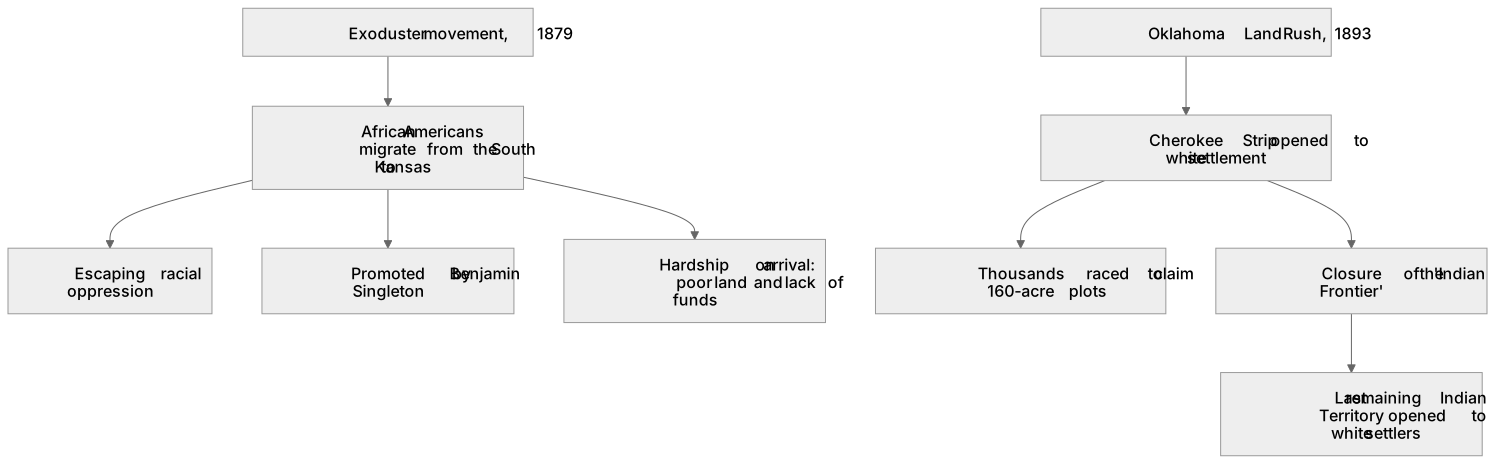
Put the events in order
Put these events in the order they happened, earliest first.
- 1. Exoduster movement to Kansas
- 2. Oklahoma Land Rush opening the Cherokee Strip
- 3. US Census declaration that the broader American frontier was closed
Key words
Say what each word means before you turn the card.
Exoduster movement
Try answering aloud or in your head before turning the card.
Oklahoma Land Rush
Try answering aloud or in your head before turning the card.
closure of the 'Indian Frontier'
Try answering aloud or in your head before turning the card.
See every definition
- Exoduster movement
- The 1879 movement in which thousands of African Americans migrated from the South to Kansas, escaping racial oppression.
- Oklahoma Land Rush
- The 1893 rush in which thousands raced to claim 160-acre plots when the Cherokee Strip, previously Indian Territory, was opened to white settlement.
- closure of the 'Indian Frontier'
- The opening up of the last remaining Indian Territory to white settlers, effectively ending the concept of a separate, protected Indian frontier.
Label the diagram
Some boxes have lost their names. Pick the right name for each number.
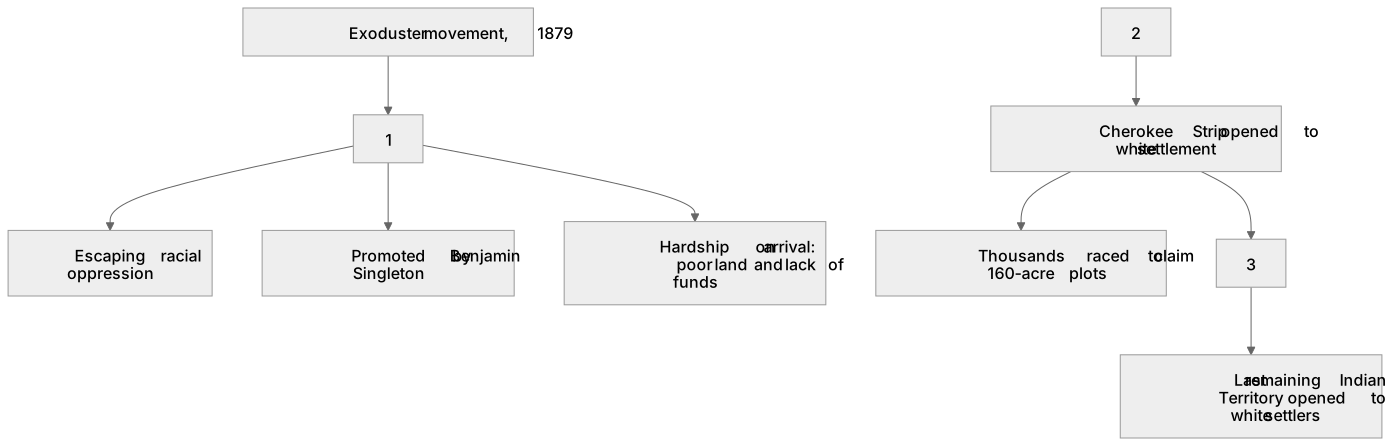
1Box 1
2Box 2
3Box 3
There is more to this lesson
The full lesson goes on to check your understanding and help you earn the marks. Create a free account to carry on, with your progress saved.
A week of Premium from your first lesson · Then the free plan continues · No card, no charge
Test your understanding of Option P3: Key topic 3: Later developments in the West, c1876–c1895 - 1 Changes in farming, the cattle industry and settlement: Continued settlement: the Exoduster movement and Kansas (1879), the Oklahoma Land Rush of 1893. The closure of the 'Indian Frontier'.
Active recall beats re-reading. Take an instant quiz now to test what you’ve learned and lock it into long-term memory.
A week of Premium from your first lesson · Then the free plan continues · No card, no charge