Pearson Edexcel · GCSE · History
Course version: 1HI0 · Version from Sept 2016
Key topic 3: Later developments in the West, c1876–c1895 - 2 Conflict and…
Full specification wording
Option P3: Key topic 3: Later developments in the West, c1876–c1895 - 2 Conflict and tension: The range wars, including the Johnson County War of 1892.
Range wars erupted as competition for land and water intensified between large cattle barons and smaller settlers.
Checked against the Pearson Edexcel 1HI0 specification (opens in a new tab) on .
- Point 2 of 3
Study notes
From the checked teaching notes for this specification point.
The idea
Range wars erupted as competition for land and water intensified between large cattle barons and smaller settlers. The Johnson County War of 1892 in Wyoming is a prime example. Wealthy cattlemen in the Wyoming Stock Growers Association (WSGA) accused small ranchers of rustling. The WSGA hired Texan mercenaries to invade Johnson County and assassinate suspected rustlers, including Nate Champion. Local sheriff Red Angus raised a citizen posse that besieged the invaders until the US Cavalry intervened to save the WSGA force. This conflict highlights the tension between powerful monopolies and ordinary settlers, demonstrating how wealthy cattle barons often manipulated the justice system to protect their interests.
What earns the marks
- Identify the underlying causes of range wars, specifically the competition for resources between large cattle ranchers and small settlers.
- Explain the role of the Wyoming Stock Growers Association (WSGA) in attempting to monopolise the cattle industry.
- Describe the events of the Johnson County War, including the hiring of Texan mercenaries and the murder of Nate Champion.
- Analyse the response of the local citizens and Sheriff Red Angus in resisting the WSGA invasion.
- Evaluate the outcome of the Johnson County War, noting that the cattle barons escaped justice but ultimately lost their absolute power in Wyoming.
Common mistakes and how to put them right
Thinking the Johnson County War was fought against Native Americans.
Put it right by specifying it was a conflict between wealthy white cattle barons and smaller white settlers.
Assuming the cattle barons won the Johnson County War.
Put it right by explaining that while they avoided prison, the local resistance effectively ended their unchecked dominance.
Confusing rustling with legal land claims.
Put it right by noting that while rustling occurred, cattle barons often used the accusation as an excuse to eliminate legitimate small competitors.
Exam tips
- Use the Johnson County War as a detailed case study when asked about the causes of conflict between different groups of settlers.
- Highlight the role of the WSGA to demonstrate how wealthy groups could corrupt state politics and law enforcement.
- Remember to mention Nate Champion as a specific individual whose death escalated the conflict and united the small settlers.
Try the lesson
The start of the Option P3: Key topic 3: Later developments in the West, c1876–c1895 - 2 Conflict and tension: The range wars, including the Johnson County War of 1892. lesson, made from checked teaching notes for this specification point.
Have a go first
Which two groups were primarily in conflict during the Johnson County War of 1892?
Listen
Range wars erupted as competition for land and water intensified between large cattle barons and smaller settlers. The Johnson County War of 1892 in Wyoming is a prime example. Wealthy cattlemen in the Wyoming Stock Growers Association (WSGA) accused small ranchers of rustling. The WSGA hired Texan mercenaries to invade Johnson County and assassinate suspected rustlers, including Nate Champion. Local sheriff Red Angus raised a citizen posse that besieged the invaders until the US Cavalry intervened to save the WSGA force. This conflict highlights the tension between powerful monopolies and ordinary settlers, demonstrating how wealthy cattle barons often manipulated the justice system to protect their interests. A strong answer earns marks for these points. Identify the underlying causes of range wars, specifically the competition for resources between large cattle ranchers and small settlers. Explain the role of the Wyoming Stock Growers Association (WSGA) in attempting to monopolise the cattle industry. Describe the events of the Johnson County War, including the hiring of Texan mercenaries and the murder of Nate Champion. Analyse the response of the local citizens and Sheriff Red Angus in resisting the WSGA invasion. A common slip: Thinking the Johnson County War was fought against Native Americans. Instead, specifying it was a conflict between wealthy white cattle barons and smaller white settlers. Exam tip: Use the Johnson County War as a detailed case study when asked about the causes of conflict between different groups of settlers.
See it
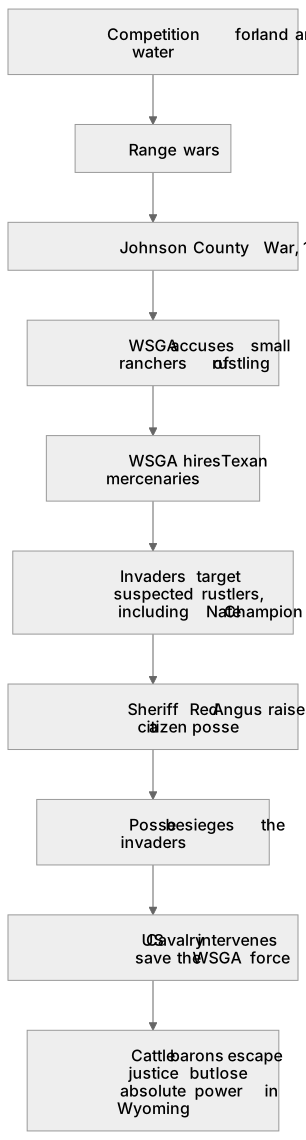
Label the diagram
Some boxes have lost their names. Pick the right name for each number.
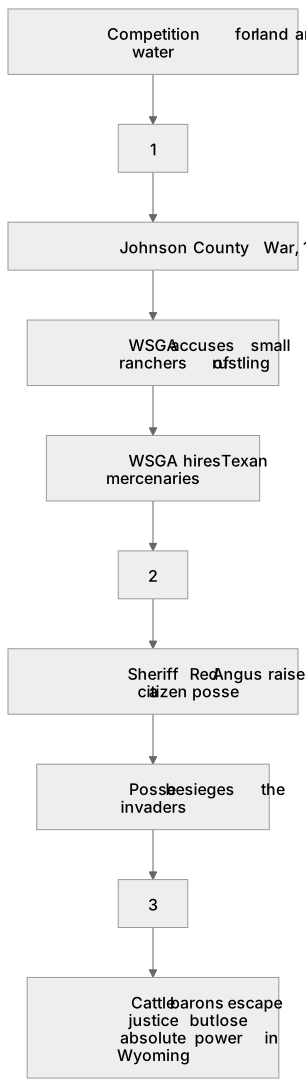
1Box 1
2Box 2
3Box 3
There is more to this lesson
The full lesson goes on to check your understanding and help you earn the marks. Create a free account to carry on, with your progress saved.
A week of Premium from your first lesson · Then the free plan continues · No card, no charge
Test your understanding of Option P3: Key topic 3: Later developments in the West, c1876–c1895 - 2 Conflict and tension: The range wars, including the Johnson County War of 1892.
Active recall beats re-reading. Take an instant quiz now to test what you’ve learned and lock it into long-term memory.
A week of Premium from your first lesson · Then the free plan continues · No card, no charge