Pearson Edexcel · GCSE · History
Course version: 1HI0 · Version from Sept 2016
Key topic 1: The origins of the Cold War, 1941–58 - 2 The development of…
Full specification wording
Option P4: Key topic 1: The origins of the Cold War, 1941–58 - 2 The development of the Cold War: The significance of Cominform (1947), Comecon (1949) and the formation of NATO (1949).
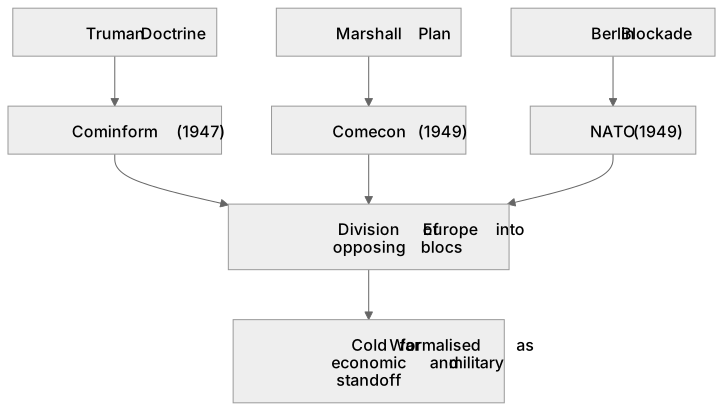
The creation of Cominform, Comecon, and NATO solidified the division of Europe into opposing blocs.
Checked against the Pearson Edexcel 1HI0 specification (opens in a new tab) on .
- Point 2 of 3
- 3 key terms
Study notes
From the checked teaching notes for this specification point.
The idea
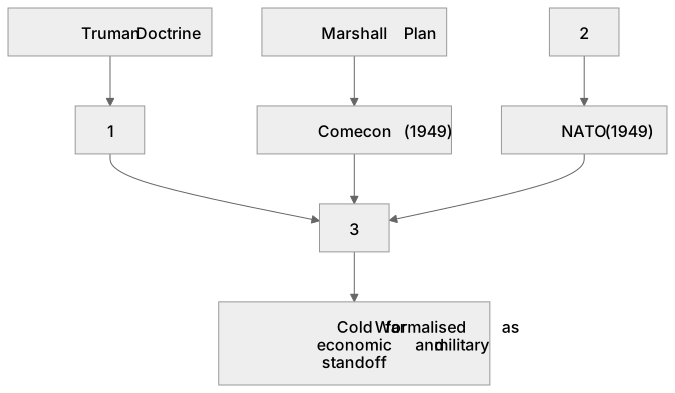
The creation of Cominform, Comecon, and NATO solidified the division of Europe into opposing blocs. In response to the Truman Doctrine, Stalin established Cominform in 1947 to coordinate European communist parties and ensure ideological obedience to Moscow. Following the Marshall Plan, Comecon was formed in 1949 to integrate Eastern Bloc economies, preventing satellite states from relying on Western aid. The Berlin Blockade heightened Western security fears, leading to the formation of NATO in 1949. This military alliance committed the US and Western European nations to mutual defence against Soviet aggression. Together, these organisations institutionalised the Cold War, transforming an ideological dispute into a formalised economic and military standoff across the continent.
What earns the marks
- Explain Cominform (1947) as a political organisation designed to consolidate Stalin's control over Eastern European communist parties.
- Explain Comecon (1949) as an economic alternative to the Marshall Plan, designed to integrate satellite economies with the Soviet Union.
- Explain NATO (1949) as a defensive military alliance formed by Western powers in response to the perceived Soviet threat following the Berlin Blockade.
- Assess the combined significance: these organisations formalised the division of Europe into two distinct, hostile spheres of influence.
Common mistakes and how to put them right
Confusing Cominform and Comecon.
Put it right: Cominform was for political/ideological control (Information), while Comecon was for economic integration (Economy).
Stating the Warsaw Pact was formed at the same time as NATO.
Put it right: Note that NATO was formed in 1949, whereas the Soviet equivalent, the Warsaw Pact, was not created until 1955.
Viewing NATO merely as a political agreement.
Put it right: Emphasise that NATO was a formal military alliance based on the principle of collective security (Article 5).
Exam tips
- Directly link Cominform as the Soviet response to the Truman Doctrine, and Comecon as the response to the Marshall Plan.
- Use the Berlin Blockade as the crucial contextual link explaining why Western European nations felt the urgent need to form NATO.
- When asked about the 'significance' of these events, focus on how they made the division of Europe permanent and institutionalised.
Try the lesson
The start of the Option P4: Key topic 1: The origins of the Cold War, 1941–58 - 2 The development of the Cold War: The significance of Cominform (1947), Comecon (1949) and the formation of NATO (1949). lesson, made from checked teaching notes for this specification point.
Have a go first
What was the primary function of Comecon, established by the Soviet Union in 1949?
Listen
The creation of Cominform, Comecon, and NATO solidified the division of Europe into opposing blocs. In response to the Truman Doctrine, Stalin established Cominform in 1947 to coordinate European communist parties and ensure ideological obedience to Moscow. Following the Marshall Plan, Comecon was formed in 1949 to integrate Eastern Bloc economies, preventing satellite states from relying on Western aid. The Berlin Blockade heightened Western security fears, leading to the formation of NATO in 1949. This military alliance committed the US and Western European nations to mutual defence against Soviet aggression. Together, these organisations institutionalised the Cold War, transforming an ideological dispute into a formalised economic and military standoff across the continent. A strong answer earns marks for these points. Explain Cominform (1947) as a political organisation designed to consolidate Stalin's control over Eastern European communist parties. Explain Comecon (1949) as an economic alternative to the Marshall Plan, designed to integrate satellite economies with the Soviet Union. Explain NATO (1949) as a defensive military alliance formed by Western powers in response to the perceived Soviet threat following the Berlin Blockade. Assess the combined significance: these organisations formalised the division of Europe into two distinct, hostile spheres of influence. A common slip: Confusing Cominform and Comecon. Instead, Cominform was for political/ideological control (Information), while Comecon was for economic integration (Economy). Exam tip: Directly link Cominform as the Soviet response to the Truman Doctrine, and Comecon as the response to the Marshall Plan.
See it
Key words
Say what each word means before you turn the card.
Cominform
Try answering aloud or in your head before turning the card.
Comecon
Try answering aloud or in your head before turning the card.
NATO
Try answering aloud or in your head before turning the card.
See every definition
- Cominform
- A political organisation established by Stalin in 1947 to coordinate European communist parties and ensure ideological obedience to Moscow.
- Comecon
- An economic alternative to the Marshall Plan, formed in 1949 to integrate satellite economies with the Soviet Union.
- NATO
- A defensive military alliance formed by Western powers in 1949 in response to the perceived Soviet threat following the Berlin Blockade.
Label the diagram
Some boxes have lost their names. Pick the right name for each number.
1Box 1
2Box 2
3Box 3
There is more to this lesson
The full lesson goes on to check your understanding and help you earn the marks. Create a free account to carry on, with your progress saved.
A week of Premium from your first lesson · Then the free plan continues · No card, no charge
Test your understanding of Option P4: Key topic 1: The origins of the Cold War, 1941–58 - 2 The development of the Cold War: The significance of Cominform (1947), Comecon (1949) and the formation of NATO (1949).
Active recall beats re-reading. Take an instant quiz now to test what you’ve learned and lock it into long-term memory.
A week of Premium from your first lesson · Then the free plan continues · No card, no charge