Pearson Edexcel · GCSE · History
Course version: 1HI0 · Version from Sept 2016
Key topic 3: The end of the Cold War, 1970–91 - 2 The end of détente and…
Full specification wording
Option P4: Key topic 3: The end of the Cold War, 1970–91 - 2 The end of détente and the ‘Second Cold War’: The significance of Reagan and Gorbachev in reducing tensions.
The reduction of Cold War tensions in the late 1980s was significantly driven by the working relationship between US President Ronald Reagan and Soviet leader Mikhail Gorbachev.
Checked against the Pearson Edexcel 1HI0 specification (opens in a new tab) on .
- Point 3 of 3
- 4 key terms
Study notes
From the checked teaching notes for this specification point.
The idea
The reduction of Cold War tensions in the late 1980s was significantly driven by the working relationship between US President Ronald Reagan and Soviet leader Mikhail Gorbachev. Gorbachev recognised that the USSR's economy was failing and could not sustain the arms race, leading him to seek better relations with the West. Reagan, despite his earlier hardline stance, was willing to negotiate with a reformist Soviet leader. Their series of summit meetings, notably Geneva (1985), Reykjavik (1986), and Washington (1987), built mutual trust. The Washington Summit resulted in the landmark Intermediate-Range Nuclear Forces (INF) Treaty, which eliminated an entire class of nuclear missiles, marking a crucial step in ending the Cold War.
What earns the marks
- Identify Gorbachev's realisation that the Soviet economy required a reduction in military spending.
- Explain Reagan's willingness to engage in diplomacy despite his earlier "evil empire" rhetoric.
- Describe the importance of the summit meetings (Geneva, Reykjavik, Washington, Moscow) in building personal trust between the leaders.
- Detail the terms of the 1987 INF Treaty, which abolished land-based intermediate-range nuclear missiles.
- Analyse how the combined leadership of both men shifted the Cold War from confrontation to cooperation.
Common mistakes and how to put them right
Attributing the reduction in tensions solely to Gorbachev's reforms.
Put it right: Emphasise that Reagan's willingness to negotiate and compromise was equally vital to the diplomatic breakthrough.
Confusing the INF Treaty with SALT or START agreements.
Put it right: Specify that the INF Treaty (1987) uniquely eliminated an entire category of intermediate-range missiles, rather than just limiting them.
Assuming Reykjavik was a failure because no treaty was signed.
Put it right: Note that while no agreement was reached at Reykjavik, it laid the essential groundwork for the subsequent INF Treaty.
Exam tips
- Use the summit meetings chronologically to demonstrate the developing relationship and trust between Reagan and Gorbachev.
- Highlight the INF Treaty as the most concrete evidence of their success in reducing tensions.
- When evaluating significance, balance the roles of both leaders, showing how Gorbachev's need for reform met Reagan's diplomatic flexibility.
Try the lesson
The start of the Option P4: Key topic 3: The end of the Cold War, 1970–91 - 2 The end of détente and the ‘Second Cold War’: The significance of Reagan and Gorbachev in reducing tensions. lesson, made from checked teaching notes for this specification point.
Have a go first
Which significant agreement was signed by Ronald Reagan and Mikhail Gorbachev in Washington in December 1987?
Listen
The reduction of Cold War tensions in the late 1980s was significantly driven by the working relationship between US President Ronald Reagan and Soviet leader Mikhail Gorbachev. Gorbachev recognised that the USSR's economy was failing and could not sustain the arms race, leading him to seek better relations with the West. Reagan, despite his earlier hardline stance, was willing to negotiate with a reformist Soviet leader. Their series of summit meetings, notably Geneva (1985), Reykjavik (1986), and Washington (1987), built mutual trust. The Washington Summit resulted in the landmark Intermediate-Range Nuclear Forces (INF) Treaty, which eliminated an entire class of nuclear missiles, marking a crucial step in ending the Cold War. A strong answer earns marks for these points. Identify Gorbachev's realisation that the Soviet economy required a reduction in military spending. Explain Reagan's willingness to engage in diplomacy despite his earlier "evil empire" rhetoric. Describe the importance of the summit meetings (Geneva, Reykjavik, Washington, Moscow) in building personal trust between the leaders. Detail the terms of the 1987 INF Treaty, which abolished land-based intermediate-range nuclear missiles. A common slip: Attributing the reduction in tensions solely to Gorbachev's reforms. Instead, Emphasise that Reagan's willingness to negotiate and compromise was equally vital to the diplomatic breakthrough. Exam tip: Use the summit meetings chronologically to demonstrate the developing relationship and trust between Reagan and Gorbachev.
See it
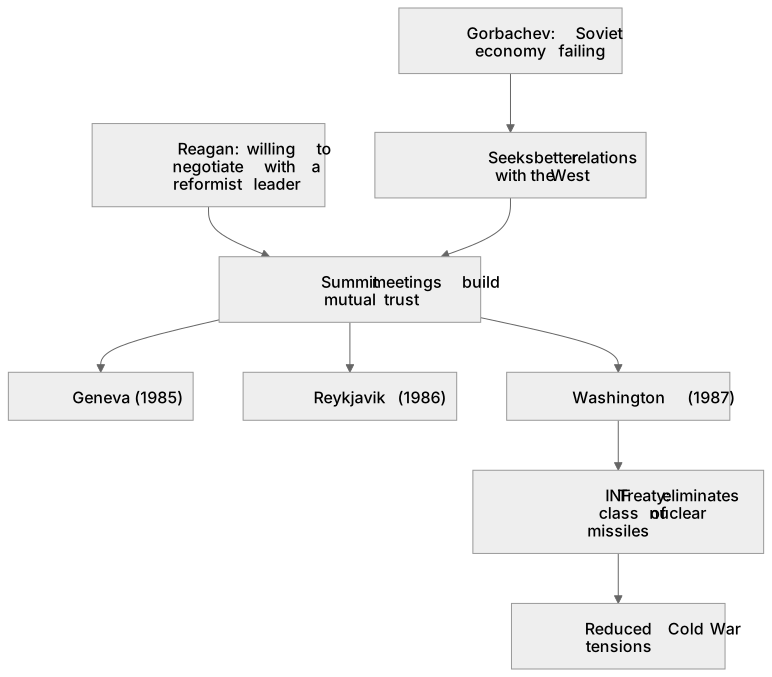
Put the events in order
Put these events in the order they happened, earliest first.
- 1. Geneva summit meeting between Reagan and Gorbachev
- 2. Washington Summit resulted in the INF Treaty
- 3. Reykjavik summit meeting between Reagan and Gorbachev
Key words
Say what each word means before you turn the card.
Summit meetings
Try answering aloud or in your head before turning the card.
INF Treaty
Try answering aloud or in your head before turning the card.
Arms race
Try answering aloud or in your head before turning the card.
Diplomacy
Try answering aloud or in your head before turning the card.
See every definition
- Summit meetings
- A series of meetings between Reagan and Gorbachev, notably Geneva (1985), Reykjavik (1986) and Washington (1987), which built mutual trust.
- INF Treaty
- The landmark Intermediate-Range Nuclear Forces Treaty, resulting from the Washington Summit, which eliminated an entire class of nuclear missiles.
- Arms race
- A competition in weapons build-up that Gorbachev recognised the failing Soviet economy could not sustain.
- Diplomacy
- Negotiation between the two leaders, which Reagan was willing to engage in with a reformist Soviet leader despite his earlier hardline stance.
Label the diagram
Some boxes have lost their names. Pick the right name for each number.
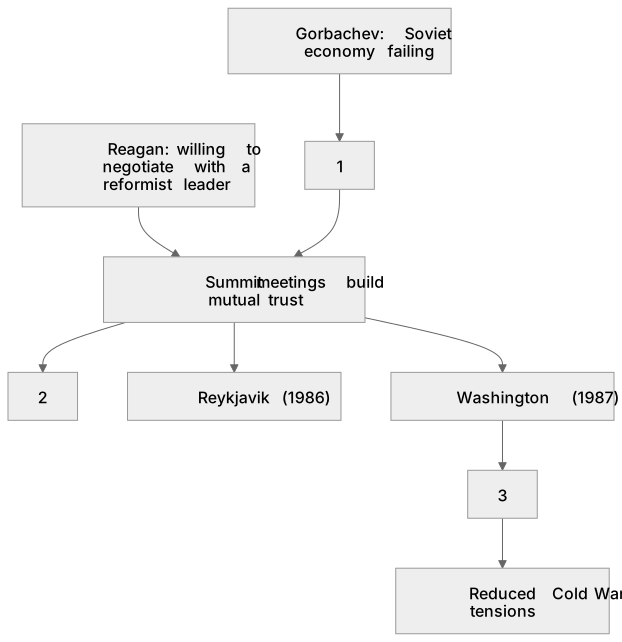
1Box 1
2Box 2
3Box 3
There is more to this lesson
The full lesson goes on to check your understanding and help you earn the marks. Create a free account to carry on, with your progress saved.
A week of Premium from your first lesson · Then the free plan continues · No card, no charge
Test your understanding of Option P4: Key topic 3: The end of the Cold War, 1970–91 - 2 The end of détente and the ‘Second Cold War’: The significance of Reagan and Gorbachev in reducing tensions.
Active recall beats re-reading. Take an instant quiz now to test what you’ve learned and lock it into long-term memory.
A week of Premium from your first lesson · Then the free plan continues · No card, no charge