Pearson Edexcel · GCSE · History
Course version: 1HI0 · Version from Sept 2016
Key topic 3: The end of the Cold War, 1970–91 - 3 The collapse of Soviet…
Full specification wording
Option P4: Key topic 3: The end of the Cold War, 1970–91 - 3 The collapse of Soviet control of Eastern Europe, 1985-91: The collapse of the Soviet Union and its significance in bringing about the end of the Warsaw Pact.
The collapse of the Soviet Union in 1991 marked the definitive end of the Cold War.
Checked against the Pearson Edexcel 1HI0 specification (opens in a new tab) on .
- Point 3 of 3
- 4 key terms
Study notes
From the checked teaching notes for this specification point.
The idea
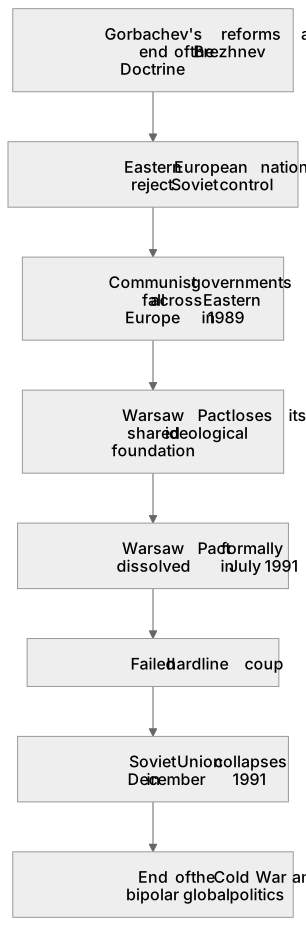
The collapse of the Soviet Union in 1991 marked the definitive end of the Cold War. Following Gorbachev's reforms and his abandonment of the Brezhnev Doctrine, Soviet control over Eastern Europe rapidly disintegrated. As satellite states ousted communist regimes in 1989, the military alliance binding them to Moscow lost its purpose. The Warsaw Pact was formally dissolved in July 1991, shortly before the Soviet Union itself collapsed in December 1991 following a failed hardline coup. The end of the Warsaw Pact was highly significant as it removed the military threat to NATO, dismantled the Iron Curtain, and allowed former Soviet satellite states to pursue independent foreign policies, fundamentally altering the balance of power in Europe.
What earns the marks
- Gorbachev's reforms and the end of the Brezhnev Doctrine encouraged Eastern European nations to reject Soviet control.
- The fall of communist governments across Eastern Europe in 1989 meant the Warsaw Pact no longer had a shared ideological foundation.
- The formal dissolution of the Warsaw Pact in July 1991 symbolised the end of Soviet military dominance in Eastern Europe.
- The subsequent collapse of the Soviet Union in December 1991 confirmed the end of the Cold War and bipolar global politics.
Common mistakes and how to put them right
Confusing the fall of the Berlin Wall in 1989 with the collapse of the Soviet Union in 1991.
Put it right: Ensure these events are sequenced correctly.
Stating that the Warsaw Pact ended after the Soviet Union collapsed.
Put it right: The Warsaw Pact was formally dissolved in July 1991, before the final collapse of the USSR in December.
Assuming Gorbachev intended to destroy the Soviet Union.
Put it right: Clarify that his reforms were meant to save communism, not end it.
Exam tips
- When explaining significance, focus on how the end of the Warsaw Pact changed international relations, such as removing the military threat to NATO.
- Use specific dates, such as July 1991 for the end of the Warsaw Pact, to demonstrate precise chronological knowledge.
- Link the collapse of the Soviet Union directly to the loss of its satellite states and the failure of the August 1991 coup.
Try the lesson
The start of the Option P4: Key topic 3: The end of the Cold War, 1970–91 - 3 The collapse of Soviet control of Eastern Europe, 1985-91: The collapse of the Soviet Union and its significance in bringing about the end of the Warsaw Pact. lesson, made from checked teaching notes for this specification point.
Have a go first
What was the primary reason for the formal dissolution of the Warsaw Pact in July 1991?
Listen
The collapse of the Soviet Union in 1991 marked the definitive end of the Cold War. Following Gorbachev's reforms and his abandonment of the Brezhnev Doctrine, Soviet control over Eastern Europe rapidly disintegrated. As satellite states ousted communist regimes in 1989, the military alliance binding them to Moscow lost its purpose. The Warsaw Pact was formally dissolved in July 1991, shortly before the Soviet Union itself collapsed in December 1991 following a failed hardline coup. The end of the Warsaw Pact was highly significant as it removed the military threat to NATO, dismantled the Iron Curtain, and allowed former Soviet satellite states to pursue independent foreign policies, fundamentally altering the balance of power in Europe. A strong answer earns marks for these points. Gorbachev's reforms and the end of the Brezhnev Doctrine encouraged Eastern European nations to reject Soviet control. The fall of communist governments across Eastern Europe in 1989 meant the Warsaw Pact no longer had a shared ideological foundation. The formal dissolution of the Warsaw Pact in July 1991 symbolised the end of Soviet military dominance in Eastern Europe. The subsequent collapse of the Soviet Union in December 1991 confirmed the end of the Cold War and bipolar global politics. Exam tip: When explaining significance, focus on how the end of the Warsaw Pact changed international relations, such as removing the military threat to NATO.
See it
Put it in order
Put these steps in the order they happen.
- 1. Warsaw Pact formally dissolved in July 1991
- 2. End of the Cold War and bipolar global politics
- 3. Failed hardline coup
- 4. Gorbachev's reforms and end of the Brezhnev Doctrine
- 5. Eastern European nations reject Soviet control
- 6. Soviet Union collapses in December 1991
- 7. Communist governments fall across Eastern Europe in 1989
- 8. Warsaw Pact loses its shared ideological foundation
Key words
Say what each word means before you turn the card.
Warsaw Pact
Try answering aloud or in your head before turning the card.
Collapse of communism
Try answering aloud or in your head before turning the card.
Changing international relations
Try answering aloud or in your head before turning the card.
Loss of empire
Try answering aloud or in your head before turning the card.
See every definition
- Warsaw Pact
- The military alliance binding the satellite states to Moscow, formally dissolved in July 1991, shortly before the Soviet Union itself collapsed.
- Collapse of communism
- The ousting of communist regimes by satellite states in 1989, which meant the Warsaw Pact no longer had a shared ideological foundation.
- Changing international relations
- The removal of the military threat to NATO, the dismantling of the Iron Curtain and the pursuit of independent foreign policies by former Soviet satellite states.
- Loss of empire
- The loss of its satellite states, linked directly to the collapse of the Soviet Union and the failure of the August 1991 coup.
Label the diagram
Some boxes have lost their names. Pick the right name for each number.
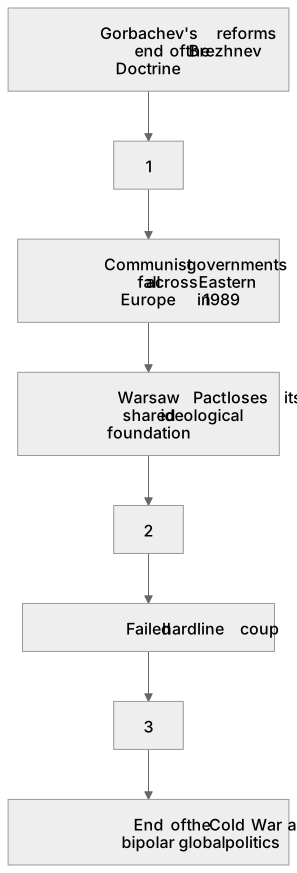
1Box 1
2Box 2
3Box 3
There is more to this lesson
The full lesson goes on to check your understanding and help you earn the marks. Create a free account to carry on, with your progress saved.
A week of Premium from your first lesson · Then the free plan continues · No card, no charge
Test your understanding of Option P4: Key topic 3: The end of the Cold War, 1970–91 - 3 The collapse of Soviet control of Eastern Europe, 1985-91: The collapse of the Soviet Union and its significance in bringing about the end of the Warsaw Pact.
Active recall beats re-reading. Take an instant quiz now to test what you’ve learned and lock it into long-term memory.
A week of Premium from your first lesson · Then the free plan continues · No card, no charge