Pearson Edexcel · GCSE · History
Course version: 1HI0 · Version from Sept 2016
Key topic 3: The end of the Cold War, 1970–91 - 3 The collapse of Soviet…
Full specification wording
Option P4: Key topic 3: The end of the Cold War, 1970–91 - 3 The collapse of Soviet control of Eastern Europe, 1985-91: The impact of Gorbachev’s ‘new thinking’ on Eastern Europe: the loosening Soviet grip on Eastern Europe.
Mikhail Gorbachev’s ‘new thinking’ fundamentally altered Soviet foreign policy, leading to the loosening of the Soviet grip on Eastern Europe.
Checked against the Pearson Edexcel 1HI0 specification (opens in a new tab) on .
- Point 1 of 3
- 4 key terms
Study notes
From the checked teaching notes for this specification point.
The idea
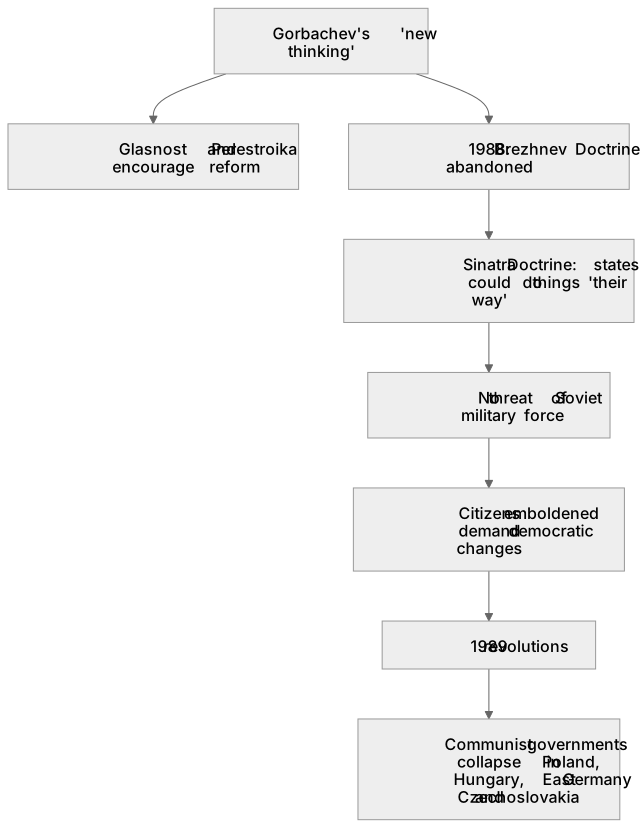
Mikhail Gorbachev’s ‘new thinking’ fundamentally altered Soviet foreign policy, leading to the loosening of the Soviet grip on Eastern Europe. He introduced 'Glasnost' (openness) and 'Perestroika' (restructuring), encouraging reform. Crucially, in 1988, Gorbachev abandoned the Brezhnev Doctrine, declaring the USSR would no longer use military force to prop up communist regimes in Warsaw Pact countries. This shift, jokingly called the Sinatra Doctrine, meant Eastern European states could do things 'their way'. Without the threat of Soviet tanks, citizens felt emboldened to demand democratic changes. This directly sparked the 1989 revolutions, collapsing communist governments in Poland, Hungary, East Germany, and Czechoslovakia.
What earns the marks
- Define Gorbachev's 'new thinking', including the concepts of Glasnost and Perestroika.
- Explain the significance of the abandonment of the Brezhnev Doctrine (the Sinatra Doctrine).
- Describe how the withdrawal of Soviet military backing removed the primary mechanism of control over satellite states.
- Identify specific examples of the loosening grip, such as Solidarity winning elections in Poland or Hungary opening its borders.
- Analyse how Gorbachev's policies inadvertently accelerated the total collapse of communism in Eastern Europe.
Common mistakes and how to put them right
Stating that Gorbachev intended to destroy communism in Eastern Europe.
Put it right: Clarify that Gorbachev wanted to reform and strengthen communism, not dismantle it; the total collapse was an unintended consequence.
Confusing the Brezhnev Doctrine with the Truman Doctrine.
Put it right: Ensure students know the Brezhnev Doctrine justified Soviet military intervention in Eastern Europe, which Gorbachev ended.
Treating Eastern Europe as a single entity.
Put it right: Use specific country examples (e.g., Poland, Hungary) to illustrate how the loosening grip manifested differently.
Exam tips
- Explicitly link the end of the Brezhnev Doctrine to the outbreak of the 1989 revolutions.
- Use the phrase 'Sinatra Doctrine' to demonstrate specific knowledge of Gorbachev's policy shift regarding Warsaw Pact nations.
- When discussing 'impact', ensure you explain the chain reaction: Gorbachev's reforms led to a lack of fear, which led to popular uprisings.
Try the lesson
The start of the Option P4: Key topic 3: The end of the Cold War, 1970–91 - 3 The collapse of Soviet control of Eastern Europe, 1985-91: The impact of Gorbachev’s ‘new thinking’ on Eastern Europe: the loosening Soviet grip on Eastern Europe. lesson, made from checked teaching notes for this specification point.
Have a go first
What was the name given to Gorbachev's policy of allowing Eastern European countries to choose their own political future without Soviet interference?
Listen
Mikhail Gorbachev’s ‘new thinking’ fundamentally altered Soviet foreign policy, leading to the loosening of the Soviet grip on Eastern Europe. He introduced 'Glasnost' (openness) and 'Perestroika' (restructuring), encouraging reform. Crucially, in 1988, Gorbachev abandoned the Brezhnev Doctrine, declaring the USSR would no longer use military force to prop up communist regimes in Warsaw Pact countries. This shift, jokingly called the Sinatra Doctrine, meant Eastern European states could do things 'their way'. Without the threat of Soviet tanks, citizens felt emboldened to demand democratic changes. This directly sparked the 1989 revolutions, collapsing communist governments in Poland, Hungary, East Germany, and Czechoslovakia. A strong answer earns marks for these points. Define Gorbachev's 'new thinking', including the concepts of Glasnost and Perestroika. Explain the significance of the abandonment of the Brezhnev Doctrine (the Sinatra Doctrine). Describe how the withdrawal of Soviet military backing removed the primary mechanism of control over satellite states. Identify specific examples of the loosening grip, such as Solidarity winning elections in Poland or Hungary opening its borders. A common slip: Stating that Gorbachev intended to destroy communism in Eastern Europe. Instead, Clarify that Gorbachev wanted to reform and strengthen communism, not dismantle it; the total collapse was an unintended consequence. Exam tip: Explicitly link the end of the Brezhnev Doctrine to the outbreak of the 1989 revolutions.
See it
Key words
Say what each word means before you turn the card.
Ideological shifts and reform
Try answering aloud or in your head before turning the card.
The collapse of Soviet hegemony
Try answering aloud or in your head before turning the card.
Popular uprisings and revolution
Try answering aloud or in your head before turning the card.
Unintended consequences of policy
Try answering aloud or in your head before turning the card.
See every definition
- Ideological shifts and reform
- Gorbachev introduced 'Glasnost' (openness) and 'Perestroika' (restructuring), encouraging reform in the Soviet Union.
- The collapse of Soviet hegemony
- The loosening of the Soviet grip on Eastern Europe meant Eastern European states could do things 'their way'.
- Popular uprisings and revolution
- Without the threat of Soviet tanks, citizens felt emboldened to demand democratic changes, directly sparking the 1989 revolutions.
- Unintended consequences of policy
- Gorbachev wanted to reform and strengthen communism, not dismantle it; the total collapse was an unintended consequence.
Label the diagram
Some boxes have lost their names. Pick the right name for each number.
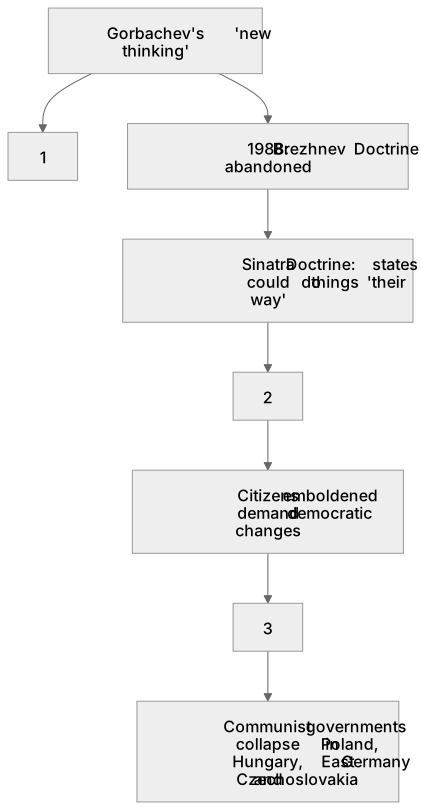
1Box 1
2Box 2
3Box 3
There is more to this lesson
The full lesson goes on to check your understanding and help you earn the marks. Create a free account to carry on, with your progress saved.
A week of Premium from your first lesson · Then the free plan continues · No card, no charge
Test your understanding of Option P4: Key topic 3: The end of the Cold War, 1970–91 - 3 The collapse of Soviet control of Eastern Europe, 1985-91: The impact of Gorbachev’s ‘new thinking’ on Eastern Europe: the loosening Soviet grip on Eastern Europe.
Active recall beats re-reading. Take an instant quiz now to test what you’ve learned and lock it into long-term memory.
A week of Premium from your first lesson · Then the free plan continues · No card, no charge