Pearson Edexcel · GCSE · History
Course version: 1HI0 · Version from Sept 2016
Key topic 1: The birth of the state of Israel, 1945–63 - 1 The British…
Full specification wording
Option P5: Key topic 1: The birth of the state of Israel, 1945–63 - 1 The British withdrawal and the creation of Israel: Conflicting interests and demands of Jews and Arabs within the British Mandate.
Following World War II, the British Mandate in Palestine faced escalating tensions due to the conflicting interests of Jewish and Arab populations.
Checked against the Pearson Edexcel 1HI0 specification (opens in a new tab) on .
- Point 1 of 3
- 3 key terms
Study notes
From the checked teaching notes for this specification point.
The idea
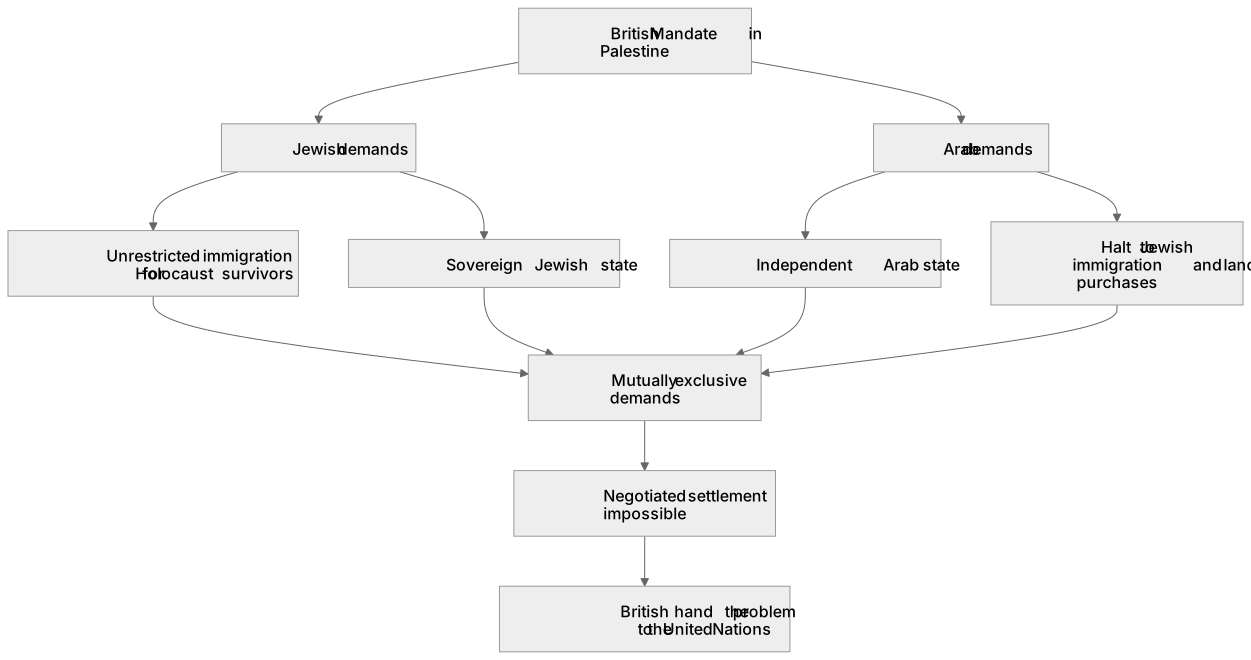
Following World War II, the British Mandate in Palestine faced escalating tensions due to the conflicting interests of Jewish and Arab populations. Jewish demands focused on creating an independent Jewish state and lifting British restrictions on Jewish immigration, particularly for Holocaust survivors. Conversely, Arabs demanded an independent Arab state, an end to Jewish immigration, and the cessation of land sales to Jewish settlers, fearing demographic marginalisation. These mutually exclusive demands made a negotiated settlement impossible. The British, exhausted by war and facing violent insurgencies, found the mandate increasingly ungovernable, leading to their decision to hand the problem to the United Nations.
What earns the marks
- Jewish groups demanded unrestricted immigration for Holocaust survivors and the establishment of a sovereign Jewish state.
- Arab leaders demanded an independent Arab state and a complete halt to Jewish immigration and land purchases.
- The conflicting nature of these demands meant that fulfilling one side's objectives inherently violated the other's.
- British attempts to manage these conflicting interests, such as maintaining immigration quotas, alienated both sides and led to violence.
Common mistakes and how to put them right
Assuming the conflict only began after 1945.
Put it right: Acknowledge that tensions over immigration and land existed throughout the interwar period.
Stating that the British favoured one side entirely.
Put it right: Explain that British policy fluctuated and ultimately failed to satisfy either group.
Overlooking the impact of the Holocaust.
Put it right: Ensure the urgency of Jewish demands for a homeland post-1945 is clearly articulated.
Exam tips
- Clearly contrast the specific demands of both groups to demonstrate an understanding of why the situation was intractable.
- Use the term Zionism correctly when discussing the Jewish demand for a national homeland.
- Link the conflicting demands directly to the British decision to withdraw from the Mandate.
Try the lesson
The start of the Option P5: Key topic 1: The birth of the state of Israel, 1945–63 - 1 The British withdrawal and the creation of Israel: Conflicting interests and demands of Jews and Arabs within the British Mandate. lesson, made from checked teaching notes for this specification point.
Have a go first
During the British Mandate in Palestine, what was a major source of conflict between the Jewish and Arab populations?
Listen
Following World War II, the British Mandate in Palestine faced escalating tensions due to the conflicting interests of Jewish and Arab populations. Jewish demands focused on creating an independent Jewish state and lifting British restrictions on Jewish immigration, particularly for Holocaust survivors. Conversely, Arabs demanded an independent Arab state, an end to Jewish immigration, and the cessation of land sales to Jewish settlers, fearing demographic marginalisation. These mutually exclusive demands made a negotiated settlement impossible. The British, exhausted by war and facing violent insurgencies, found the mandate increasingly ungovernable, leading to their decision to hand the problem to the United Nations. A strong answer earns marks for these points. Jewish groups demanded unrestricted immigration for Holocaust survivors and the establishment of a sovereign Jewish state. Arab leaders demanded an independent Arab state and a complete halt to Jewish immigration and land purchases. The conflicting nature of these demands meant that fulfilling one side's objectives inherently violated the other's. British attempts to manage these conflicting interests, such as maintaining immigration quotas, alienated both sides and led to violence. Exam tip: Clearly contrast the specific demands of both groups to demonstrate an understanding of why the situation was intractable.
See it
Key words
Say what each word means before you turn the card.
Jewish demands
Try answering aloud or in your head before turning the card.
Arab demands
Try answering aloud or in your head before turning the card.
Mutually exclusive demands
Try answering aloud or in your head before turning the card.
See every definition
- Jewish demands
- These focused on creating an independent Jewish state and lifting British restrictions on Jewish immigration, particularly for Holocaust survivors.
- Arab demands
- These were an independent Arab state, an end to Jewish immigration, and the cessation of land sales to Jewish settlers, fearing demographic marginalisation.
- Mutually exclusive demands
- These demands made a negotiated settlement impossible, as fulfilling one side's objectives inherently violated the other's.
Label the diagram
Some boxes have lost their names. Pick the right name for each number.
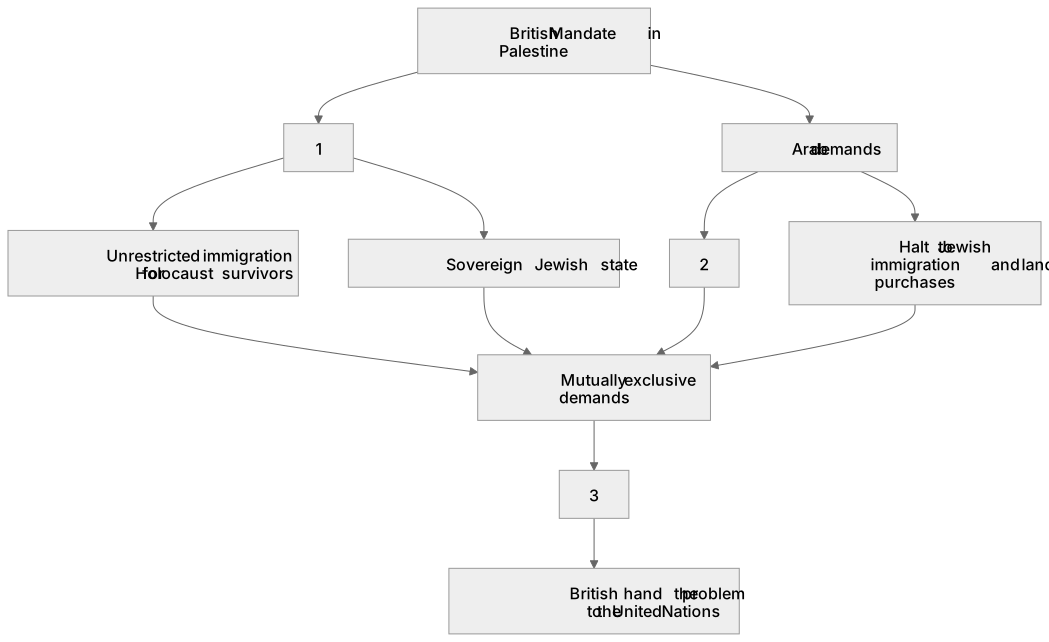
1Box 1
2Box 2
3Box 3
There is more to this lesson
The full lesson goes on to check your understanding and help you earn the marks. Create a free account to carry on, with your progress saved.
A week of Premium from your first lesson · Then the free plan continues · No card, no charge
Test your understanding of Option P5: Key topic 1: The birth of the state of Israel, 1945–63 - 1 The British withdrawal and the creation of Israel: Conflicting interests and demands of Jews and Arabs within the British Mandate.
Active recall beats re-reading. Take an instant quiz now to test what you’ve learned and lock it into long-term memory.
A week of Premium from your first lesson · Then the free plan continues · No card, no charge