Pearson Edexcel · GCSE · History
Course version: 1HI0 · Version from Sept 2016
Key topic 1: The birth of the state of Israel, 1945–63 - 2 Aftermath of…
Full specification wording
Option P5: Key topic 1: The birth of the state of Israel, 1945–63 - 2 Aftermath of the 1948–49 war: Israel’s relations with Egypt.
Following the 1948–49 war, Israel’s relations with Egypt were characterised by intense hostility.
Checked against the Pearson Edexcel 1HI0 specification (opens in a new tab) on .
- Point 3 of 3
- 4 key terms
Study notes
From the checked teaching notes for this specification point.
The idea
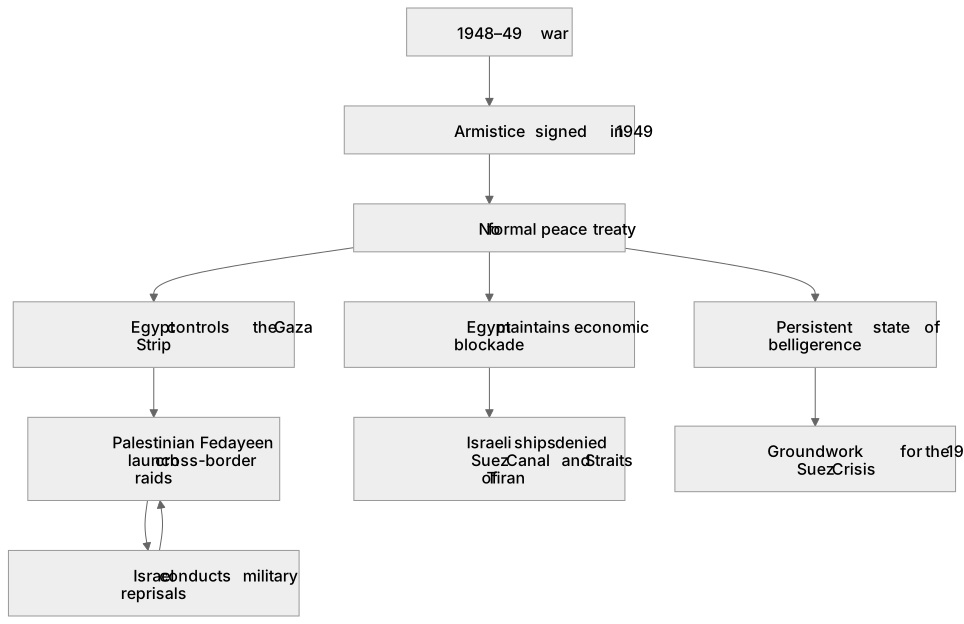
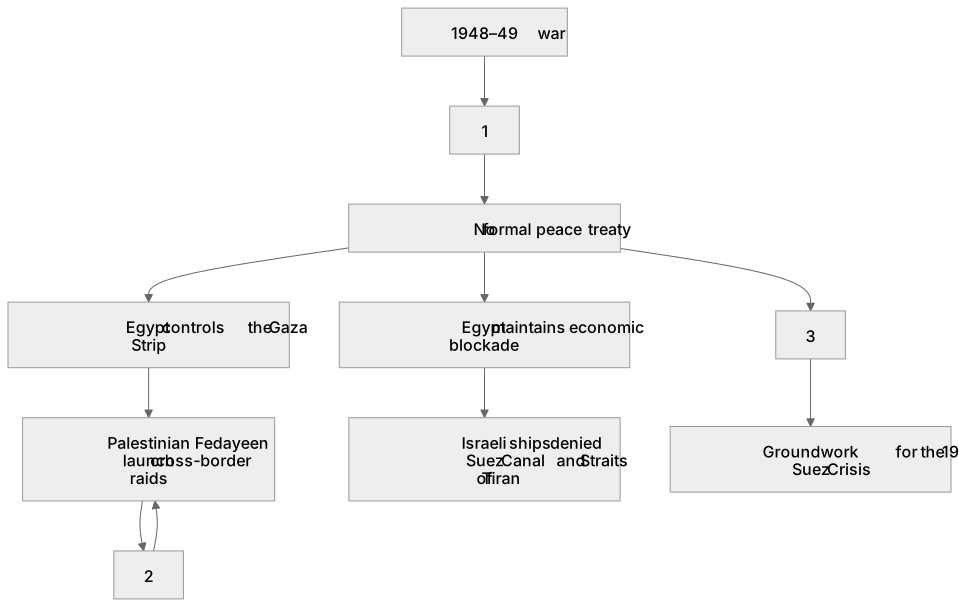
Following the 1948–49 war, Israel’s relations with Egypt were characterised by intense hostility. Although an armistice was signed in 1949, a formal peace treaty was never established. Egypt, controlling the Gaza Strip, permitted Palestinian Fedayeen (guerrillas) to launch cross-border raids into Israeli territory, attacking civilian and military targets. In response, Israel conducted severe military reprisal operations against Egyptian positions, escalating the cycle of violence. Furthermore, Egypt maintained an economic blockade, denying Israeli ships access to the Suez Canal and the Straits of Tiran, which severely restricted Israel's trade. This persistent state of belligerence laid the groundwork for future conflicts, notably the 1956 Suez Crisis.
What earns the marks
- Describe the nature of the border clashes, specifically the Fedayeen raids from Egyptian-controlled Gaza.
- Explain Israel's policy of military reprisals in response to cross-border attacks.
- Identify the economic measures taken by Egypt against Israel, such as blocking the Suez Canal and Straits of Tiran.
- Analyse how the lack of a formal peace treaty contributed to ongoing tensions between the two nations.
Common mistakes and how to put them right
Stating that Egypt and Israel signed a peace treaty in 1949.
Put it right by clarifying they only signed an armistice agreement, leaving them technically at war.
Confusing the Fedayeen with the regular Egyptian army.
Put it right by explaining the Fedayeen were Palestinian guerrillas, though often supported by Egypt.
Overlooking the economic blockade.
Put it right by including Egypt's closure of the Suez Canal and Straits of Tiran to Israeli shipping as a key source of tension.
Exam tips
- Use the term 'Fedayeen' when discussing the cross-border raids to demonstrate specific historical knowledge.
- Clearly link the border skirmishes and economic blockades to the build-up of tension that eventually caused the 1956 Suez Crisis.
- Remember to mention that Egypt's control of the Gaza Strip provided a direct launchpad for attacks against Israel.
Try the lesson
The start of the Option P5: Key topic 1: The birth of the state of Israel, 1945–63 - 2 Aftermath of the 1948–49 war: Israel’s relations with Egypt. lesson, made from checked teaching notes for this specification point.
Have a go first
In the early 1950s, which group frequently crossed the border from Egyptian-controlled Gaza to launch attacks inside Israel?
Listen
Following the 1948–49 war, Israel’s relations with Egypt were characterised by intense hostility. Although an armistice was signed in 1949, a formal peace treaty was never established. Egypt, controlling the Gaza Strip, permitted Palestinian Fedayeen (guerrillas) to launch cross-border raids into Israeli territory, attacking civilian and military targets. In response, Israel conducted severe military reprisal operations against Egyptian positions, escalating the cycle of violence. Furthermore, Egypt maintained an economic blockade, denying Israeli ships access to the Suez Canal and the Straits of Tiran, which severely restricted Israel's trade. This persistent state of belligerence laid the groundwork for future conflicts, notably the 1956 Suez Crisis. A strong answer earns marks for these points. Describe the nature of the border clashes, specifically the Fedayeen raids from Egyptian-controlled Gaza. Explain Israel's policy of military reprisals in response to cross-border attacks. Identify the economic measures taken by Egypt against Israel, such as blocking the Suez Canal and Straits of Tiran. Analyse how the lack of a formal peace treaty contributed to ongoing tensions between the two nations. A common slip: Stating that Egypt and Israel signed a peace treaty in 1949. Instead, clarifying they only signed an armistice agreement, leaving them technically at war. Exam tip: Use the term 'Fedayeen' when discussing the cross-border raids to demonstrate specific historical knowledge.
See it
Key words
Say what each word means before you turn the card.
Fedayeen
Try answering aloud or in your head before turning the card.
Armistice
Try answering aloud or in your head before turning the card.
Economic blockade
Try answering aloud or in your head before turning the card.
Military reprisals
Try answering aloud or in your head before turning the card.
See every definition
- Fedayeen
- Palestinian guerrillas permitted by Egypt, which controlled the Gaza Strip, to launch cross-border raids into Israeli territory.
- Armistice
- An agreement signed in 1949, although a formal peace treaty was never established between Israel and Egypt.
- Economic blockade
- A measure maintained by Egypt, denying Israeli ships access to the Suez Canal and the Straits of Tiran, which severely restricted Israel's trade.
- Military reprisals
- Severe operations conducted by Israel against Egyptian positions in response to cross-border attacks, escalating the cycle of violence.
Label the diagram
Some boxes have lost their names. Pick the right name for each number.
1Box 1
2Box 2
3Box 3
There is more to this lesson
The full lesson goes on to check your understanding and help you earn the marks. Create a free account to carry on, with your progress saved.
A week of Premium from your first lesson · Then the free plan continues · No card, no charge
Test your understanding of Option P5: Key topic 1: The birth of the state of Israel, 1945–63 - 2 Aftermath of the 1948–49 war: Israel’s relations with Egypt.
Active recall beats re-reading. Take an instant quiz now to test what you’ve learned and lock it into long-term memory.
A week of Premium from your first lesson · Then the free plan continues · No card, no charge