Pearson Edexcel · GCSE · History
Course version: 1HI0 · Version from Sept 2016
Key topic 1: The birth of the state of Israel, 1945–63 - 3 Increased…
Full specification wording
Option P5: Key topic 1: The birth of the state of Israel, 1945–63 - 3 Increased tension, 1955–63: Nasser and Egypt’s leadership of the Arab world.
Gamal Abdel Nasser championed Pan-Arabism, advocating for the political unity of Arab nations.
Checked against the Pearson Edexcel 1HI0 specification (opens in a new tab) on .
- Point 1 of 3
- 4 key terms
Study notes
From the checked teaching notes for this specification point.
The idea
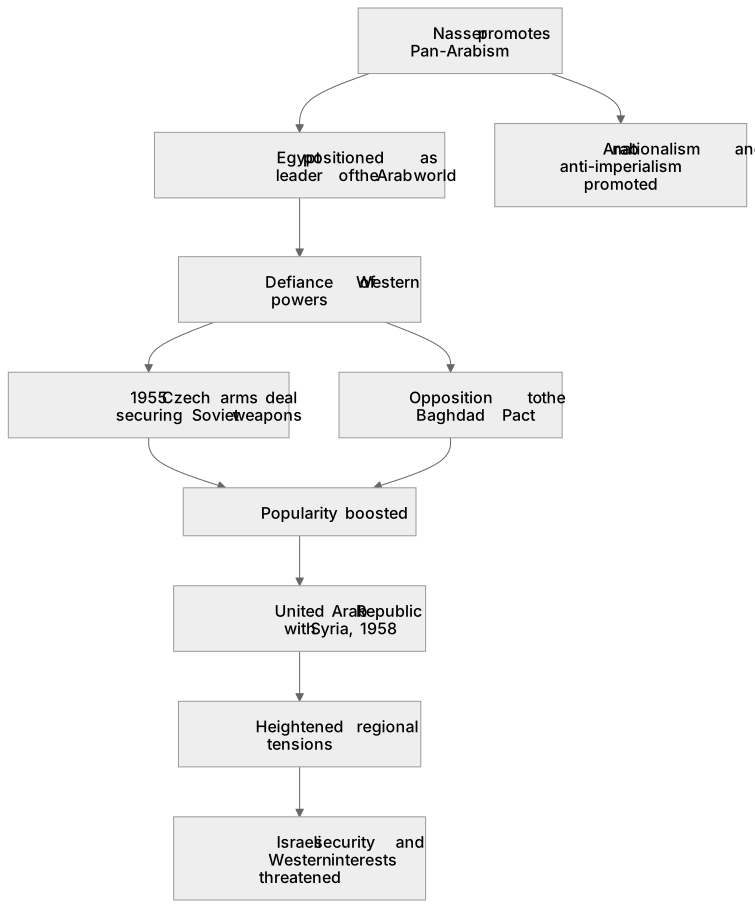
Gamal Abdel Nasser championed Pan-Arabism, advocating for the political unity of Arab nations. By promoting Arab nationalism and anti-imperialism, Nasser positioned Egypt as the leader of the Arab world. His defiance of Western powers, notably through the 1955 Czech arms deal securing Soviet weapons, and his opposition to the Baghdad Pact, boosted his popularity. Nasser's leadership aimed to unite Arab states against Israel and Western influence, culminating in the short-lived United Arab Republic with Syria in 1958. This leadership role heightened regional tensions, as Nasser's aggressive rhetoric and policies directly threatened Israeli security and Western interests, making Egypt the focal point of Arab resistance during this period.
What earns the marks
- Define Pan-Arabism and explain Nasser's role in promoting it.
- Identify key actions Nasser took to defy Western powers, such as the 1955 Czech arms deal.
- Describe the formation of the United Arab Republic (UAR) as a practical application of Nasser's leadership.
- Analyse how Nasser's leadership of the Arab world increased tensions with Israel.
Common mistakes and how to put them right
Assuming Nasser was the leader of all Arab countries.
Put it right by explaining he was the President of Egypt but acted as the ideological leader of the broader Arab nationalist movement.
Confusing the Czech arms deal with direct Soviet aid.
Put it right by noting the weapons were purchased from Czechoslovakia, though it was a Soviet satellite state acting with Soviet approval.
Believing the United Arab Republic was a long-lasting union.
Put it right by stating it only lasted from 1958 to 1961 before Syria seceded.
Exam tips
- Use the term 'Pan-Arabism' to describe Nasser's ideology of uniting Arab nations.
- Connect Nasser's rising popularity in the Arab world to his willingness to stand up to Western imperialism and his strong anti-Israel stance.
- Mention the Czech arms deal as a turning point that shifted the balance of power and increased Israeli fears of Egyptian military strength.
Try the lesson
The start of the Option P5: Key topic 1: The birth of the state of Israel, 1945–63 - 3 Increased tension, 1955–63: Nasser and Egypt’s leadership of the Arab world. lesson, made from checked teaching notes for this specification point.
Have a go first
Which political ideology did Gamal Abdel Nasser promote to unite Arabic-speaking countries against foreign influence?
Listen
Gamal Abdel Nasser championed Pan-Arabism, advocating for the political unity of Arab nations. By promoting Arab nationalism and anti-imperialism, Nasser positioned Egypt as the leader of the Arab world. His defiance of Western powers, notably through the 1955 Czech arms deal securing Soviet weapons, and his opposition to the Baghdad Pact, boosted his popularity. Nasser's leadership aimed to unite Arab states against Israel and Western influence, culminating in the short-lived United Arab Republic with Syria in 1958. This leadership role heightened regional tensions, as Nasser's aggressive rhetoric and policies directly threatened Israeli security and Western interests, making Egypt the focal point of Arab resistance during this period. A strong answer earns marks for these points. Define Pan-Arabism and explain Nasser's role in promoting it. Identify key actions Nasser took to defy Western powers, such as the 1955 Czech arms deal. Describe the formation of the United Arab Republic (UAR) as a practical application of Nasser's leadership. Analyse how Nasser's leadership of the Arab world increased tensions with Israel. A common slip: Assuming Nasser was the leader of all Arab countries. Instead, explaining he was the President of Egypt but acted as the ideological leader of the broader Arab nationalist movement. Exam tip: Use the term 'Pan-Arabism' to describe Nasser's ideology of uniting Arab nations.
See it
Key words
Say what each word means before you turn the card.
Pan-Arabism
Try answering aloud or in your head before turning the card.
Arab nationalism
Try answering aloud or in your head before turning the card.
Czech arms deal
Try answering aloud or in your head before turning the card.
United Arab Republic
Try answering aloud or in your head before turning the card.
See every definition
- Pan-Arabism
- The ideology championed by Gamal Abdel Nasser advocating for the political unity of Arab nations.
- Arab nationalism
- A force Nasser promoted, alongside anti-imperialism, to position Egypt as the leader of the Arab world.
- Czech arms deal
- The 1955 deal securing Soviet weapons, through which Nasser defied Western powers and boosted his popularity.
- United Arab Republic
- The short-lived union with Syria in 1958, culminating from Nasser's leadership aimed at uniting Arab states.
Label the diagram
Some boxes have lost their names. Pick the right name for each number.
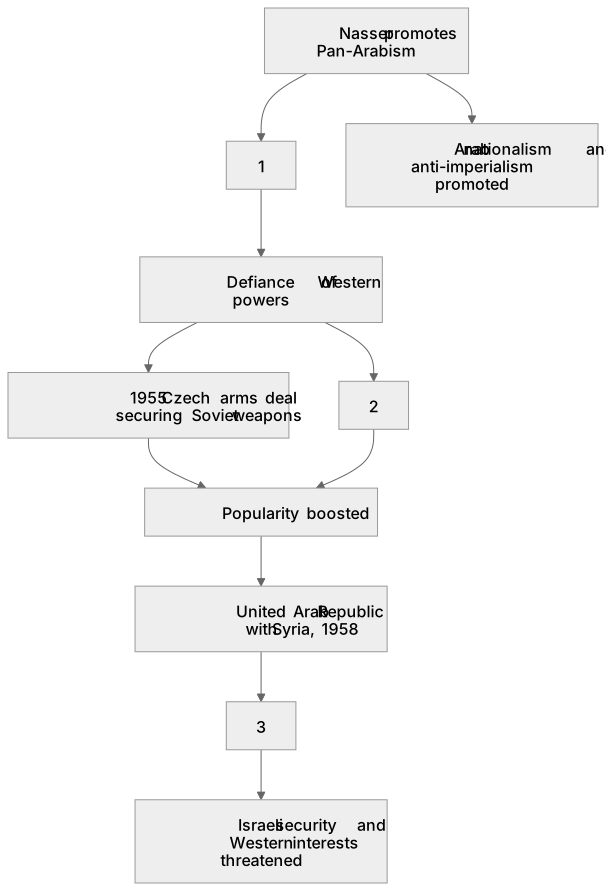
1Box 1
2Box 2
3Box 3
There is more to this lesson
The full lesson goes on to check your understanding and help you earn the marks. Create a free account to carry on, with your progress saved.
A week of Premium from your first lesson · Then the free plan continues · No card, no charge
Test your understanding of Option P5: Key topic 1: The birth of the state of Israel, 1945–63 - 3 Increased tension, 1955–63: Nasser and Egypt’s leadership of the Arab world.
Active recall beats re-reading. Take an instant quiz now to test what you’ve learned and lock it into long-term memory.
A week of Premium from your first lesson · Then the free plan continues · No card, no charge