Pearson Edexcel · GCSE · History
Course version: 1HI0 · Version from Sept 2016
Key topic 2: The escalating conflict, 1964–73 - 2 Aftermath of the 1967…
Full specification wording
Option P5: Key topic 2: The escalating conflict, 1964–73 - 2 Aftermath of the 1967 war: UN Resolution 242 and continued dispute over the Suez Canal.
Following the 1967 war, the UN Security Council passed Resolution 242, establishing the 'land for peace' formula.
Checked against the Pearson Edexcel 1HI0 specification (opens in a new tab) on .
- Point 1 of 3
- 4 key terms
Study notes
From the checked teaching notes for this specification point.
The idea
Following the 1967 war, the UN Security Council passed Resolution 242, establishing the 'land for peace' formula. It called for Israeli withdrawal from territories occupied in the recent conflict and the acknowledgement of the sovereignty and political independence of every state in the area. However, ambiguous wording led to differing interpretations and failure to implement it. Meanwhile, the Suez Canal remained closed and became a heavily fortified frontline. The continued dispute over the Canal led to the War of Attrition (1967-1970), involving artillery duels and commando raids between Egypt and Israel.
What earns the marks
- Explain the core principle of UN Resolution 242: 'land for peace'.
- Identify the key demands: Israeli withdrawal from occupied territories and Arab recognition of Israel's right to exist.
- Discuss the ambiguity in the resolution's wording and how it hindered implementation.
- Describe the closure of the Suez Canal following the 1967 war.
- Explain how the Suez Canal became the frontline for the War of Attrition between Egypt and Israel.
Common mistakes and how to put them right
Claiming UN Resolution 242 was successfully implemented immediately.
Put it right: The resolution was accepted in principle but failed in practice due to differing interpretations.
Stating the Suez Canal remained open to international shipping.
Put it right: The Canal was blocked by sunken ships and mines, remaining closed from 1967 until 1975.
Ignoring the War of Attrition.
Put it right: The continued dispute over the Suez Canal directly caused the War of Attrition, which must be mentioned.
Exam tips
- Memorise the phrase 'land for peace' as a shorthand for the core concept of Resolution 242.
- Be able to explain why the English and French translations of Resolution 242 caused diplomatic friction.
- Link the failure of Resolution 242 directly to the outbreak of the War of Attrition along the Suez Canal.
Try the lesson
The start of the Option P5: Key topic 2: The escalating conflict, 1964–73 - 2 Aftermath of the 1967 war: UN Resolution 242 and continued dispute over the Suez Canal. lesson, made from checked teaching notes for this specification point.
Have a go first
What was the core principle established by UN Resolution 242 following the 1967 war?
Listen
Following the 1967 war, the UN Security Council passed Resolution 242, establishing the 'land for peace' formula. It called for Israeli withdrawal from territories occupied in the recent conflict and the acknowledgement of the sovereignty and political independence of every state in the area. However, ambiguous wording led to differing interpretations and failure to implement it. Meanwhile, the Suez Canal remained closed and became a heavily fortified frontline. The continued dispute over the Canal led to the War of Attrition (1967-1970), involving artillery duels and commando raids between Egypt and Israel. A strong answer earns marks for these points. Explain the core principle of UN Resolution 242: 'land for peace'. Identify the key demands: Israeli withdrawal from occupied territories and Arab recognition of Israel's right to exist. Discuss the ambiguity in the resolution's wording and how it hindered implementation. Describe the closure of the Suez Canal following the 1967 war. A common slip: Claiming UN Resolution 242 was successfully implemented immediately. Instead, The resolution was accepted in principle but failed in practice due to differing interpretations. Exam tip: Memorise the phrase 'land for peace' as a shorthand for the core concept of Resolution 242.
See it
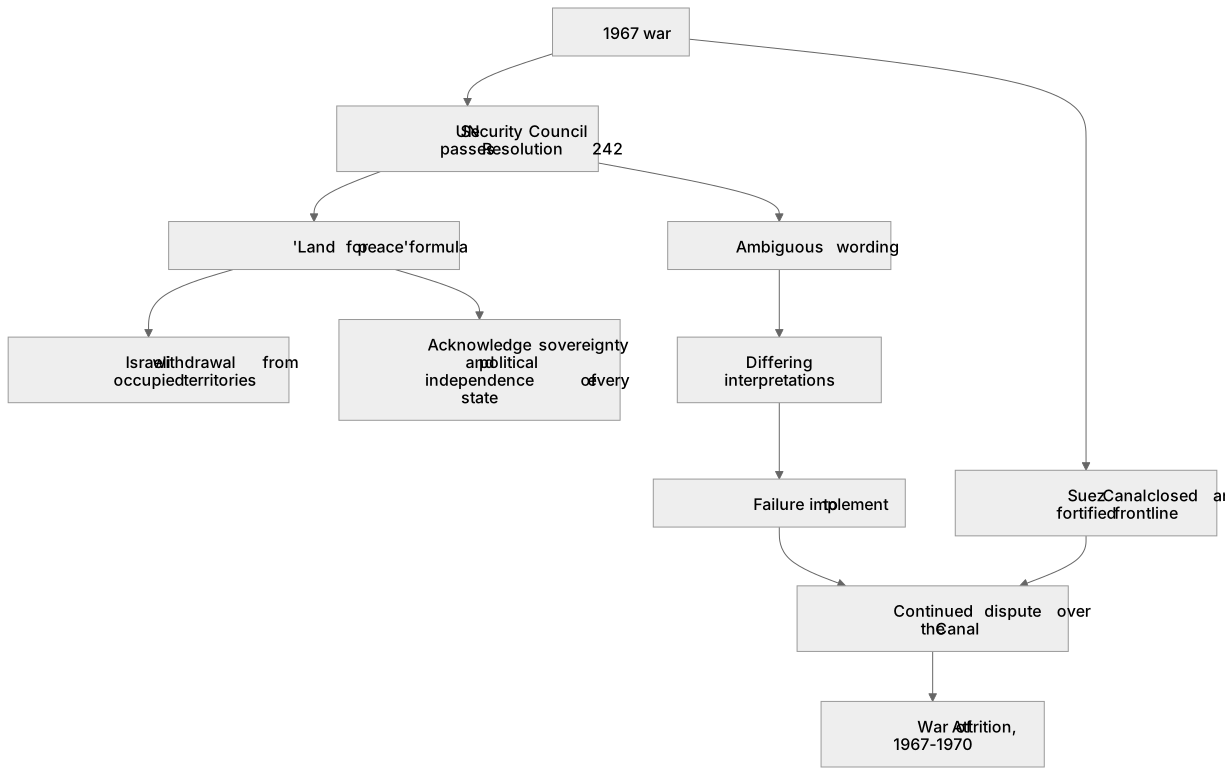
Key words
Say what each word means before you turn the card.
UN Resolution 242
Try answering aloud or in your head before turning the card.
'land for peace'
Try answering aloud or in your head before turning the card.
War of Attrition
Try answering aloud or in your head before turning the card.
Suez Canal
Try answering aloud or in your head before turning the card.
See every definition
- UN Resolution 242
- Passed by the UN Security Council after the 1967 war, it established the 'land for peace' formula and called for Israeli withdrawal from occupied territories and acknowledgement of every state's sovereignty.
- 'land for peace'
- The formula established by UN Resolution 242, calling for Israeli withdrawal from territories occupied in the recent conflict and acknowledgement of the sovereignty and political independence of every state in the area.
- War of Attrition
- A conflict from 1967 to 1970, involving artillery duels and commando raids between Egypt and Israel, caused by the continued dispute over the Suez Canal.
- Suez Canal
- Remained closed after the 1967 war and became a heavily fortified frontline, with the continued dispute over it leading to the War of Attrition.
Label the diagram
Some boxes have lost their names. Pick the right name for each number.
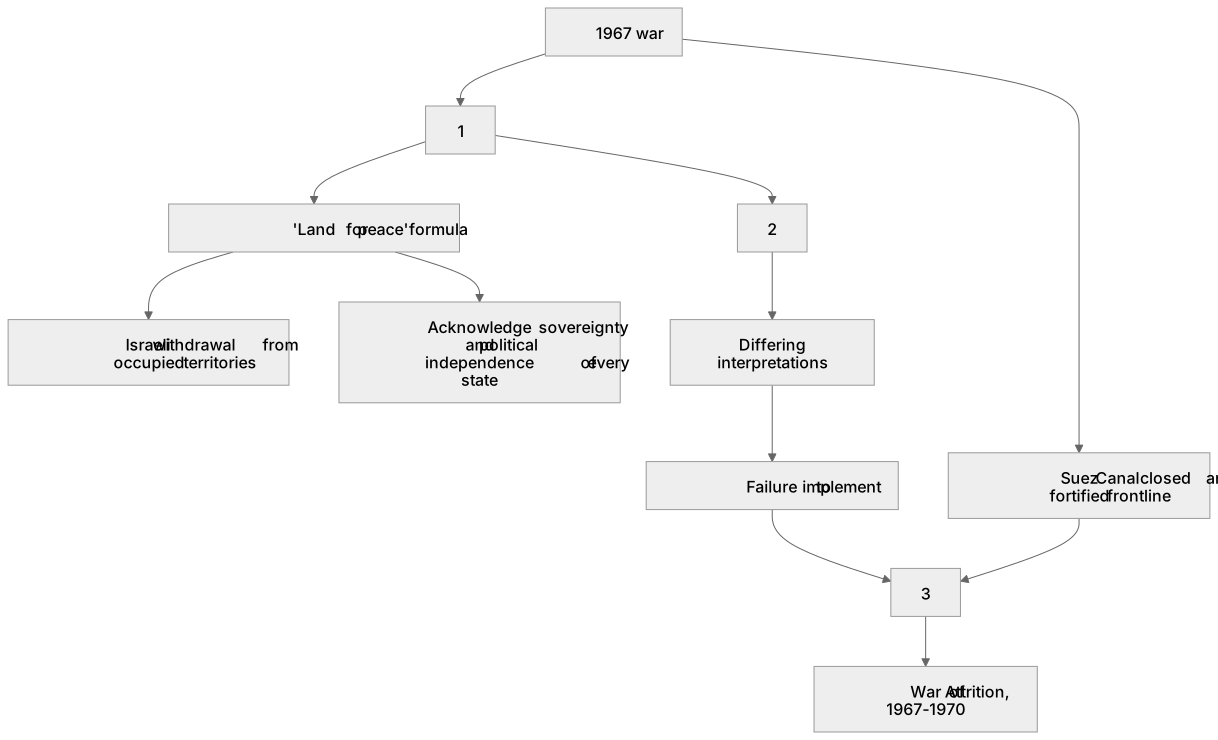
1Box 1
2Box 2
3Box 3
There is more to this lesson
The full lesson goes on to check your understanding and help you earn the marks. Create a free account to carry on, with your progress saved.
A week of Premium from your first lesson · Then the free plan continues · No card, no charge
Test your understanding of Option P5: Key topic 2: The escalating conflict, 1964–73 - 2 Aftermath of the 1967 war: UN Resolution 242 and continued dispute over the Suez Canal.
Active recall beats re-reading. Take an instant quiz now to test what you’ve learned and lock it into long-term memory.
A week of Premium from your first lesson · Then the free plan continues · No card, no charge