Pearson Edexcel · GCSE · History
Course version: 1HI0 · Version from Sept 2016
Key topic 2: The escalating conflict, 1964–73 - 3 Israel and Egypt,…
Full specification wording
Option P5: Key topic 2: The escalating conflict, 1964–73 - 3 Israel and Egypt, 1967–73: Egyptian relations with Israel, the USA, the USSR and other Arab states.
Between 1967 and 1973, Egypt's foreign relations were defined by the aftermath of the Six Day War and the desire to regain the Sinai Peninsula.
Checked against the Pearson Edexcel 1HI0 specification (opens in a new tab) on .
- Point 1 of 3
Study notes
From the checked teaching notes for this specification point.
The idea
Between 1967 and 1973, Egypt's foreign relations were defined by the aftermath of the Six Day War and the desire to regain the Sinai Peninsula. Relations with Israel were hostile, characterised by the War of Attrition (1967–1970) where artillery exchanges occurred across the Suez Canal. Egypt relied heavily on the USSR for military and economic aid, including weapons to rebuild its armed forces. However, President Sadat expelled Soviet advisors in 1972 to signal his independence and court the USA, hoping American influence could pressure Israel into concessions. Relations with other Arab states were complex; while Egypt sought pan-Arab solidarity and financial support from oil-rich nations like Saudi Arabia, Sadat's willingness to consider diplomatic solutions sometimes alienated hardline Arab leaders.
What earns the marks
- Describe the War of Attrition as a key feature of Egyptian-Israeli hostility between 1967 and 1970.
- Explain Egypt's reliance on the USSR for military rebuilding after the 1967 defeat.
- Analyse Sadat's 1972 expulsion of Soviet advisors as a strategic pivot towards the USA.
- Evaluate Egypt's efforts to secure financial and political backing from other Arab states, particularly Saudi Arabia, in preparation for future conflict.
Common mistakes and how to put them right
Claiming Egypt was allied with the USA throughout this period.
Put it right: Egypt was primarily backed by the USSR until Sadat expelled Soviet advisors in 1972 to open diplomatic channels with the USA.
Confusing Nasser's and Sadat's foreign policies.
Put it right: Nasser maintained strong Soviet ties and pan-Arab leadership, whereas Sadat shifted towards Egyptian nationalism and sought US involvement.
Assuming peaceful relations with Israel existed before 1973.
Put it right: The period was marked by the violent War of Attrition along the Suez Canal, not peace.
Exam tips
- When discussing superpower involvement, contrast the roles of the USSR (military supplier) and the USA (potential diplomatic broker).
- Use the War of Attrition as specific evidence of the ongoing hostility between Egypt and Israel.
- Highlight the transition from Nasser to Sadat in 1970 as a turning point in Egypt's foreign relations.
Try the lesson
The start of the Option P5: Key topic 2: The escalating conflict, 1964–73 - 3 Israel and Egypt, 1967–73: Egyptian relations with Israel, the USA, the USSR and other Arab states. lesson, made from checked teaching notes for this specification point.
Have a go first
Which superpower was the primary supplier of military equipment and advisors to Egypt immediately following the Six Day War in 1967?
Listen
Between 1967 and 1973, Egypt's foreign relations were defined by the aftermath of the Six Day War and the desire to regain the Sinai Peninsula. Relations with Israel were hostile, characterised by the War of Attrition (1967–1970) where artillery exchanges occurred across the Suez Canal. Egypt relied heavily on the USSR for military and economic aid, including weapons to rebuild its armed forces. However, President Sadat expelled Soviet advisors in 1972 to signal his independence and court the USA, hoping American influence could pressure Israel into concessions. Relations with other Arab states were complex; while Egypt sought pan-Arab solidarity and financial support from oil-rich nations like Saudi Arabia, Sadat's willingness to consider diplomatic solutions sometimes alienated hardline Arab leaders. A strong answer earns marks for these points. Describe the War of Attrition as a key feature of Egyptian-Israeli hostility between 1967 and 1970. Explain Egypt's reliance on the USSR for military rebuilding after the 1967 defeat. Analyse Sadat's 1972 expulsion of Soviet advisors as a strategic pivot towards the USA. Evaluate Egypt's efforts to secure financial and political backing from other Arab states, particularly Saudi Arabia, in preparation for future conflict. A common slip: Claiming Egypt was allied with the USA throughout this period. Instead, Egypt was primarily backed by the USSR until Sadat expelled Soviet advisors in 1972 to open diplomatic channels with the USA. Exam tip: When discussing superpower involvement, contrast the roles of the USSR (military supplier) and the USA (potential diplomatic broker).
See it
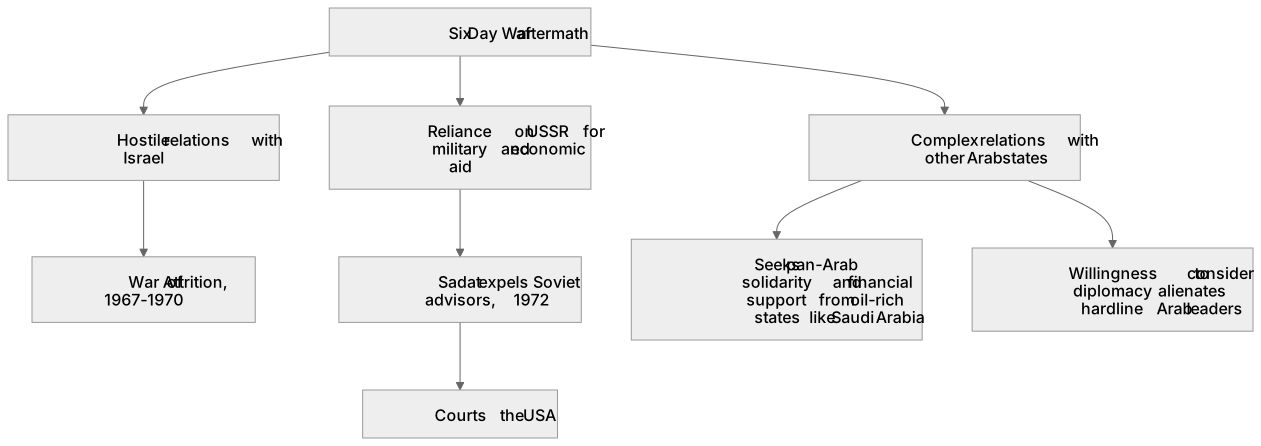
Put the events in order
Put these events in the order they happened, earliest first.
- 1. War of Attrition began as Egyptian-Israeli hostility
- 2. Sadat expelled Soviet advisors to court the USA
- 3. Transition from Nasser to Sadat as a turning point
Label the diagram
Some boxes have lost their names. Pick the right name for each number.
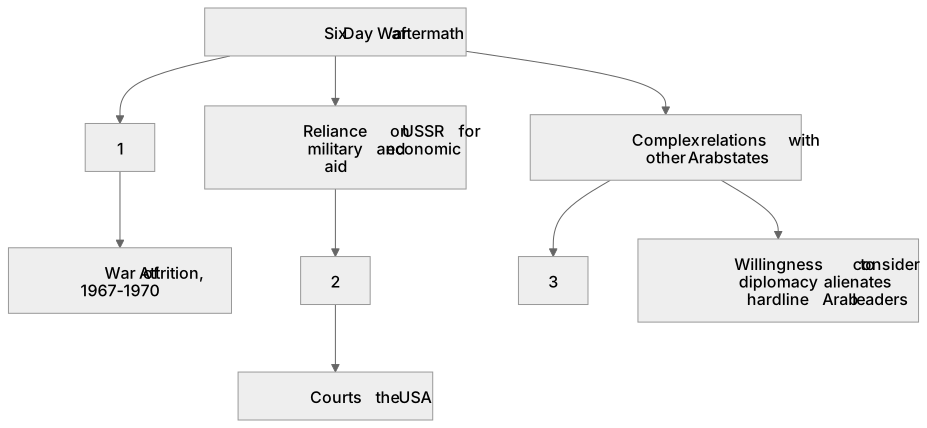
1Box 1
2Box 2
3Box 3
There is more to this lesson
The full lesson goes on to check your understanding and help you earn the marks. Create a free account to carry on, with your progress saved.
A week of Premium from your first lesson · Then the free plan continues · No card, no charge
Test your understanding of Option P5: Key topic 2: The escalating conflict, 1964–73 - 3 Israel and Egypt, 1967–73: Egyptian relations with Israel, the USA, the USSR and other Arab states.
Active recall beats re-reading. Take an instant quiz now to test what you’ve learned and lock it into long-term memory.
A week of Premium from your first lesson · Then the free plan continues · No card, no charge