Pearson Edexcel · GCSE · History
Course version: 1HI0 · Version from Sept 2016
Key topic 3: Attempts at a solution, 1974–95 - 3 Attempts at a solution:…
Full specification wording
Option P5: Key topic 3: Attempts at a solution, 1974–95 - 3 Attempts at a solution: Changing superpower policies in the Middle East: US involvement in the Gulf War (1991), and the end of the Cold War.
The end of the Cold War profoundly altered superpower policies in the Middle East.
Checked against the Pearson Edexcel 1HI0 specification (opens in a new tab) on .
- Point 2 of 3
- 4 key terms
Study notes
From the checked teaching notes for this specification point.
The idea
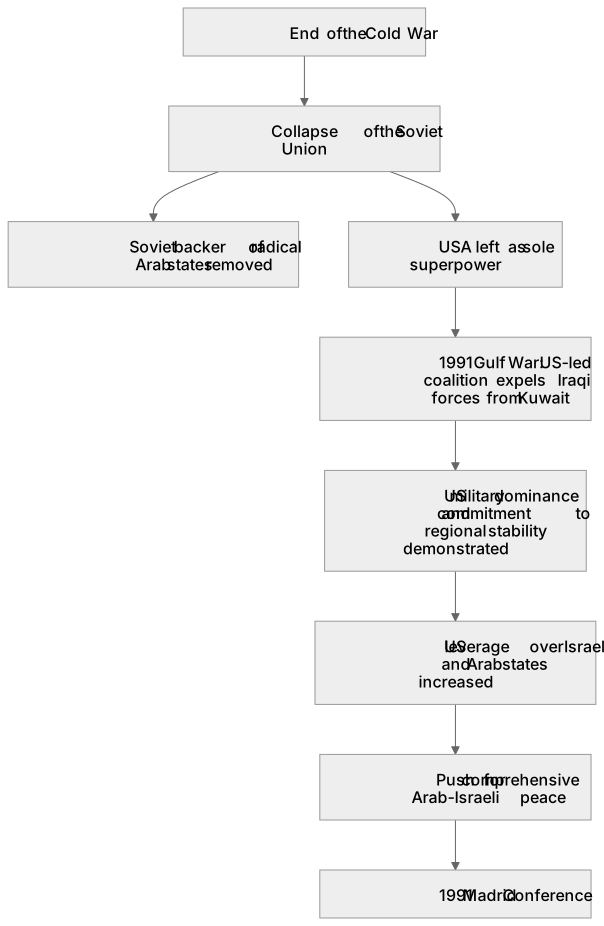
The end of the Cold War profoundly altered superpower policies in the Middle East. The collapse of the Soviet Union removed the primary backer of radical Arab states, leaving the USA as the sole superpower. This shift was evident during the 1991 Gulf War, when the US successfully led a broad coalition, including several Arab nations, to expel Iraqi forces from Kuwait. The war demonstrated US military dominance and its commitment to regional stability. Consequently, the US leveraged its enhanced influence to push for a comprehensive Arab-Israeli peace, leading to the 1991 Madrid Conference. The diminished Soviet threat meant the US no longer viewed Israel solely as a Cold War strategic asset, allowing for a more balanced diplomatic approach.
What earns the marks
- Explain how the end of the Cold War reduced Soviet influence in the Middle East and left the USA as the dominant power.
- Describe the context and outcome of the 1991 Gulf War, highlighting the US-led coalition's expulsion of Iraq from Kuwait.
- Analyse how the Gulf War increased US leverage over both Israel and Arab states.
- Evaluate the connection between these changing superpower dynamics and the renewed push for peace, such as the Madrid Conference.
Common mistakes and how to put them right
Confusing the 1991 Gulf War with the 2003 Iraq War.
Put it right: Ensure you focus on the 1991 conflict triggered by Iraq's invasion of Kuwait, not the later invasion to topple Saddam Hussein.
Assuming the Soviet Union played a major role in the 1991 Gulf War.
Put it right: Note that the declining Soviet Union cooperated with the US and did not block UN action against Iraq.
Overlooking the impact on the PLO.
Put it right: Mention that the PLO's support for Saddam Hussein during the Gulf War isolated them politically and financially, forcing them towards negotiations.
Exam tips
- Use the term 'New World Order' to describe the post-Cold War era where the US acted as the primary global mediator.
- Connect the PLO's weakened position after the Gulf War to their willingness to participate in the peace process.
- Highlight how the US used its success in the Gulf War as political capital to convene the Madrid Conference.
Try the lesson
The start of the Option P5: Key topic 3: Attempts at a solution, 1974–95 - 3 Attempts at a solution: Changing superpower policies in the Middle East: US involvement in the Gulf War (1991), and the end of the Cold War. lesson, made from checked teaching notes for this specification point.
Have a go first
How did the end of the Cold War primarily affect superpower involvement in the Middle East in the early 1990s?
Listen
The end of the Cold War profoundly altered superpower policies in the Middle East. The collapse of the Soviet Union removed the primary backer of radical Arab states, leaving the USA as the sole superpower. This shift was evident during the 1991 Gulf War, when the US successfully led a broad coalition, including several Arab nations, to expel Iraqi forces from Kuwait. The war demonstrated US military dominance and its commitment to regional stability. Consequently, the US leveraged its enhanced influence to push for a comprehensive Arab-Israeli peace, leading to the 1991 Madrid Conference. The diminished Soviet threat meant the US no longer viewed Israel solely as a Cold War strategic asset, allowing for a more balanced diplomatic approach. A strong answer earns marks for these points. Explain how the end of the Cold War reduced Soviet influence in the Middle East and left the USA as the dominant power. Describe the context and outcome of the 1991 Gulf War, highlighting the US-led coalition's expulsion of Iraq from Kuwait. Analyse how the Gulf War increased US leverage over both Israel and Arab states. Evaluate the connection between these changing superpower dynamics and the renewed push for peace, such as the Madrid Conference. A common slip: Confusing the 1991 Gulf War with the 2003 Iraq War. Instead, Ensure you focus on the 1991 conflict triggered by Iraq's invasion of Kuwait, not the later invasion to topple Saddam Hussein. Exam tip: Use the term 'New World Order' to describe the post-Cold War era where the US acted as the primary global mediator.
See it
Key words
Say what each word means before you turn the card.
Superpower rivalry
Try answering aloud or in your head before turning the card.
Conflict and intervention
Try answering aloud or in your head before turning the card.
Diplomacy and negotiation
Try answering aloud or in your head before turning the card.
Geopolitics
Try answering aloud or in your head before turning the card.
See every definition
- Superpower rivalry
- The competition between the USA and the Soviet Union that shaped policies in the Middle East until the end of the Cold War.
- Conflict and intervention
- US involvement in the Gulf War of 1991, when the US led a broad coalition to expel Iraqi forces from Kuwait.
- Diplomacy and negotiation
- The push for a comprehensive Arab-Israeli peace, leading to the 1991 Madrid Conference, after the US gained enhanced influence.
- Geopolitics
- The shift in power when the collapse of the Soviet Union removed the primary backer of radical Arab states, leaving the USA as the sole superpower.
Label the diagram
Some boxes have lost their names. Pick the right name for each number.
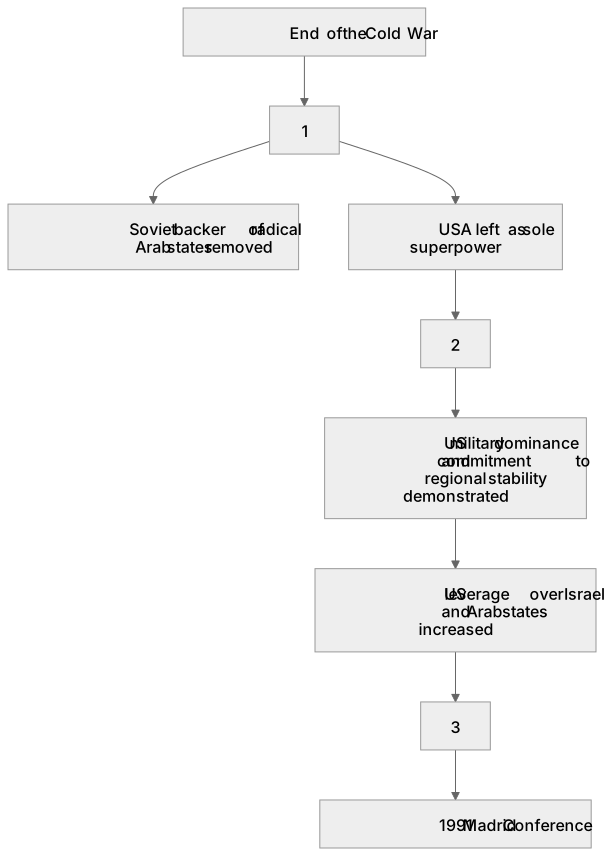
1Box 1
2Box 2
3Box 3
There is more to this lesson
The full lesson goes on to check your understanding and help you earn the marks. Create a free account to carry on, with your progress saved.
A week of Premium from your first lesson · Then the free plan continues · No card, no charge
Test your understanding of Option P5: Key topic 3: Attempts at a solution, 1974–95 - 3 Attempts at a solution: Changing superpower policies in the Middle East: US involvement in the Gulf War (1991), and the end of the Cold War.
Active recall beats re-reading. Take an instant quiz now to test what you’ve learned and lock it into long-term memory.
A week of Premium from your first lesson · Then the free plan continues · No card, no charge