AQA · GCSE · Italian
Course version: AQA-GCSE-Italian · Version from Mar 2026
Communication strategies
This topic equips candidates with essential strategies to tackle unfamiliar vocabulary across all four skills. It focuses on using visual clues, verbal context, real-world knowledge, and recognizing false friends to infer meaning, a crucial skill for accessing Higher tier marks.
- 12 min read
- 4 worked examples
- 6 practice questions
- 8 key terms
Check what you remember
Read the wording for your board, then hide it and explain Inference in your own words. Rough notes are fine. This is a self-check, with no mark or grade.
Reference: AQA
The process of deducing the meaning of an unknown word using the surrounding text and logic.
Study Notes
Overview

This topic is your secret weapon for the GCSE Italian exam. It doesn't teach you what to say, but how to figure out what you don't know. In every paper—Listening, Speaking, Reading, and Writing—you will encounter unfamiliar words. Examiners deliberately include vocabulary outside the specification to test your resilience and inference skills. Mastering communication strategies means you can confidently guess meanings using visual layout, surrounding words, your real-world knowledge, and an awareness of 'false friends'. It is the difference between freezing in the exam hall and securing those top grades.
📖 Essential Vocabulary
Tier 1 — Foundation Core
| Italian | English | Gender | Example Sentence |
|---|---|---|---|
| il contesto | context | m | Devo capire il contesto della frase. |
| la parola | word | f | Non capisco questa parola. |
| il significato | meaning | m | Qual è il significato di questo verbo? |
| l'immagine | image/picture | f | L'immagine mi aiuta a capire. |
| il titolo | title | m | Il titolo dell'articolo è interessante. |
| leggere | to read | - | Mi piace leggere il giornale. |
| ascoltare | to listen | - | Devi ascoltare attentamente. |
| capire | to understand | - | Non riesco a capire l'audio. |
| ripetere | to repeat | - | Può ripetere, per favore? |
| aiutare | to help | - | Il dizionario mi può aiutare. |
| difficile | difficult | - | Questo testo è molto difficile. |
| facile | easy | - | La domanda era facile. |
| importante | important | - | È importante leggere tutto. |
| lento | slow | - | Può parlare più lento? |
| veloce | fast | - | Parla troppo veloce per me. |
Tier 2 — Higher Tier
| Italian | English | Gender | Example Sentence |
|---|---|---|---|
| dedurre | to deduce/infer | - | Posso dedurre il significato dal contesto. |
| l'indizio | clue | m | Cerca un indizio nel paragrafo precedente. |
| l'ipotesi | guess/hypothesis | f | Faccio un'ipotesi basata sulle immagini. |
| il falso amico | false friend | m | Attenzione al falso amico 'camera'. |
| l'argomento | topic/subject | m | Qual è l'argomento principale? |
| la strategia | strategy | f | Uso una strategia di comunicazione. |
| il riassunto | summary | m | Scrivi un breve riassunto del testo. |
| sconosciuto | unknown | - | Sottolinea le parole sconosciute. |
| il collegamento | connection/link | m | C'è un collegamento tra le due frasi. |
| intuire | to guess/infer | - | Ho intuito la risposta corretta. |
High-Frequency Words & Phrases
| Phrase | English | Usage Context |
|---|---|---|
| Cosa vuol dire...? | What does ... mean? | Asking for clarification (Speaking) |
| Come si dice...? | How do you say...? | Asking for vocabulary (Speaking) |
| Non lo so | I don't know | Admitting lack of knowledge |
| Penso che significhi... | I think it means... | Making a guess based on context |
| Può parlare più lentamente? | Can you speak more slowly? | Managing the Listening/Speaking pace |
| Non ho capito bene | I didn't understand well | Requesting repetition |
| In altre parole... | In other words... | Rephrasing your own ideas |
| Probabilmente | Probably | Expressing a logical guess |
| Secondo me | In my opinion | Giving your perspective |
| Per esempio | For example | Illustrating a point when stuck for the exact word |
📝 Grammar Focus
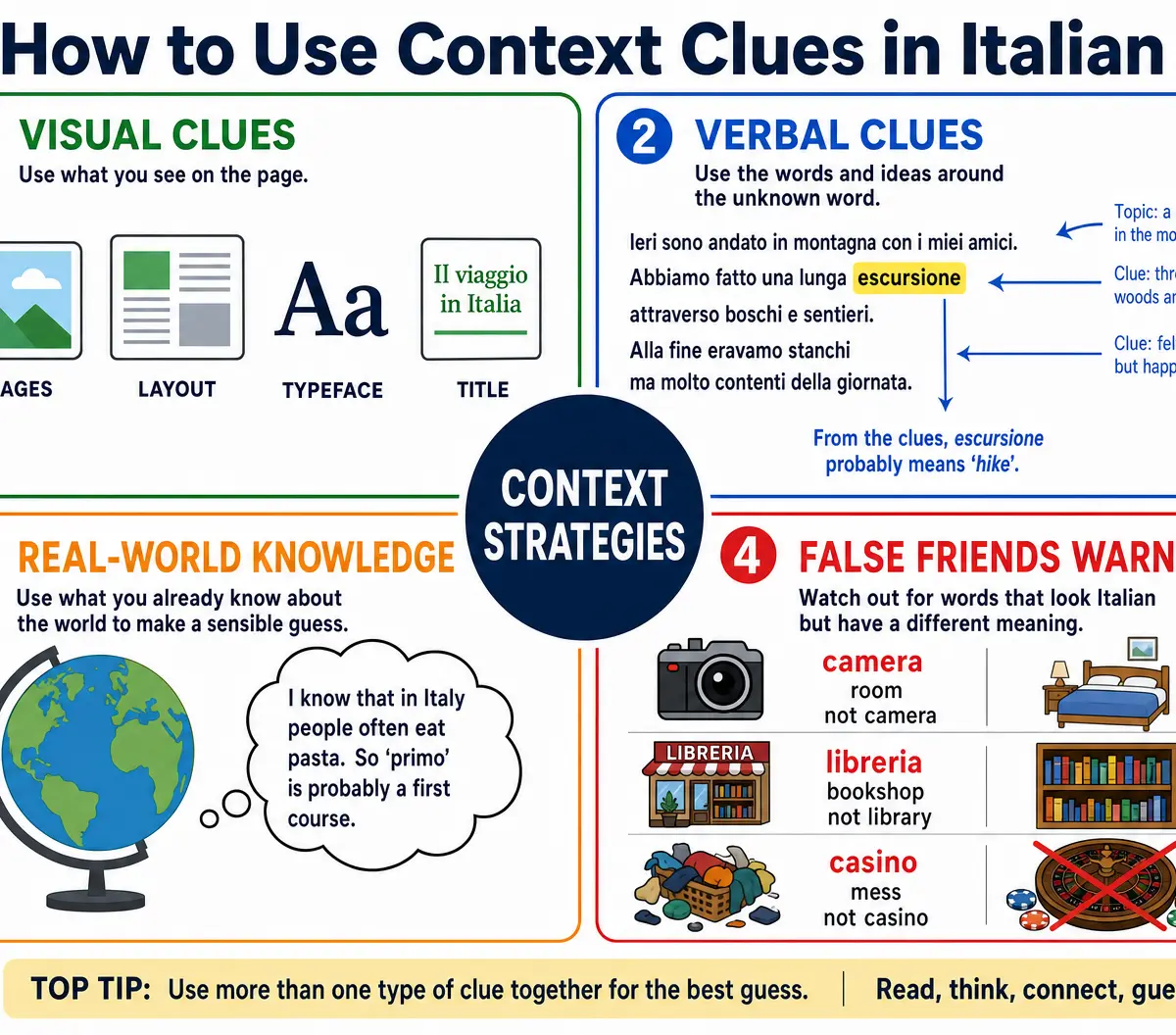
Key Structure 1: The Imperative (Commands)
When to use it: Used frequently in reading texts like instructions, recipes, or advice columns. Understanding commands helps you follow the logic of a text.
Conjugation Table (Regular -are, -ere, -ire verbs)
| Subject | -are (Parlare) | -ere (Leggere) | -ire (Dormire) |
|---|---|---|---|
| tu | parla | leggi | dormi |
| Lei (formal) | parli | legga | dorma |
| noi | parliamo | leggiamo | dormiamo |
| voi | parlate | leggete | dormite |
Irregulars to learn: Essere (sii, sia, siamo, siate), Avere (sii, sia, siamo, siate), Fare (fa', faccia, facciamo, fate), Andare (vai/va', vada, andiamo, andate).
Key Structure 2: Modal Verbs (Dovere, Potere, Volere)
When to use it: Essential for expressing what you must, can, or want to do when trying to understand a text. They are always followed by an infinitive.
Conjugation Table
| Subject | Dovere (must/have to) | Potere (can/be able to) | Volere (want to) |
|---|---|---|---|
| io | devo | posso | voglio |
| tu | devi | puoi | vuoi |
| lui/lei | deve | può | vuole |
| noi | dobbiamo | possiamo | vogliamo |
| voi | dovete | potete | volete |
| loro | devono | possono | vogliono |
Key Structure 3: The Present Perfect (Passato Prossimo)
When to use it: Crucial for narrating past events. Often used in texts to describe what happened, providing context for unknown nouns.
Conjugation Table (Avere vs Essere as auxiliary)
| Subject | Parlare (Avere) | Andare (Essere) |
|---|---|---|
| io | ho parlato | sono andato/a |
| tu | hai parlato | sei andato/a |
| lui/lei | ha parlato | è andato/a |
| noi | abbiamo parlato | siamo andati/e |
| voi | avete parlato | siete andati/e |
| loro | hanno parlato | sono andati/e |
Irregulars to learn: fare (fatto), leggere (letto), scrivere (scritto), prendere (preso), vedere (visto).
🎧 Listening Skills
What to Expect
The listening exam will feature native speakers talking at a natural pace. You will encounter unfamiliar words. The test is designed to see if you can extract the required information despite not knowing every word.
Listening Strategies
- Read the questions first: The English questions provide the context. If the question asks "Where did Marco go?", you are listening for a place, ignoring unfamiliar adjectives.
- Listen for cognates: Words that sound like English (e.g., tradizione, famiglia) can anchor your understanding.
- Note the tone: Is the speaker angry, happy, or sad? The tone often gives away the meaning of unknown adjectives.
Common Listening Traps
- Negatives: Missing a non completely changes the meaning. "Non mi piace per niente" is the opposite of "Mi piace".
- Time markers: Words like ieri (yesterday), oggi (today), domani (tomorrow) change the tense context. If you hear ieri, you know the action is finished, helping you deduce verb meanings.
🗣️ Speaking Skills
Role Play Scenarios
Scenario 1: At the Tourist Office
You are asking for information, but you don't know the word for 'map'.
- Student: Scusi, ha un... un foglio con le strade della città? (Excuse me, do you have a... a paper with the streets of the city?)
- Examiner: Ah, una mappa! Certo.
Scenario 2: In a Restaurant
You want to order, but don't understand an ingredient on the menu.
- Student: Cameriere, cosa vuol dire 'melanzane'? È una verdura o una carne? (Waiter, what does 'melanzane' mean? Is it a vegetable or a meat?)
- Examiner: È una verdura viola. (It's a purple vegetable - aubergine).
Photo Card Practice
Model Photo Card Response:
- Qu 1 (Description): Nella foto vedo due persone in una biblioteca. Stanno leggendo un libro molto grande. Sembrano concentrati. (In the photo I see two people in a library. They are reading a very big book. They seem concentrated.)
- Qu 2 (Opinion): Secondo me, studiare in biblioteca è utile perché c'è silenzio e puoi concentrarti meglio. (In my opinion, studying in the library is useful because there is silence and you can concentrate better.)
- Qu 3 (Related topic): Di solito, uso internet per trovare informazioni, ma a volte i libri sono più precisi. (Usually, I use the internet to find information, but sometimes books are more precise.)
- Qu 4 (Past/Future): Ieri ho studiato per tre ore per l'esame di italiano. È stato difficile ma importante. (Yesterday I studied for three hours for the Italian exam. It was difficult but important.)
- Qu 5 (Unpredictable): Se non capisco una parola, cerco di indovinare dal contesto o uso un dizionario. (If I don't understand a word, I try to guess from the context or I use a dictionary.)
General Conversation Questions
| Question (Italian) | Model Answer | English Translation |
|---|---|---|
| Cosa fai se non capisci una parola in italiano? | Se non capisco una parola, cerco di leggere la frase intera per capire il contesto. A volte chiedo aiuto all'insegnante. | What do you do if you don't understand a word in Italian? (If I don't understand a word, I try to read the whole sentence to understand the context. Sometimes I ask the teacher for help.) |
| Pensi che la grammatica sia importante? | Sì, secondo me la grammatica è molto importante perché ti aiuta a costruire frasi corrette, ma il vocabolario è essenziale per comunicare. | Do you think grammar is important? (Yes, in my opinion grammar is very important because it helps you build correct sentences, but vocabulary is essential to communicate.) |
| Come impari i nuovi vocaboli? | Di solito, scrivo le parole nuove su un quaderno e le ripeto ad alta voce. Uso anche delle app sul telefono. | How do you learn new vocabulary? (Usually, I write new words in a notebook and repeat them out loud. I also use apps on my phone.) |
| Hai mai fatto un errore divertente in italiano? | Sì! Una volta ho detto 'ho caldo' (I am hot) invece di 'sono eccitato' (I am excited). È stato un po' imbarazzante! | Have you ever made a funny mistake in Italian? (Yes! Once I said 'I am hot' instead of 'I am excited'. It was a bit embarrassing!) |
| Qual è la cosa più difficile dell'italiano? | Per me, la cosa più difficile sono i verbi irregolari e ricordarsi se una parola è maschile o femminile. | What is the most difficult thing about Italian? (For me, the most difficult thing is the irregular verbs and remembering if a word is masculine or feminine.) |
✍️ Writing Skills
Translation Practice
English → Italian:
| English | Italian | Key Grammar |
|---|---|---|
| I read the title first. | Leggo prima il titolo. | Present tense, sequence word (prima) |
| We must understand the context. | Dobbiamo capire il contesto. | Modal verb (dovere) + infinitive |
| Yesterday, I guessed the meaning. | Ieri, ho indovinato il significato. | Passato prossimo (avere) |
| If I don't know a word, I look at the picture. | Se non conosco una parola, guardo l'immagine. | 'Se' (if) clause, present tense |
| It is important to use these strategies. | È importante usare queste strategie. | Impersonal expression + infinitive, demonstrative adjective |
Extended Writing
**Model 90-word response (Foundation):**Per imparare l'italiano, uso molte strategie. Prima di tutto, quando leggo un testo, guardo sempre il titolo e le foto. Questo mi aiuta molto. Se non capisco una parola, leggo la frase intera per indovinare il significato. Non uso sempre il dizionario perché è lento. Ieri ho letto un articolo difficile, ma ho capito il senso generale. In classe, chiedo spesso all'insegnante: "Cosa vuol dire?". Secondo me, ascoltare la musica italiana è anche un ottimo modo per imparare parole nuove.
**Model 150-word response (Higher):**Imparare una lingua straniera è una sfida, ma ci sono molte strategie utili. Personalmente, quando affronto un testo difficile in italiano, non mi fermo alla prima parola sconosciuta. Al contrario, cerco di dedurre il significato dal contesto, analizzando le frasi vicine. Inoltre, faccio molta attenzione ai 'falsi amici'; per esempio, so che 'camera' significa stanza e non macchina fotografica!
Ieri, durante l'esame di ascolto, ho usato un'altra tecnica: ho letto attentamente le domande prima che l'audio iniziasse. Questo mi ha permesso di prevedere il vocabolario. In futuro, vorrei viaggiare in Italia per praticare queste strategie nella vita reale. Credo fermamente che non sia necessario capire ogni singola parola per comunicare efficacemente. L'importante è avere fiducia in se stessi e usare la logica.
Writing Checklist
- ✅ Have I used at least three tenses (Past, Present, Future/Conditional)?
- ✅ Are my opinions justified using 'perché' or 'poiché'?
- ✅ Have I included connectives (inoltre, tuttavia, al contrario)?
- ✅ Are adjective agreements (gender and number) correct?
📚 Reading Skills
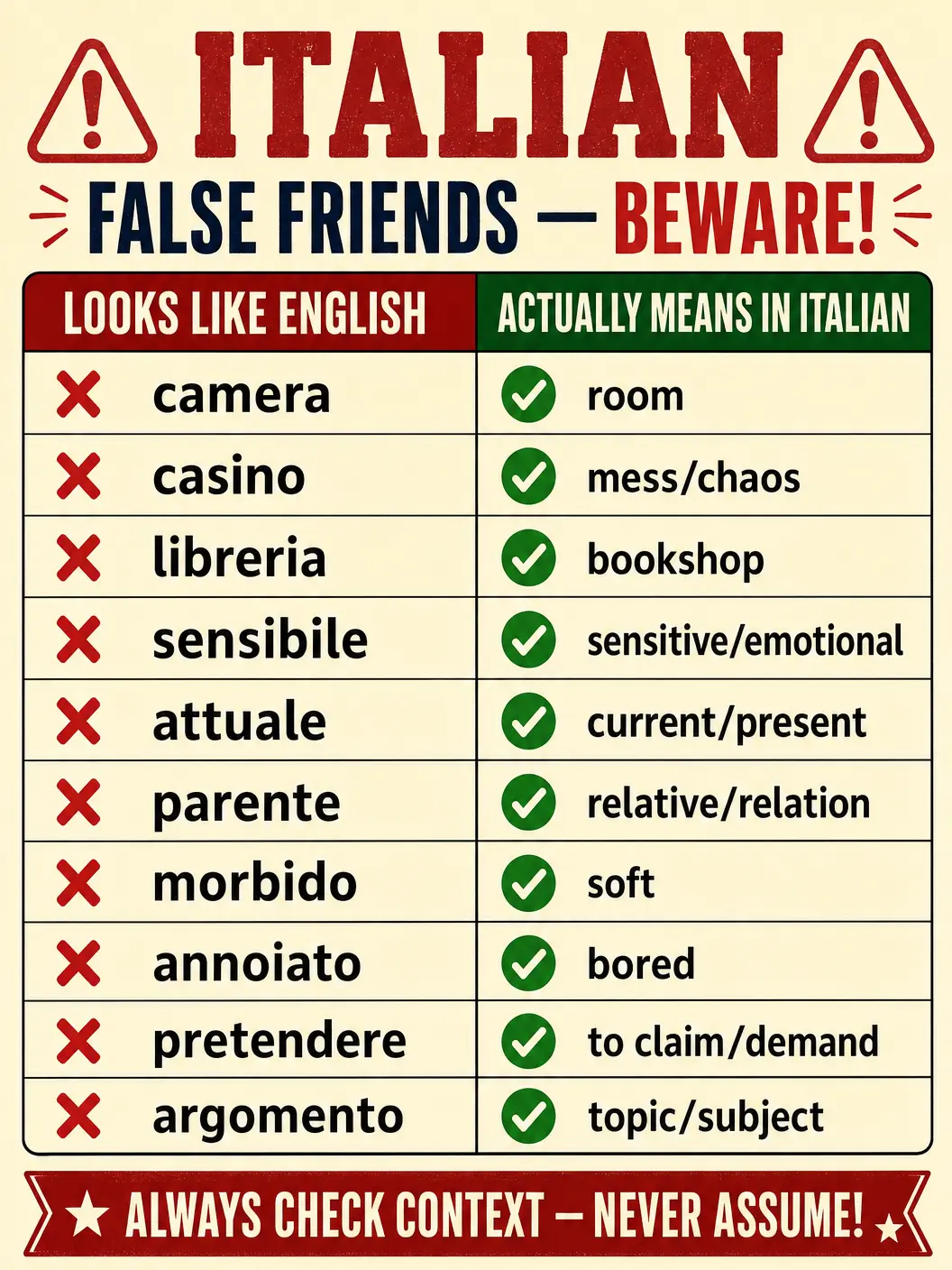
Key Strategies
- The Skim and Scan: Read the entire text quickly (skim) to get the main idea before looking at the questions. Then, scan for specific information related to the questions.
- Use the Layout: Is it an email, an advert, or a news article? The format dictates the type of language used.
- Word Families: If you know insegnare (to teach), you can guess insegnante (teacher).
False Friends & Tricky Words
| Word | Looks Like | Actually Means |
|---|---|---|
| la camera | camera | room (bedroom) |
| la libreria | library | bookshop |
| il parente | parent | relative (e.g., uncle, cousin) |
| sensibile | sensible | sensitive |
| attualmente | actually | currently/nowadays |
| il fattoria | factory | farm |
| caldo | cold | hot |
🌍 Cultural Knowledge
Understanding Italian culture provides invaluable real-world context. For instance, knowing that a typical Italian breakfast (colazione) is small and sweet (a cornetto and cappuccino) helps you infer meaning if a reading text describes someone eating 'un cornetto' in the morning—you know it's food, not an instrument. Similarly, understanding the structure of the Italian school system (e.g., liceo vs scuola media) or the importance of regional festivals (sagre) allows you to anticipate vocabulary and themes in reading and listening tasks.
Visual Resources
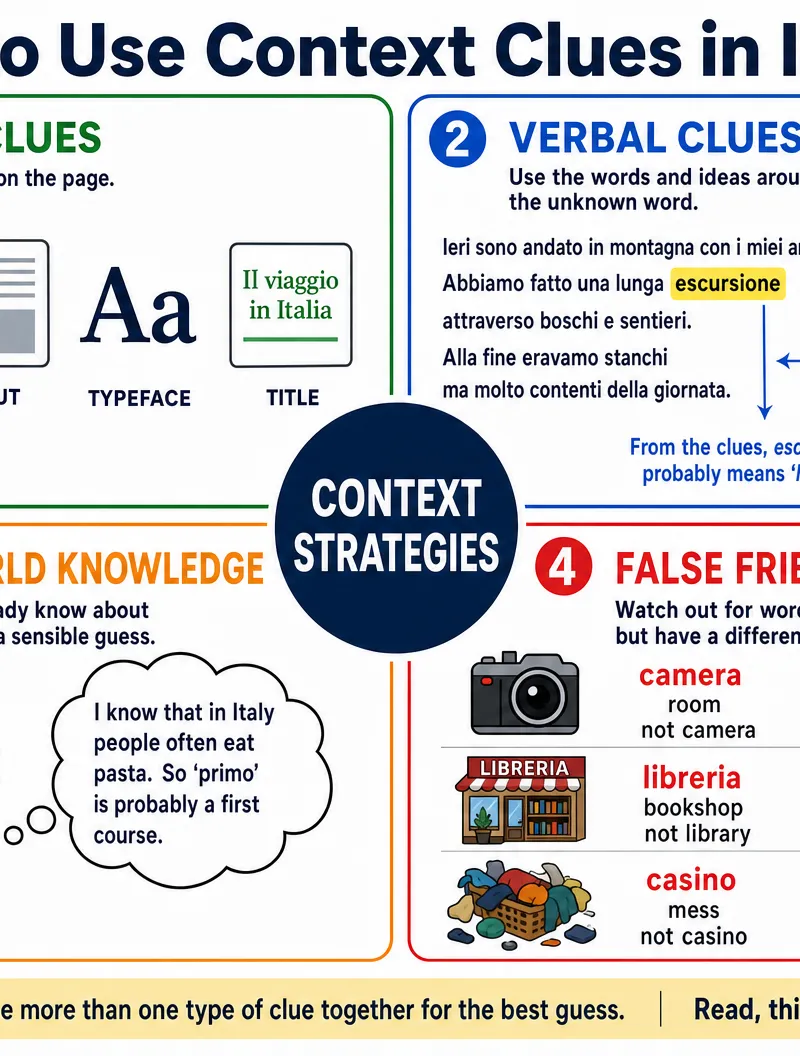
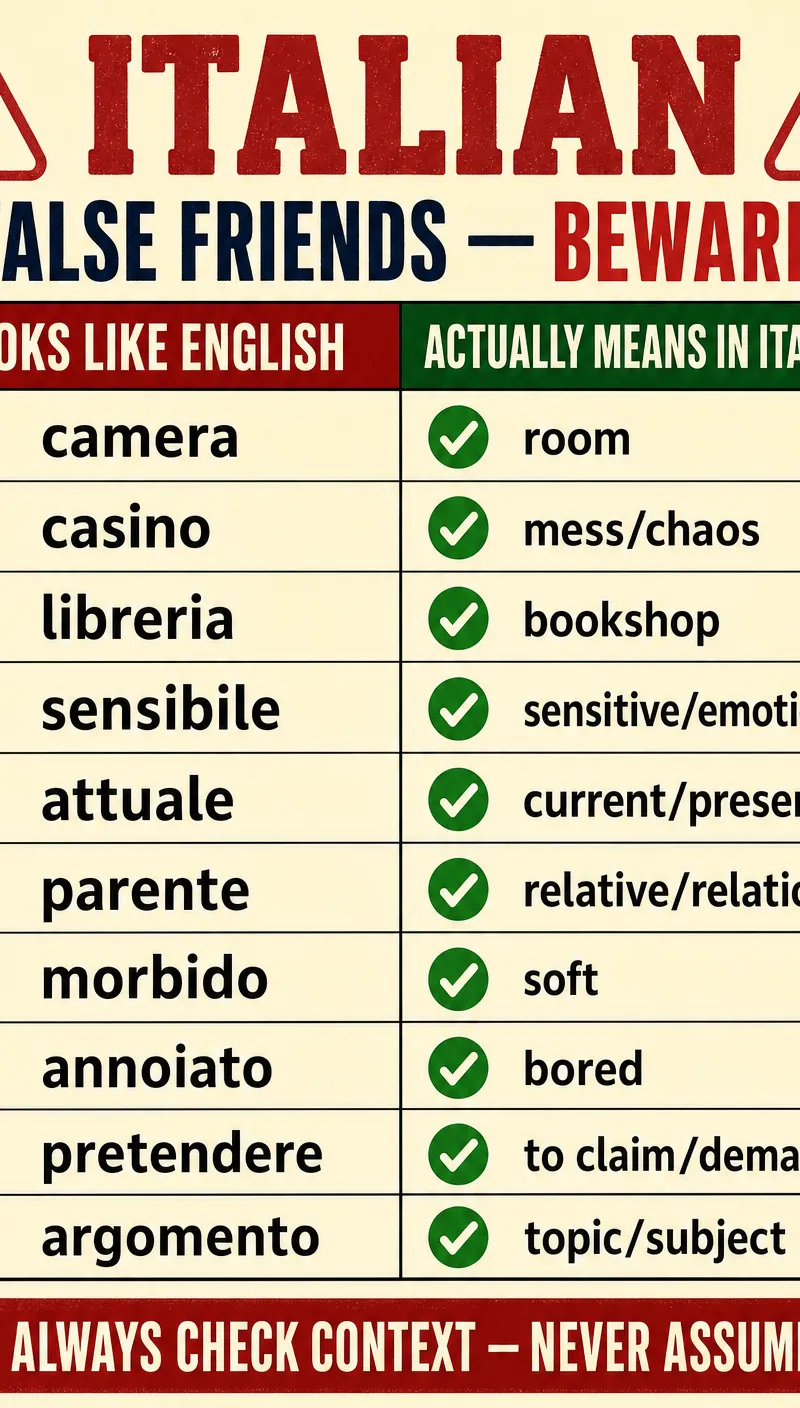
2 diagrams and illustrations
Interactive Diagrams
1 interactive diagram to visualise key concepts
Conceptual Flow Outline
The Context Clue Decision Tree
Worked Examples
4 worked examples — open one to explore the question and available guidance.
Practice Questions
Try the question, then reveal an answer plan or example response
Reading: Leggi il testo e rispondi alla domanda in inglese. 'Il mio gatto è molto morbido e gli piace dormire sulla mia camera.' What two things do we learn about the cat?
Hint: Watch out for the false friends 'morbido' and 'camera'.
Speaking: Role Play. You are buying train tickets but don't know the word for 'return ticket'. Ask the clerk for a ticket that goes to Rome and comes back.
Hint: Use circumlocution. Explain the journey you want to take.
Writing: Translate into Italian. 'I don't understand this word, can you help me?'
Hint: Use the negative correctly and the verb 'aiutare'.
Listening: Ascolta e scegli l'opzione corretta. 'Mio padre lavora in una grande fabbrica, ma mio zio ha una fattoria in campagna.' Where does the uncle work? A) In a factory B) On a farm C) In an office
Hint: Beware of the false friend 'fattoria'.
Reading: Skim the following title and subtitle, then predict the topic. Titolo: 'I pericoli del fumo tra i giovani'. Sottotitolo: 'Sempre più adolescenti iniziano a fumare al liceo.' What is the text about?
Hint: Look for cognates in the title.
Writing (Extended): Write approximately 90 words about how you learn Italian. Include: what you find difficult, what strategies you use, what you did last week to practice.
Hint: Ensure you cover all bullet points and use past and present tenses.
Exam technique
How to turn what you know into marks
How to approach the question
Skill-by-skill strategy: Listening — read questions first, note keywords. Speaking — prepare opinions in advance, have fillers ready. Reading — skim first, then detail. Writing — plan before writing, check accuracy after.
How to structure your answer
Writing: Introduction → Main points with opinions → Justified reasons → Different tenses → Conclusion. Speaking: Give opinion → Justify → Extend → Use different tense.
Timing
Listening: 25 mins (heard twice). Speaking: 7-12 mins total (role play + photo card + conversation). Reading: 45-60 mins. Writing: 60-75 mins (translation + structured + extended).
Common pitfalls
- Translating word-for-word instead of reading for meaning.
- Ignoring the title and pictures in the Reading exam.
- Falling for false friends like 'camera' or 'libreria'.
- Giving up when encountering an unknown word instead of reading the rest of the sentence.
- Not listening for negatives ('non') which flip the meaning entirely.
- Writing the English word in a gap instead of describing the item in Italian.
What the command words want
- Describe the photo
- Say what you can see, give an opinion, relate to your experience.
- Translate into English
- Meaning over word-for-word — capture the sense, don't guess cognates blindly.
- Translate into Italian
- Write full sentences with correct grammar — partial marks for partially correct.
- Write approximately 90 words
- Foundation task — cover all 4 bullet points, use present + one other tense.
- Write approximately 150 words
- Higher task — 3 tenses, opinions, complex structures, ambitious vocabulary.
Watch or listen (optional)
Test your understanding of Communication strategies
Active recall beats re-reading. Take an instant quiz now to test what you’ve learned and lock it into long-term memory.
7 days Premium · Then the free plan continues · No card, no charge