AQA · GCSE · Italian
Course version: AQA-GCSE-Italian · Version from Mar 2026
Grammar
This topic covers essential numerical and temporal vocabulary for Italian GCSE. You will learn to form cardinal and ordinal numbers, tell the time, and express dates accurately. Mastering these structures is crucial as they appear across all four skills (Listening, Speaking, Reading, Writing) in contexts like shopping, schedules, and personal information.
- 12 min read
- 4 worked examples
- 6 practice questions
- 8 key terms
Check what you remember
Read the wording for your board, then hide it and explain Cardinal Numbers in your own words. Rough notes are fine. This is a self-check, with no mark or grade.
Reference: AQA
Numbers used for counting or stating quantity (e.g., uno, due, tre).
Study Notes
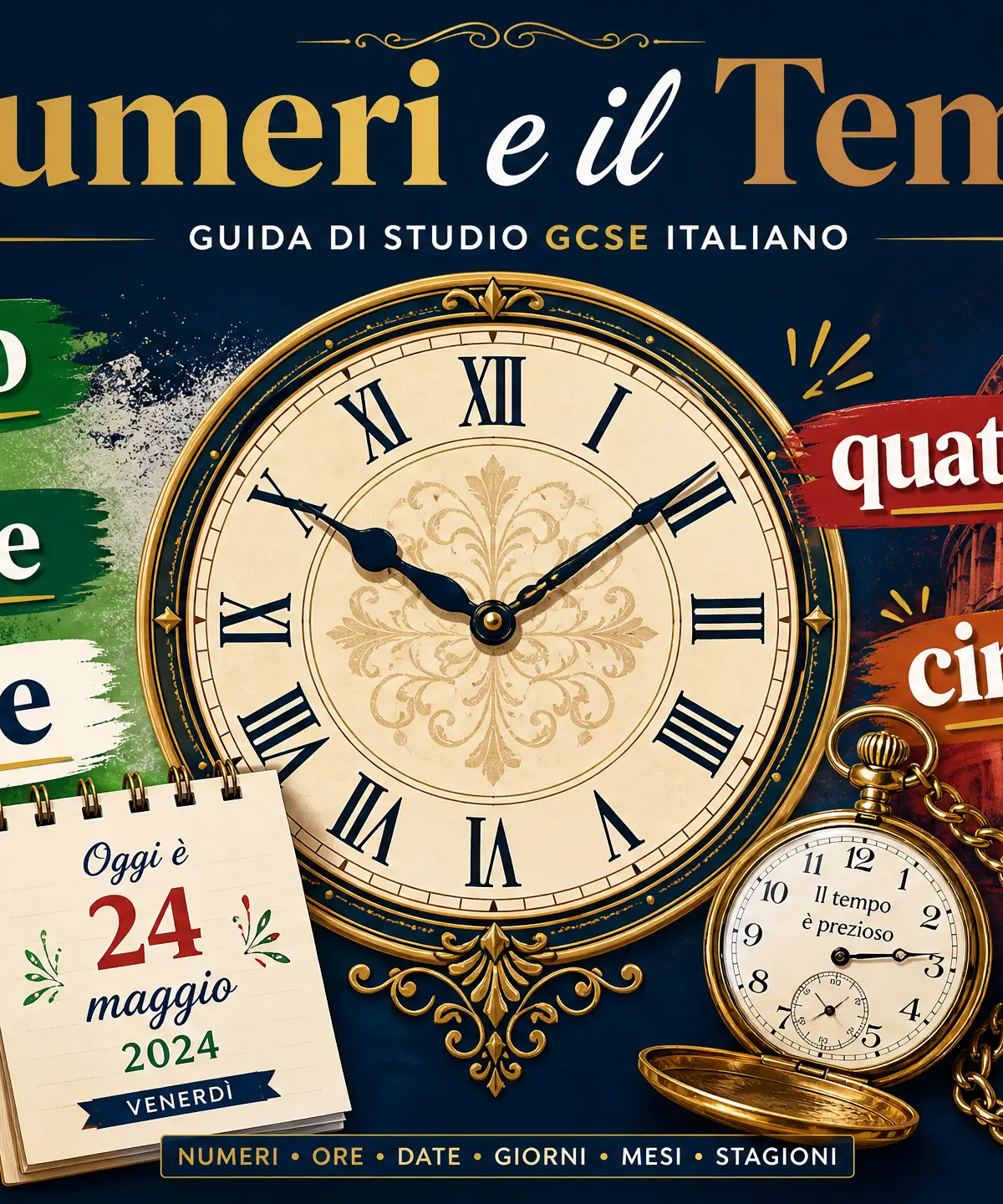
Overview
This topic is foundational to your success in GCSE Italian. Numbers, dates, and times are not just isolated vocabulary words; they are the building blocks of communication. Whether you are describing a past holiday, planning a future trip, or discussing your daily routine, you will need this vocabulary.
Examiners love to test numbers in the Listening and Reading papers because they require precision. A single letter difference (like mille vs milione) can change the entire meaning of a sentence. In the Speaking and Writing papers, using numbers and times accurately allows you to add detail and complexity to your answers, which is essential for reaching the higher mark bands.
🎧 Listen to the Podcast
Listen to our 10-minute exam boost podcast covering all the core concepts, common mistakes, and a quick-fire recall quiz:
📖 Essential Vocabulary
Tier 1 — Foundation Core
| Italian | English | Gender | Example Sentence |
|---|---|---|---|
| uno | one | n/a | Ho un fratello. |
| due | two | n/a | Ci sono due gatti. |
| tre | three | n/a | Compro tre mele. |
| dieci | ten | n/a | Sono le dieci. |
| venti | twenty | n/a | Ho venti euro. |
| cento | one hundred | n/a | Costa cento euro. |
| mille | one thousand | n/a | Ci sono mille persone. |
| primo | first | m | È il mio primo giorno. |
| l'ora | the hour/time | f | Che ora è? |
| il giorno | the day | m | Che giorno è oggi? |
| la settimana | the week | f | Vado in Italia la prossima settimana. |
| il mese | the month | m | Qual è il tuo mese preferito? |
| l'anno | the year | m | Sono nato l'anno scorso. |
| oggi | today | n/a | Oggi è lunedì. |
| domani | tomorrow | n/a | Domani vado al cinema. |
Tier 2 — Higher Tier
| Italian | English | Gender | Example Sentence |
|---|---|---|---|
| un milione | one million | m | La città ha un milione di abitanti. |
| la mezzanotte | midnight | f | Il treno parte a mezzanotte. |
| il mezzogiorno | noon/midday | m | Mangiamo a mezzogiorno. |
| il secolo | the century | m | È un edificio del ventesimo secolo. |
| quotidiano | daily | m/adj | Leggo il giornale quotidiano. |
| mensile | monthly | m/adj | Ho un abbonamento mensile. |
| annuale | annual | m/adj | La festa annuale è a luglio. |
| la data di nascita | date of birth | f | Qual è la tua data di nascita? |
| in orario | on time | n/a | Il treno è arrivato in orario. |
| in ritardo | late/delayed | n/a | Purtroppo, l'autobus è in ritardo. |
High-Frequency Words & Phrases
| Phrase | English | Usage Context |
|---|---|---|
| Che ora è? | What time is it? | Asking for the time (singular form) |
| Che ore sono? | What time is it? | Asking for the time (plural form) |
| A che ora...? | At what time...? | Asking when an event happens |
| È l'una | It is one o'clock | Telling the time (1:00 only) |
| Sono le... | It is... o'clock | Telling the time (all other hours) |
| e un quarto | quarter past | Adding 15 minutes to the hour |
| e mezza | half past | Adding 30 minutes to the hour |
| meno un quarto | quarter to | Subtracting 15 minutes from the hour |
| Che giorno è oggi? | What day is it today? | Asking for the day of the week |
| Quanti anni hai? | How old are you? | Asking someone's age (literally: How many years do you have?) |
📝 Grammar Focus
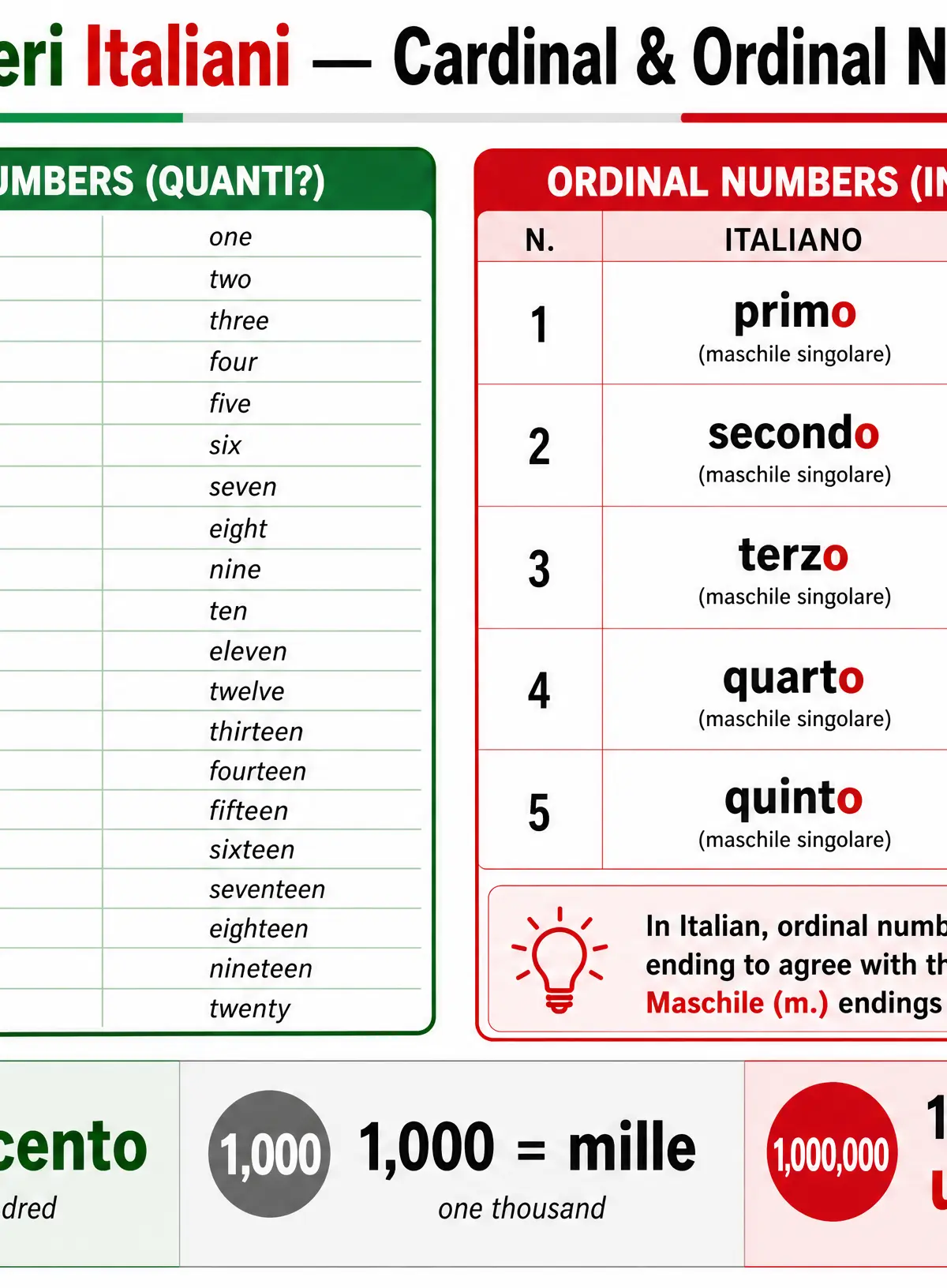
Key Structure 1: Forming Cardinal Numbers (11-19)
When to use it: When counting items or stating quantities between 11 and 19.
The Pattern
From 11 to 16, the number ends in -dici. From 17 to 19, the word dici- comes at the beginning.
| Number | Italian | English |
|---|---|---|
| 11 | undici | eleven |
| 12 | dodici | twelve |
| 13 | tredici | thirteen |
| 14 | quattordici | fourteen |
| 15 | quindici | fifteen |
| 16 | sedici | sixteen |
| 17 | diciassette | seventeen |
| 18 | diciotto | eighteen |
| 19 | diciannove | nineteen |
Irregulars to learn: Note the double consonants in diciassette and diciannove.
Key Structure 2: Ordinal Numbers as Adjectives
When to use it: When describing the order of something (first, second, third, etc.).
The Pattern
Ordinal numbers in Italian behave like regular adjectives ending in -o. They must agree in gender (masculine/feminine) and number (singular/plural) with the noun they describe.
| Masculine Singular | Feminine Singular | Masculine Plural | Feminine Plural | English |
|---|---|---|---|---|
| primo | prima | primi | prime | first |
| secondo | seconda | secondi | seconde | second |
| terzo | terza | terzi | terze | third |
| quarto | quarta | quarti | quarte | fourth |
| quinto | quinta | quinti | quinte | fifth |
Irregulars to learn: The first ten ordinal numbers have unique forms. From 11th onwards, drop the final vowel of the cardinal number and add -esimo (e.g., undici -> undicesimo).
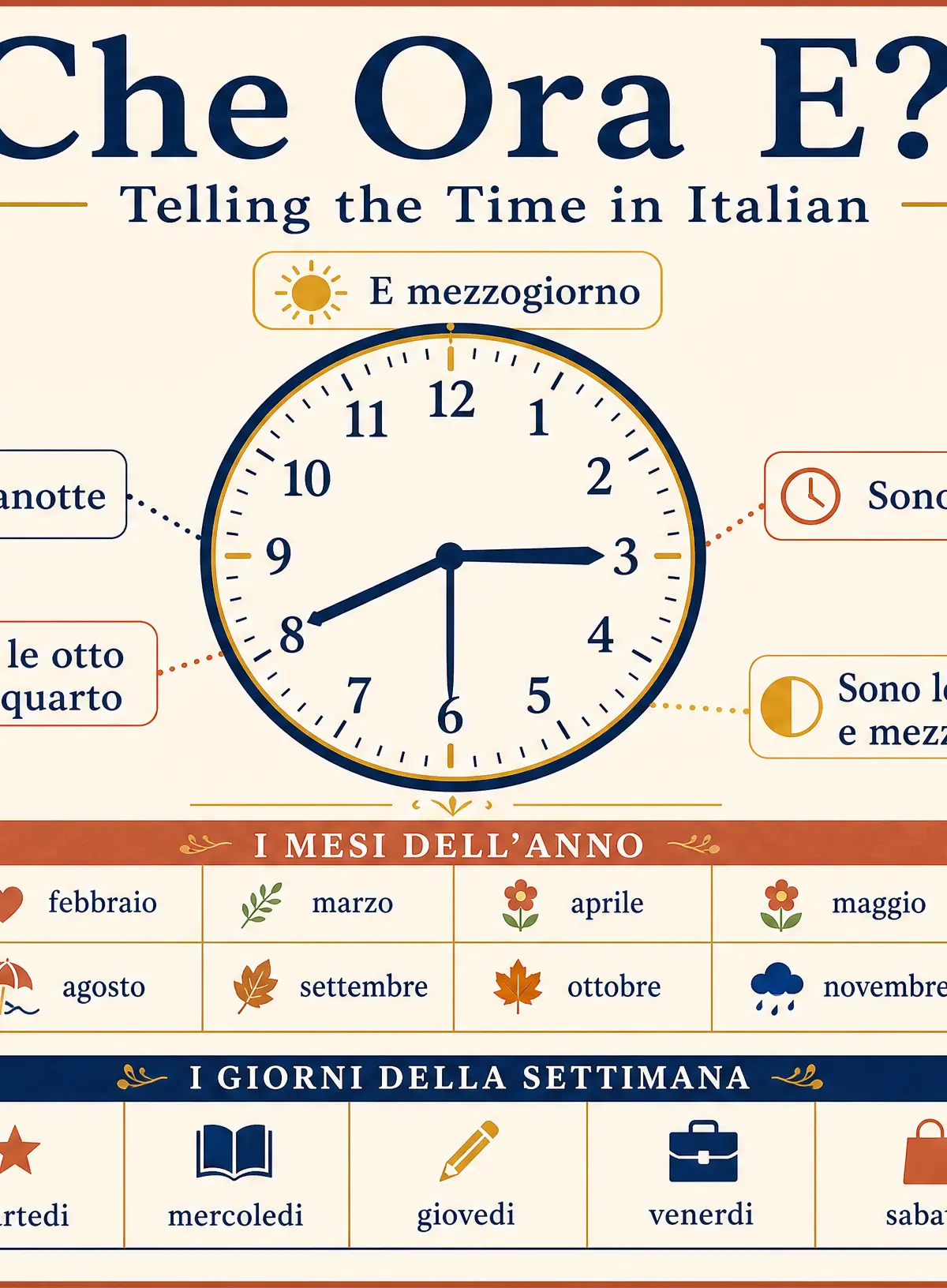
Key Structure 3: Telling the Time
When to use it: When stating the current time or the time an event occurs.
The Pattern
Use the verb essere (to be) + the definite article (the) + the hour.
| Italian Structure | Example | English Translation |
|---|---|---|
| È + l' + una | È l'una. | It is one o'clock. |
| Sono + le + [number 2-12] | Sono le tre. | It is three o'clock. |
| È + mezzogiorno | È mezzogiorno. | It is midday/noon. |
| È + mezzanotte | È mezzanotte. | It is midnight. |
| [Time] + e + [minutes] | Sono le due e venti. | It is twenty past two. |
| [Next hour] + meno + [minutes] | Sono le cinque meno dieci. | It is ten to five. |
🎧 Listening Skills
What to Expect
In the listening exam, numbers frequently appear in contexts such as train announcements, shopping dialogues, booking a table at a restaurant, or discussing opening hours. You will need to listen carefully for specific times, prices, dates, and quantities.
Listening Strategies
- Write numbers as digits: When you hear a number, quickly jot it down as a digit (e.g., write '14' instead of 'quattordici') in the margin to save time.
- Listen for the 'e' and 'meno': When hearing times, pay close attention to whether the speaker says e (past) or meno (to). Sono le tre e un quarto (3:15) is very different from Sono le tre meno un quarto (2:45).
- Distinguish between teens and tens: A classic examiner trick is to test your ability to distinguish between numbers like tredici (13) and trenta (30), or quattordici (14) and quaranta (40). Focus on the ending of the word.
Common Listening Traps
- Mille vs. Milione: Hearing mille and writing down 1,000,000. Mille is 1,000. Un milione is 1,000,000.
- Mezzogiorno vs. Mezzanotte: Confusing midday (12:00 PM) with midnight (12:00 AM).
- Prices with cents: In Italian, prices are often said with e between the euros and cents. Due euro e cinquanta means €2.50.
🗣️ Speaking Skills
Role Play Scenarios
Scenario 1: Buying a train ticket
Examiner: A che ora parte il treno per Roma?
Candidate: Il treno parte alle otto e mezza. (The train leaves at half past eight.)
Examiner: Quanto costa il biglietto?
Candidate: Costa venticinque euro. (It costs twenty-five euros.)
Scenario 2: Making a reservation
Examiner: Per quale giorno è la prenotazione?
Candidate: Per il quindici luglio. (For the fifteenth of July.)
Examiner: A che ora arrivate?
Candidate: Arriviamo alle diciannove. (We arrive at 19:00 / 7:00 PM.)
Photo Card Practice
Model Photo Card Response (A photo showing people at a birthday party):
- Qu 1 (Description): Nella foto ci sono molte persone a una festa. C'è una torta con sedici candeline. (In the photo there are many people at a party. There is a cake with sixteen candles.)
- Qu 2 (Opinion): Secondo me, le feste di compleanno sono molto divertenti perché puoi vedere i tuoi amici. (In my opinion, birthday parties are very fun because you can see your friends.)
- Qu 3 (Related topic): Il mio compleanno è il due maggio. Di solito, vado al ristorante con la mia famiglia. (My birthday is the second of May. Usually, I go to a restaurant with my family.)
- Qu 4 (Past/Future): L'anno scorso, per il mio quindicesimo compleanno, ho fatto una grande festa a casa mia. (Last year, for my fifteenth birthday, I had a big party at my house.)
- Qu 5 (Unpredictable): Penso che il regalo ideale per un adolescente sia il denaro, forse cinquanta euro, per comprare vestiti. (I think the ideal gift for a teenager is money, maybe fifty euros, to buy clothes.)
General Conversation Questions
| Question (Italian) | Model Answer | English Translation |
|---|---|---|
| Quando è il tuo compleanno? | Il mio compleanno è il ventiquattro ottobre. | My birthday is the twenty-fourth of October. |
| A che ora ti alzi la mattina? | Di solito mi alzo alle sette meno un quarto, perché la scuola inizia presto. | Usually I get up at quarter to seven, because school starts early. |
| Quanti studenti ci sono nella tua scuola? | Nella mia scuola ci sono circa millecinquecento studenti. È una scuola molto grande! | In my school there are about one thousand five hundred students. It is a very big school! |
| A che ora finiscono le lezioni? | Le lezioni finiscono alle tre e mezza del pomeriggio. | Lessons finish at half past three in the afternoon. |
| Qual è la tua data preferita dell'anno e perché? | La mia data preferita è il venticinque dicembre, perché adoro il Natale e stare con la famiglia. | My favourite date is the twenty-fifth of December, because I love Christmas and being with family. |
✍️ Writing Skills
Translation Practice
English → Italian:
| English | Italian | Key Grammar |
|---|---|---|
| My birthday is the first of June. | Il mio compleanno è il primo giugno. | Using ordinal number for the 1st of the month |
| The train leaves at quarter to five. | Il treno parte alle cinque meno un quarto. | Telling time with 'meno' |
| There are a thousand people. | Ci sono mille persone. | 'Mille' for one thousand |
| It is the third time. | È la terza volta. | Ordinal adjective agreement (f.sg) |
| I arrived at half past midnight. | Sono arrivato a mezzanotte e mezza. | Time with 'mezzanotte' and 'e mezza' |
Extended Writing
**Model 90-word response (Foundation):**La mia giornata tipica è molto occupata. Mi alzo alle sette e faccio colazione. Vado a scuola alle otto meno un quarto. La scuola inizia alle otto e mezza e finisce alle tre. Mi piace la scuola perché vedo i miei amici. Dopo la scuola, faccio i compiti. Ceno con la mia famiglia alle diciannove. Il mio giorno preferito è il sabato perché non vado a scuola. Sabato scorso, sono andato al cinema con i miei amici. Il biglietto è costato dieci euro. È stato molto divertente!
**Model 150-word response (Higher):**La mia routine quotidiana è abbastanza faticosa. Durante la settimana, mi devo alzare alle sei e mezza, il che è troppo presto per me! Faccio una colazione veloce e prendo l'autobus alle sette e un quarto. Le lezioni iniziano puntualmente alle otto.
Secondo me, la giornata scolastica è troppo lunga. Finiamo alle quindici, ma poi devo fare i compiti per due ore. La sera, ceno con la mia famiglia verso le venti.
Il mio momento preferito dell'anno è l'estate. Il mio compleanno è il quindici agosto, quindi festeggio sempre durante le vacanze. L'anno scorso, per il mio sedicesimo compleanno, i miei genitori mi hanno regalato cento euro. Ho comprato dei vestiti nuovi. Il prossimo anno, spero di fare una grande festa con almeno cinquanta invitati. Sarà fantastico!
Writing Checklist
- ✅ Have I used È l'una for 1:00 and Sono le for other times?
- ✅ Did I use primo for the 1st of the month, and cardinal numbers for the rest?
- ✅ Have I made my ordinal numbers agree with the noun (e.g., la prima volta)?
- ✅ Did I write months and days of the week with lowercase letters?
- ✅ Have I checked the spelling of tricky numbers like diciassette and diciannove?
📚 Reading Skills
Key Strategies
- Scan for digits and time expressions: In reading comprehension texts, scan the text quickly to locate numbers, times, and dates before reading in detail. This helps you quickly locate the answers to specific questions.
- Understand the 24-hour clock: Italian texts (like schedules, timetables, and formal invitations) frequently use the 24-hour clock. Make sure you can quickly convert le sedici to 4:00 PM and le venti to 8:00 PM.
False Friends & Tricky Words
| Word | Looks Like | Actually Means |
|---|---|---|
| mille | a million | one thousand |
| parente | parent | relative |
| camera | camera | bedroom/room |
| libreria | library | bookshop/bookcase |
| fattoria | factory | farm |
🌍 Cultural Knowledge
Understanding how time and numbers are used in Italy adds authenticity to your work. In Italy, the 24-hour clock (l'orologio a 24 ore) is widely used for all official purposes—train timetables, cinema listings, TV schedules, and business hours. However, in casual conversation, Italians often use the 12-hour clock, adding di mattina (in the morning), del pomeriggio (in the afternoon), di sera (in the evening), or di notte (at night) for clarity.
Dates are written in the format Day/Month/Year (e.g., 24/05/2024), never Month/Day/Year. Also, remember that the first floor of a building in Italy (il primo piano) is the floor above the ground floor (il pianterreno), just like in the UK, but unlike in the US.
Visual Resources
2 diagrams and illustrations
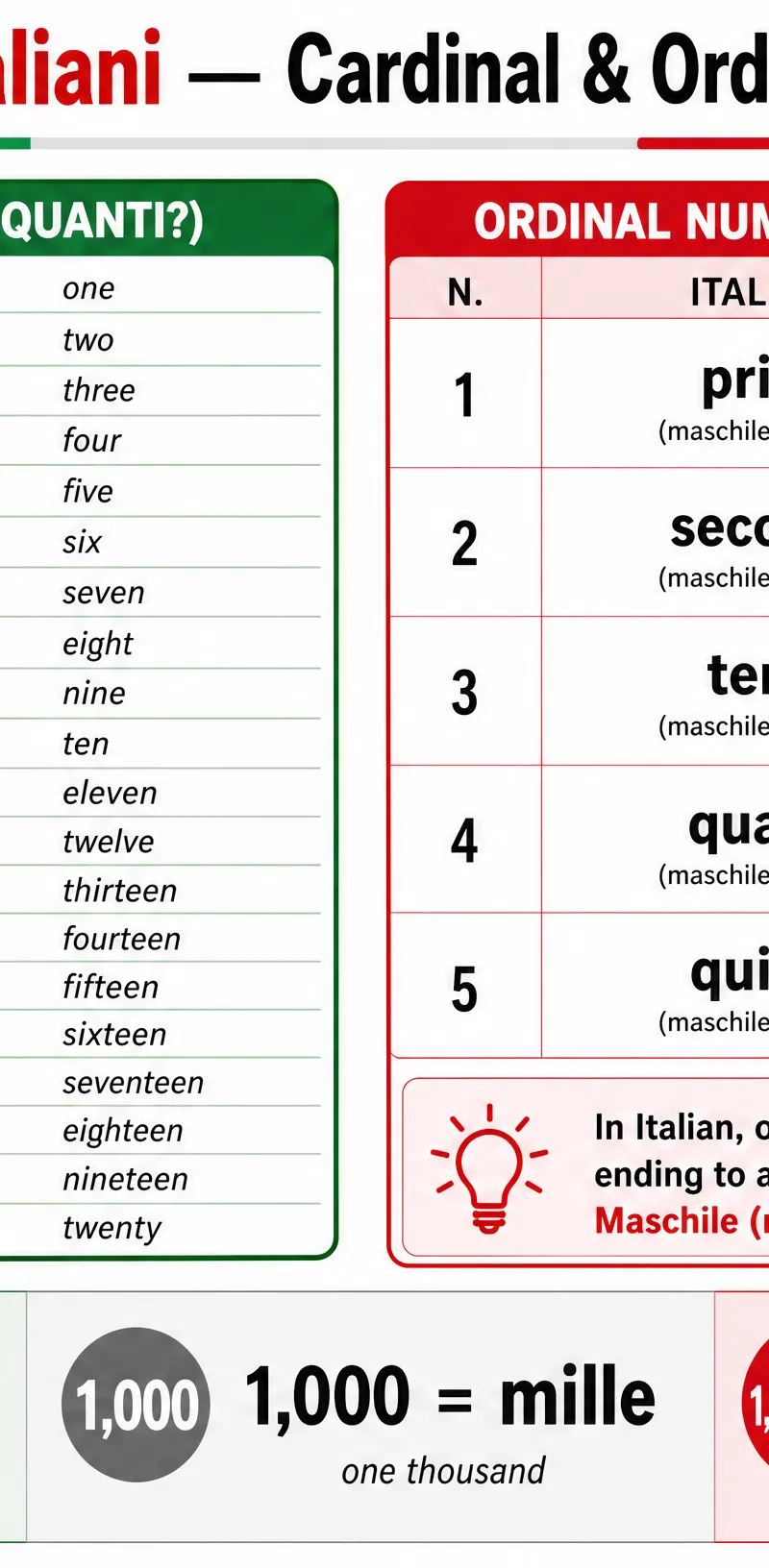
Interactive Diagrams
1 interactive diagram to visualise key concepts
Conceptual Flow Outline
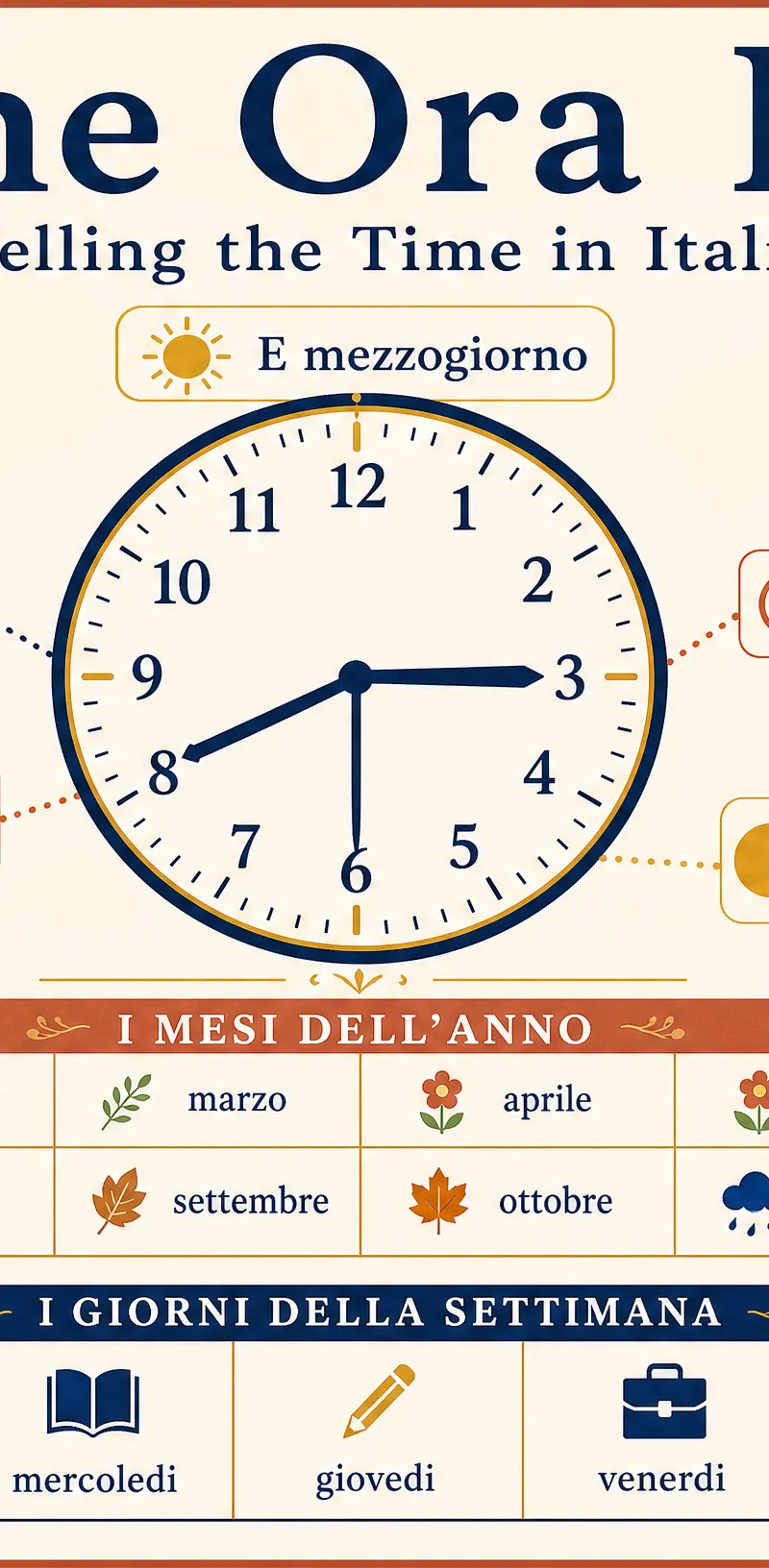
Flowchart for telling the time in Italian
Worked Examples
4 worked examples — open one to explore the question and available guidance.
Practice Questions
Try the question, then reveal an answer plan or example response
Writing (Translation): Translate into Italian: 'My train leaves at quarter past eight in the morning.'
Hint: Remember to use 'alle' for 'at' before the time, and the correct phrase for 'quarter past'.
Reading: Read the text: 'La biblioteca è aperta dal lunedì al venerdì, dalle 09:00 alle 18:30. Il sabato chiude alle 13:00.' What time does the library close on Wednesdays?
Hint: Wednesday falls between Monday (lunedì) and Friday (venerdì). Read the time using the 12-hour clock in English.
Speaking (Conversation): Quando è il tuo compleanno e come festeggi di solito?
Hint: Give the date accurately (remember the rule for the 1st of the month if applicable), then use present tense verbs to describe your usual celebration.
Listening: You hear: 'Il biglietto per il concerto costa quarantacinque euro.' How much does the ticket cost?
Hint: Break down the word 'quarantacinque'.
Writing (90 words): Write an email to your Italian friend about your school routine. Include: what time school starts and ends, your favourite subject, and what you did yesterday after school.
Hint: Cover all bullet points. Use present tense for routine, and past tense (passato prossimo) for yesterday.
Reading: You see a sign: 'Saldi! Sconti del 50% su tutti i cappotti. Offerta valida fino al 31 gennaio.' What is the offer and when does it end?
Hint: Look for the percentage and the date.
Exam technique
How to turn what you know into marks
How to approach the question
Skill-by-skill strategy: Listening — read questions first, note keywords. Speaking — prepare opinions in advance, have fillers ready. Reading — skim first, then detail. Writing — plan before writing, check accuracy after.
How to structure your answer
Writing: Introduction → Main points with opinions → Justified reasons → Different tenses → Conclusion. Speaking: Give opinion → Justify → Extend → Use different tense.
Timing
Listening: 25 mins (heard twice). Speaking: 7-12 mins total (role play + photo card + conversation). Reading: 45-60 mins. Writing: 60-75 mins (translation + structured + extended).
Common pitfalls
- Confusing 'mille' (1,000) and 'un milione' (1,000,000)
- Using 'Sono le una' instead of the correct 'È l'una'
- Failing to make ordinal numbers agree with nouns (e.g., writing 'la primo volta' instead of 'la prima volta')
- Capitalising months and days of the week in writing tasks
- Misspelling the 'dici' placement in numbers 17, 18, 19
What the command words want
- Describe the photo
- Say what you can see, give an opinion, relate to your experience
- Translate into English
- Meaning over word-for-word — capture the sense, don't guess cognates
- Translate into Italian
- Write full sentences with correct grammar — partial marks for partially correct
- Write approximately 90 words
- Foundation task — cover all 4 bullet points, use present + one other tense
- Write approximately 150 words
- Higher task — 3 tenses, opinions, complex structures, ambitious vocabulary
Watch or listen (optional)
Test your understanding of Grammar
Active recall beats re-reading. Take an instant quiz now to test what you’ve learned and lock it into long-term memory.
7 days Premium · Then the free plan continues · No card, no charge