AQA · A-Level · Law
Course version: AQA-A-Level-Law · Version from Mar 2026
Law of contract
Master the Consumer Rights Act 2015, the essential law that protects consumers when buying goods and services. Learn the key implied terms, strict remedies, and exactly how to apply them in exam scenarios to secure top marks.
- 6 min read
- 3 worked examples
- 5 practice questions
- 6 key terms
Check what you remember
Read the wording for your board, then hide it and explain Consumer in your own words. Rough notes are fine. This is a self-check, with no mark or grade.
Reference: AQA
An individual acting for purposes that are wholly or mainly outside their trade, business, craft, or profession.
Study Notes
Overview
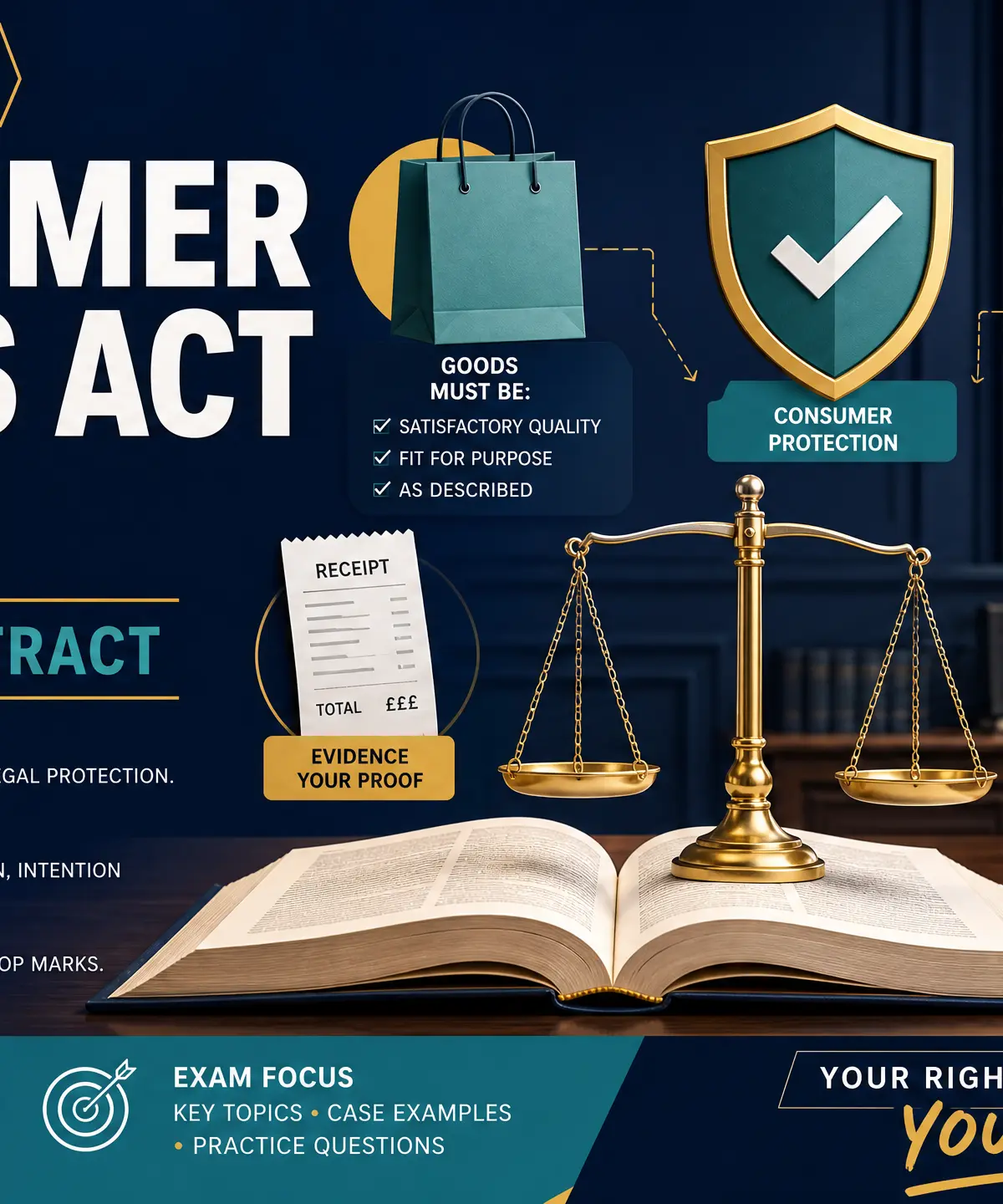
Welcome to the Law of Contract, focusing specifically on the Consumer Rights Act 2015 (CRA). This topic is absolutely vital because it governs almost every transaction you make in daily life—from buying a sandwich to hiring a plumber. In your GCSE Law exam, you will frequently encounter problem scenarios requiring you to 'Advise' a consumer who has received faulty goods or poor service.
The CRA 2015 replaced a patchwork of older laws (like the Sale of Goods Act 1979) to create a single, clear set of rules for consumer contracts. To succeed in this topic, you must be able to correctly identify whether a contract is for goods or services, state the relevant implied terms (the rules automatically written into the contract by law), and apply the correct statutory remedies when those terms are breached. Examiners consistently reward precision: citing the exact section numbers and distinguishing clearly between goods and services will elevate your answers to the top band.
Listen to the companion podcast for a comprehensive review of this topic:
Key Concepts
Concept 1: The Consumer Contract
Before applying any rules from the CRA 2015, you must first establish that the agreement is actually a consumer contract. The Act only applies to contracts between a trader (a person acting for purposes relating to their trade, business, or profession) and a consumer (an individual acting for purposes that are wholly or mainly outside their trade, business, craft, or profession).
Why does this matter? Because the law aims to protect the weaker party. A consumer buying a laptop from a massive electronics retailer has less bargaining power than a business buying 50 laptops directly from the manufacturer. If a scenario involves two businesses (B2B) or two private individuals (C2C), the CRA 2015 does not apply in the same way. Always explicitly state in your exam answer: "This is a consumer contract because [Name] is acting outside their business and [Shop] is a trader."
Concept 2: Implied Terms for the Supply of Goods
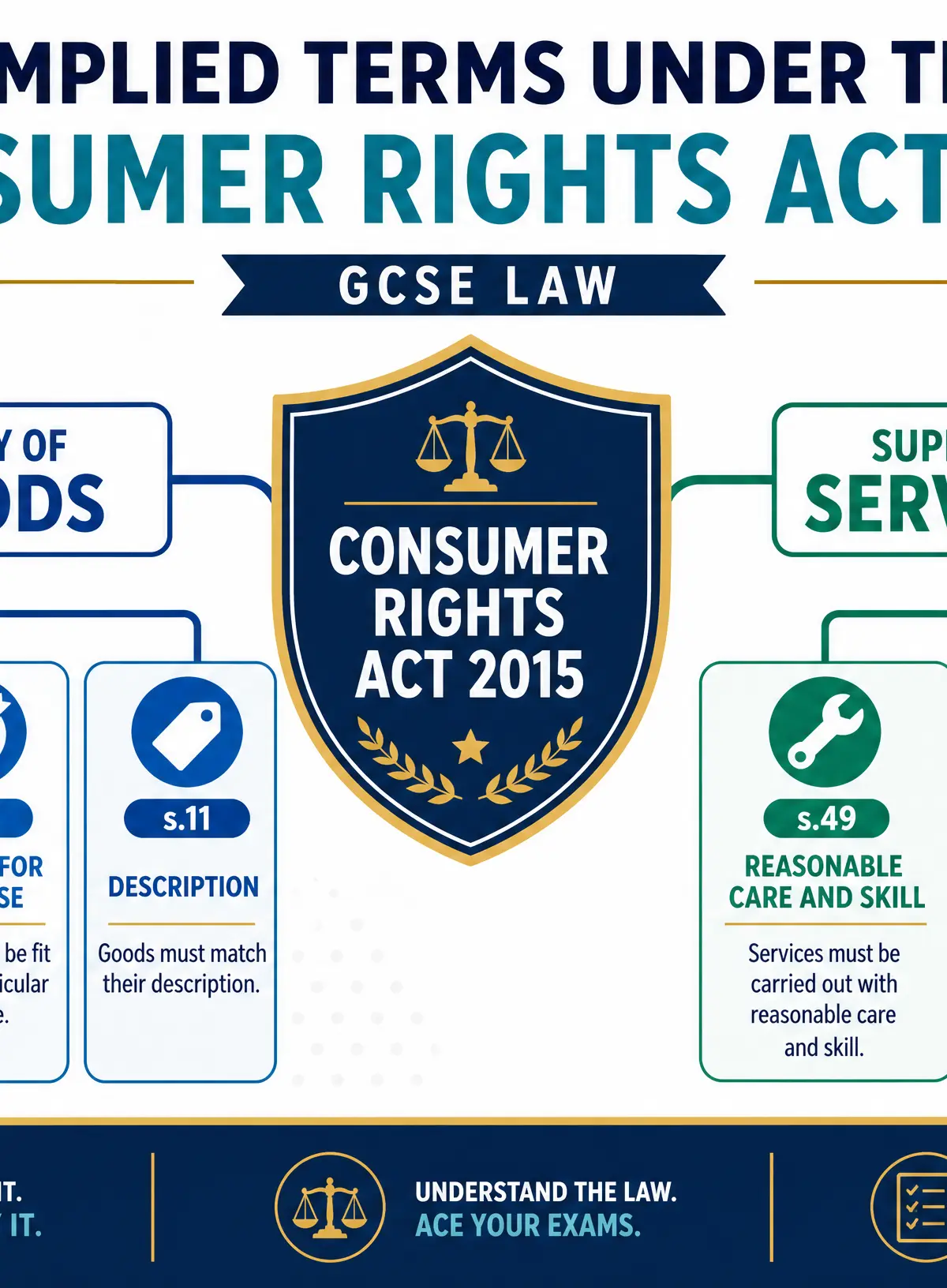
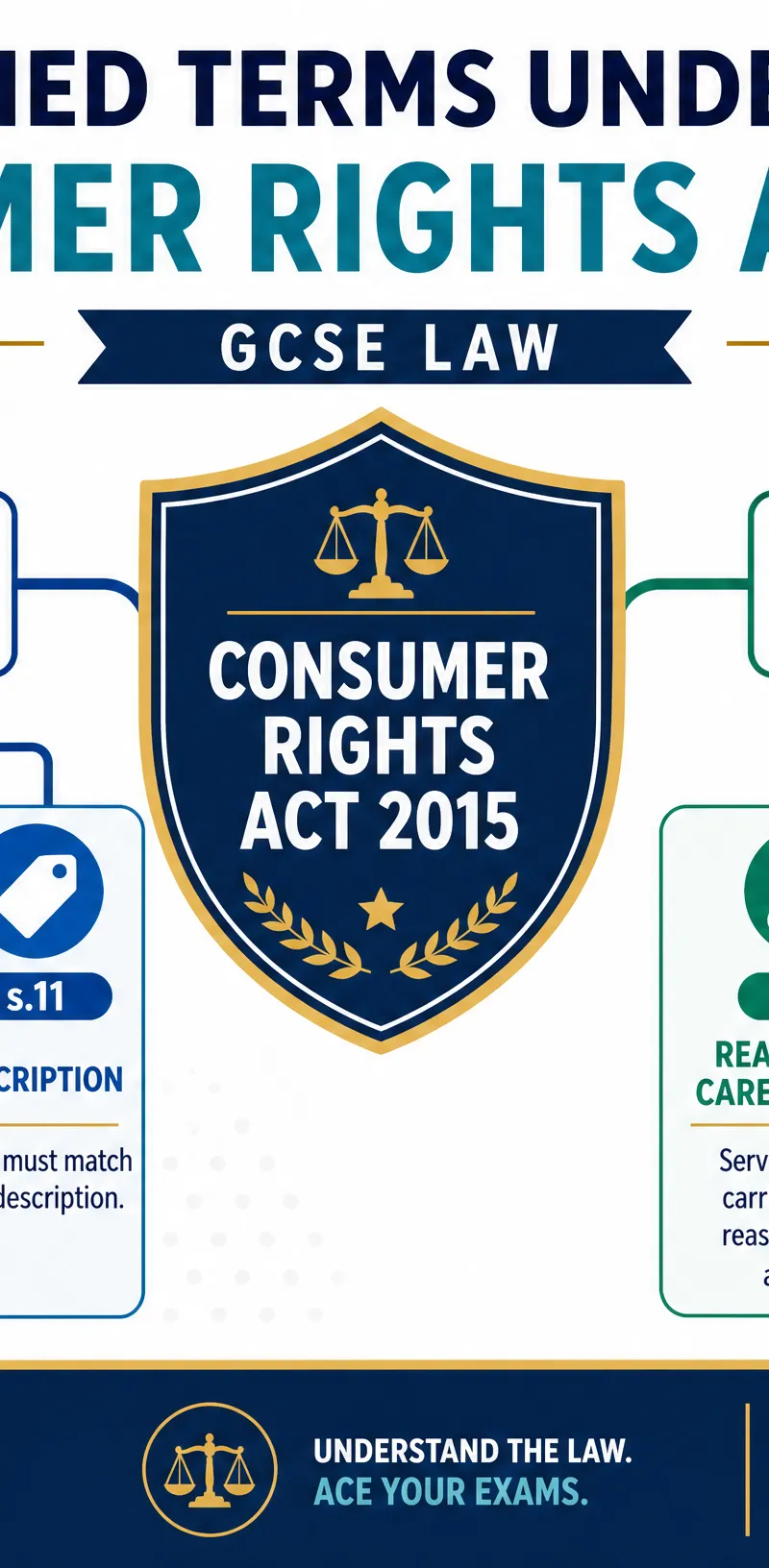
When a consumer buys physical goods, the CRA 2015 automatically implies three crucial terms into the contract. You must memorize these section numbers:
- Section 9: Satisfactory Quality. Goods must meet the standard that a reasonable person would consider satisfactory, taking into account the description, price, and all other relevant circumstances. This includes fitness for all the purposes for which goods of that kind are usually supplied, appearance and finish, freedom from minor defects, safety, and durability.
- Section 10: Fitness for Particular Purpose. If the consumer makes known to the trader (expressly or by implication) any particular purpose for which they are buying the goods, there is an implied term that the goods are reasonably fit for that purpose. This relies on the consumer trusting the trader's skill or judgement.
- Section 11: Description. Every contract to supply goods by description is to be treated as including a term that the goods will match the description.
Concept 3: Remedies for Breach of Goods Contracts
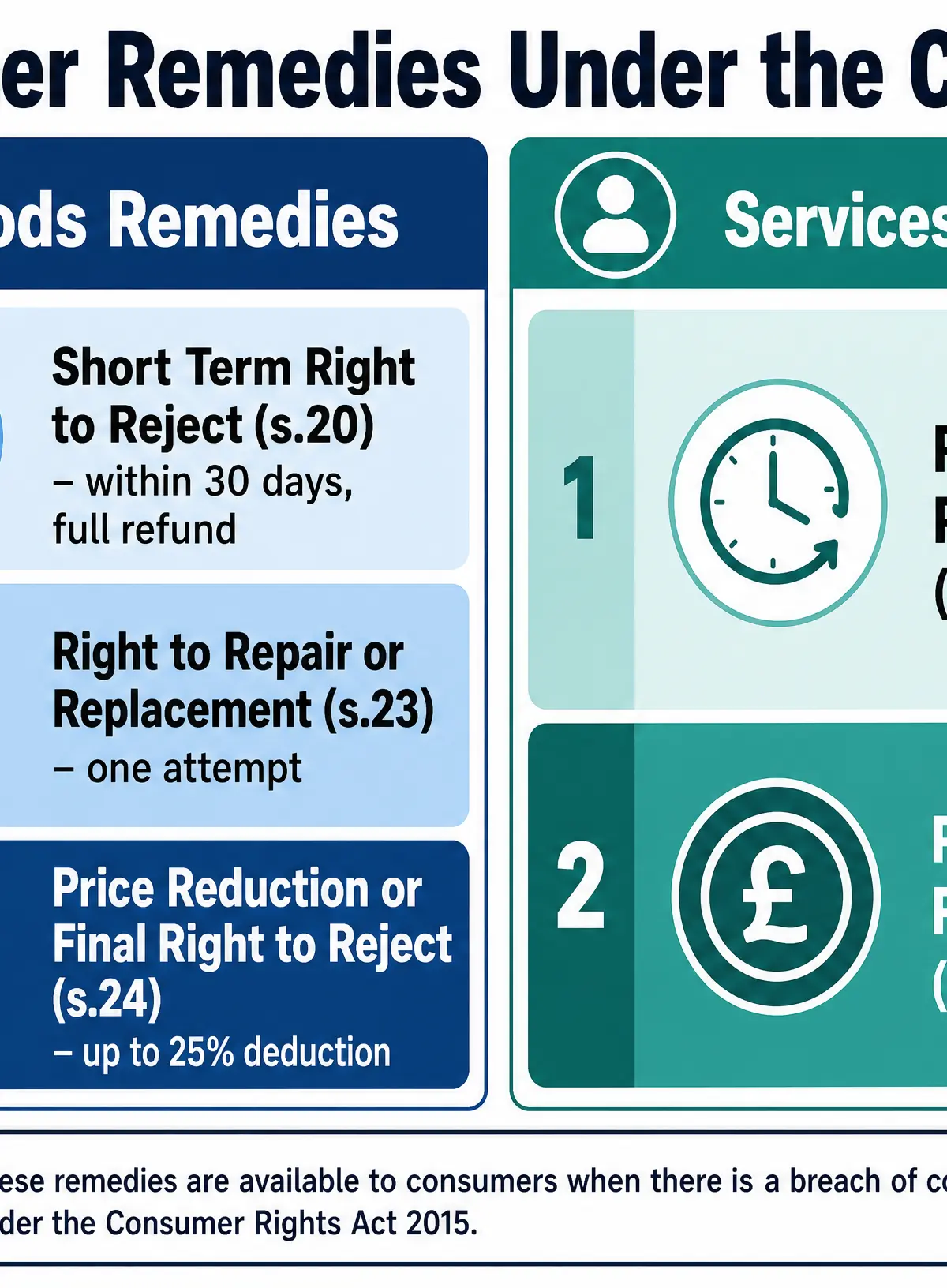
If goods fail to meet the standards of sections 9, 10, or 11, the consumer has specific statutory remedies. Examiners love testing the strict timeline of these remedies:
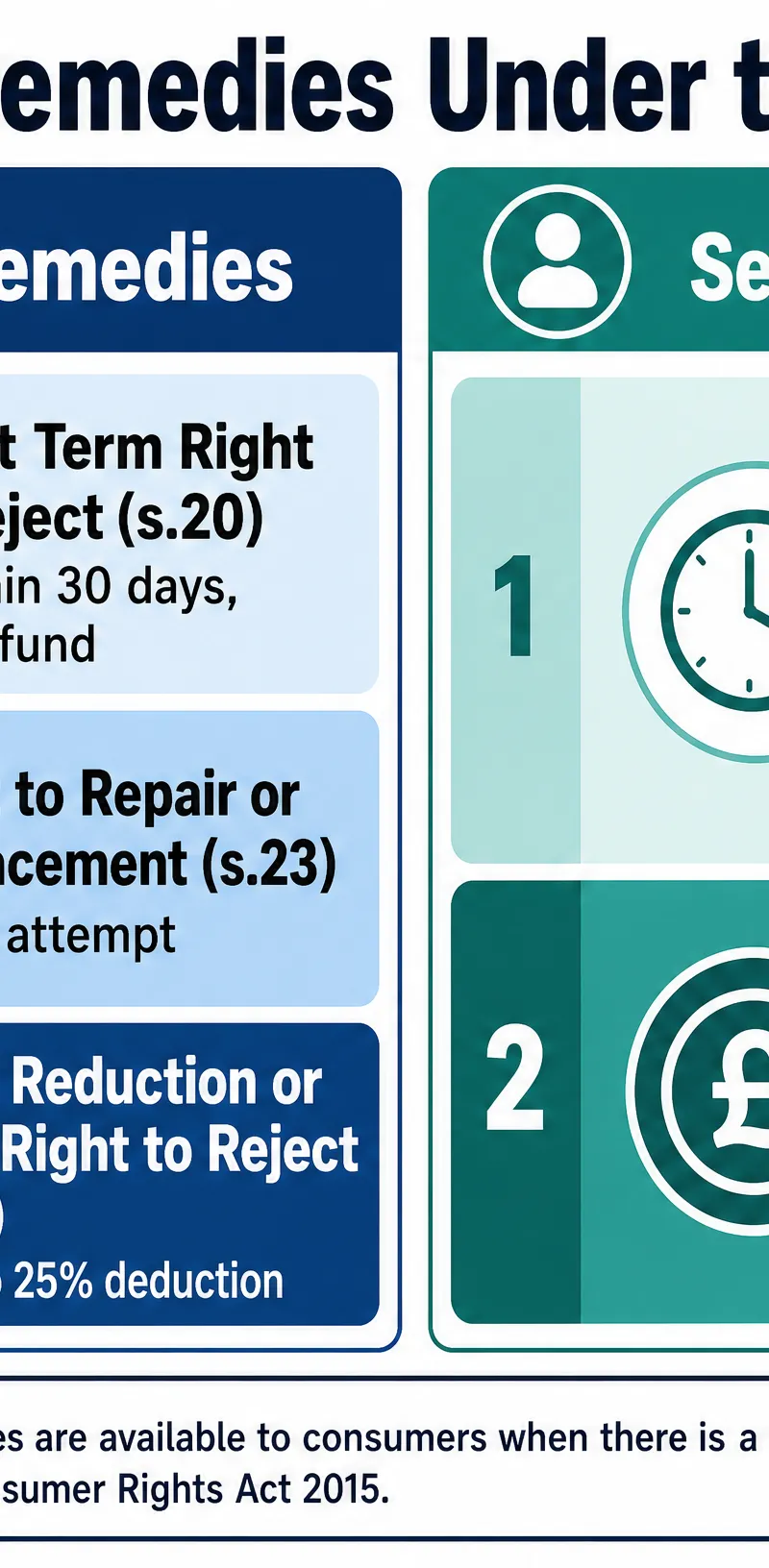
- Section 20: The Short-Term Right to Reject. If the goods are faulty, the consumer has a strict 30-day window (from ownership/delivery) to reject the goods and demand a full refund.
- Section 23: Right to Repair or Replacement. If the 30 days have passed, or the consumer chooses not to reject immediately, they can demand a repair or replacement. The trader must do this within a reasonable time and without significant inconvenience to the consumer. Crucially, the trader only gets one opportunity to repair or replace the goods.
- Section 24: Right to Price Reduction or Final Right to Reject. If the single repair attempt fails, or the replacement is also faulty, the consumer moves to the final tier. They can either keep the goods and receive a price reduction, or reject the goods for a refund (though the trader can make a deduction for the use the consumer has had if more than six months have passed).
Concept 4: Implied Terms for the Supply of Services
Services (like haircuts, building work, or dry cleaning) have different rules. Never apply goods rules to a service contract!
- Section 49: Reasonable Care and Skill. Every contract to supply a service is to be treated as including a term that the trader must perform the service with reasonable care and skill. The standard is objective: what would a reasonably competent professional in that field do?
- Section 52: Performance within a Reasonable Time. If the contract does not expressly fix the time for the service to be performed, there is an implied term that it will be performed within a reasonable time.
Concept 5: Remedies for Breach of Service Contracts
If a service falls short of sections 49 or 52, the remedies are entirely different from goods remedies:
- Section 55: Right to Repeat Performance. The consumer can require the trader to repeat the service to the extent necessary to complete it in conformity with the contract. This must be done at the trader's expense, within a reasonable time.
- Section 56: Right to a Price Reduction. The consumer has the right to an appropriate price reduction (up to 100%) if repeat performance is impossible, or if the trader has failed to provide repeat performance within a reasonable time and without significant inconvenience to the consumer.
Practical Applications
Understanding the CRA 2015 is incredibly empowering in real life. If you buy a pair of trainers and the sole falls off after two weeks, you don't need the shop's "returns policy" or a receipt showing "no refunds"—your statutory rights under Section 9 (Satisfactory Quality) override store policies, and you are entitled to a full refund under the Section 20 Short-Term Right to Reject.
Similarly, if you hire a mechanic to fix your car and they cause further damage to the engine, they have breached Section 49 (Reasonable Care and Skill). You are legally entitled to demand they fix it properly at their own expense under Section 55 (Repeat Performance).
Visual Resources
2 diagrams and illustrations
Interactive Diagrams
2 interactive diagrams to visualise key concepts
Conceptual Flow Outline
Flowchart showing the chronological progression of remedies for faulty goods under the CRA 2015.
Conceptual Flow Outline
Flowchart showing the remedies available for breach of a services contract under the CRA 2015.
Worked Examples
3 worked examples — open one to explore the question and available guidance.
Practice Questions
Try the question, then reveal an answer plan or example response
State the implied term found in Section 11 of the Consumer Rights Act 2015. (1 mark)
Hint: Think about what must happen if you buy something based on a catalogue or website picture.
Advise Tom. Tom bought a new mountain bike for £80 from a specialist cycle shop. He told the assistant he needed it for extreme downhill racing. During his first race, the frame snapped in half. (4 marks)
Hint: Tom explicitly stated what he was going to use the bike for. Which section does this trigger?
Advise Aisha. Six months ago, Aisha paid a professional landscape gardener £1000 to redesign her garden. The gardener finally started work last week but accidentally destroyed several of Aisha's existing, expensive plants while digging. The gardener says it's 'just one of those things'. (5 marks)
Hint: This is a services contract, not a goods contract. Which terms apply to how the work is carried out?
Explain how the remedies available to a consumer change after they have owned a faulty product for 30 days. (4 marks)
Hint: Think about the timeline. What right expires, and what rights replace it?
Marcus buys a second-hand car from a dealership for £2,000. After three days, the exhaust falls off. The dealer refuses a refund, stating 'it's a used car, you get what you pay for'. Advise Marcus. (6 marks)
Hint: Does the CRA 2015 apply to second-hand goods? How does the 'reasonable person' test apply here?
Exam technique
How to turn what you know into marks
How to approach the question
For 'Advise' questions, use the IDEA structure: Identify the contract type (goods/services), Define the law (section number + rule), Explain the breach using the scenario facts, Advise on the specific statutory remedy available.
How to structure your answer
Start every answer by stating 'This is a consumer contract governed by the Consumer Rights Act 2015'. Then split your answer logically: state the breach, then state the remedy.
Timing
Approximately 1 minute per mark. A 6-mark scenario question should take about 6-7 minutes to plan and write.
Common pitfalls
- Applying goods remedies (like the 30-day right to reject) to a services contract (like a haircut). They are entirely separate in the Act.
- Citing the 'Sale of Goods Act 1979'. This is old law for consumer contracts and examiners will penalise you for using it instead of the CRA 2015.
- Saying the consumer can demand a refund after 3 months without mentioning the trader's right to attempt a repair/replacement first.
What the command words want
- Advise
- Apply the law to the specific facts of the scenario to tell the fictional client exactly what their legal rights are and what they should do next.
- Explain
- Say HOW or WHY - e.g., explain why a specific remedy is or isn't available based on the timeframes.
- Describe
- Set out the characteristics - e.g., describe the process of the right to repair or replacement.
- State/Give
- Brief factual answer - e.g., 'Section 9 of the CRA 2015'. No explanation needed.
Watch or listen (optional)
Test your understanding of Law of contract
Active recall beats re-reading. Take an instant quiz now to test what you’ve learned and lock it into long-term memory.
7 days Premium · Then the free plan continues · No card, no charge