AQA · A-Level · Law
Course version: AQA-A-Level-Law · Version from Mar 2026
The nature of law and the English legal system
Master the rules and aids judges use to interpret Acts of Parliament. This topic is essential for understanding how the law works in practice and is a high-scoring area in GCSE Law exams.
- 6 min read
- 3 worked examples
- 5 practice questions
- 6 key terms
Check what you remember
Read the wording for your board, then hide it and explain Literal Rule in your own words. Rough notes are fine. This is a self-check, with no mark or grade.
Reference: AQA
Giving words in a statute their plain, ordinary, and natural meaning, even if it leads to an absurd result.
Study Notes
Overview
Welcome to Topic 3.1: Statutory Interpretation. Parliament makes the law by passing Acts of Parliament (statutes), but language is inherently imperfect. Words can be ambiguous, and situations arise that Parliament never anticipated. Therefore, judges must interpret these statutes to apply them to real-world cases. This topic covers the four main rules judges use to interpret legislation, the internal and external aids that assist them, and the profound impact of the Human Rights Act 1998. Understanding these concepts is crucial for GCSE Law, as examiners frequently ask you to apply these rules to hypothetical scenarios and evaluate their effectiveness.
Listen to the Podcast
Key Concepts
The Four Rules of Interpretation
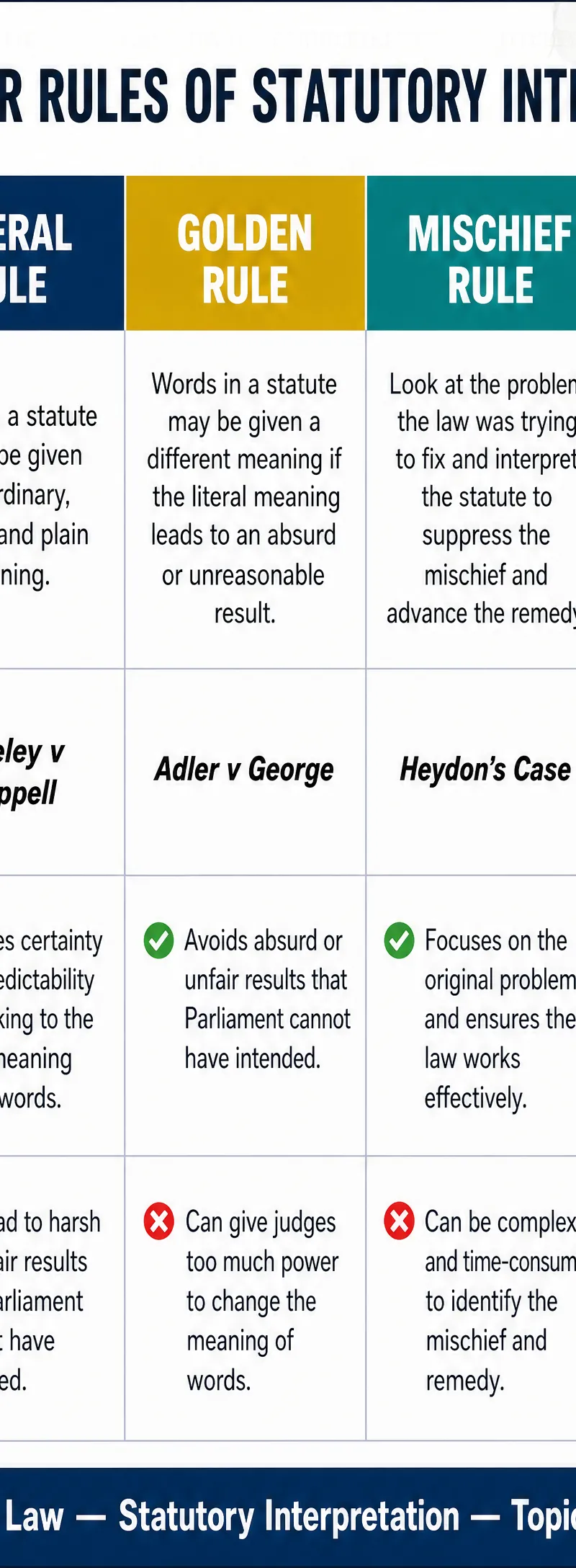
Judges generally use four main approaches, or 'rules', to interpret statutes. It is best to think of these on a spectrum, from strict adherence to the words (Literal Rule) to looking broadly at Parliament's overall goal (Purposive Approach).
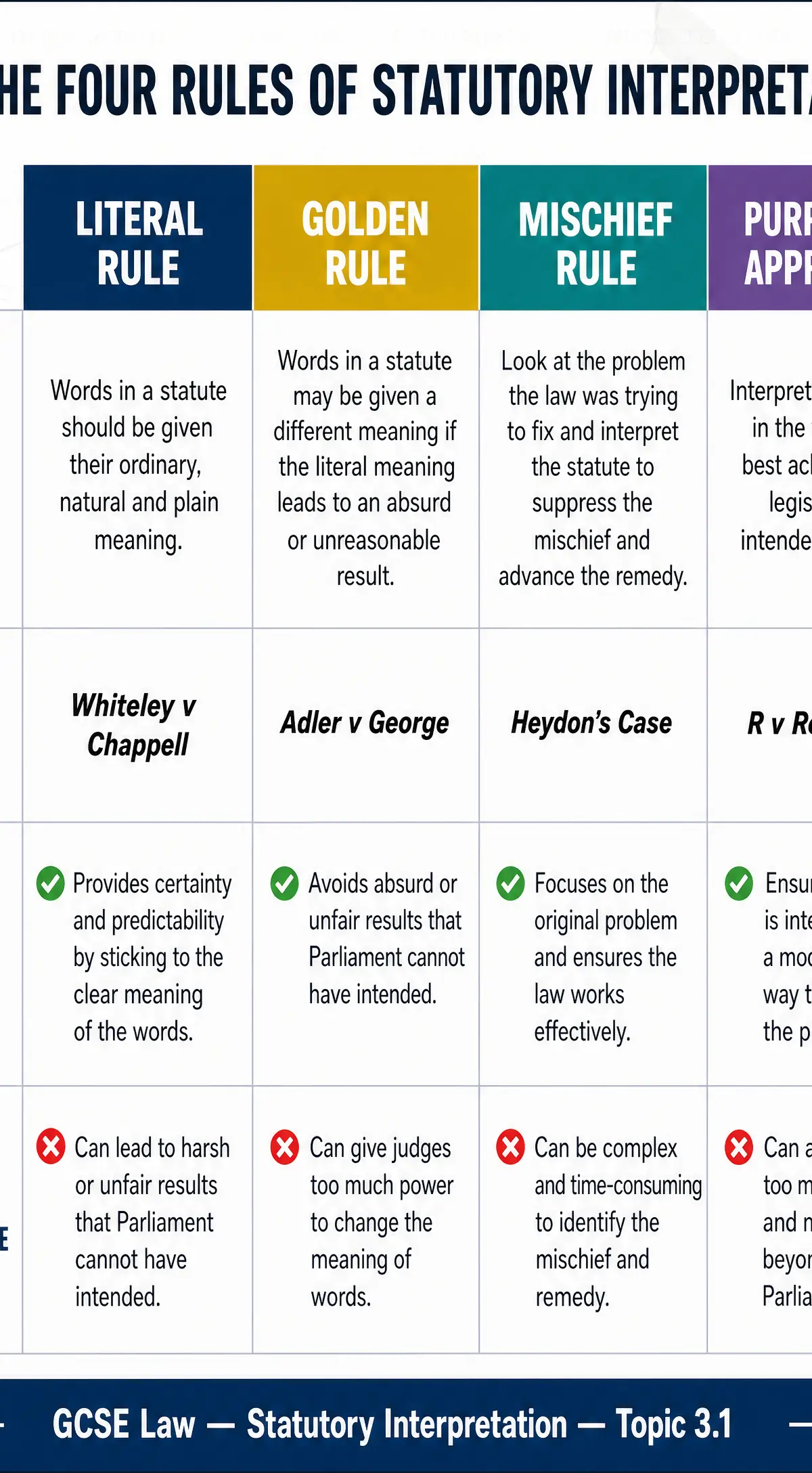
1. The Literal Rule
Under the literal rule, words in a statute must be given their plain, ordinary, and natural meaning, even if this leads to a result that is absurd, harsh, or unjust. The rationale is that Parliament is the supreme law-maker, and judges should respect the exact words chosen.
Example Case: Whiteley v Chappell (1868). A statute made it an offence to impersonate "any person entitled to vote". The defendant impersonated a dead person. Applying the literal rule, the court found him not guilty, as a dead person is not "entitled to vote".
2. The Golden Rule
The golden rule is an extension of the literal rule. Judges start by looking at the literal meaning, but if this leads to an absurd or repugnant result, they can modify the meaning to avoid that absurdity.
Example Case: Adler v George (1964). Under the Official Secrets Act, it was an offence to obstruct forces "in the vicinity of" a prohibited place. The defendant was actually inside the prohibited place. Applying the literal rule would mean he wasn't "in the vicinity" (near) it. The court used the golden rule to interpret the phrase to include being inside the place, avoiding the absurd result that someone inside would be less guilty than someone outside.
3. The Mischief Rule
Originating from Heydon's Case (1584), this rule requires the judge to look at the gap or 'mischief' in the law that Parliament was trying to fix. The judge then interprets the statute in a way that suppresses the mischief and advances the remedy.
Example Case: Smith v Hughes (1960). The Street Offences Act 1959 made it an offence for prostitutes to solicit "in a street or public place". The defendants were soliciting from private balconies and windows. The court applied the mischief rule: the 'mischief' was the nuisance to the public. Since the nuisance was still occurring, they were found guilty, even though they were not literally in the street.
4. The Purposive Approach
This is a modern, broader approach where the court looks at the overall purpose of the legislation and interprets the words to best achieve that purpose. It goes beyond the mischief rule by looking forward to what Parliament wanted to achieve, rather than just backward at the problem they were fixing.
Example Case: R v Registrar General, ex parte Smith (1990). A statute gave adopted people the right to access their birth records. Smith, a convicted murderer, applied for his records. The court used the purposive approach to deny his request, reasoning that Parliament's purpose could not have been to facilitate serious crime (as there was a risk he might harm his birth mother).
Aids to Interpretation
To help them apply these rules, judges use various aids.
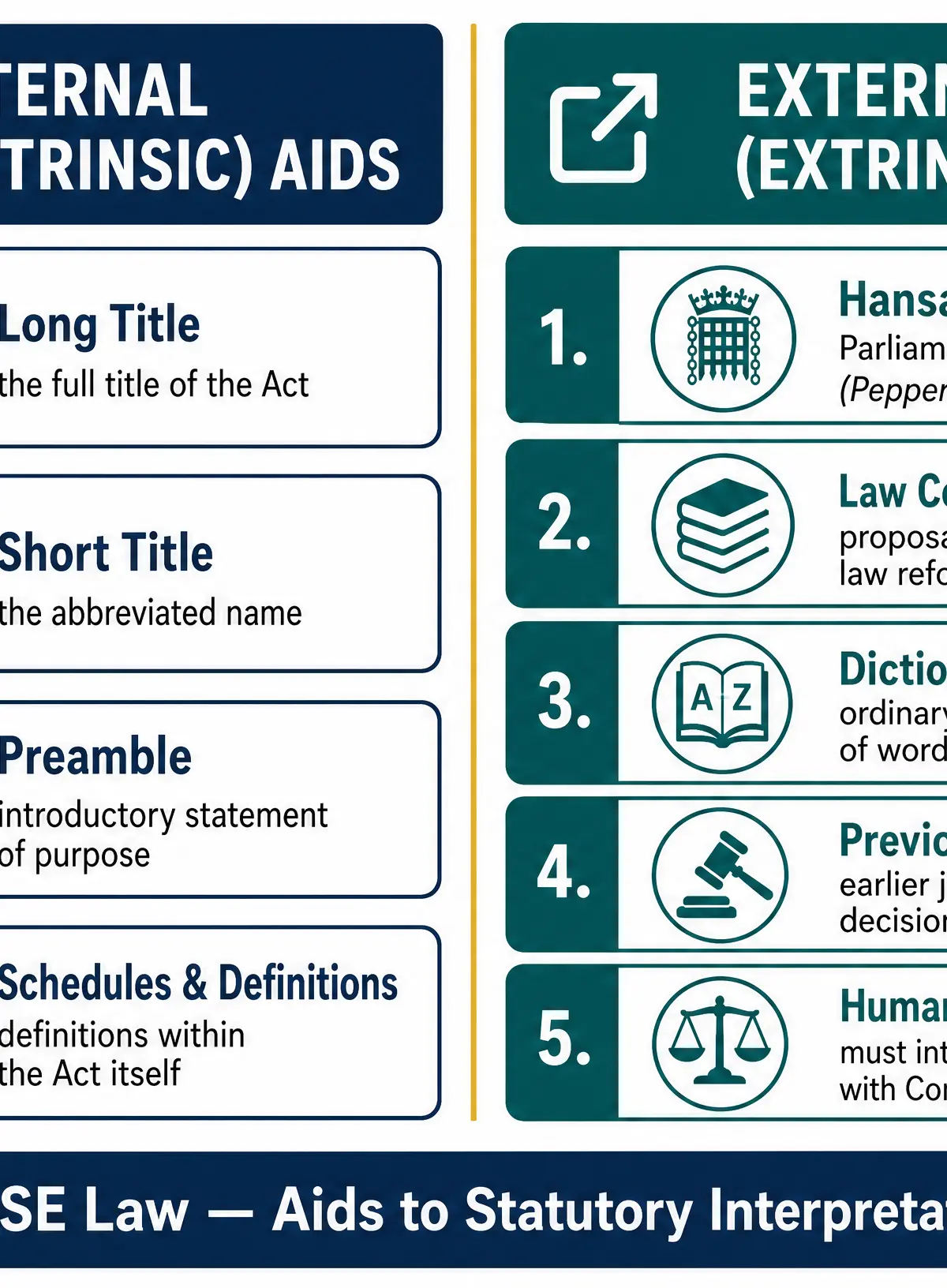
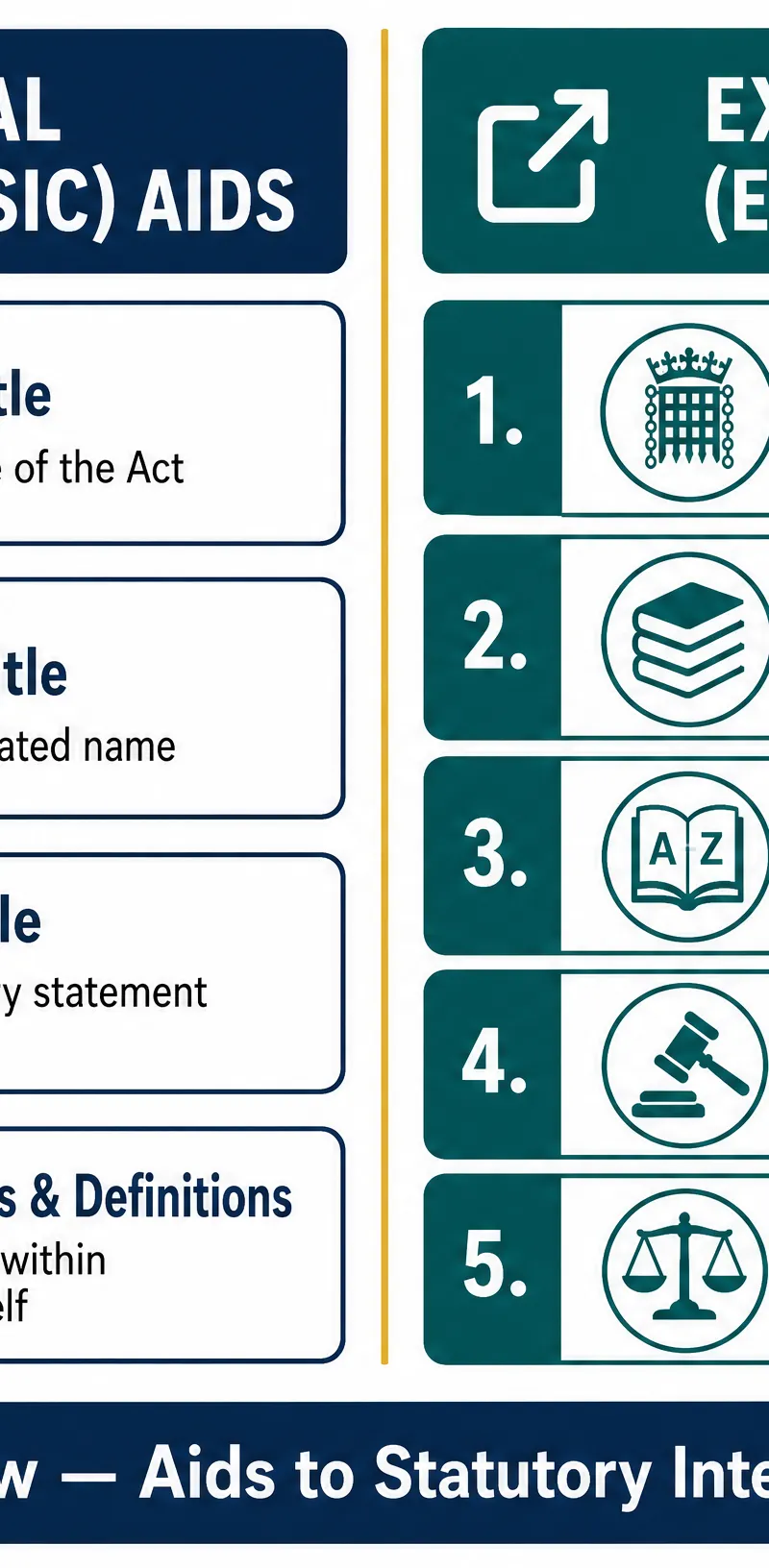
Internal (Intrinsic) Aids
These are found within the Act itself:
- Long Title: Explains the Act's overall purpose.
- Short Title: The name we usually use (e.g., Theft Act 1968).
- Preamble: An introductory statement (more common in older Acts).
- Schedules and Definition Sections: Sections at the end of the Act that define specific terms used.
External (Extrinsic) Aids
These are found outside the Act:
- Dictionaries: Usually from the time the Act was passed, to find the ordinary meaning of words.
- Hansard: The official daily record of Parliamentary debates. Following the case of Pepper v Hart (1993), judges can consult Hansard if the statute is ambiguous or obscure.
- Law Commission Reports: Reports that recommended the new law, which help identify the original 'mischief'.
- Previous Case Law: How other judges have interpreted similar words.
The Impact of the Human Rights Act 1998
The Human Rights Act 1998 (HRA) has fundamentally changed statutory interpretation.
Section 3 of the HRA requires that, "so far as it is possible to do so", all legislation must be read and given effect in a way which is compatible with the European Convention on Human Rights.
This is a powerful obligation. It means judges must strive to find an interpretation that upholds human rights, even if it strains the literal meaning of the words. If a compatible interpretation is truly impossible, the court cannot strike down the law (due to Parliamentary Sovereignty). Instead, under Section 4, they can issue a 'Declaration of Incompatibility', which flags the issue for Parliament to change the law.
Practical Applications
Understanding these rules isn't just academic; it determines whether people go to prison or go free. When a new technology emerges (like e-scooters), judges must interpret old traffic laws to decide if they apply. Statutory interpretation is the engine of the common law system.
Visual Resources
2 diagrams and illustrations
Interactive Diagrams
2 interactive diagrams to visualise key concepts
Conceptual Flow Outline
Flowchart showing how a judge might decide which rule of interpretation to apply.
Conceptual Flow Outline
The impact of the Human Rights Act 1998 on statutory interpretation.
Worked Examples
3 worked examples — open one to explore the question and available guidance.
Practice Questions
Try the question, then reveal an answer plan or example response
State the name of the rule of interpretation applied in Smith v Hughes (1960). (1 mark)
Hint: Think about the prostitutes on the balcony.
Explain the difference between internal and external aids to statutory interpretation. Give one example of each. (4 marks)
Hint: Where are the aids located relative to the Act itself?
Read the scenario: Parliament passes the 'Parks Act' which states 'No vehicles are permitted in the park.' Sarah rides her bicycle through the park and is fined. Evaluate whether the court should use the Literal Rule or the Purposive Approach to decide if a bicycle is a 'vehicle'. (6 marks)
Hint: Apply both rules to the facts. What would happen under each? Which is better?
Explain the impact of the Human Rights Act 1998 on statutory interpretation. (3 marks)
Hint: Think about Section 3 and Section 4.
Describe the rule established in the case of Pepper v Hart (1993). (2 marks)
Hint: What external aid did this case allow judges to use?
Exam technique
How to turn what you know into marks
How to approach the question
Always identify the command word first. If the question contains a scenario (e.g., 'Bob is charged under the Dangerous Dogs Act...'), you MUST apply the rules to Bob's situation, not just recite the definitions.
How to structure your answer
For 4+ marks: Define the rule -> Name the case -> Explain the case facts -> State the outcome/advantage.
Timing
Approximately 1 minute per mark. A 6-mark evaluation should take 6-7 minutes.
Common pitfalls
- Describing a rule perfectly but forgetting to name a supporting case.
- Confusing the Golden Rule (avoiding absurdity) with the Mischief Rule (fixing a gap in the law).
- Listing only advantages in an 'Evaluate' question. You must show balance.
What the command words want
- Apply
- Link the legal rule to the specific facts given in the scenario.
- Compare
- Identify similarities AND differences between two rules.
- Explain
- Say HOW or WHY it works - use 'because'.
- Describe
- Set out characteristics - what is the rule?
- Evaluate
- Consider advantages and disadvantages, use evidence (cases), make a judgement.
- State/Identify
- Brief factual answer - 1-2 words or a short phrase.
Watch or listen (optional)
Test your understanding of The nature of law and the English legal system
Active recall beats re-reading. Take an instant quiz now to test what you’ve learned and lock it into long-term memory.
7 days Premium · Then the free plan continues · No card, no charge