Pearson Edexcel · A-Level · Law
Course version: Pearson-A-Level-Law · Version from Mar 2026
The criminal offender
Master the core of criminal liability, from actus reus and mens rea to specific property offences, defences, and sentencing. This comprehensive guide provides everything you need to secure top marks in Topic 2.2 of your GCSE Law exam.
- 7 min read
- 3 worked examples
- 5 practice questions
- 6 key terms
Check what you remember
Read the wording for your board, then hide it and explain Actus Reus in your own words. Rough notes are fine. This is a self-check, with no mark or grade.
Reference: Pearson Edexcel
The physical element or 'guilty act' of a crime. It must be voluntary and can be an act, an omission, or a state of affairs.
Study Notes
Overview
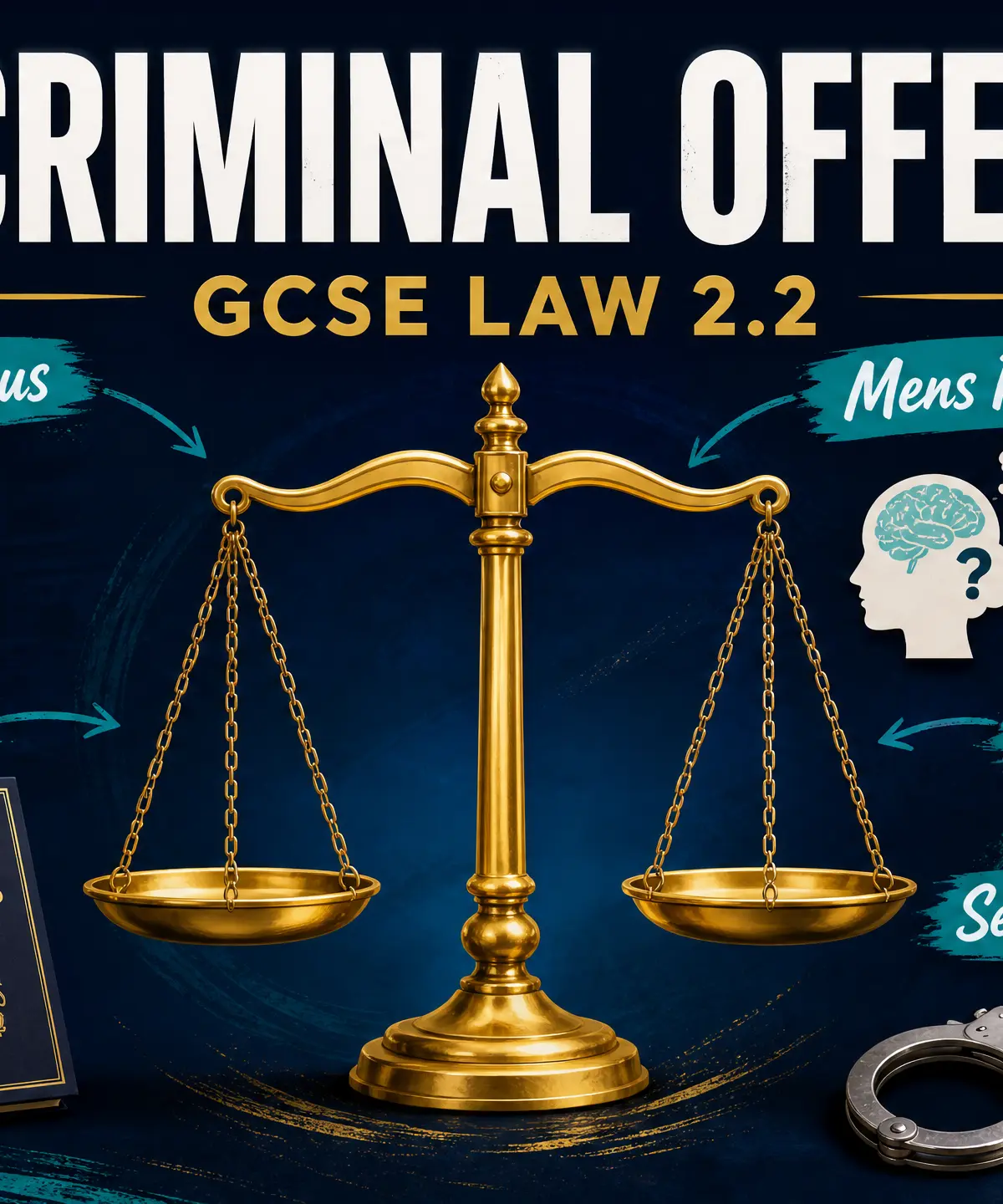
Welcome to Topic 2.2: The Criminal Offender. This is one of the most fundamental and heavily tested areas of the GCSE Law specification. It forms the bedrock of criminal liability, exploring exactly what makes an act a crime and what mental state is required to be held legally responsible.
In this topic, you will learn how to dissect a crime into its physical element (actus reus) and mental element (mens rea). You'll then apply these concepts to a range of specific property offences, including theft, robbery, burglary, and fraud. We will also explore the general defences of duress and intoxication, and conclude with how offenders are sentenced under the Criminal Justice Act 2003.
Examiners love scenario-based questions in this topic. You will frequently be asked to read a short case study and determine whether criminal liability exists, which offence has been committed, and what sentence might be appropriate. Mastering this content is essential for securing those higher-grade boundaries.
Key Concepts
1. The Elements of a Crime: Actus Reus and Mens Rea
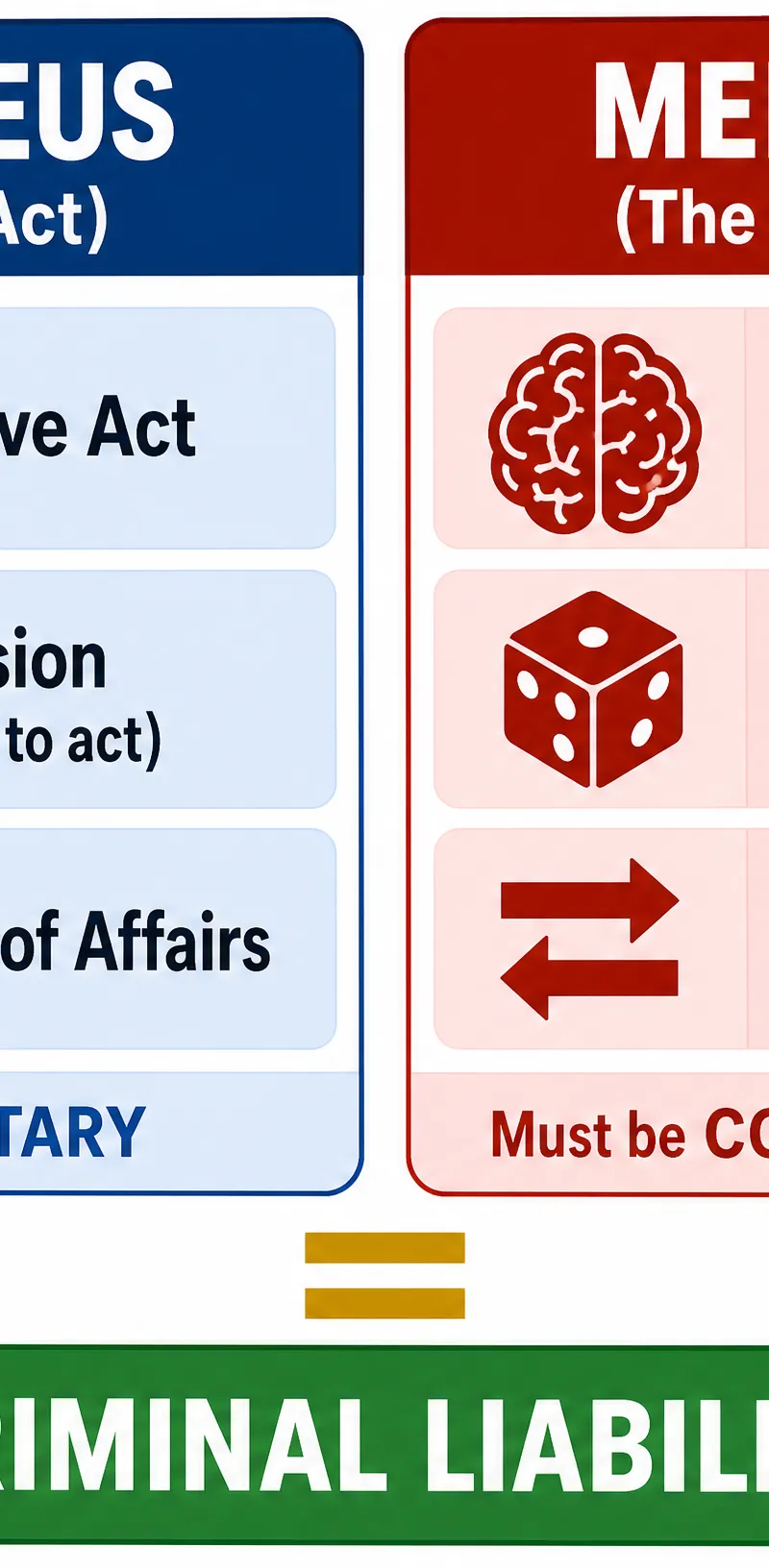
For a defendant to be found guilty of a crime, the prosecution must usually prove two elements beyond reasonable doubt: the actus reus and the mens rea.
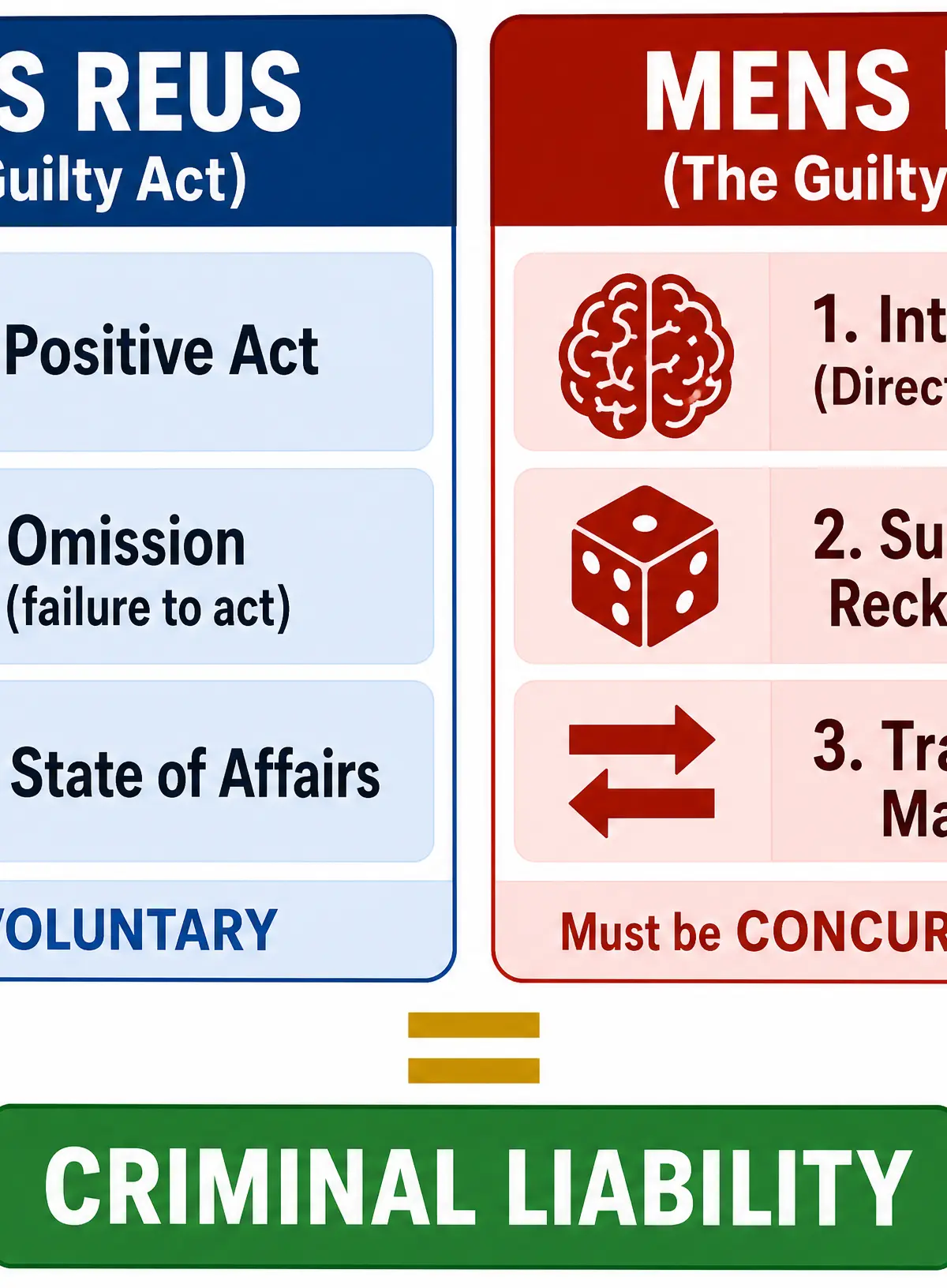
Actus Reus (The Guilty Act)
This is the physical element of the crime. It must be voluntary. The actus reus can take three forms:
- A positive act: e.g., punching someone (Battery).
- An omission (failure to act): Generally, there is no liability for an omission in English law. However, a duty to act can arise in specific situations: via a contract (e.g., a lifeguard), a special relationship (e.g., parent and child), a voluntary assumption of care, or creating a dangerous situation and failing to mitigate it.
- A state of affairs: Being found in a prohibited situation (e.g., being found drunk in charge of a vehicle).
Mens Rea (The Guilty Mind)
This is the mental element of the crime. The level of mens rea required depends on the specific offence:
- Intention: The highest level of mens rea.
- Direct Intention: It is the defendant's aim or purpose to bring about the result.
- Oblique Intention: The result is a virtual certainty of the defendant's actions, and they foresee it as such (R v Woollin).
- Subjective Recklessness: The defendant takes an unjustifiable risk and is actually aware of that risk (R v Cunningham).
Transferred Malice: If a defendant intends to commit a crime against Person A, but accidentally commits the same type of crime against Person B, the mens rea transfers to the actual victim (R v Latimer).
Strict Liability: These are exceptional offences where no mens rea is required for at least one element of the actus reus. They are usually regulatory offences designed to protect the public (e.g., speeding, selling alcohol to a minor).
2. Property Offences
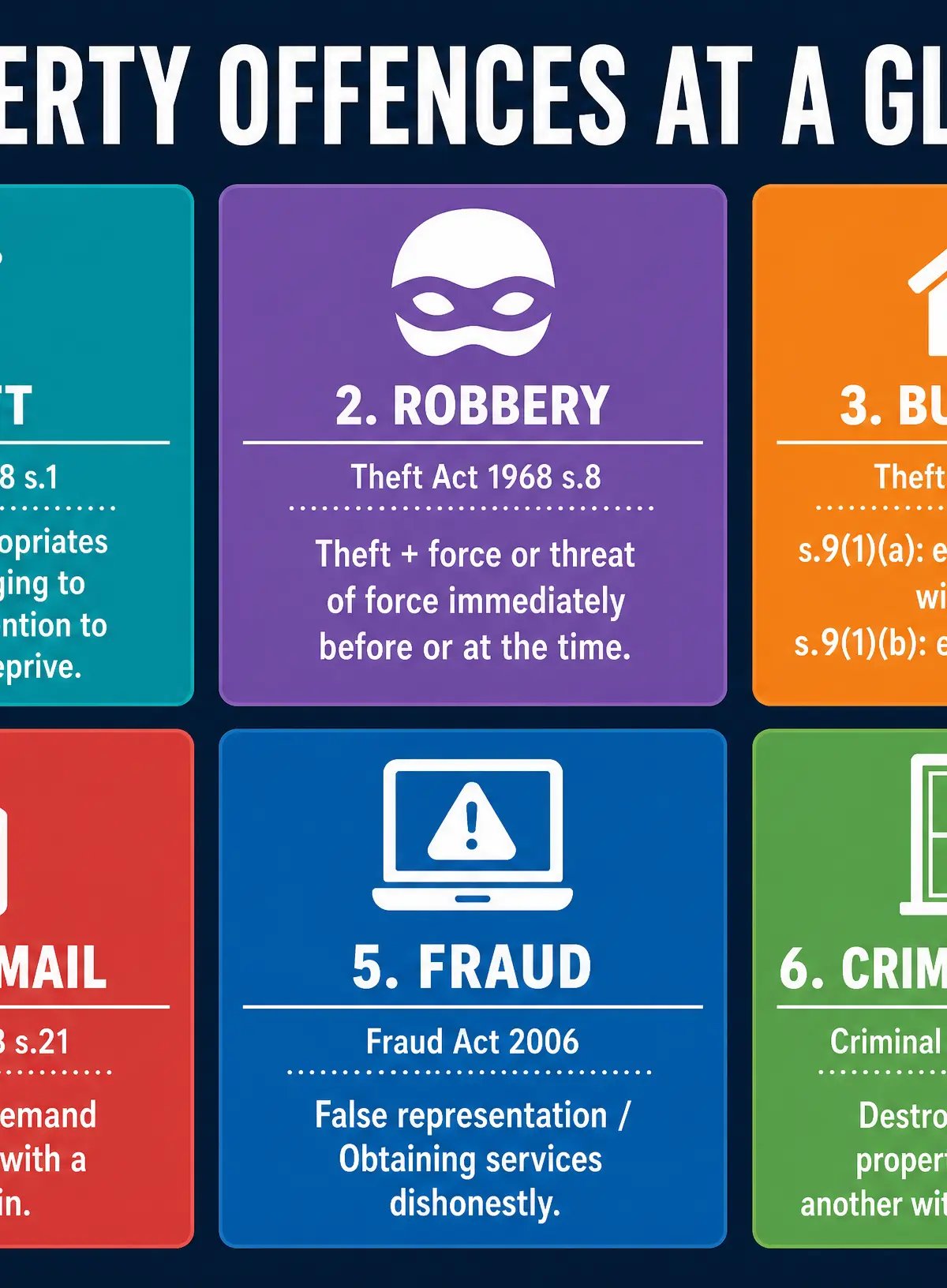
Theft (Theft Act 1968, s.1)
Definition: "A person is guilty of theft if he dishonestly appropriates property belonging to another with the intention of permanently depriving the other of it."
- Appropriation: Assuming the rights of the owner.
- Property: Includes money, real, personal, and intangible property.
- Belonging to another: Possession, control, or a proprietary right.
- Dishonesty: Tested objectively by the standards of ordinary decent people (Ivey v Genting Casinos).
- Intention to permanently deprive: Treating the thing as one's own to dispose of regardless of the other's rights.
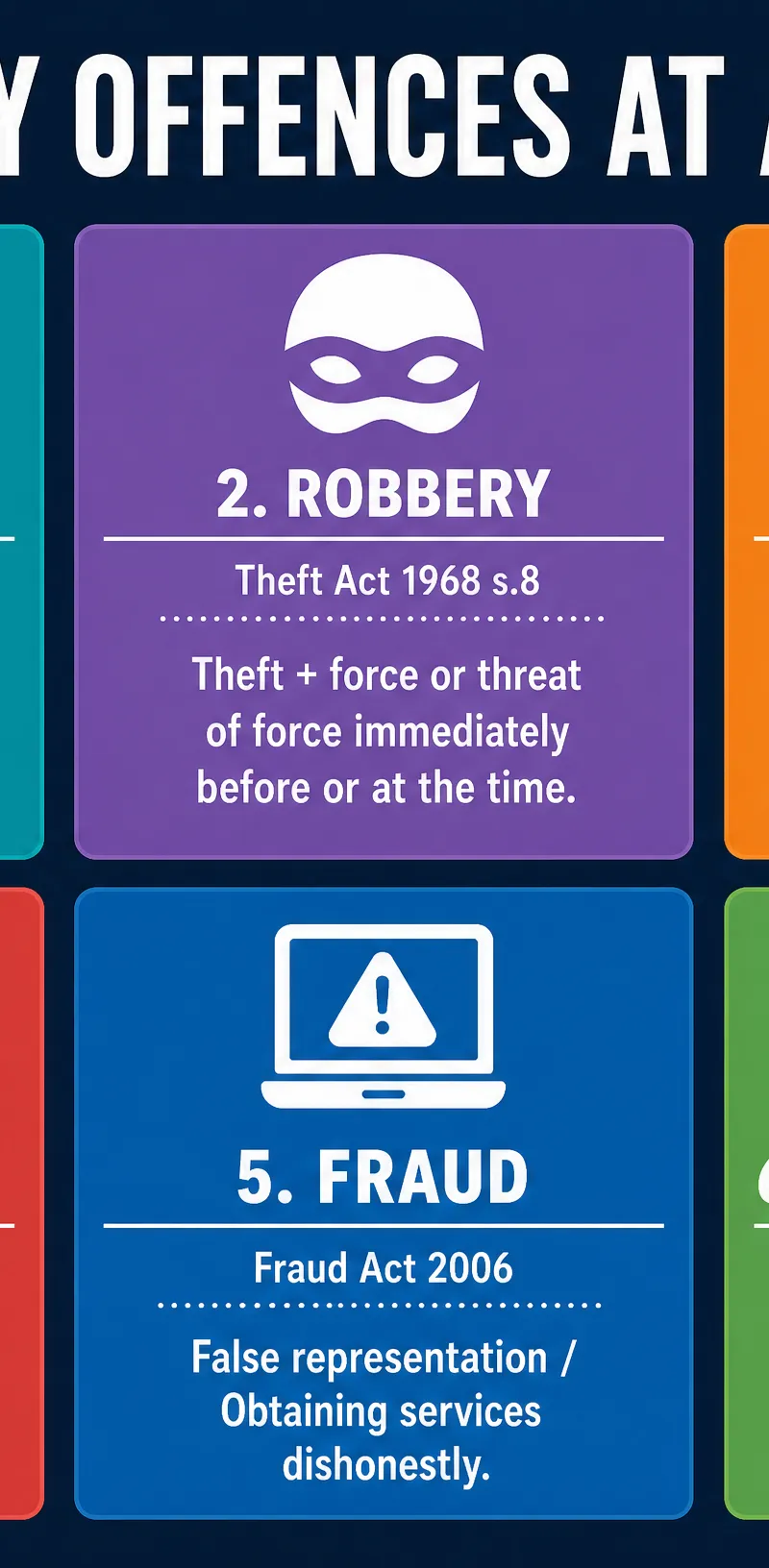
Robbery (Theft Act 1968, s.8)
Definition: A completed theft, where the defendant uses force or the threat of force immediately before or at the time of doing so, and in order to do so. Even minimal force suffices (R v Dawson).
Burglary (Theft Act 1968, s.9)
- s.9(1)(a): Entering a building or part of a building as a trespasser with intent to steal, inflict GBH, or do unlawful damage. (The intent must exist at the point of entry).
- s.9(1)(b): Entering a building or part of a building as a trespasser and subsequently stealing or inflicting GBH. (The intent is formed after entry).
Fraud (Fraud Act 2006)
- Fraud by false representation (s.2): Dishonestly making a false representation, knowing it is or might be untrue or misleading, with intent to make a gain or cause a loss.
- Obtaining services dishonestly (s.11): Obtaining services by a dishonest act, knowing payment is required, with intent to avoid payment.
Criminal Damage (Criminal Damage Act 1971)
Definition: Destroying or damaging property belonging to another without lawful excuse, intending to destroy/damage or being reckless as to whether it would be destroyed/damaged.
3. General Defences
Duress
A defence where the defendant argues they were forced to commit the crime due to a threat of death or serious injury. It is a complete defence, resulting in an acquittal, but cannot be used for murder or attempted murder (R v Hasan).
- Duress of Threats: A specific threat from a person.
- Duress of Circumstances: The threat arises from the objective situation.
The Test: Was the defendant compelled to act because they reasonably believed they had good cause to fear death or serious injury? And would a sober person of reasonable firmness, sharing the defendant's characteristics, have responded in the same way?
Intoxication
Whether intoxication is a defence depends on whether it was voluntary or involuntary, and the type of offence.
- Voluntary Intoxication: The defendant chose to take the substance. It can only be a defence to specific intent offences (e.g., murder, theft) if it prevented them forming the mens rea. It is no defence to basic intent offences (e.g., assault, criminal damage) because getting drunk is considered a reckless act.
- Involuntary Intoxication: E.g., a spiked drink. This is a defence to both specific and basic intent offences, provided the defendant lacked the mens rea (R v Kingston).
4. Sentencing Framework
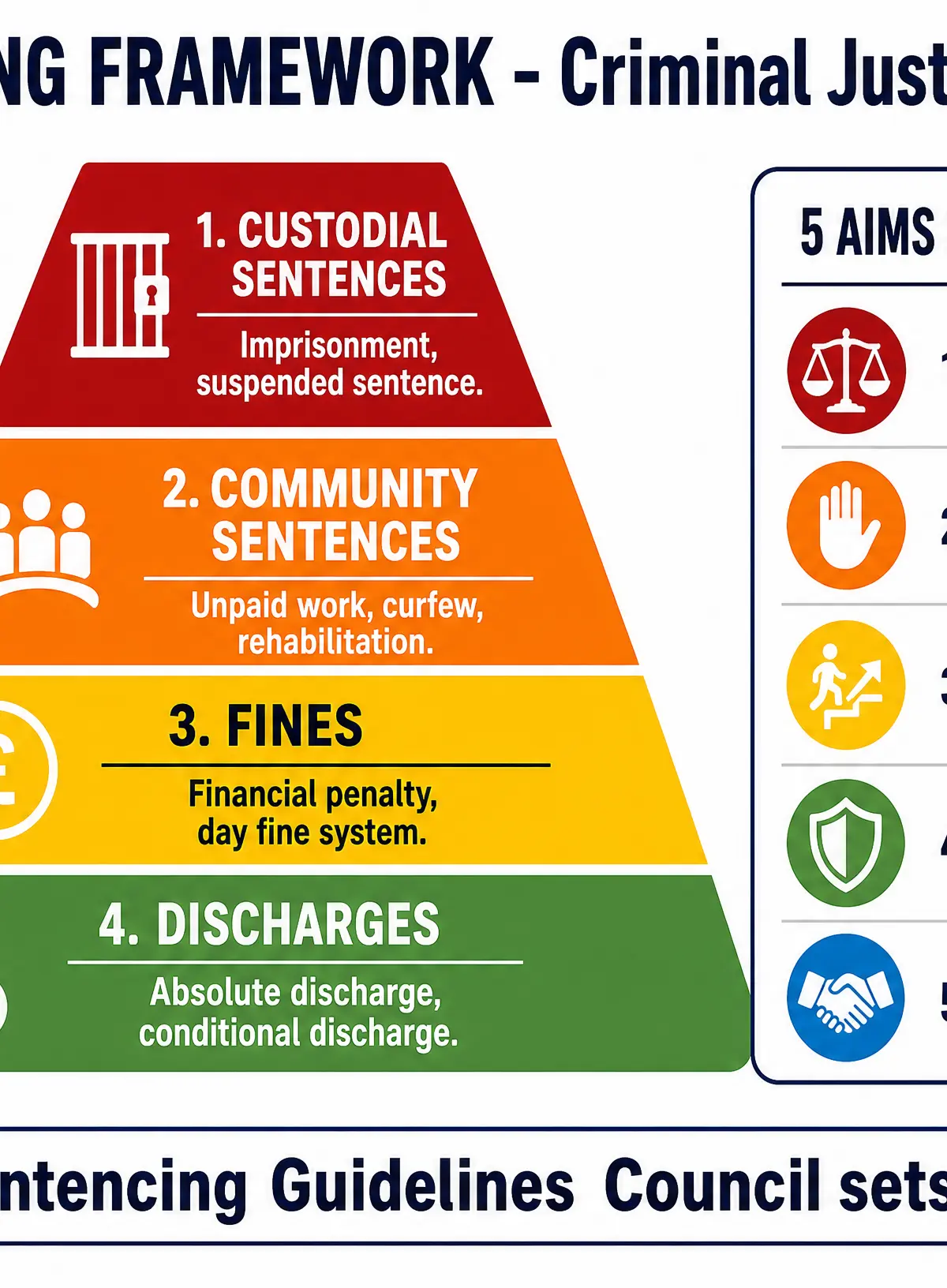
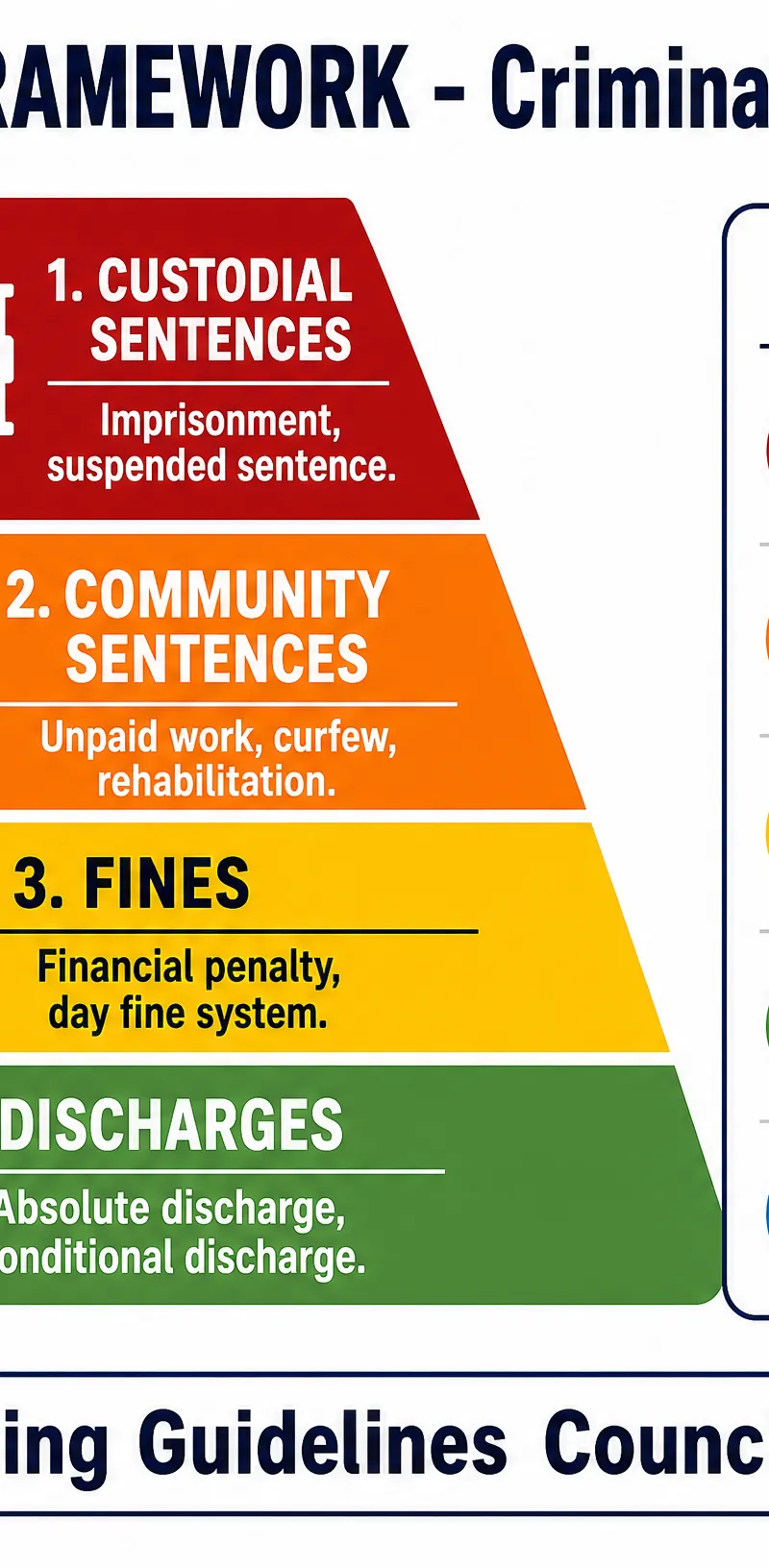
Under the Criminal Justice Act 2003, adult courts have four main sentencing options, chosen based on the seriousness of the offence and the offender's background.
- Custodial Sentences: The most severe. Immediate imprisonment or a suspended sentence (where the offender does not go to prison unless they commit another offence or breach conditions).
- Community Sentences: Includes requirements like unpaid work (up to 300 hours), curfews, or rehabilitation activity requirements.
- Fines: The most common sentence, calculated based on the severity of the offence and the offender's ability to pay.
- Discharges: Absolute (no penalty imposed) or Conditional (no penalty unless the offender reoffends within a specified period).
When sentencing, magistrates and judges must consider the five aims of sentencing:
- Retribution: Punishment for the harm caused.
- Deterrence: Discouraging the offender (individual) and others (general) from offending.
- Rehabilitation: Reforming the offender to prevent future crimes.
- Protection of the public: Keeping society safe from dangerous offenders.
- Reparation: Making amends to the victim or the community.
Podcast Revision
Listen to this 10-minute podcast episode to consolidate your knowledge on The Criminal Offender. It covers all key concepts, common exam traps, and includes a quick-fire recall quiz.
Visual Resources
3 diagrams and illustrations
Interactive Diagrams
2 interactive diagrams to visualise key concepts
Conceptual Flow Outline
Flowchart showing the logical steps to establish criminal liability.
Conceptual Flow Outline
The distinction between s.9(1)(a) and s.9(1)(b) Burglary.
Worked Examples
3 worked examples — open one to explore the question and available guidance.
Practice Questions
Try the question, then reveal an answer plan or example response
State the meaning of 'actus reus'. (1 mark)
Hint: Think of the Latin translation.
Explain the difference between direct intention and oblique intention. (3 marks)
Hint: What is the defendant's aim in direct intention? What phrase is essential for oblique intention?
Explain what is meant by 'strict liability' and give one reason why such offences exist. (3 marks)
Hint: What element of a crime is missing in strict liability?
Ben goes to a pub and drinks six pints of beer. He becomes highly intoxicated. On his way home, he sees a car with the window open. He reaches in and steals a sat-nav. When arrested, Ben claims he was so drunk he didn't know what he was doing. Discuss whether Ben can rely on the defence of intoxication. (5 marks)
Hint: Is theft a basic or specific intent offence? Was the intoxication voluntary or involuntary?
A judge is sentencing an offender who has committed a series of minor thefts to fund a drug addiction. The judge imposes a community sentence with a drug rehabilitation requirement. Identify two aims of sentencing the judge is trying to achieve and explain how this sentence achieves them. (4 marks)
Hint: Look at the specific requirements of the community sentence.
Exam technique
How to turn what you know into marks
How to approach the question
Always highlight the command word first. If it's a scenario question, read the facts twice. The first time to get the story, the second time to spot the specific legal issues (e.g., did they use force? were they drunk?). Plan your answer using the 'State, Apply, Conclude' structure.
How to structure your answer
For 6+ mark scenario questions: Paragraph 1: Identify the offence and state the statutory definition. Paragraph 2: Apply the Actus Reus elements to the facts. Paragraph 3: Apply the Mens Rea elements to the facts. Paragraph 4: Consider any defences. Paragraph 5: Brief conclusion on liability.
Timing
Approximately 1 minute per mark. A 6-mark scenario question should take about 6-7 minutes to read, plan, and write.
Common pitfalls
- Failing to apply the law to the facts. Stating the law perfectly but not linking it to the scenario will cap your marks at half.
- Confusing basic and specific intent when discussing voluntary intoxication. Remember: getting drunk is reckless, so it's no defence to crimes that only require recklessness (basic intent).
- Using the word 'reckless' without specifying 'subjective recklessness'.
What the command words want
- Apply
- Use the legal rules to solve the problem presented in the scenario. Use the word 'here'.
- Discuss
- Present key points about a topic, often looking at different sides or elements.
- Explain
- Set out the legal rules and show understanding of how they work. Use cases/statutes.
- Describe
- Set out the main characteristics or steps. Do not explain why.
- Evaluate
- Consider strengths and weaknesses, weigh up arguments, and reach a reasoned conclusion.
- State/Give
- Brief factual answer - no explanation needed. Often 1 mark.
Watch or listen (optional)
Test your understanding of The criminal offender
Active recall beats re-reading. Take an instant quiz now to test what you’ve learned and lock it into long-term memory.
7 days Premium · Then the free plan continues · No card, no charge