Pearson Edexcel · A-Level · Law
Course version: Pearson-A-Level-Law · Version from Mar 2026
The nature, purpose of and liability in law
This topic introduces the very foundations of the legal system: what law is, why we need it, and how it differs from everyday rules. It's a crucial topic because understanding the distinction between civil and criminal liability, and the theories behind punishment, underpins everything else you'll study in GCSE Law.
- 7 min read
- 3 worked examples
- 5 practice questions
- 6 key terms
Check what you remember
Read the wording for your board, then hide it and explain Burden of Proof in your own words. Rough notes are fine. This is a self-check, with no mark or grade.
Reference: Pearson Edexcel
The obligation on a party to prove the facts of the case. In criminal law, this is on the prosecution; in civil law, it is on the claimant.
Study Notes
Overview
Welcome to Topic 1.1: The Nature, Purpose of and Liability in Law. This topic is the foundation of your entire GCSE Law course. Before we can look at specific crimes or contracts, we need to understand what 'law' actually is.
Why is this important? Because the law isn't just a list of rules; it's a complex system that reflects society's values, protects our rights, and provides a mechanism for resolving disputes. In this topic, we will explore the fundamental differences between rules and laws, dive into the crucial distinction between civil and criminal liability, and examine the philosophical debates about the relationship between law and morality.
Examiners love testing this area through both short-answer definition questions and longer, evaluative essays where you must apply legal theories to real-world scenarios.
Listen to our 10-minute revision podcast covering all the core concepts of this topic.
Key Concepts
Concept 1: Rules vs. Law
We all follow rules every day—rules at home, rules at school, rules in sports. But what elevates a rule to a law? There are three essential characteristics that distinguish a law from a mere rule:
- Certainty: Laws are formalised, written down, and publicly accessible. You can look up the Theft Act 1968, but you won't find your family's rule about washing the dishes in a statute book.
- Enforcement: There is a recognised, formal mechanism to ensure compliance.
- State Sanctioning: This is the most critical difference. Laws are backed by the authority of the state (the government). If you break a rule, you might get grounded; if you break a law, the state can deprive you of your liberty, money, or property.
Example: A school rule states students must wear ties. If broken, a teacher gives a detention. The law states you must not steal (Theft Act 1968). If broken, the police arrest you, the Crown Prosecution Service prosecutes you, and a judge sentences you to prison. The state has the ultimate monopoly on legitimate force.
Concept 2: Civil Liability vs. Criminal Liability
This is perhaps the most important distinction in the entire legal system. You must never confuse the terminology between the two.
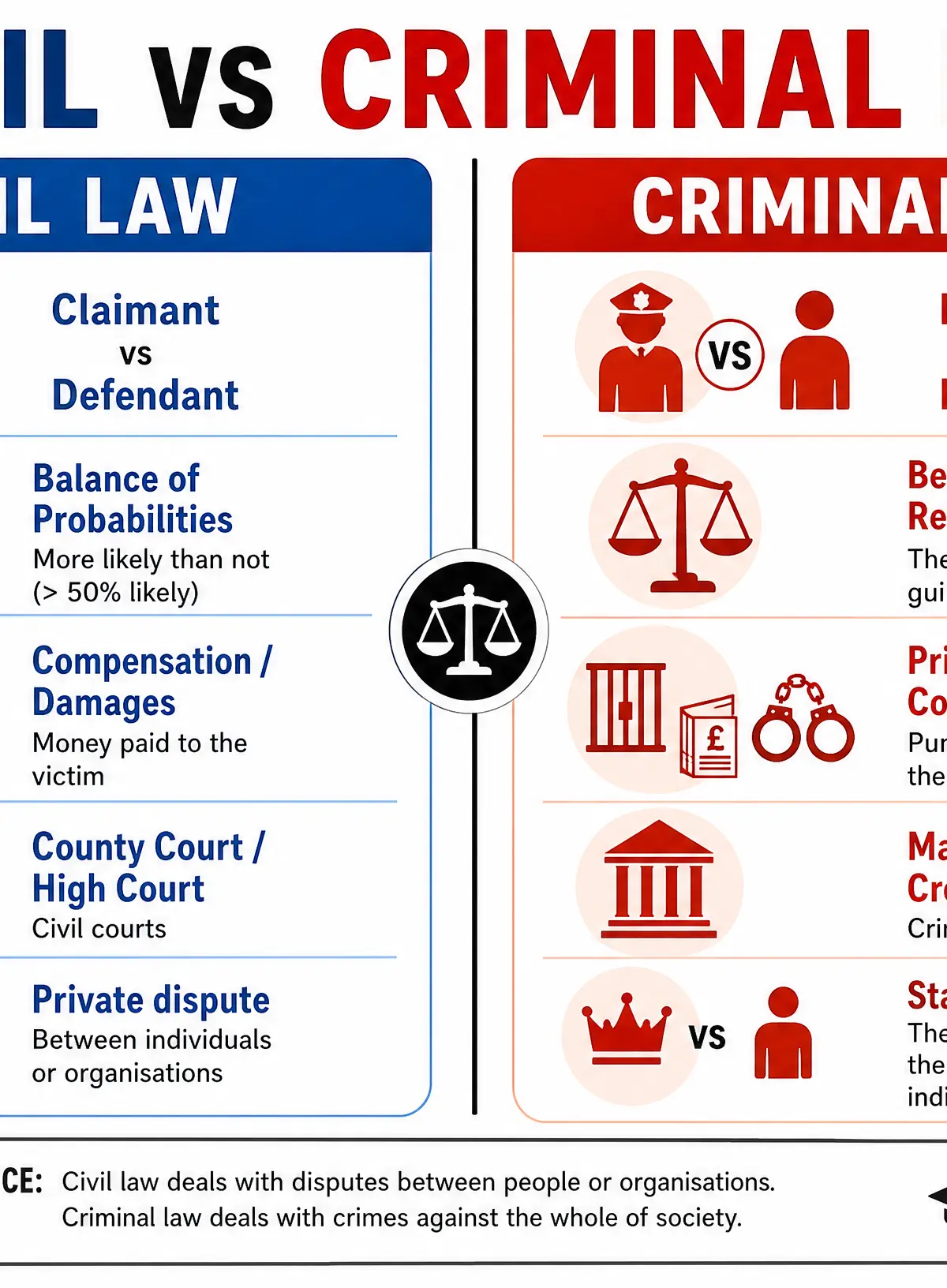
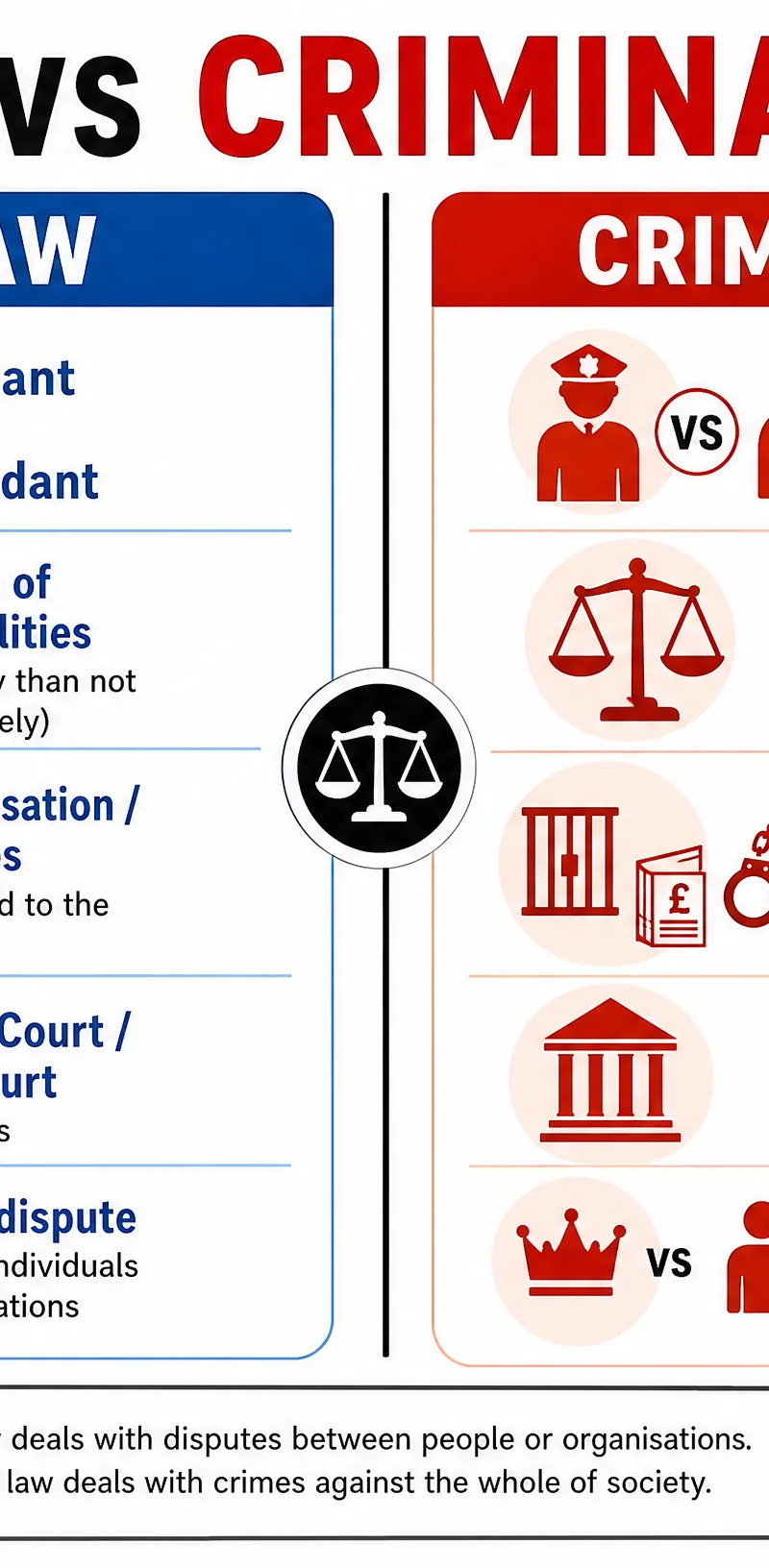
Criminal Law deals with offences against the state and society as a whole. Even if a crime is committed against one person (like an assault), it is viewed as an attack on the public order.
- Parties: The State (represented by the Crown Prosecution Service, or 'Prosecution') brings the case against the Defendant.
- Burden of Proof: The burden is on the prosecution to prove the defendant is guilty. The defendant does not have to prove their innocence.
- Standard of Proof: Beyond reasonable doubt. This is a very high standard. If the jury has any logical, sensible doubt, they must acquit.
- Sanctions: Punishments such as imprisonment, fines paid to the state, or community orders.
Civil Law deals with disputes between private individuals or organisations. It's about rights and duties between citizens.
- Parties: The Claimant (the person who has suffered loss) brings the case against the Defendant.
- Burden of Proof: The burden is on the claimant to prove their case.
- Standard of Proof: On the balance of probabilities. This simply means it is more likely than not (>50% likely) that the defendant is liable.
- Sanctions: Remedies, usually damages (financial compensation paid to the claimant) or an injunction (an order to stop doing something).
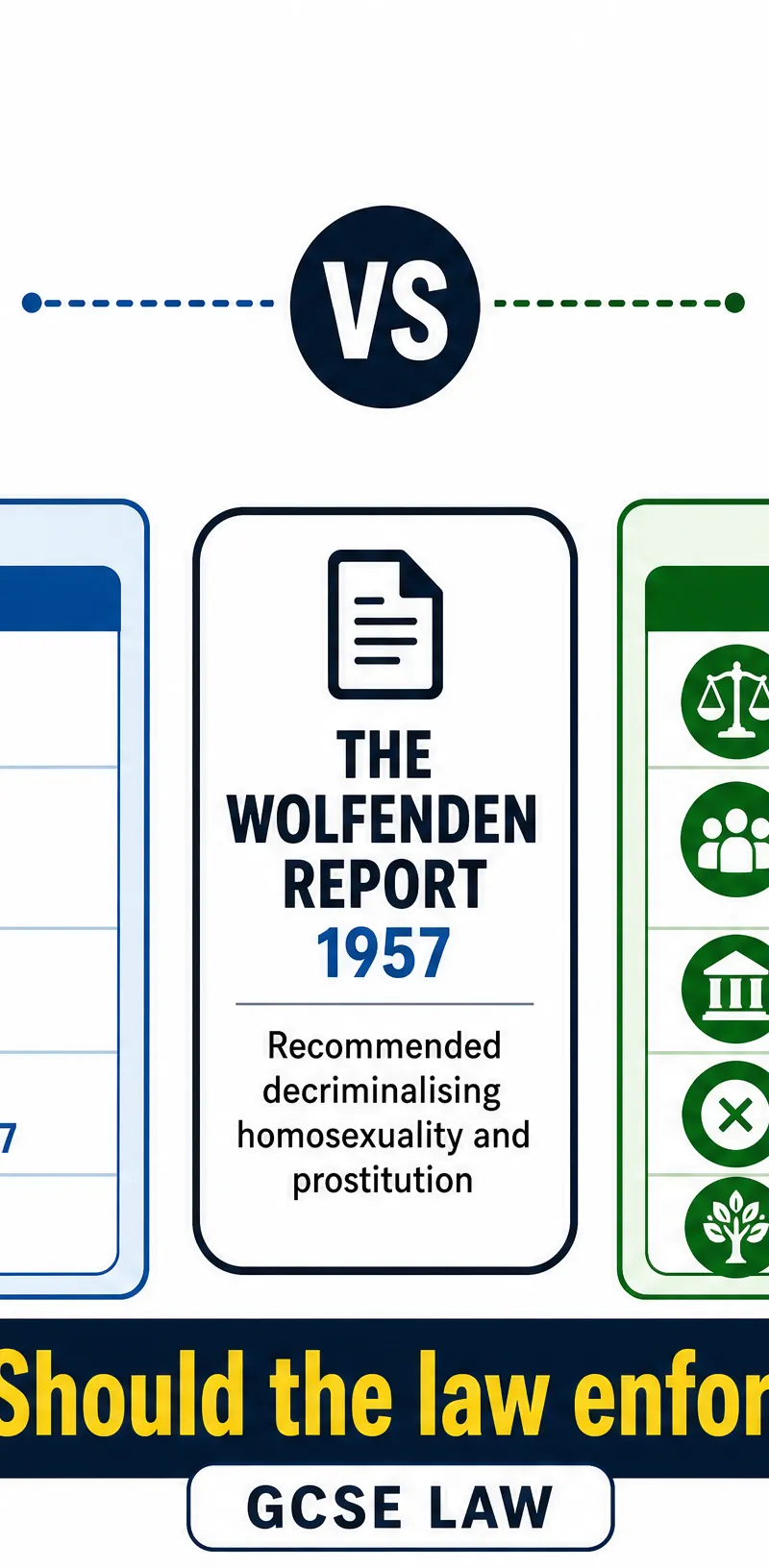
Concept 3: Law and Morality (The Hart-Devlin Debate)
Does the law have to be moral? Should the law enforce society's moral code? These questions form the basis of legal philosophy.
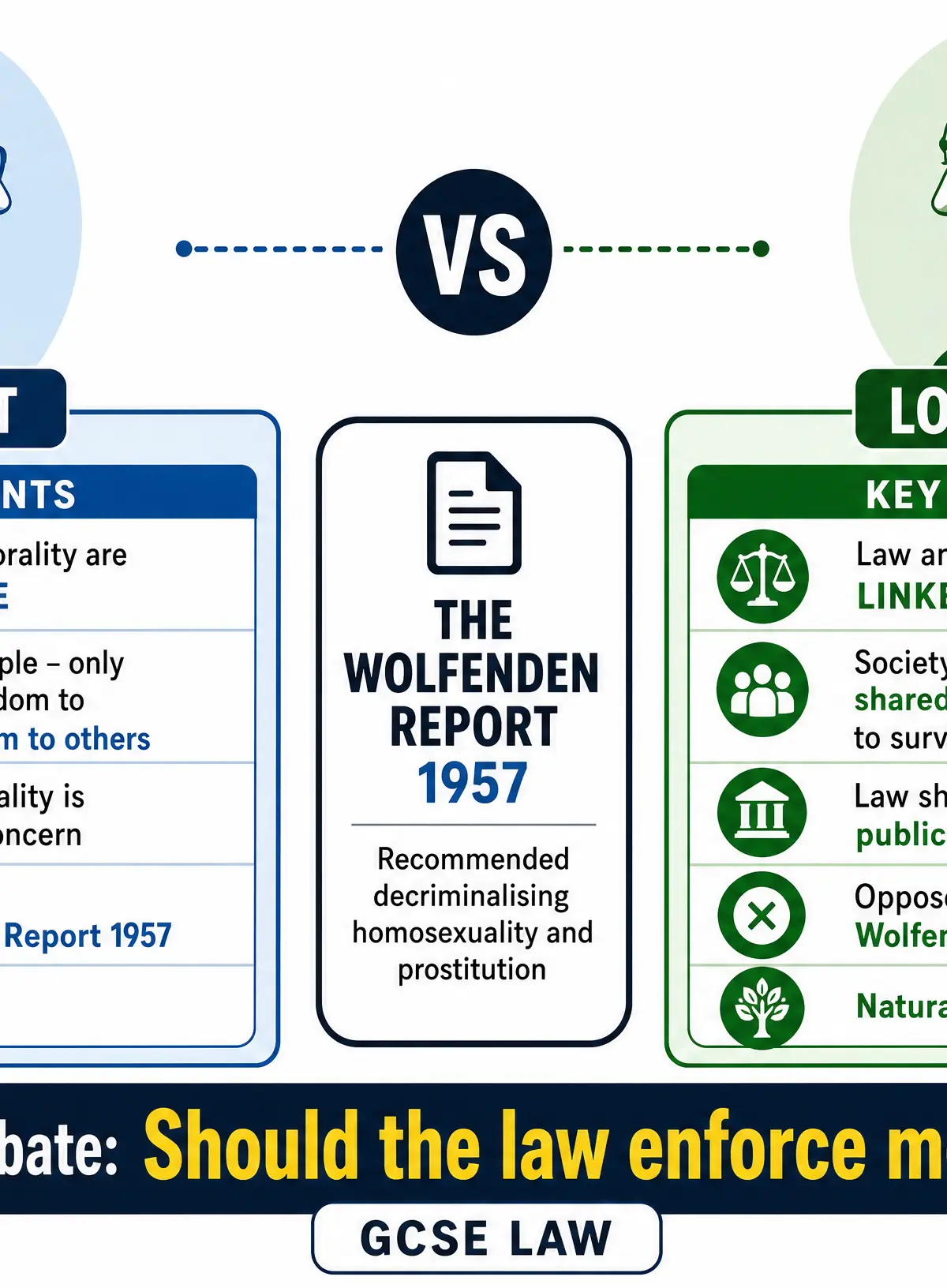
- Positivism: Theorists like H.L.A. Hart argue that law and morality are separate. A law is valid simply because it was made by the correct authority (e.g., Parliament), regardless of whether it is 'good' or 'bad'.
- Natural Law: Theorists like Lord Devlin argue that law must be rooted in morality. An unjust law is not a true law.
This clash came to a head following the Wolfenden Report 1957, which recommended decriminalising homosexuality and prostitution between consenting adults in private.
Lord Devlin argued that society is held together by a shared public morality. If the law doesn't enforce this morality, society will disintegrate. Therefore, the law should regulate private behaviour if it deeply offends the public.
H.L.A. Hart disagreed, relying on John Stuart Mill's Harm Principle: the only justification for the state to interfere with an individual's liberty is to prevent harm to others. What consenting adults do in private, Hart argued, is not the law's business.
Concept 4: Theories of Punishment
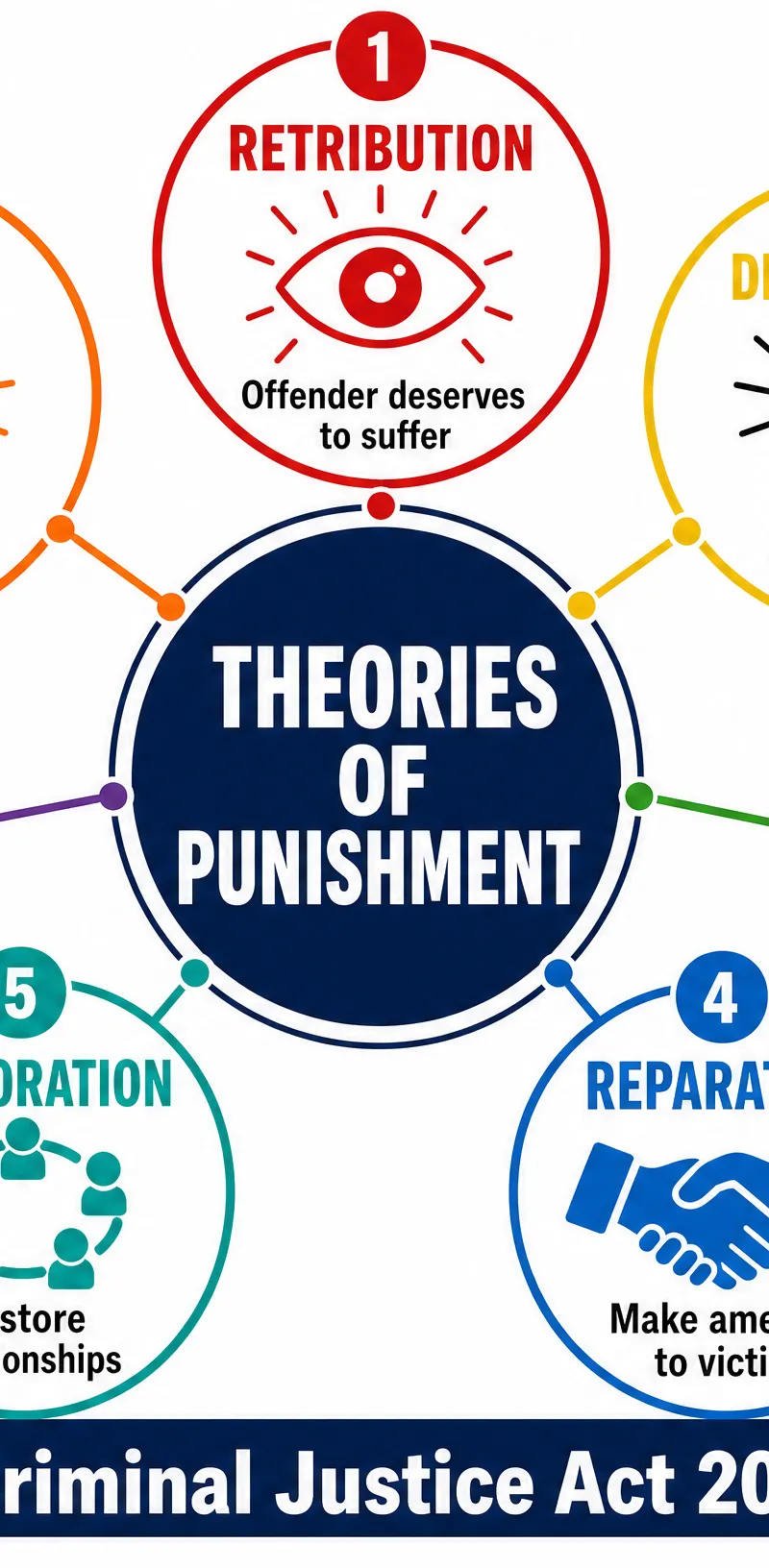
When a criminal is sentenced, the judge isn't just picking a punishment at random. Under the Criminal Justice Act 2003, sentences must reflect specific aims or theories of punishment:
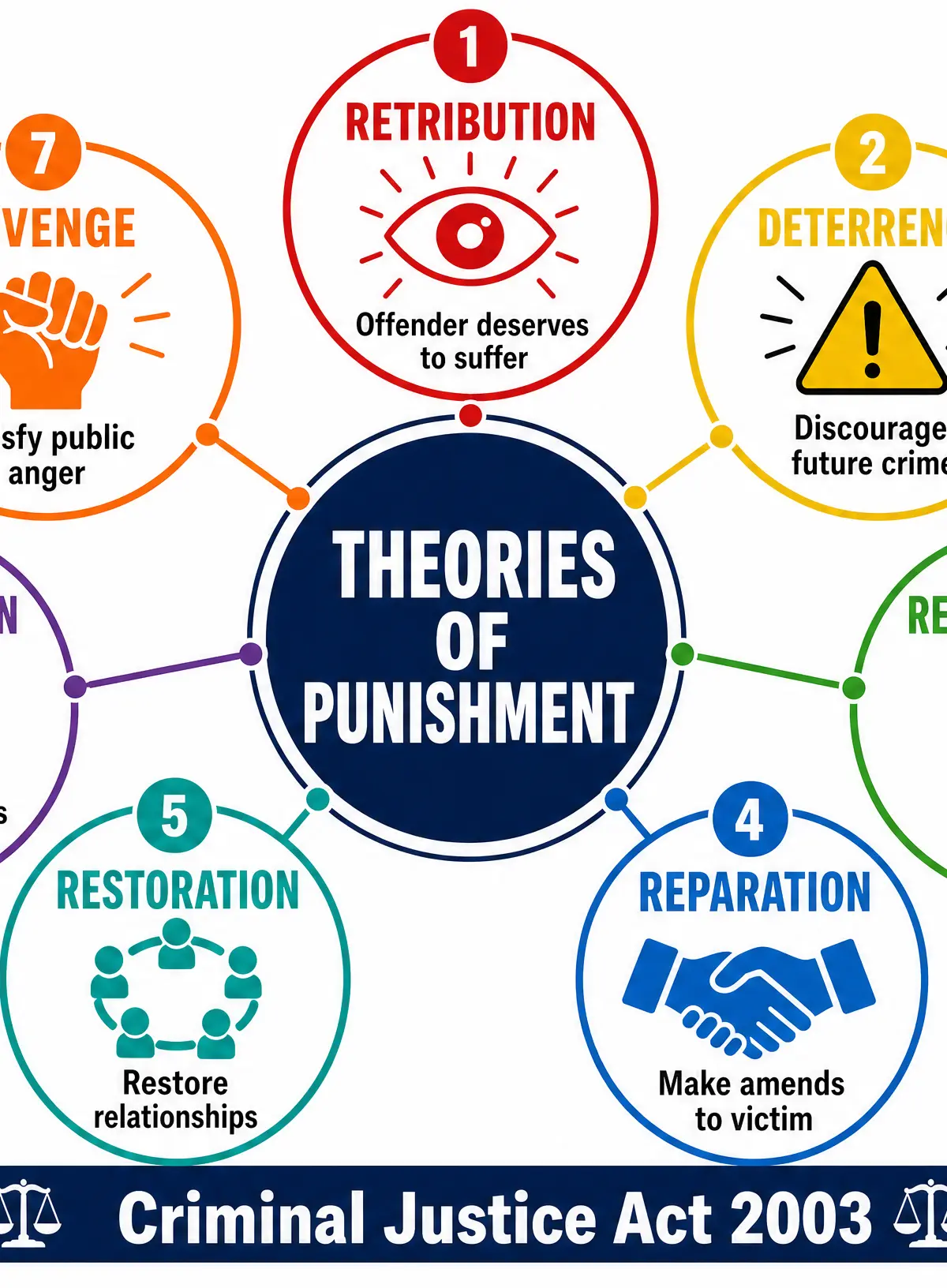
- Retribution: The offender deserves to be punished in proportion to their crime (an 'eye for an eye'). It is backward-looking, focusing on the offence committed.
- Deterrence: Aimed at preventing future crime. Individual deterrence aims to stop the specific offender from reoffending (e.g., a heavy fine). General deterrence aims to show the public what will happen if they commit the crime (e.g., a harsh prison sentence for rioting).
- Rehabilitation: Forward-looking. Aims to reform the offender's character so they can reintegrate into society and not reoffend (e.g., drug treatment programmes).
- Reparation: The offender makes amends to the victim or society (e.g., paying compensation or doing unpaid work).
- Restoration: Focuses on repairing the harm caused, often bringing the offender and victim together (Restorative Justice) so the offender understands the impact of their actions.
- Denunciation: Society expressing its outrage and condemnation of the behaviour, reinforcing moral boundaries.
- Revenge: Often considered the most primitive theory; satisfying the public's desire for vengeance.
Practical Applications
Understanding the difference between civil and criminal law is vital when reading the news. When a celebrity sues a newspaper for defamation, that is a civil case (Claimant vs Defendant, balance of probabilities). When a person is arrested for theft, that is a criminal case (Prosecution vs Defendant, beyond reasonable doubt). Recognising this distinction allows you to understand why different courts are used and why the outcomes (damages vs prison) are so different.
Visual Resources
3 diagrams and illustrations
Interactive Diagrams
2 interactive diagrams to visualise key concepts
Conceptual Flow Outline
Flowchart showing the procedural differences between Civil and Criminal Law
Conceptual Flow Outline
The Hart-Devlin Debate summary
Worked Examples
3 worked examples — open one to explore the question and available guidance.
Practice Questions
Try the question, then reveal an answer plan or example response
State the standard of proof in a civil case. (1 mark)
Hint: Think about percentages and likelihood.
Explain one difference between a rule and a law. (2 marks)
Hint: Who enforces a rule versus who enforces a law?
Describe the theory of deterrence as an aim of sentencing. (3 marks)
Hint: Who is being deterred? Is it just the offender?
Explain Lord Devlin's view on the relationship between law and morality. (4 marks)
Hint: Think about what Devlin thought would happen to society without shared morals.
Discuss the differences between civil and criminal liability. (6 marks)
Hint: Compare the parties, the burdens/standards of proof, and the outcomes.
Exam technique
How to turn what you know into marks
How to approach the question
Always highlight the command word first. If it says 'State', don't waste time writing a paragraph. If it says 'Discuss', ensure you are looking at multiple sides or comparing concepts explicitly.
How to structure your answer
For 4-6 mark questions, use P.E.E.L (Point, Evidence/Example, Explain, Link back to the question).
Timing
Approximately 1 minute per mark, so a 6-mark question should take about 6-7 minutes.
Common pitfalls
- Mixing up the burden of proof (who has to prove it) with the standard of proof (how much proof is needed).
- Using the word 'guilty' in a civil law context. In civil law, a defendant is found 'liable', not guilty.
- Failing to link a theory of punishment to a specific type of sentence when asked to explain its application.
What the command words want
- Compare
- Identify similarities AND differences - use comparative language.
- Explain
- Say HOW or WHY - use 'because' to link cause and effect.
- Describe
- Say what happens or what something is like - use correct terminology.
- Evaluate
- Consider both sides, use evidence, make a judgement.
- Calculate
- Show working, use correct formula, include units.
- State/Give
- Brief factual answer - 1-2 words or a short phrase.
Watch or listen (optional)
Test your understanding of The nature, purpose of and liability in law
Active recall beats re-reading. Take an instant quiz now to test what you’ve learned and lock it into long-term memory.
7 days Premium · Then the free plan continues · No card, no charge