Pearson Edexcel · A-Level · Law
Course version: Pearson-A-Level-Law · Version from Mar 2026
The sources of English law, its enforcement and administration
This topic explores the fundamental question: where do our laws come from? You will learn how Parliament creates statutes, how judges interpret them and make new law through precedent, and the roles of the legal personnel who keep the justice system running.
- 7 min read
- 3 worked examples
- 5 practice questions
- 6 key terms
Check what you remember
Read the wording for your board, then hide it and explain Parliamentary Sovereignty in your own words. Rough notes are fine. This is a self-check, with no mark or grade.
Reference: Pearson Edexcel
The constitutional principle that Parliament is the supreme law-making body and can enact or repeal any law.
Study Notes
Overview
Welcome to Topic 1.2: The Sources of English Law. This is a foundational topic in your GCSE Law specification because it explains the origin of every law you will study, from criminal offences to civil disputes.
English law is not found in a single document or constitution. Instead, it is drawn from multiple sources: Acts of Parliament (statutes), judicial decisions (common law and precedent), delegated legislation, equity, and historically, EU law. Understanding how these sources interact is crucial for the exam.
Examiners frequently test your ability to explain the stages of an Act of Parliament, apply the rules of statutory interpretation to given scenarios, and evaluate the advantages of different types of delegated legislation. You will also need to understand the hierarchy of the courts and how the doctrine of precedent binds lower courts to the decisions of higher ones.

Key Concepts
Concept 1: Parliamentary Law-Making
Parliament is the supreme law-making body in the UK, a principle known as Parliamentary Sovereignty. This means Parliament can create or repeal any law, and no court can overrule an Act of Parliament.
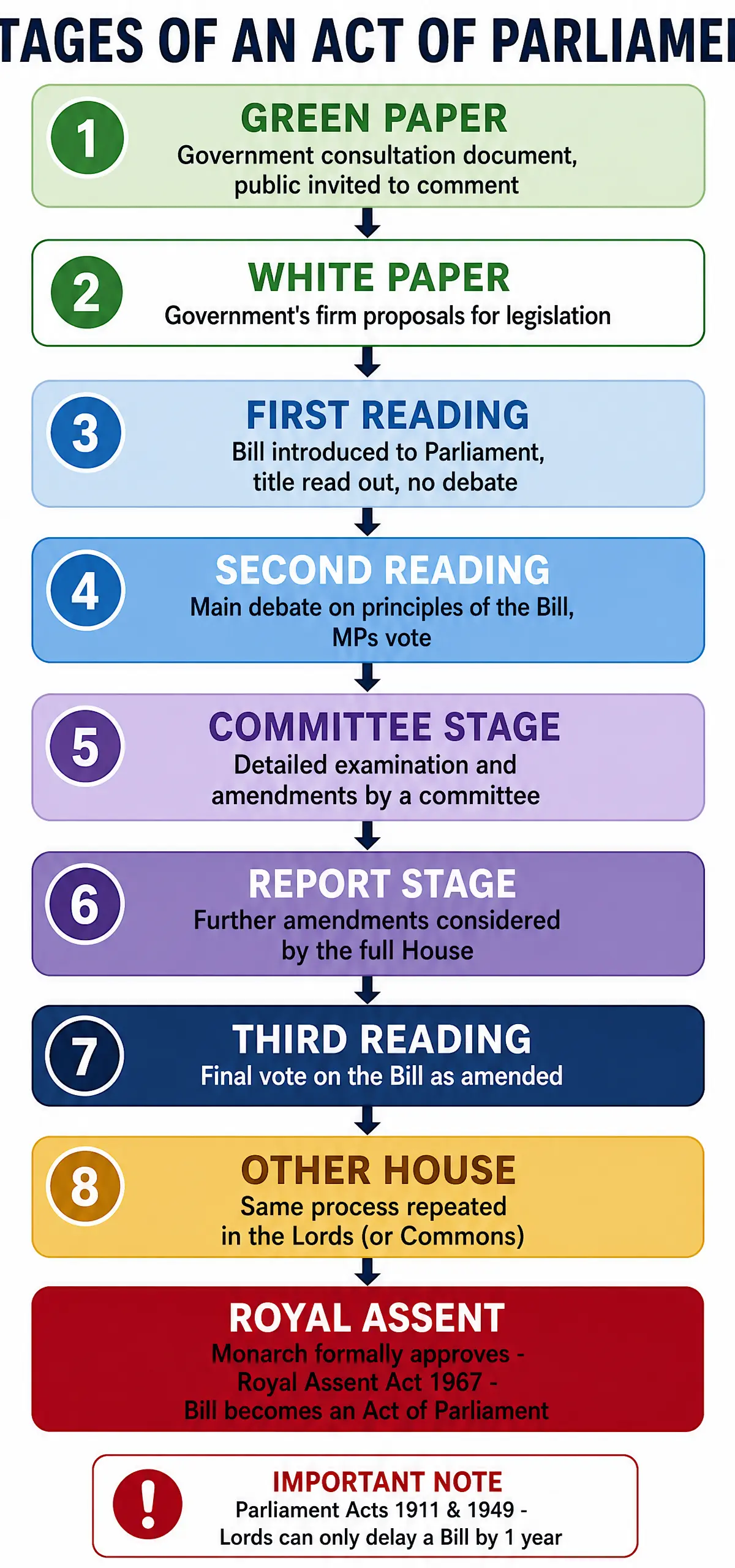
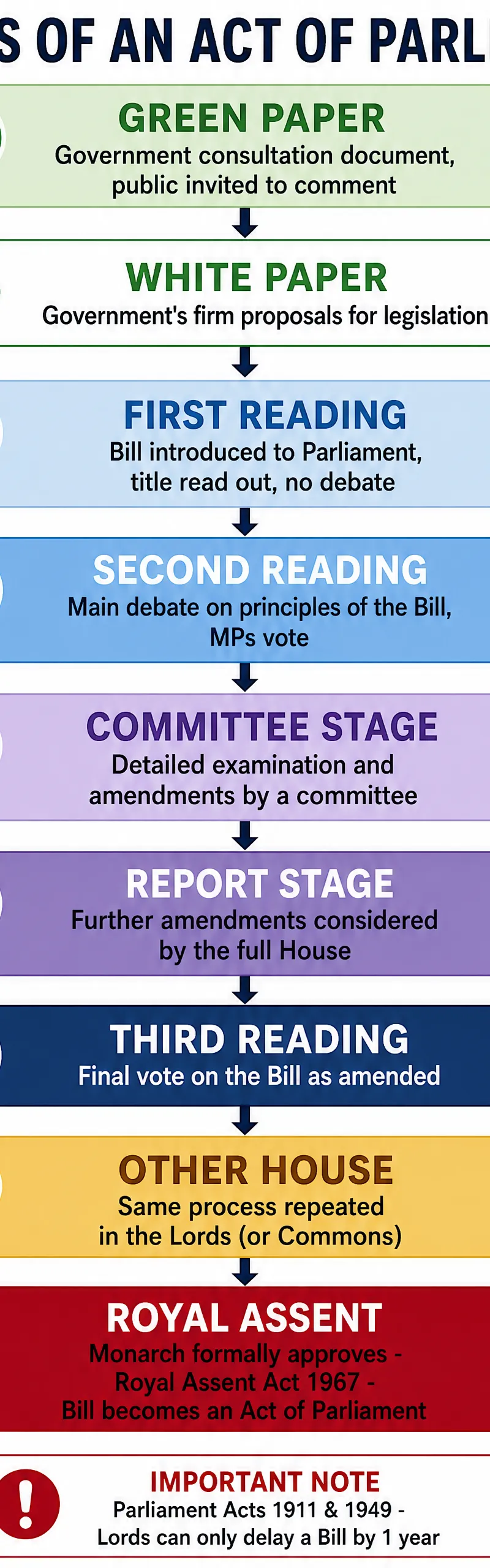
The process of creating an Act begins with a proposal. A Green Paper is a consultation document inviting public feedback, followed by a White Paper setting out firm proposals. The Bill then enters Parliament and goes through five main stages in both the House of Commons and the House of Lords:
- First Reading: The Bill is introduced and its title read out.
- Second Reading: The main debate on the principles of the Bill, followed by a vote.
- Committee Stage: Detailed examination and amendment by a smaller committee of MPs.
- Report Stage: The full House considers the committee's amendments.
- Third Reading: The final vote on the amended Bill.
Once passed by both Houses, the Bill receives Royal Assent (now a formality under the Royal Assent Act 1967) and becomes an Act of Parliament.
Crucial Legislation: The Parliament Acts 1911 and 1949 limit the power of the House of Lords. They can only delay a Bill for up to one year, ensuring the elected House of Commons has the final say.
Concept 2: Statutory Interpretation
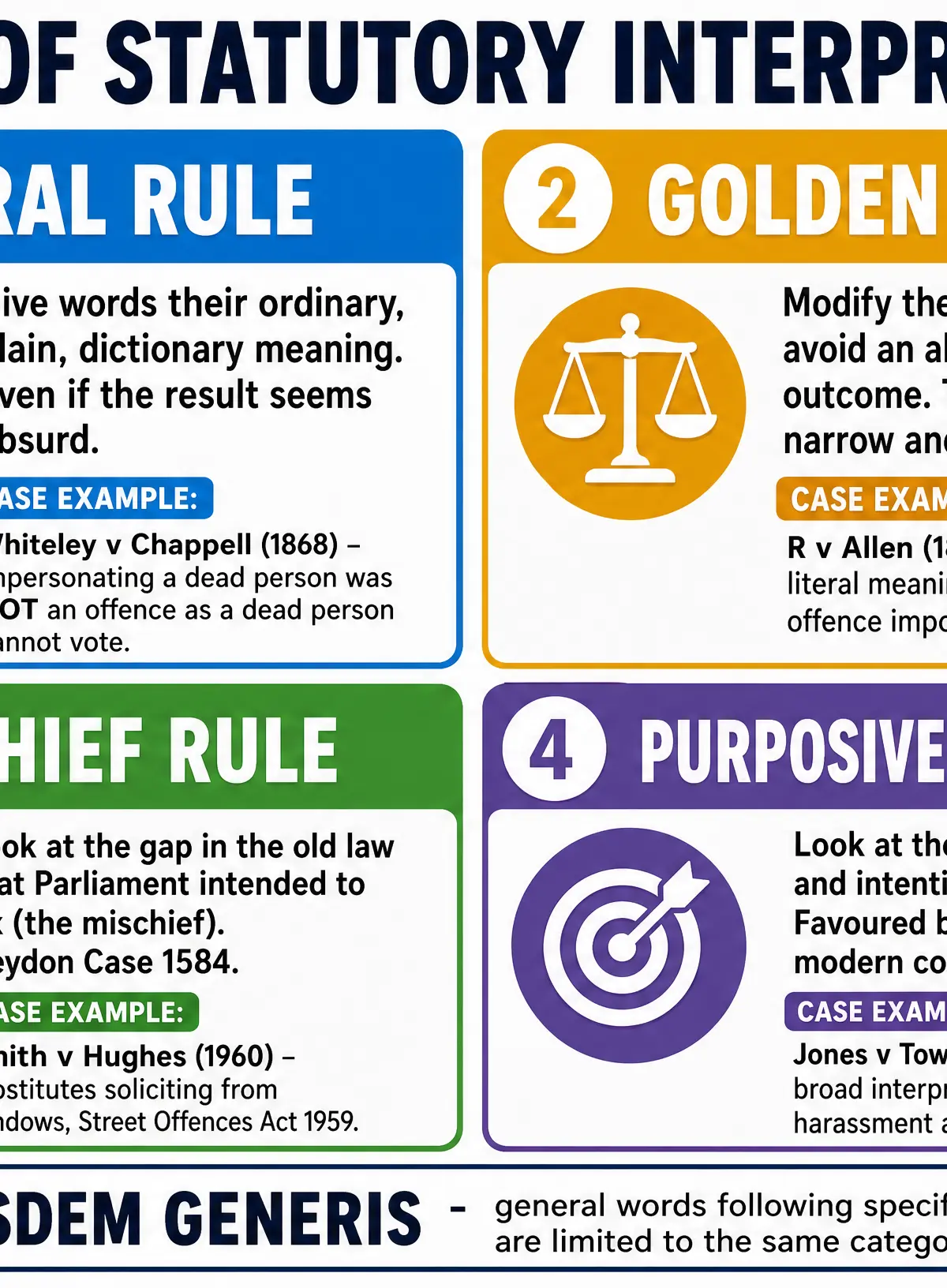
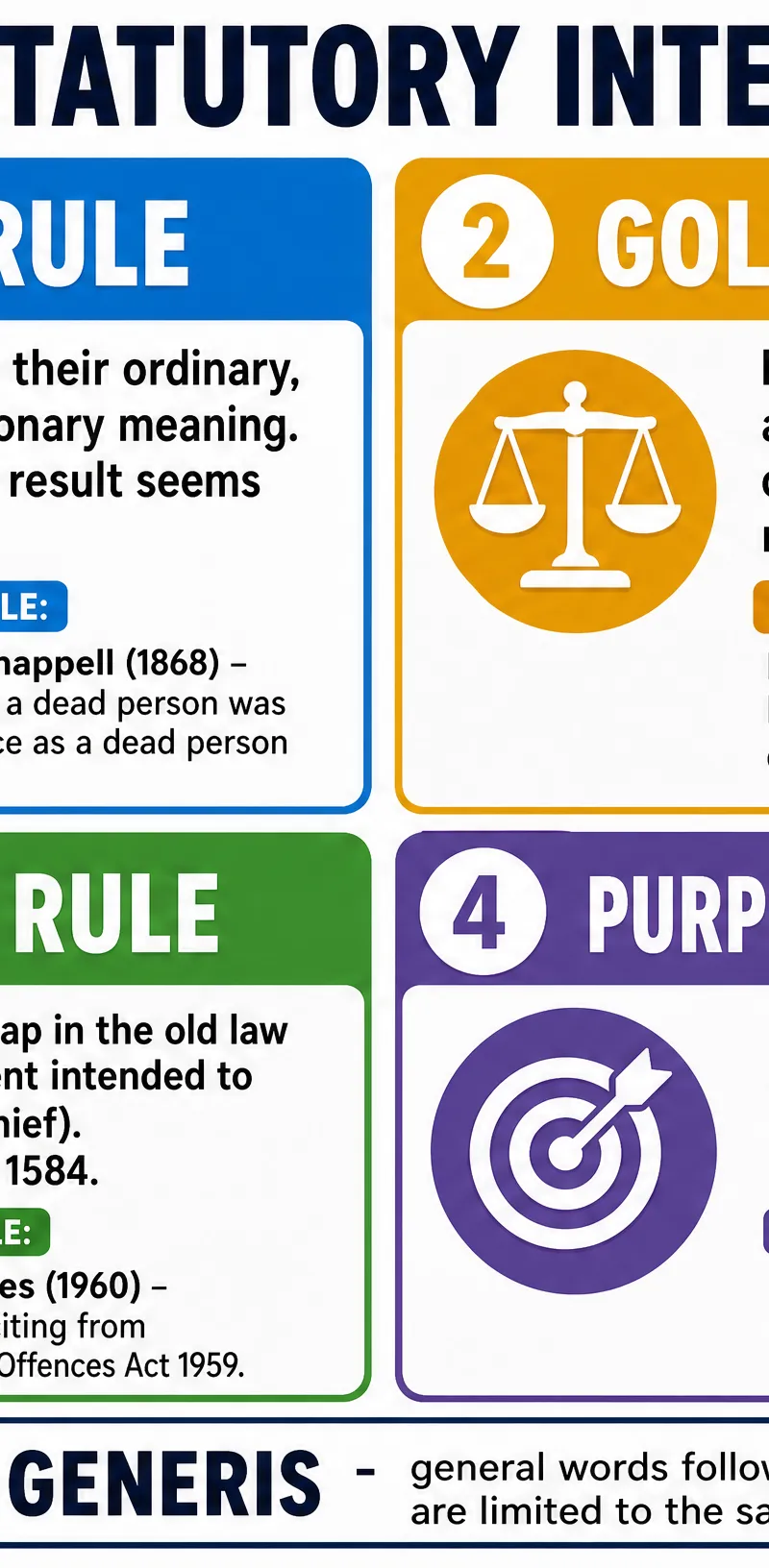
Once an Act is passed, courts must apply it. However, words can be ambiguous. Judges use four main rules to interpret statutes:
-
The Literal Rule: Words are given their plain, dictionary meaning, even if the result is absurd.
Example: Whiteley v Chappell (1868). A statute made it an offence to impersonate a "person entitled to vote". The defendant impersonated a dead person. Using the literal rule, he was found not guilty, as a dead person is not entitled to vote. -
The Golden Rule: Modifies the literal rule to avoid an absurd or repugnant outcome.
Example: R v Allen (1872). The Offences Against the Person Act made it an offence to "marry" while already married. Taken literally, this is impossible, as a second marriage is legally void. The court used the golden rule to interpret "marry" as "going through a ceremony of marriage". -
The Mischief Rule: Looks at the gap or "mischief" in the old law that Parliament intended to fix, and interprets the Act to suppress that mischief.
Example: Smith v Hughes (1960). The Street Offences Act made it illegal for prostitutes to solicit "in a street or public place". The defendants were soliciting from windows and balconies. The court held the mischief the Act intended to stop was public nuisance, so they were guilty even though they were technically inside. -
The Purposive Approach: A broader, modern approach that looks at the overall purpose of the legislation.
Example: Jones v Tower Boot Co (1997). The court took a purposive approach to the Race Relations Act to ensure it covered racial harassment in the workplace, fulfilling Parliament's intention to eliminate discrimination.
Concept 3: Delegated Legislation
Parliament delegates law-making power to other bodies because it lacks the time and technical expertise to pass detailed rules for every situation. There are three types:
- Orders in Council: Made by the Privy Council (monarch and ministers) for emergencies or constitutional matters.
- Statutory Instruments: Regulations made by government ministers for their specific departments (e.g., the Minister for Transport making road traffic rules). These are the most common.
- Bylaws: Made by local authorities or public bodies for local matters (e.g., banning drinking in a specific park).
Controls: Delegated legislation is controlled by Parliament (through affirmative or negative resolution procedures) and by the courts. Judges can declare delegated legislation ultra vires (beyond the powers) if it exceeds the authority granted by the parent Act.
Concept 4: Judicial Precedent (Stare Decisis)
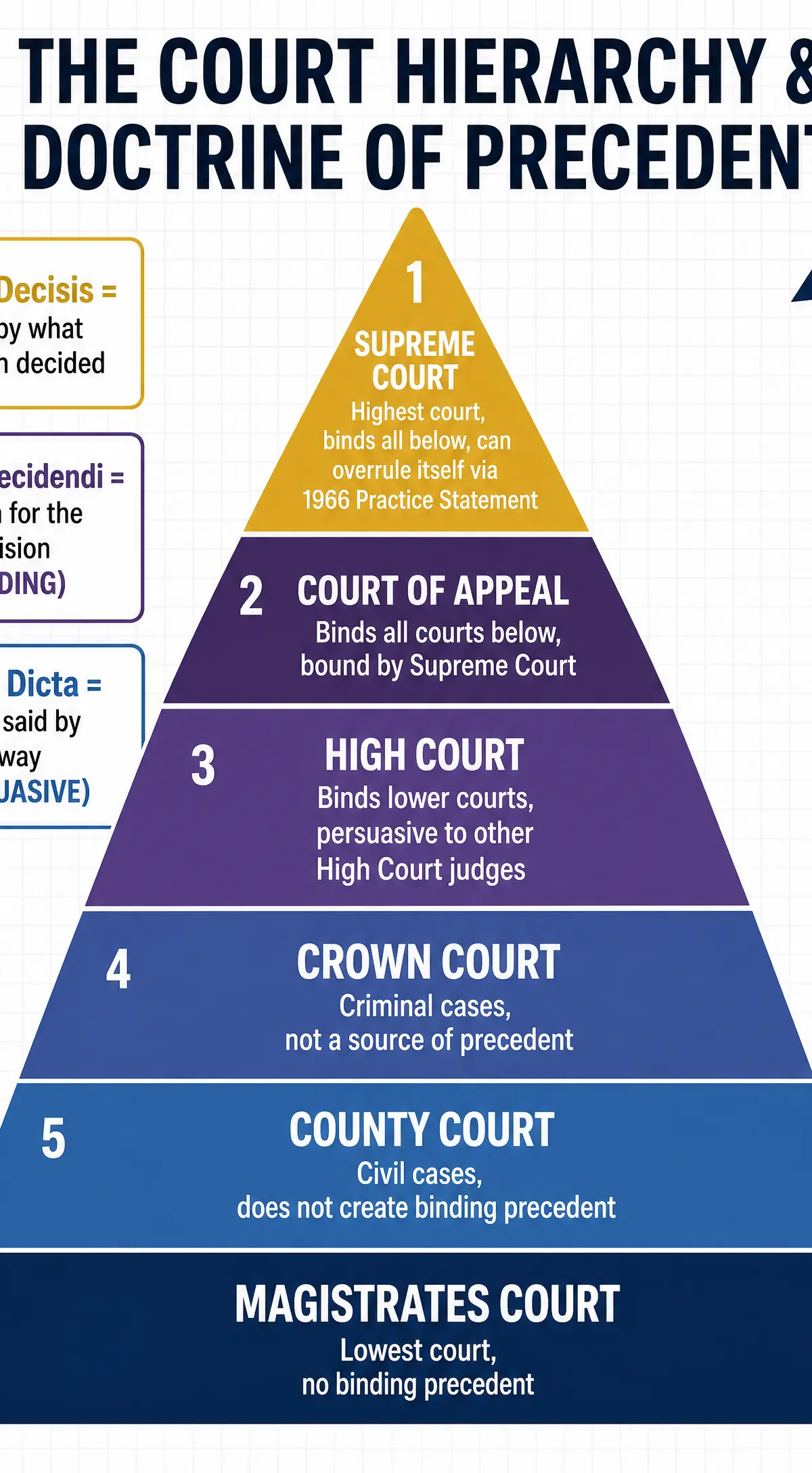
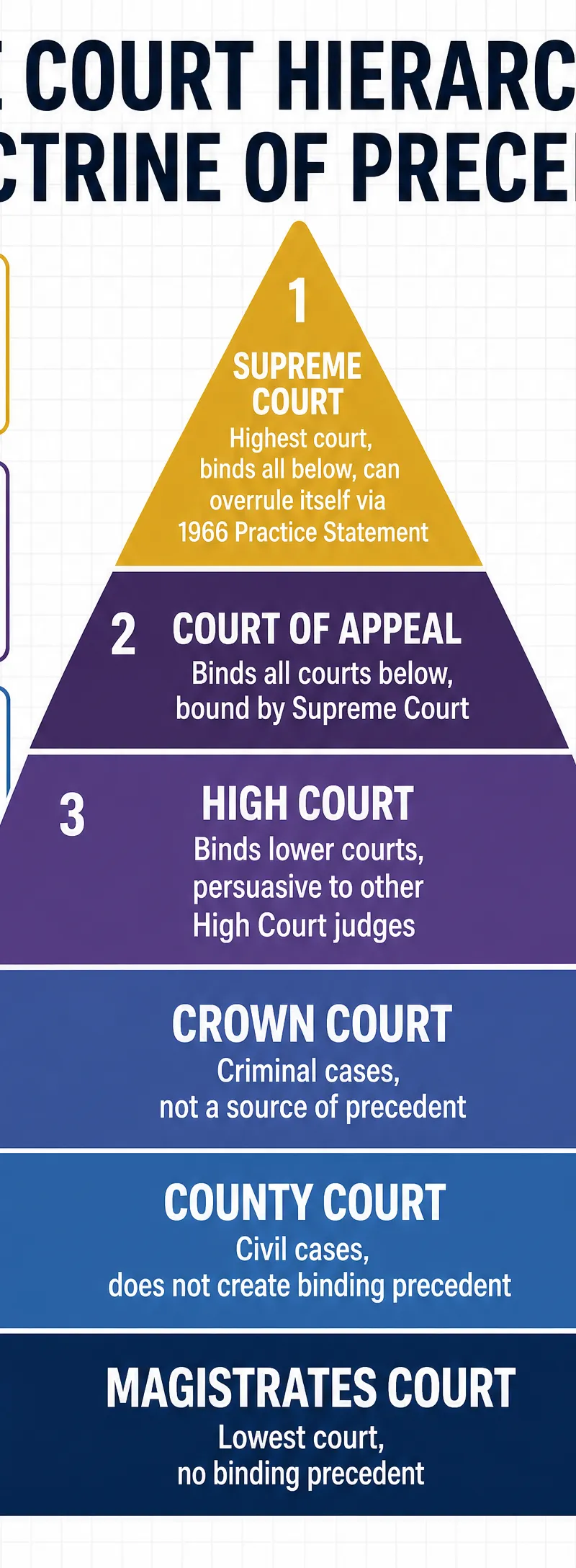
Precedent is the process whereby judges follow the decisions of previous cases. The Latin term is stare decisis (stand by what has been decided).
Only the ratio decidendi (the reason for the decision) is binding on future courts. Any other statements made by the judge are obiter dicta (things said by the way) and are only persuasive.
Precedent relies on a strict court hierarchy. The Supreme Court binds all lower courts. Crucially, under the 1966 Practice Statement, the Supreme Court (formerly the House of Lords) can depart from its own previous decisions "when it appears right to do so", allowing the law to adapt to social changes.
Concept 5: Equity
Equity developed historically to remedy the rigid and sometimes unfair rules of the common law. It introduced new equitable remedies that are still used today, primarily:
- Specific Performance: A court order compelling a party to fulfill their contractual obligations.
- Rescission: Setting aside a contract and returning the parties to their pre-contractual position.
Concept 6: Legal Personnel and Dispute Resolution
The legal system relies on various personnel:
- Judges: Appointed by the Judicial Appointments Commission (created by the Constitutional Reform Act 2005 to ensure independence).
- Solicitors: Provide legal advice and handle everyday legal matters.
- Barristers: Specialist advocates who represent clients in higher courts.
- Magistrates: Lay people (unpaid, without formal legal qualifications) who hear 95% of criminal cases.
- Jurors: Members of the public who decide the facts in Crown Court trials.
For civil disputes, Alternative Dispute Resolution (ADR) offers alternatives to court. These include negotiation, mediation (using a neutral third party), arbitration (a formal binding decision by an arbitrator), and tribunals (specialist bodies for specific disputes like employment).
Practical Applications
Understanding the rules of statutory interpretation is highly practical. Lawyers use these rules daily to argue how a statute should apply to their client's specific circumstances. Knowing the court hierarchy is essential for understanding whether a previous decision will bind the judge in a current case, or if it can be distinguished.
Visual Resources
3 diagrams and illustrations
Interactive Diagrams
2 interactive diagrams to visualise key concepts
Conceptual Flow Outline
The legislative process for an Act of Parliament
Conceptual Flow Outline
The hierarchy of the civil courts and binding precedent
Worked Examples
3 worked examples — open one to explore the question and available guidance.
Practice Questions
Try the question, then reveal an answer plan or example response
State the three types of delegated legislation. (3 marks)
Hint: Think about the Privy Council, government ministers, and local councils.
Explain the mischief rule of statutory interpretation using one case example. (4 marks)
Hint: What is the rule trying to fix? Remember the case involving prostitutes soliciting from windows.
Describe the role of a jury in the Crown Court. (3 marks)
Hint: Do they decide the law or the facts? Do they pass the sentence?
Evaluate the use of tribunals as a method of alternative dispute resolution compared to the civil courts. (8 marks)
Hint: Consider cost, speed, formality, and the expertise of the panel. Then consider the drawbacks, such as lack of legal aid.
Explain the difference between ratio decidendi and obiter dicta. (4 marks)
Hint: Which one is binding and which one is persuasive?
Exam technique
How to turn what you know into marks
How to approach the question
Always identify the command word first. If the question asks for cases, underline that requirement so you don't forget. Plan your points before writing for questions worth 6 marks or more.
How to structure your answer
For 4-6 mark questions, use PEEL (Point, Evidence/Case, Explain, Link). For evaluation questions, use a balanced structure: Advantages -> Disadvantages -> Conclusion.
Timing
Approximately 1 minute per mark. A 6-mark question should take about 6-7 minutes.
Common pitfalls
- Confusing the literal rule with the golden rule.
- Stating that the Court of Appeal can use the 1966 Practice Statement (it cannot; only the Supreme Court can).
- Failing to cite specific Acts of Parliament when discussing law-making or legal personnel.
What the command words want
- Compare
- Identify both similarities and differences between two concepts (e.g., mediation vs arbitration).
- Explain
- Show how or why something happens, often requiring you to link a legal principle to a case example.
- Describe
- Set out the main characteristics or steps in a process (e.g., the stages of a Bill).
- Evaluate
- Consider both the strengths and weaknesses of a legal concept or process, and provide a reasoned conclusion.
- Calculate
- Not typically used in this Law topic.
- State/Give
- Provide a brief factual answer without lengthy explanation.
Watch or listen (optional)
Test your understanding of The sources of English law, its enforcement and administration
Active recall beats re-reading. Take an instant quiz now to test what you’ve learned and lock it into long-term memory.
7 days Premium · Then the free plan continues · No card, no charge