AQA · A-Level · Mathematics
Course version: 7357 · Version from Sept 2017
B: Algebra and functions
Algebra and functions are the organising language of A-Level Mathematics: they connect exact manipulation, graph behaviour and mathematical modelling. Mastering the structure behind an expression lets candidates earn dependable method marks across all three AQA papers, not merely on isolated algebra questions.
- 11 min read
- 3 worked examples
- 5 practice questions
- 9 key terms
Try the lesson
The start of the B: Algebra and functions lesson, made from checked teaching notes for this specification point.
Have a go first
The graph of y = 3/x has a horizontal asymptote. What is the equation of this asymptote?
There is more to this lesson
The full lesson goes on to check your understanding and help you earn the marks. Create a free account to carry on, with your progress saved.
7 days Premium · Then the free plan continues · No card, no charge
Check what you remember
Read the wording for your board, then hide it and explain Discriminant in your own words. Rough notes are fine. This is a self-check, with no mark or grade.
Reference: AQA
For ax² + bx + c = 0, the value b² − 4ac that determines the number and nature of real roots.
Study Notes
Overview
AQA 7357 section 3.3 B: Algebra and functions is the language that makes much of A-Level Mathematics work. It develops the algebra behind equations, graphs and models: candidates manipulate an expression accurately, decide what a graph tells them, then communicate restrictions on a solution precisely. AQA lists B1–B11, from indices and surds through to partial fractions and modelling. It can be examined anywhere in the three A-Level papers, so it is not a topic to learn once and park.1
A typical question starts with a familiar technique but changes one feature: an equation in (x^2) rather than (x), an inverse whose domain needs restricting, or a rational graph whose cancelled factor creates a hole rather than an asymptote. Marks are awarded for a mathematically sound route, not merely a final answer. In the 2-hour, 100-mark A-Level papers, budget about 1.2 minutes per mark and leave enough time to check signs, excluded values and notation.2
Key concepts
1. Indices and surds: preserve the structure
An index is a compact instruction about repeated multiplication. The rule (a^m a^n=a^{m+n}) works because you have (m+n) factors of (a); division removes factors, giving (a^m/a^n=a^{m-n}), where (a
e0). A fractional index links powers and roots: (a^{p/q}=\sqrt[q]{a^p}). Work from the meaning rather than attempting to add exponents across addition: (x^2+x^3) cannot become (x^5), because the terms are being added, not multiplied.
Surds are exact irrational values such as (\sqrt{12}=2\sqrt3). To rationalise a denominator of the form (a+\sqrt b$), multiply top and bottom by the conjugate (a-\sqrt b). The middle terms cancel, leaving a rational denominator through the difference of two squares. Credit is normally given for a correct equivalent exact form, but a decimal approximation loses the point of an exact-surds question.$
Example: (\frac{3}{2+\sqrt3}=\frac{3(2-\sqrt3)}{(2+\sqrt3)(2-\sqrt3)}=3(2-\sqrt3)=6-3\sqrt3). The denominator is 1 because (2^2-(\sqrt3)^2=1).
2. Quadratics: the discriminant predicts the graph
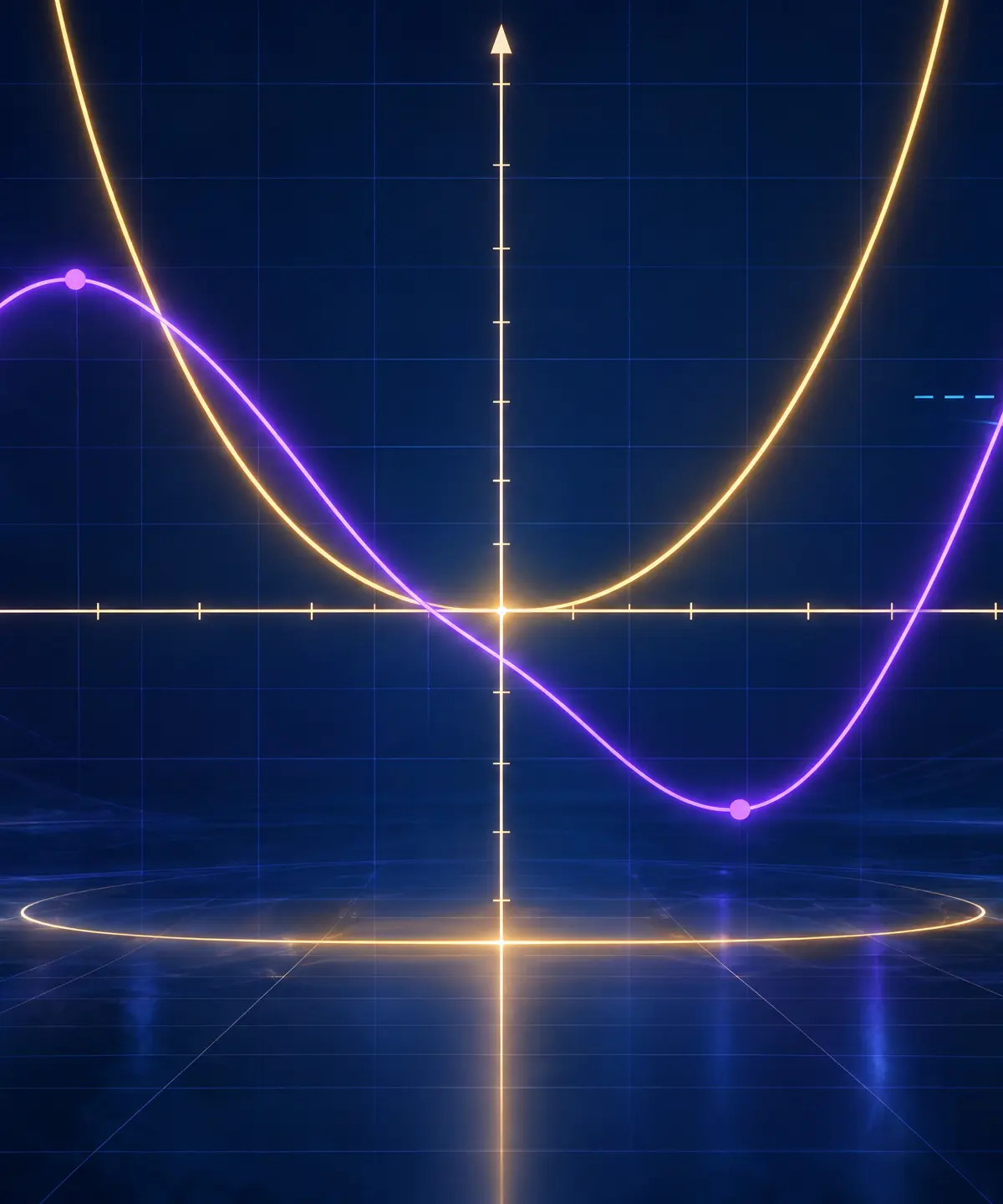
For (ax^2+bx+c=0), the discriminant is (\Delta=b^2-4ac). It records the number of real roots: (\Delta>0) means two distinct real roots, (\Delta=0) means one repeated real root where the parabola touches the (x)-axis, and (\Delta<0) means no real roots because the graph misses the axis. When a parameter is present, use the discriminant before trying to solve.
Completing the square exposes the turning point and is often safer than formula-first thinking: (x^2+6x+5=(x+3)^2-4). The minimum is (-4) at (x=-3). If the coefficient of (x^2) is negative, the turning point is a maximum. An equation such as (x^4-5x^2+4=0) is a quadratic in (x^2): substitute (u=x^2), solve, then return to (x). Candidates must substitute back, otherwise they receive only method marks.
3. Simultaneous equations and inequalities: intervals matter
For a line and a curve, substitution normally reveals the intersection values. Substitute the linear expression into the quadratic, solve the resulting quadratic, then find both coordinates. In an inequality, first bring everything to one side, identify the roots or discontinuities, and use a sign diagram or a sketch to test each interval. A quadratic with positive leading coefficient is positive outside its roots and negative between them; reverse this pattern for a negative leading coefficient.
$For a rational inequality, denominator values that make the expression undefined must be marked as open boundaries even if they appear during cancellation. Use set notation accurately: (x\in(-\infty,1)\cup[3,\infty)) means “or”; (1<x\le3) means both conditions hold. A shaded graph of (y>f(x)) uses the region above the boundary, with a dashed boundary for a strict inequality.$
4. Polynomials and rational expressions: factor first, then interpret
The factor theorem says (f(a)=0) if and only if (x-a) is a factor of (f(x)). Test likely integer roots, divide by the associated linear factor, and factor the smaller polynomial. In long or algebraic division, line up powers, including zero-coefficient terms. For example, write (x^3-4x+3) as (x^3+0x^2-4x+3) before dividing.
A rational expression should be factorised before cancellation. (\frac{(x-2)(x+3)}{(x-2)(x-1)}) simplifies to (\frac{x+3}{x-1}), but the original expression is still undefined at (x=2). The simplification has a removable discontinuity, or hole, at (x=2), while (x=1) is a vertical asymptote. This distinction is a frequent source of a lost interpretation mark.
5. Functions, composites and inverses: domain is part of the answer
A function assigns one output to each permitted input. State the domain when it affects the answer. For a composite function, (fg(x)) means (f(g(x))): feed (x) into (g), then feed that output into (f). It does not mean (f(x)g(x)). For an inverse, replace (f(x)) by (y), swap (x) and (y), then rearrange for (y). Check by showing (f(f^{-1}(x))=x).
An inverse must itself be a function. A quadratic therefore needs a restricted domain before an inverse is allowed, for example (f(x)=x^2), (x\ge0), has inverse (f^{-1}(x)=\sqrt{x}). Its graph is the reflection of the original graph in (y=x). Range restrictions are not decorative: credit is given for them because they make the inverse valid.

6. Graphs, asymptotes and transformations: read the brackets
Know the parent shapes: a polynomial is continuous; (y=|x|) has a corner; (y=1/x) has axes as asymptotes; and (y=1/x^2) is positive on both branches. A vertical asymptote comes from a denominator factor that remains after simplification. A horizontal asymptote can be read from end behaviour: for (\frac{ax+b}{cx+d}), it is (y=a/c), provided numerator and denominator have equal degree.
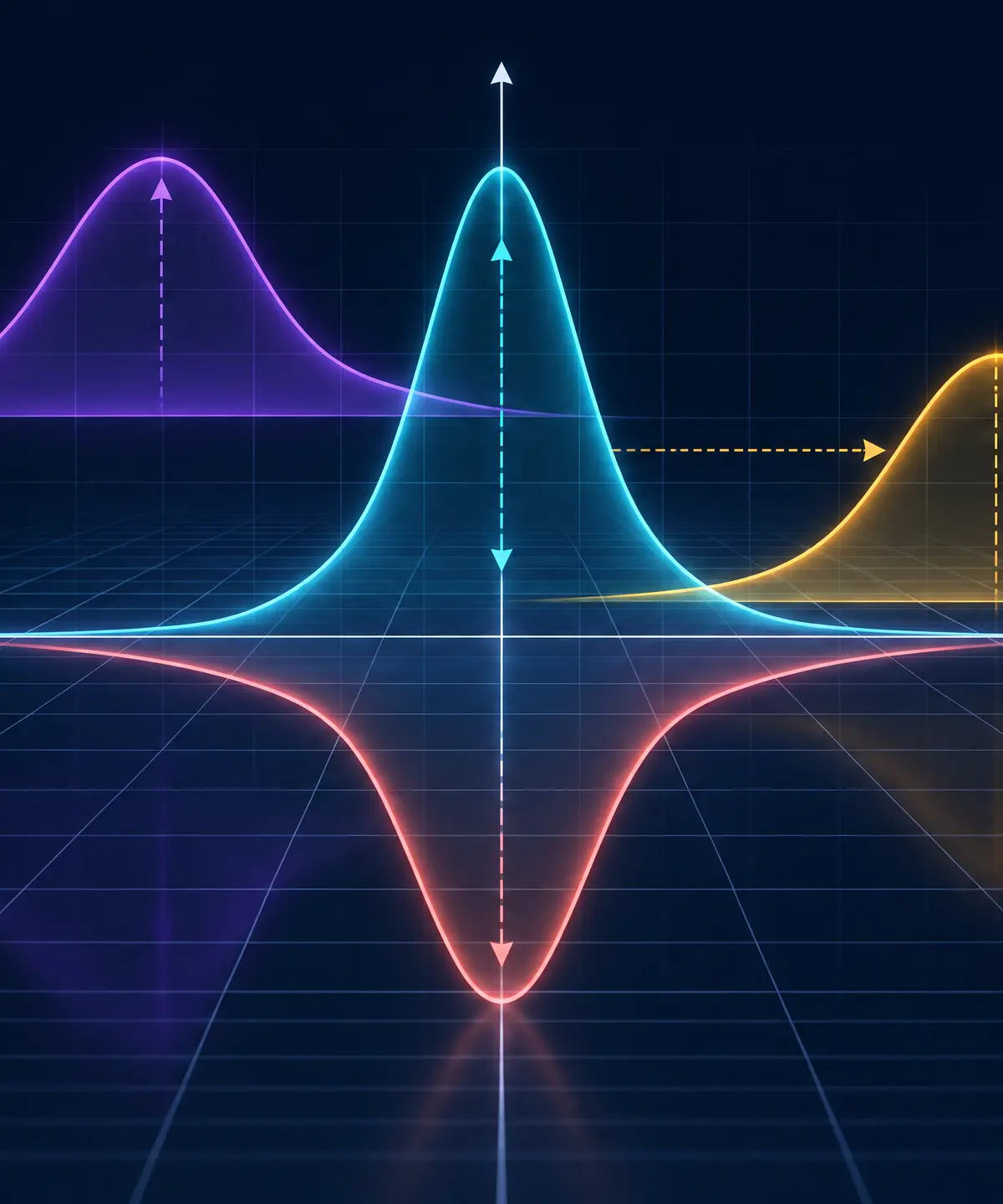
For transformations of (y=f(x)), changes outside the function act vertically and keep their direction: (y=af(x)+b) stretches or reflects vertically by (a), then shifts by (b). Changes inside act horizontally and reverse their direction: (y=f(x+a)) shifts left by (a), while (y=f(ax)) gives a horizontal scale factor (1/a). Apply a sequence in a stated order and map recognisable points, intercepts and asymptotes. A sketch should label the key features rather than relying on artistic accuracy.
7. Partial fractions and modelling: expose useful pieces
Partial fractions rewrite one rational expression as simpler fractions. First ensure the numerator degree is lower than the denominator degree. For distinct linear factors use (\frac{A}{x-a}+\frac{B}{x-b}); for a repeated factor use (\frac{A}{x-a}+\frac{B}{(x-a)^2}); for an irreducible quadratic use (\frac{Ax+B}{x^2+px+q}). Multiply by the full denominator before comparing coefficients or choosing convenient values of (x). State the final decomposition clearly.
A model is not simply an equation with a context attached. Identify the input and output, state assumptions, test whether the output is plausible, and name a refinement. For example, a quadratic revenue model can describe a trend over a short range, but it should not be used to forecast indefinitely because the relationship may change and a negative revenue prediction is not meaningful. This is where explanation marks are awarded for interpretation rather than algebra alone.
Mathematical relationships to memorise
AQA says the listed formulae and identities must be used without being provided, so the relationships below are must memorise, not formula-sheet gifts.3
- Index laws: (a^m a^n=a^{m+n}), (a^m/a^n=a^{m-n}), ((a^m)^n=a^{mn}), (a^{-n}=1/a^n), (a^{p/q}=\sqrt[q]{a^p}), with the usual non-zero restrictions.
- Quadratic roots and discriminant: (x=\frac{-b\pm\sqrt{b^2-4ac}}{2a}) and (\Delta=b^2-4ac). Both are must memorise.
- Difference of squares: (a^2-b^2=(a-b)(a+b)). This powers conjugate rationalisation and factorisation.
- Factor theorem:(f(a)=0\iff(x-a)) is a factor. It ismust memorise as a result and method.
- Transformation rules: (y=af(x)), (y=f(x)+a), (y=f(x+a)), and (y=f(ax)). All are must memorise. Record the reciprocal factor for horizontal scaling.
- Asymptote cues: (y=1/x) has (x=0), (y=0); (y=1/x^2) has (x=0), (y=0). Transform these features with the graph.
- Partial-fraction templates: choose denominators from the factorisation, then use constant numerators for linear factors and linear numerators for irreducible quadratics. This is a must memorise procedure.
Graph and data skills
Before drawing, calculate intercepts, roots, turning points, asymptotes, holes and one or two sign-check points. A candidate who labels (x=2) as an asymptote after cancelling ((x-2)) has not interpreted the expression. Use a solid curve only where the function is defined, keep separate branches separate, and show arrows for continuing behaviour. For a graph-based equation, an intersection is an approximate solution unless the algebra gives an exact value.
Podcast revision companion
Listen after attempting the worked examples, then pause before each recall prompt to answer aloud.
Practical applications
Functions model inputs and outputs: a taxi-fare rule, temperature conversion or revenue against price. Rational functions model behaviours that settle towards a limiting value, such as a cost-per-item relationship when fixed costs are spread. Transformations let a modeller change a baseline graph without rebuilding it. In an exam, name what each variable represents and challenge the model: “This assumes all other factors are constant” is a useful start, but finish by explaining whether that assumption is realistic over the stated interval.
How to practise for durable marks
Use interleaving rather than completing twenty identical questions. Pair a quadratic question with a graph transformation and a partial-fractions question, then decide which method each needs before looking at worked solutions. After marking, correct the first wrong line rather than merely copying the answer: this identifies the misconception that caused the error. Once a week, redraw key parent graphs from memory and label their asymptotes, intercepts and domains. This mirrors the exam demand to move between symbolic, graphical and contextual representations. Candidates who can explain why a restriction exists are less likely to lose a mark when AQA changes the surface appearance of a familiar task.
Examiner checklist
Write enough working for a reader to follow substitutions, expansions and cancellations. Use (\Rightarrow) only for a logical consequence, not as decoration. Give exact values unless a question requests a decimal, state excluded values for rational expressions, and turn algebra back into the original context. The topic rewards precision: a correct number with the wrong interval, graph label or domain is not a fully correct answer.
References
Visual Resources
2 diagrams and illustrations


Interactive Diagrams
2 interactive diagrams to visualise key concepts
Conceptual Flow Outline
A composite applies functions in sequence; an inverse reverses a one-to-one mapping after the correct domain restriction.
Conceptual Flow Outline
Use factorisation to distinguish removable discontinuities from asymptotes before sketching a rational function.
Worked Examples
3 worked examples — open one to explore the question and available guidance.
Practice Questions
Try the question, then reveal an answer plan or example response
Simplify (27x^6)^(1/3) / (3x^(−1)). [3 marks]
Hint: Apply the cube root to both 27 and x^6 before dealing with the negative index in the denominator.
Solve x² − 5x + 6 ≥ 0. Give your answer using set notation. [3 marks]
Hint: Factorise, mark the roots on a number line, then decide where the upward-opening quadratic is non-negative.
Given f(x) = x³ − 4x² − x + 4, show that x − 1 is a factor and fully factorise f(x). [4 marks]
Hint: Evaluate f(1), then group terms or divide by x − 1.
For f(x) = 3x − 2 and g(x) = x² + 1, find fg(x) and solve fg(x) = 25. [4 marks]
Hint: Substitute g(x) into f, not the other way round.
Express (5x + 7)/[(x − 2)(x + 3)] in partial fractions. [4 marks]
Hint: Set it equal to A/(x − 2) + B/(x + 3), then use x = 2 and x = −3.
Exam technique
How to turn what you know into marks
How to approach the question
Underline the command word, identify the mathematical structure before calculating, then choose a named method. For functions and rational expressions, record domain restrictions at the start. For graphs and inequalities, sketch or make a sign chart before committing to an interval.
How to structure your answer
1–2 marks: show the key substitution or formula and state the exact result. 3–4 marks: show each reversible algebraic step, then give every solution. 5–6 marks: state the model, transformation or template; work logically; interpret the result or restriction in context.
Timing
About 1.2 minutes per mark. Each AQA A-Level paper is 2 hours and 100 marks, so reserve several minutes at the end to check signs, restrictions and graph labels.
Common pitfalls
- Cancelling terms across addition, such as cancelling x in (x + 2)/x. Factorise first and only cancel common factors.
- Giving a graph transformation in the wrong horizontal direction. Read the bracket: x + a moves left a.
- Retaining an excluded value after cancelling a denominator factor. The simplified formula may be defined there, but the original function is not.
- Giving an inverse of a quadratic without a domain restriction. Restrict the original function so it is one-to-one.
What the command words want
- Find
- Choose a method, show enough working to make the method markable, then state the required exact value or function.
- Solve
- Give every value satisfying the original equation or inequality. Check denominator restrictions and return from any substitution.
- State
- Give the requested fact precisely. For discriminants, say “two distinct real roots”, “a repeated real root” or “no real roots”.
- Sketch
- Draw the correct family of curve and label intercepts, turning points, asymptotes, holes and relevant transformed points.
- Evaluate
- Make a judgement about a model or solution using an assumption, limitation and relevant contextual evidence.
- Show that
- Start from the given information and provide a reversible chain of algebra. Do not assume the stated result.
Watch or listen (optional)
Test your understanding of B: Algebra and functions
Active recall beats re-reading. Take an instant quiz now to test what you’ve learned and lock it into long-term memory.
7 days Premium · Then the free plan continues · No card, no charge