AQA · A-Level · Mathematics
Course version: 7357 · Version from Sept 2017
D: Sequences and series
Sequences and series turn repeated change into precise mathematics: add a constant, multiply by a constant, or build each term from the previous one. In AQA A-level Mathematics, the marks come from choosing the right model, showing the formula clearly and stating the condition that makes an infinite expansion or sum valid.
- 10 min read
- 3 worked examples
- 5 practice questions
- 8 key terms
Try the lesson
The start of the D: Sequences and series lesson, made from checked teaching notes for this specification point.
Have a go first
A sequence is given by the formula xₙ = 3n + 1 for n = 1, 2, 3, … . What is the value of x₄?
There is more to this lesson
The full lesson goes on to check your understanding and help you earn the marks. Create a free account to carry on, with your progress saved.
7 days Premium · Then the free plan continues · No card, no charge
Check what you remember
Read the wording for your board, then hide it and explain Sequence in your own words. Rough notes are fine. This is a self-check, with no mark or grade.
Reference: AQA
An ordered set of terms, usually generated by an explicit formula or a recurrence relation.
Study Notes

Overview
Specification reference: AQA A-level Mathematics 7357, Section 3.5 D (D1–D6). Sequences and series are the language of repeated change. A sequence lists ordered terms; a series adds them. On AQA, the topic ranges from exact finite binomial expansions to infinite geometric sums, recurrence relations and mathematical modelling. It can be assessed on Papers 1, 2 or 3, so it is not a minor add-on. Each paper is 2 hours for 100 marks, giving a sensible planning benchmark of about 1.2 minutes per mark.
The examiner is testing choices as well as calculation. Candidates must decide whether terms are produced by repeated addition or repeated multiplication, distinguish a term from a total, interpret sigma notation, and state conditions that make an infinite method valid. Typical question styles include finding an unknown parameter, proving a series is geometric, modelling a quantity that changes each time period, and using a binomial expansion to approximate a value. Clear symbols and conditions are creditworthy working: they make method marks visible even if an arithmetic slip occurs later.
Key Concepts
1. Sequences, recurrence relations and classification
A sequence is written as (u_1, u_2, u_3, \ldots), where (u_n) means thenth term. An explicit rule gives a term directly, for example (u_n=5+3(n-1)). A recurrence rule gives the next term from the current term, for example (x_1=5), (x_{n+1}=0.7x_n+3). Use the starting value before applying the rule: without it, a recurrence does not define one particular sequence.
Classify before choosing a formula. If the same number is added each time, the sequence is arithmetic. If the same non-zero multiplier is used each time, it is geometric. A sequence can also be increasing, decreasing or periodic. Do not assume that a decreasing sequence is geometric: 10, 7, 4, 1 is arithmetic because the common difference is (-3).
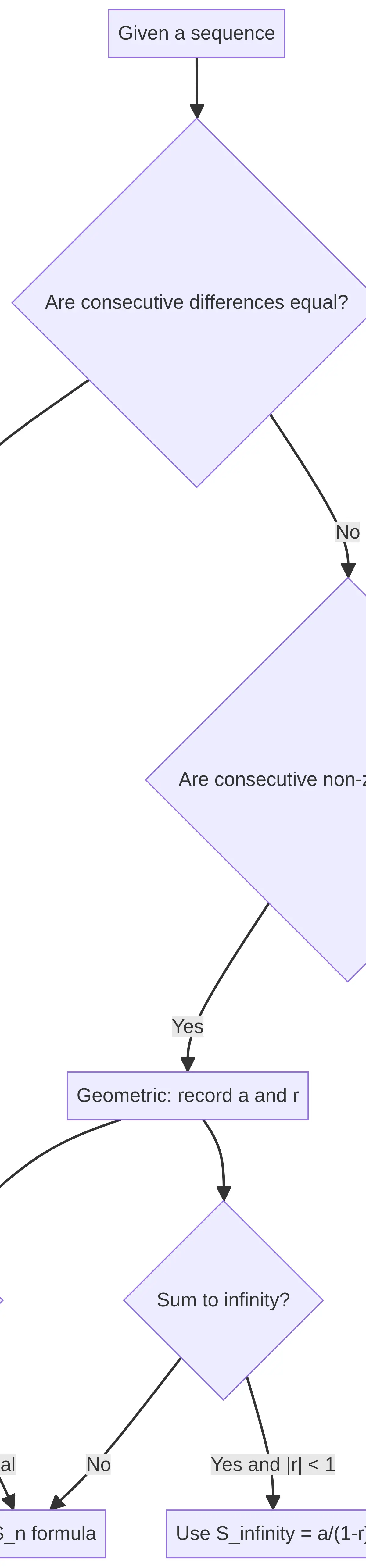
Examiner cue: When the command word is show, calculate at least two consecutive differences or ratios. Writing “geometric” without evidence may not earn the classification mark in a multi-step argument.
2. Arithmetic sequences and series
For first term (a) and common difference (d):
- nth term: (u_n=a+(n-1)d)
- sum of n terms: (S_n=\frac{n}{2}[2a+(n-1)d]), or equivalently (S_n=\frac{n}{2}(a+l)) when the last term (l) is known.
These formulas must be memorised. The nth-term formula is a location formula: it finds one term. The sum formula is a total formula: it adds a block of terms. In a practical model, (a) is the starting amount and (d) is the fixed change per interval. For example, a saving plan adding £50 more each month is arithmetic if the monthly deposits rise by £50 each time.
Why it works: the first and last terms add to the same total as the second and second-last terms. Pairing terms therefore creates equal totals, giving the factor (n/2). This pairing explanation is useful when asked to derive a result rather than merely calculate.
3. Geometric sequences, finite sums and convergence
For first term (a) and common ratio (r):
- nth term: (u_n=ar^{n-1})
- sum of n terms: (S_n=\frac{a(1-r^n)}{1-r}), (r
e1) - sum to infinity: (S_\infty=\frac{a}{1-r}), only when (|r|<1).
The ratio is found by division, such as (r=12/4=3), not by subtraction. A ratio between -1 and 1 causes terms to shrink towards zero. Negative ratios make the terms alternate sign, but they can still converge: for (r=-0.4), (|r|=0.4<1). If (|r|\ge1), the terms do not settle to zero, so no finite sum to infinity exists.
For an exact AQA-style conclusion, write: “Since (|r|=0.4<1), the series converges; therefore (S_\infty=...).” The condition earns credit because it justifies the formula. Writing only (r<1) is insufficient, as it wrongly excludes negative ratios.
4. Sigma notation
Sigma notation is a compact instruction to add. In (\sum_{r=1}^{4}(2r+1)), the lower limit says start with (r=1), the upper limit says finish with (r=4), and the expression gives each term:
[3+5+7+9=24.]
A safe routine is limits, first term, last term, sum. First substitute the lower limit, then the upper limit, then list or use an appropriate formula. Check that the number of terms is upper limit minus lower limit plus 1. This matters when an index starts at 0 or 2 rather than 1.
5. Binomial expansion
For a positive integer (n), the exact finite expansion is:
[(a+b)^n=\sum_{r=0}^{n} {n\choose r}a^{n-r}b^r.]
Here ({n\choose r}=\frac{n!}{r!(n-r)!}), and (0!=1). The term number and the power of the second bracket move together: the first term corresponds to (r=0), so its second-factor power is zero. This notation links to binomial probabilities, where ({n\choose r}) counts arrangements.
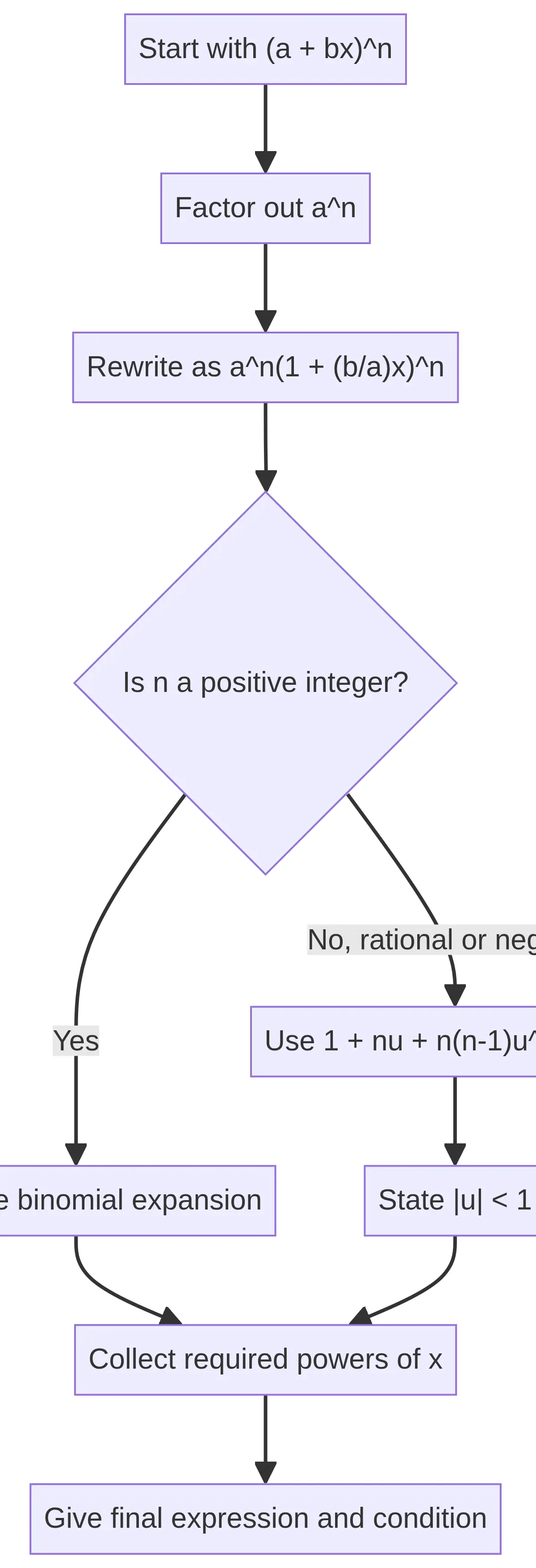
For rational or negative powers, use the infinite expansion:
[(1+x)^n=1+nx+\frac{n(n-1)}{2!}x^2+\frac{n(n-1)(n-2)}{3!}x^3+\cdots]
This is valid only for (|x|<1). If the bracket is not (1+x), factor out a constant first. For instance, ((4-2x)^{1/2}=2(1-x/2)^{1/2}), so the validity condition becomes (|x/2|<1), hence (|x|<2). The condition is not optional text: it defines where the approximation is justified.
6. Modelling and calculator checks
A sequence model describes a discrete process: monthly savings, repeated depreciation, medication doses or a bouncing height. State what one term and one step represent. An arithmetic model has a fixed additive change; a geometric model has a fixed percentage change. For a recurrence, explain the multiplier and fixed adjustment in context.
Use a calculator to check generated terms, but show the recurrence or formula used. A calculator table is a checking tool, not a substitute for algebra. Round only at the end and match the question’s requested accuracy. There are no topic-specific unit conversions here, but any model answer must retain the units supplied in the question.
7. Marks are earned through mathematical communication
In sequence questions, good notation is not cosmetic. It enables the examiner to credit a method. Write (a=), (d=), (r=) and (n=) before a formula if these values have been supplied or found. This takes seconds and prevents the common mistake of using the last term as the first term. Where a question says show that, do not replace the requested proof with calculator output. Begin from the stated facts, choose the relevant formula and keep equal signs aligned. A conclusion such as “therefore (S_{10}=...)” closes the logical chain.
Be particularly alert to indexing. In (u_n=ar^{n-1}), the first term has exponent zero, so (u_1=a). In a sigma expression, count the number of substituted values rather than assuming that the upper limit is the number of terms. For example, (\sum_{r=3}^{8}) contains six terms, not eight: (8-3+1=6). AQA can make an otherwise routine calculation demanding by changing the first index or asking for a series that starts at a term other than (u_1).
For an approximation question, use only the number of binomial terms demanded and keep fractions exact during the expansion. If a question says “up to and including the term in (x^3)”, include the constant, (x), (x^2) and (x^3) terms. It does not mean “write three terms”. The next omitted term determines the order of the approximation, so read the power rather than counting lines. When using your expansion to estimate a value, substitute only after the polynomial has been obtained, then give the requested degree of accuracy.
Finally, test whether a model is plausible. Arithmetic models have a constant absolute change, while geometric models have a constant proportional change. A monthly phone contract with a fixed £5 increase is arithmetic; a population with a fixed 3% increase is geometric. In an evaluation question, credit is given for saying that a constant percentage or constant addition may cease to be realistic over a long period. This is modelling, not an invitation to use a formula without thought.
Mathematical Relationships: Formula Audit
| Relationship | Meaning and use | Formula-sheet status |
|---|---|---|
| Arithmetic nth term | Find one term after repeated addition | Must memorise: (u_n=a+(n-1)d) |
| Arithmetic sum | Add the first (n) arithmetic terms | Must memorise: (S_n=\frac{n}{2}[2a+(n-1)d]) |
| Geometric nth term | Find one term after repeated multiplication | Must memorise: (u_n=ar^{n-1}) |
| Finite geometric sum | Add the first (n) geometric terms | Must memorise: (S_n=\frac{a(1-r^n)}{1-r}) |
| Infinite geometric sum | Add indefinitely only for a convergent series | Must memorise: (S_\infty=\frac{a}{1-r}), ( |
| Positive-integer binomial | Expand exactly | Must memorise: ((a+b)^n=\sum {n\choose r}a^{n-r}b^r) |
| Rational binomial | Approximate after rewriting as ((1+x)^n) | Must memorise with ( |
AQA’s formulae appendix identifies the arithmetic and geometric general-term formulas as formulas students must use without provision. Revise the full set above as “must memorise”, not as a formula-booklet lookup.
Audio Revision Podcast
Use this ten-minute episode after completing the worked examples. Pause at the quick-fire recall section, answer aloud, then check the script only after committing to an answer.
Practical Applications
An arithmetic series can model a theatre increasing its ticket allocation by the same number each performance. A geometric series models a value repeatedly multiplied by the same proportion, such as a machine retaining 80% of its value each year. A recurring rule is appropriate when each new amount depends on the previous amount plus a fixed intervention. The key modelling judgement is whether the change is additive, multiplicative or dependent on the earlier value. State assumptions: a real process may not keep the same difference or ratio forever, so models are usually useful approximations rather than permanent laws.
Specification sources: AQA 3.5 D: Sequences and series and AQA assessment structure.
Visual Resources
2 diagrams and illustrations

Interactive Diagrams
2 interactive diagrams to visualise key concepts
Conceptual Flow Outline
A decision route for selecting arithmetic, geometric or recurrence methods and choosing a term or sum formula.
Conceptual Flow Outline
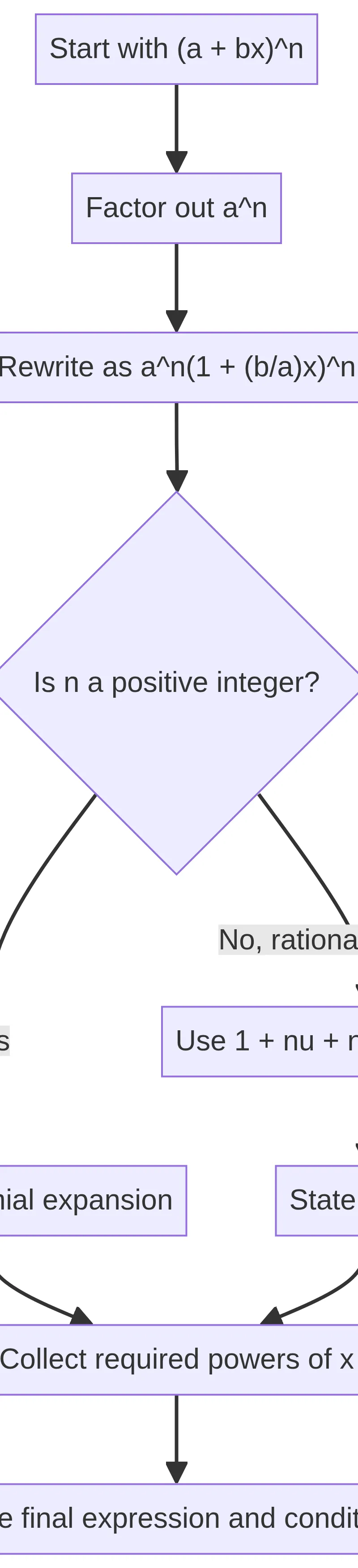
A disciplined workflow for binomial expansion, including the required validity condition for a non-integer power.
Worked Examples
3 worked examples — open one to explore the question and available guidance.
Practice Questions
Try the question, then reveal an answer plan or example response
Write out (\sum_{r=2}^{5}(3r-1)) and find its value. [3 marks]
Hint: Substitute 2, 3, 4 and 5 into the bracket before adding.
The arithmetic sequence has first term 7 and common difference -3. Find (u_{12}) and (S_{12}). [4 marks]
Hint: Use a term formula first, then a sum formula. Keep d negative.
A geometric series has first term 48 and common ratio (1/3). Calculate its sum to infinity. [3 marks]
Hint: Check the modulus of the ratio before using the infinity formula.
Expand ((1+2x)^{-1}) up to and including the term in (x^3), and state the validity condition. [4 marks]
Hint: Set n = -1 and u = 2x in the general expansion.
The sequence is defined by (x_1=4), (x_{n+1}=0.6x_n+8). Show that the sequence converges and find its limiting value. [5 marks]
Hint: For a limit L, replace both \(x_{n+1}\) and \(x_n\) by L. Then justify why the multiplier gives convergence.
Exam technique
How to turn what you know into marks
How to approach the question
Classify first. Write the known values of a, d, r and n. Select the formula, substitute with brackets, simplify, then answer the exact command word. For rational binomial and infinite geometric questions, write the validity or convergence condition before the final answer.
How to structure your answer
For 1–2 marks, write the relevant formula and a concise value. For 3–4 marks, show classification, substitution and simplification. For 5–6 marks, define the model, show a logical chain, justify any condition and finish with a contextual or exact conclusion.
Timing
AQA Papers 1, 2 and 3 each have 100 marks in 120 minutes. Use approximately 1.2 minutes per mark as a planning benchmark, then reserve a final check for signs, powers and conditions.
Common pitfalls
- Using a difference to identify a geometric sequence. Divide consecutive terms to find r.
- Using \(S_\infty\) for a finite-series question. Read whether the question asks for ‘first n terms’ or ‘to infinity’.
- Writing r < 1 instead of \(|r|<1\). Negative ratios between -1 and 0 also converge.
- Expanding a rational power without first creating \((1+x)^n\), or omitting the resulting validity condition.
- Misreading sigma limits. Write the first and final substituted terms before adding.
What the command words want
- Compare
- Give a similarity and a difference, such as both being ordered lists but arithmetic has a constant difference whereas geometric has a constant ratio.
- Explain
- Give the mathematical reason, usually introduced by ‘because’: for example, ‘because \(|r|<1\), the geometric series converges’.
- Describe
- Use mathematical language such as increasing, decreasing, periodic, convergent or alternating, supported by the pattern.
- Evaluate
- State model assumptions, consider whether a fixed difference or ratio is realistic, and make a justified conclusion.
- Calculate
- Show the formula, substitution and final answer. Retain exact values until the final line unless instructed otherwise.
- Show that
- Start from the supplied information and present a connected algebraic chain that reaches the stated result without assuming it.
- State/Give
- Provide the requested value, formula or condition directly. Do not bury it in a paragraph.
Watch or listen (optional)
Test your understanding of D: Sequences and series
Active recall beats re-reading. Take an instant quiz now to test what you’ve learned and lock it into long-term memory.
7 days Premium · Then the free plan continues · No card, no charge