AQA · A-Level · Mathematics
Course version: 7357 · Version from Sept 2017
E: Trigonometry
AQA A-level Trigonometry is where circular geometry, algebra and modelling meet: use it to calculate arcs, prove identities, sketch periodic functions and solve every permitted angle. Master the unit circle, radians and interval checks, and this topic becomes a reliable source of method marks across pure and mechanics questions.
- 10 min read
- 3 worked examples
- 5 practice questions
- 8 key terms
Try the lesson
The start of the E: Trigonometry lesson, made from checked teaching notes for this specification point.
Have a go first
In triangle ABC, side a = 7 cm, side b = 9 cm and angle C = 40°. Find the area of the triangle, giving your answer to 3 significant figures.
There is more to this lesson
The full lesson goes on to check your understanding and help you earn the marks. Create a free account to carry on, with your progress saved.
7 days Premium · Then the free plan continues · No card, no charge
Check what you remember
Read the wording for your board, then hide it and explain radian in your own words. Rough notes are fine. This is a self-check, with no mark or grade.
Reference: AQA
The angle at the centre of a circle subtended by an arc whose length is equal to the radius.
Study Notes

Overview
AQA A-level Mathematics 3.6 E: Trigonometry turns familiar triangle ratios into a language for circular motion, periodic graphs, proof and mathematical modelling. Candidates are expected to work fluently in radians, use exact values, manipulate identities, solve every valid angle in a stated interval and model situations from a rotating wheel to a force acting at an angle. The topic is assessed across the linear A-level: Paper 1 can assess pure trigonometry directly, while Papers 2 and 3 can combine it with mechanics, vectors, calculus or statistics.
AQA papers are two hours for 100 marks, so plan around 1.2 minutes per mark. There is no fixed trigonometry question size: a one-mark exact value can sit beside a multi-step modelling problem. The examiner awards marks for a valid method as well as the final answer, so write enough algebra for each transformation to be checked. Your central habit is simple: identify the form, select the identity or model, then respect the interval and units.
Key Concepts
1. Radians, circles and exact values
A radian is the angle subtended at the centre of a circle by an arc equal in length to the radius. It is a natural circular measure, rather than a new type of angle. One full revolution is (2\pi) radians, so convert with (\theta_{\rm rad}=\theta_{\rm deg}\pi/180). For a radius (r) and angle (\theta) in radians, use (s=r\theta) for arc length and (A=\tfrac12r^2\theta$) for sector area. Only radians make these forms work directly.$
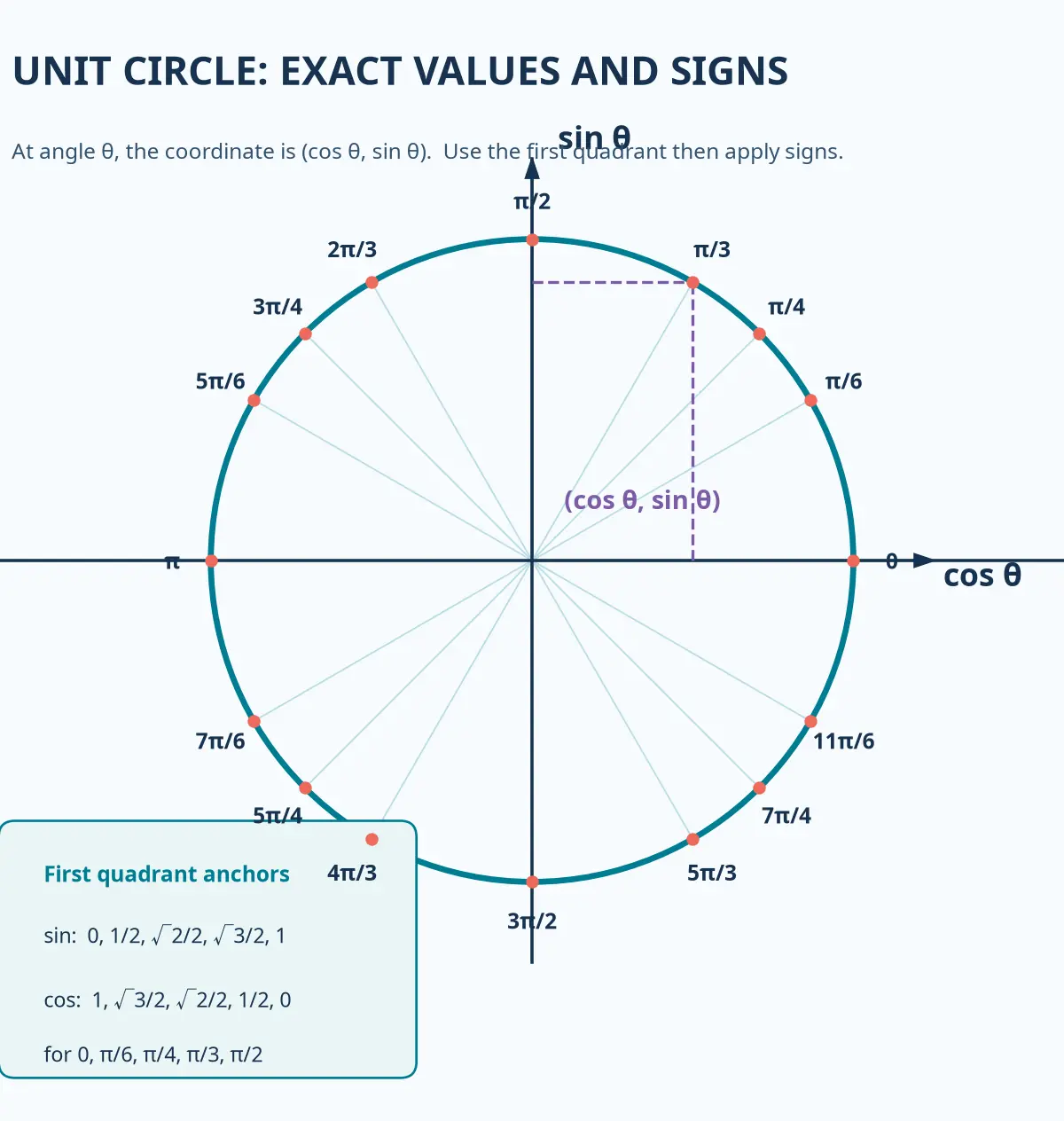
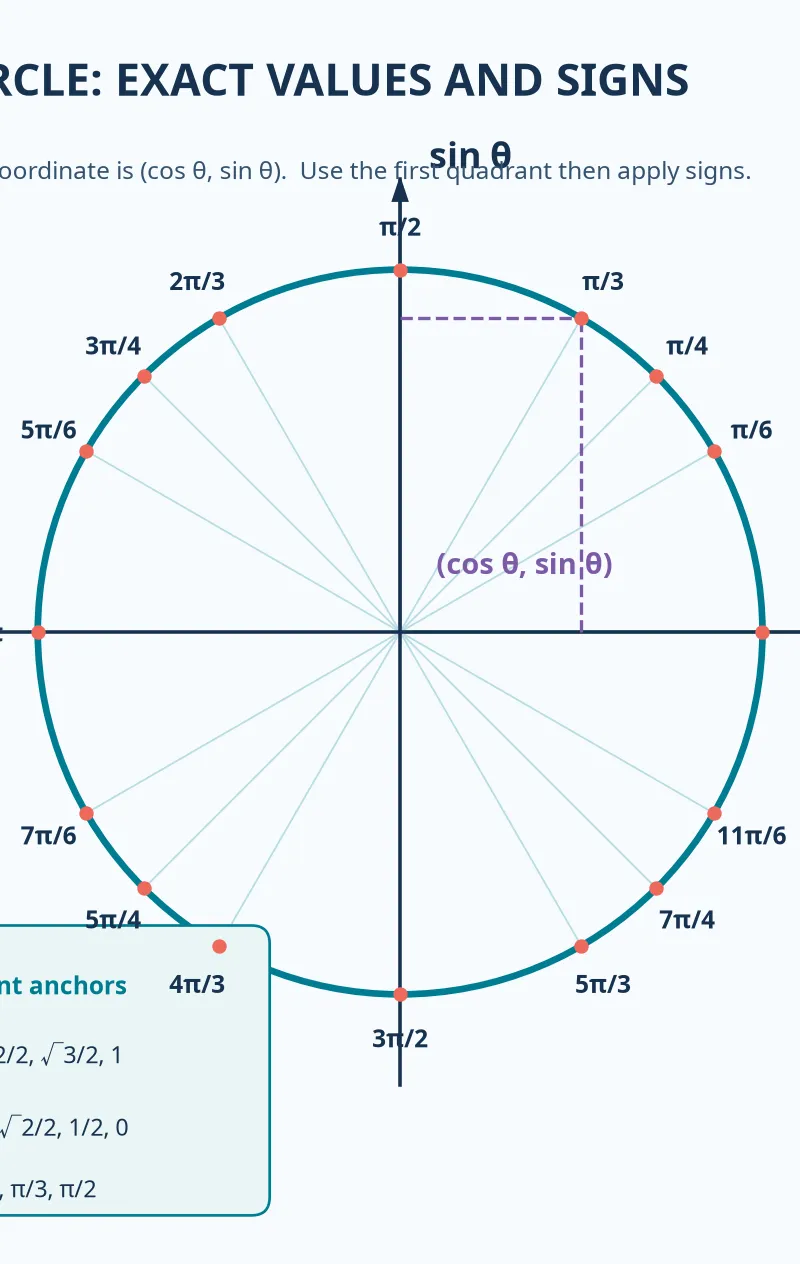
On the unit circle, the point at angle (\theta) is ((\cos\theta,\sin\theta)). This is why sine and cosine work for every real angle, not just acute angles in a triangle. Learn the first-quadrant values at (0,\pi/6,\pi/4,\pi/3,\pi/2), then use symmetry and signs in the other quadrants. For example, (\sin(5\pi/6)=\sin(\pi/6)=\tfrac12), whereas (\cos(5\pi/6)=-\cos(\pi/6)=-\tfrac{\sqrt3}{2}). Tangent is (\sin\theta/\cos\theta), so it is undefined wherever (\cos\theta=0).
2. Trig functions, reciprocals and inverse functions
Sine and cosine have range ([-1,1]), period (2\pi), and satisfy (\sin(-x)=-\sin x) and (\cos(-x)=\cos x). Tangent has period (\pi), is undefined at (\pi/2+k\pi), and is odd. State domain restrictions when a graph or inverse function requires them. The reciprocal functions are (\sec x=1/\cos x), (\cosec x=1/\sin x), and (\cot x=1/\tan x). Their graphs inherit vertical asymptotes from the zeros of the denominator.
$(\arcsin), (\arccos) and (\arctan) returnprincipal values, not every angle that has that trig value. Their restricted ranges make them functions: (\arcsin x\in[-\pi/2,\pi/2]), (\arccos x\in[0,\pi]), and (\arctan x\in(-\pi/2,\pi/2)). Use the calculator only after choosing the correct mode and then use the interval to locate any additional solutions.$
3. Identities and proof
An identity is true for every value in its domain. A trig equation is true only for particular values. This distinction changes your method. In a proof, begin with the more complicated side, convert everything into sine and cosine where useful, and make one reversible, justified algebraic change per line. The core identity (\sin^2x+\cos^2x=1) generates the reciprocal identities (1+\tan^2x=\sec^2x) and (1+\cot^2x=\cosec^2x). The addition formulae lead to the double-angle formulae, which turn expressions such as (1-\cos2x) into (2\sin^2x).
Credit is given for a clear chain of equivalent expressions. Do not write an equality sign between unrelated lines or attempt to prove an identity by testing one numerical angle. When cancelling, state or understand the excluded value: division by (\sin x) or (\cos x) can lose a solution in an equation.
4. Equations in a given interval
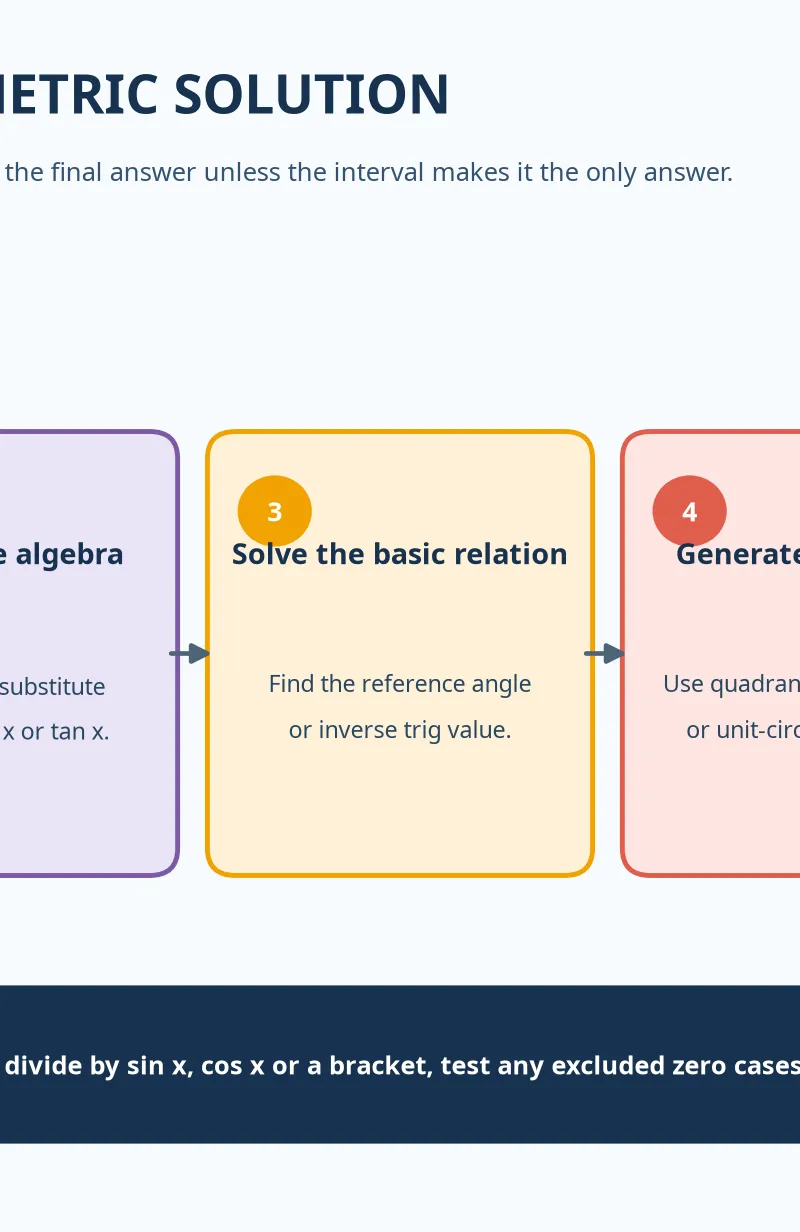
AQA E7 expects simple equations, quadratic forms in (\sin x), (\cos x) or (\tan x), and equations involving multiple angles. First turn the equation into a basic relation, such as (\cos x$=\tfrac12), then generate all angles in the requested interval. For a quadratic in (\sin x), let (u=\sin x), solve the algebraic quadratic, then solve each trig equation. If the equation contains (2x), solve for (2x) over the doubled interval before dividing by two.$
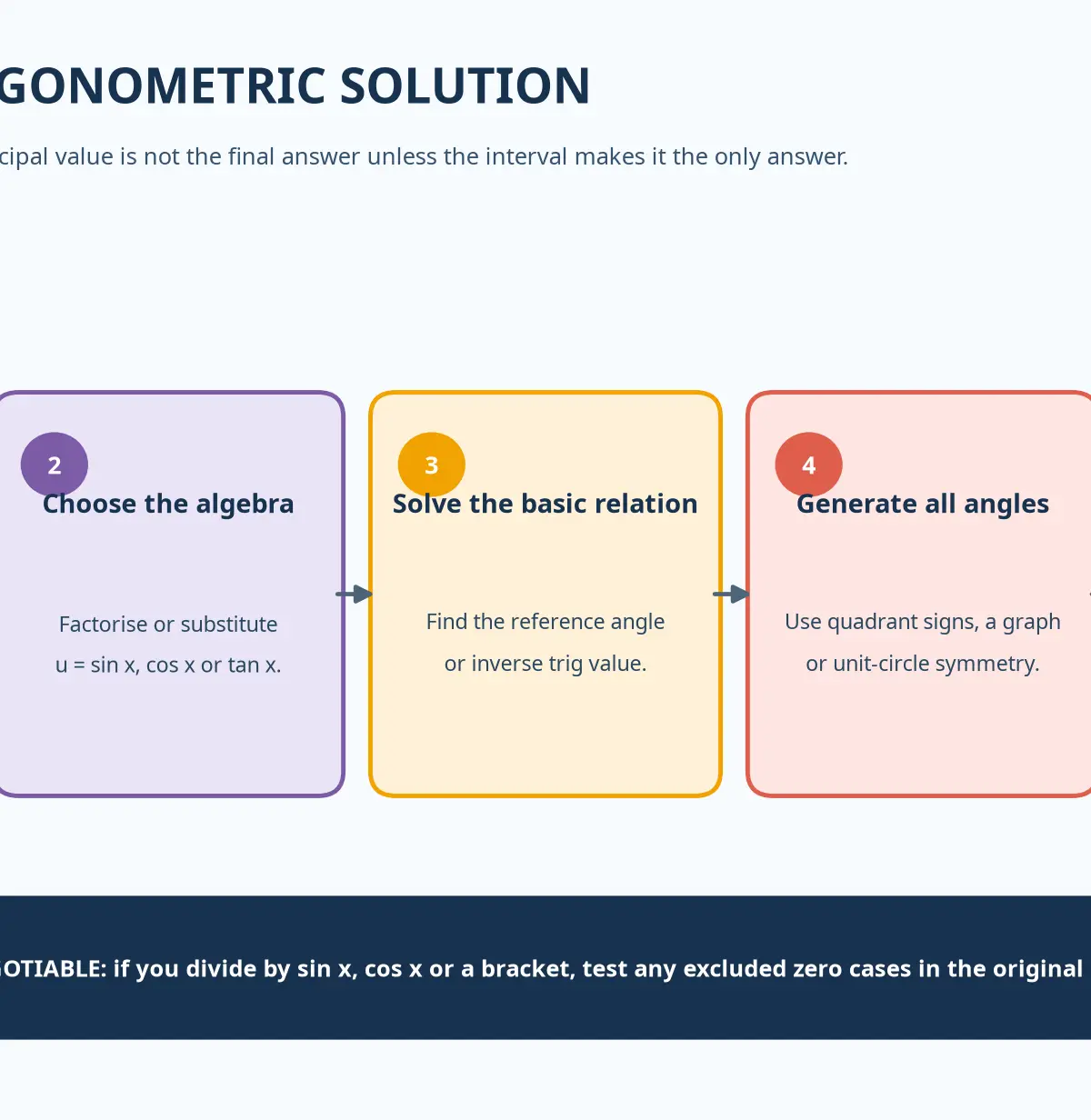
A sketch, the unit circle or CAST signs can act as an independent check. The final line must give every answer, in radians unless the question explicitly uses degrees. A correct principal value alone does not earn the solution marks when the interval asks for more.
5. Double angles, harmonic form and small angles
Double-angle formulae give alternative forms for (\sin2x), (\cos2x) and (\tan2x). Select the form that exposes what the question needs: use (\cos2x=1-2\sin^2x) to make sine-squared appear, or (\cos2x=2\cos^2x-1) to make cosine-squared appear. For (a\cos x+b\sin x), write (R\cos(x-\alpha)), where (R=\sqrt{a^2+b^2}), (R\cos\alpha=a), and (R\sin\alpha=b). This reveals the maximum magnitude (R) and simplifies equations.
$For small (x) in radians, (\sin x\approx x), (\tan x\approx x), and (\cos x\approx1-\tfrac12x^2). These are approximations near zero, not identities. State the approximation and retain sensible accuracy. A degree value put into these formulae makes the approximation invalid.$
Mathematical Relationships and Formula Status
AQA Appendix B states that students must be able to use its formulae and identities without them being supplied, except where a formula is the stated start or end of a proof. Treat the following as must memorise, not as a guaranteed formula-booklet lookup.
- Circle and sector: (s=r\theta), (A=\tfrac12r^2\theta), with (\theta) in radians.
- Triangle methods: (a/\sin A=b/\sin B=c/\sin C); (a^2=b^2+c^2-2bc\cos A); (\text{area}=\tfrac12ab\sin C). Use the sine rule when an opposite pair is known, the cosine rule for an SAS or SSS triangle, and the area formula for two sides and their included angle.
- Definitions and core identities: (\tan x=\sin x/\cos x); (\sec x=1/\cos x); (\cosec x=1/\sin x); (\cot x=1/\tan x); (\sin^2x+\cos^2x=1); (1+\tan^2x=\sec^2x); (1+\cot^2x=\cosec^2x).
- Addition and subtraction: (\sin(A\pm B)=\sin A\cos B\pm\cos A\sin B); (\cos(A\pm B)=\cos A\cos B\mp\sin A\sin B); (\tan(A\pm B)=\frac{\tan A\pm\tan B}{1\mp\tan A\tan B}).
- Double angles: (\sin2A=2\sin A\cos A); (\cos2A=\cos^2A-\sin^2A=1-2\sin^2A=2\cos^2A-1); (\tan2A=\frac{2\tan A}{1-\tan^2A}).
- Harmonic and small-angle forms: (a\cos x+b\sin x=R\cos(x-\alpha)), with (R=\sqrt{a^2+b^2}), (\tan\alpha=b/a) after quadrant checking; (\sin x\approx x), (\tan x\approx x), (\cos x\approx1-x^2/2), for small radian (x).
Graph and Data Skills
When sketching, label intercepts, turning points, asymptotes and the requested interval. A sine graph (y=a\sin(bx+c)+d) has amplitude (|a|), period (2\pi/|b|), phase shift (-c/b), and vertical translation (d). Amplitude is not defined for tangent. For a graph-based equation, intersections show roots, but a precise final value should normally be calculated or read to the required accuracy.
Practical Applications
Trigonometry models any quantity with repeating circular behaviour. In mechanics, resolve a force (F) at angle (\theta) into (F\cos\theta) horizontally and (F\sin\theta) vertically, after drawing a labelled diagram. In kinematics, a rotating point can have sinusoidal displacement. In vectors, a dot product uses (\cos\theta) to connect magnitude and direction. In all contexts, decide whether the model needs a bearing, a degree angle, or radian measure before substituting. Units, a sensible domain and an interpretation of the result are often the final marks.
Triangle Decisions, Context and Ambiguity
Choose a triangle method from the information, not from habit. The sine rule connects a side with its opposite angle and is efficient when an opposite pair is known. The cosine rule is designed for two sides and the included angle, or for all three sides. The area formula (\tfrac12ab\sin C$) requires the includedangle. In an SSA sine-rule situation, the inverse sine may produce an acute value while a second obtuse triangle is also possible. Check whether the supplementary angle keeps the total angle below (180^\circ), then state both physically possible triangles. A diagram and sensible units make the context clear.$
In mechanics and vector questions, never select sine or cosine from the word ‘horizontal’ alone. Draw the right triangle and label the given angle. The component adjacent to the angle uses cosine; the component opposite uses sine. State the direction, especially for vertical components or forces, because an unsigned magnitude can lose an interpretation mark.
Proof, Exact Form and Independent Checking
$For a show that result, the given value or expression is the destination, not something to assume. Start with the supplied information, preserve exact surds and (\pi) where possible, and make the displayed result appear naturally. A calculator decimal can be a useful private sense-check but not a replacement for an exact proof. In an identity proof, use brackets whenever a substitution changes more than one term. For example, replacing (\cos 2x) by (1-2\sin^2x) in a numerator should visibly preserve the subtraction outside it.$
Use a second representation as a fast accuracy check. A unit-circle sketch tests signs and solutions; a graph tests the period and number of roots; substitution into the original equation tests a candidate value; and a dimension check tests a circle, vector or mechanics answer. This is not extra decoration. It is the candidate’s safeguard against lost interval marks, accidental division by zero and a calculator in the wrong mode.
Ten-Minute Audio Recap
Listen once without notes, then pause at the recall quiz and answer aloud. On a second listen, stop after each core section and reproduce the formula or method from memory.
Examiner’s Final Checklist
Before moving on, check: Have I used radians where a formula needs them? Have I shown a line of algebra for each available method mark? Have I listed all values in the interval? Have I kept exact form unless decimal accuracy is asked for? These checks are short, but they prevent the most common lost marks.
Visual Resources
2 diagrams and illustrations
Interactive Diagrams
2 interactive diagrams to visualise key concepts
Conceptual Flow Outline
A reliable route from a trig equation to all valid AQA solutions.
Conceptual Flow Outline
The unit circle connects coordinates, ratios, reciprocals and graph behaviour.
Worked Examples
3 worked examples — open one to explore the question and available guidance.
Practice Questions
Try the question, then reveal an answer plan or example response
State the exact values of tan(5π/4), cos(7π/6) and sin(2π/3). [3 marks]
Hint: Use the reference angles π/4, π/6 and π/3, then apply quadrant signs.
Solve 2sin²x = 1 + cos x for 0 ≤ x < 2π. [4 marks]
Hint: Replace sin²x using 1 − cos²x, then factorise in cos x.
Prove that (1 − cos 2x)/sin 2x = tan x, where both sides are defined. [4 marks]
Hint: Use the double-angle forms for cos 2x and sin 2x.
Use a suitable small-angle approximation to estimate cos(0.08). State why the method is valid. [4 marks]
Hint: The cosine approximation contains an x² term and x is already in radians.
A force of magnitude 120 N acts at an angle of 35° above the horizontal. Calculate its horizontal and vertical components. Give answers to 3 significant figures. [5 marks]
Hint: Draw the force as the hypotenuse of a right triangle. The angle is measured from the horizontal.
Exam technique
How to turn what you know into marks
How to approach the question
Underline the command word, interval, units and accuracy. Name the target form before calculating: circle formula, identity, quadratic in a trig function, graph transformation or harmonic form. Show every reversible algebraic step, then test the final values against the interval and the original equation.
How to structure your answer
For 1–2 marks, state the relevant exact value or formula and answer. For 3–4 marks, show substitution and simplification on separate lines. For 5–6 marks, state the model or identity, develop it logically, solve every branch, and give a final set of answers in the requested form. For proof, start from one side and finish exactly at the other.
Timing
AQA A-level papers are 2 hours for 100 marks: budget about 1.2 minutes per mark, with a short review at the end.
Common pitfalls
- Using degrees in s = rθ, A = 1/2r²θ or small-angle approximations. Convert first, or set the calculator to radians.
- Giving only the principal inverse-trig value. Sketch or use the unit circle to generate every value in the stated interval.
- Cancelling a factor containing sin x or cos x without checking whether it could be zero. Check excluded cases in the original equation.
- Using an identity backwards with the wrong sign, especially in cosine addition and double-angle formulae.
- Rounding before the final line in R-form questions. Keep calculator precision until the requested accuracy is known.
What the command words want
- Prove
- Start with one side only, apply identities in a logical chain and finish at the other side. A numerical check earns no proof credit.
- Solve
- Rearrange to a basic trig equation, state every angle in the interval and present the final set clearly.
- Sketch
- Show the defining features: period, amplitude where relevant, intercepts, asymptotes and the labelled interval.
- Calculate
- Select the formula, substitute with units and preserve accuracy until the final answer.
- Show that
- Work from the given side or data and reach the stated result. Do not assume the answer inside the working.
- State/Give
- Give the exact requested result with no unnecessary working, but keep a unit if one is required.
Watch or listen (optional)
Test your understanding of E: Trigonometry
Active recall beats re-reading. Take an instant quiz now to test what you’ve learned and lock it into long-term memory.
7 days Premium · Then the free plan continues · No card, no charge