AQA · A-Level · Mathematics
Course version: 7357 · Version from Sept 2017
F: Exponentials and logarithms
Exponentials and logarithms are the mathematical language of repeated proportional change: they appear in growth, decay, graphs, differentiation and data modelling. For AQA 7357 section 3.7F, candidates must use the inverse relationship confidently, show the logarithm laws accurately and interpret models rather than treating them as calculator exercises.
- 9 min read
- 4 worked examples
- 6 practice questions
- 8 key terms
Try the lesson
The start of the F: Exponentials and logarithms lesson, made from checked teaching notes for this specification point.
Have a go first
Write log₃ 8 + log₃ 5 as a single logarithm.
There is more to this lesson
The full lesson goes on to check your understanding and help you earn the marks. Create a free account to carry on, with your progress saved.
7 days Premium · Then the free plan continues · No card, no charge
Check what you remember
Read the wording for your board, then hide it and explain Exponential function in your own words. Rough notes are fine. This is a self-check, with no mark or grade.
Reference: AQA
A function of the form y = a^x, where a > 0 and a ≠ 1; its variable is in the exponent.
Study Notes

Overview
AQA A-level Mathematics 7357, section 3.7F makes exponentials and logarithms a connected topic rather than a rule-collection. Exponential functions model quantities that change by a constant proportion, such as continuously compounded savings, radioactive material and drug concentration. Logarithms reverse an exponential process. That inverse relationship is why logarithms solve equations with an unknown power, straighten curved data and produce graphs with a recognisable asymptote.
AQA can assess this material in any of the three A-level papers. All papers are 2 hours and 100 marks, so the average working rate is 1.2 minutes per mark. Expect short algebraic manipulations, graph sketches, differentiation, parameter estimation from transformed graphs and modelling questions with a final interpretation. Strong candidates do not just press ln on a calculator. They state restrictions, show equivalent algebraic steps, keep accuracy until the end and explain what a parameter means in context.
The topic connects directly to Algebra and functions, Differentiation, Numerical methods and mathematical modelling. Its central idea is simple: an exponential input and a logarithmic output undo one another. Once candidates see that relationship, the graphs, laws and equation-solving methods become predictable.
Specification map: F1 to F7
AQA requires candidates to know and use y = a^x and y = e^x; understand why the gradient of e^(kx) is k e^(kx); use logarithms as inverse functions; apply the logarithm laws; solve equations of the form a^x = b; linearise exponential and power relationships; and model exponential growth and decay. The specification expressly includes the limitations and refinements of exponential models, not just calculation.
Key concepts
1. Exponential functions and their graphs
For y = a^x, the base must satisfy a > 0 and a ≠ 1. When a > 1, each step to the right multiplies y by a number greater than 1, so the graph grows. When 0 < a < 1, each step multiplies by a fraction, so the graph decays. Every exponential graph goes through (0, 1) because a^0 = 1. Its output is always positive, so it cannot touch or cross the x-axis. The x-axis, y = 0, is therefore a horizontal asymptote.
The natural exponential e^x is the most important version. Its base is Euler's number, e ≈ 2.71828. It appears whenever a quantity changes continuously at a rate proportional to its present size. A graph sketch needs its key point and its asymptote, not a decorative curve. If a question asks for y = e^(x-2) + 3, translate both features: (0,1) becomes (2,3) and y = 0 becomes y = 3.
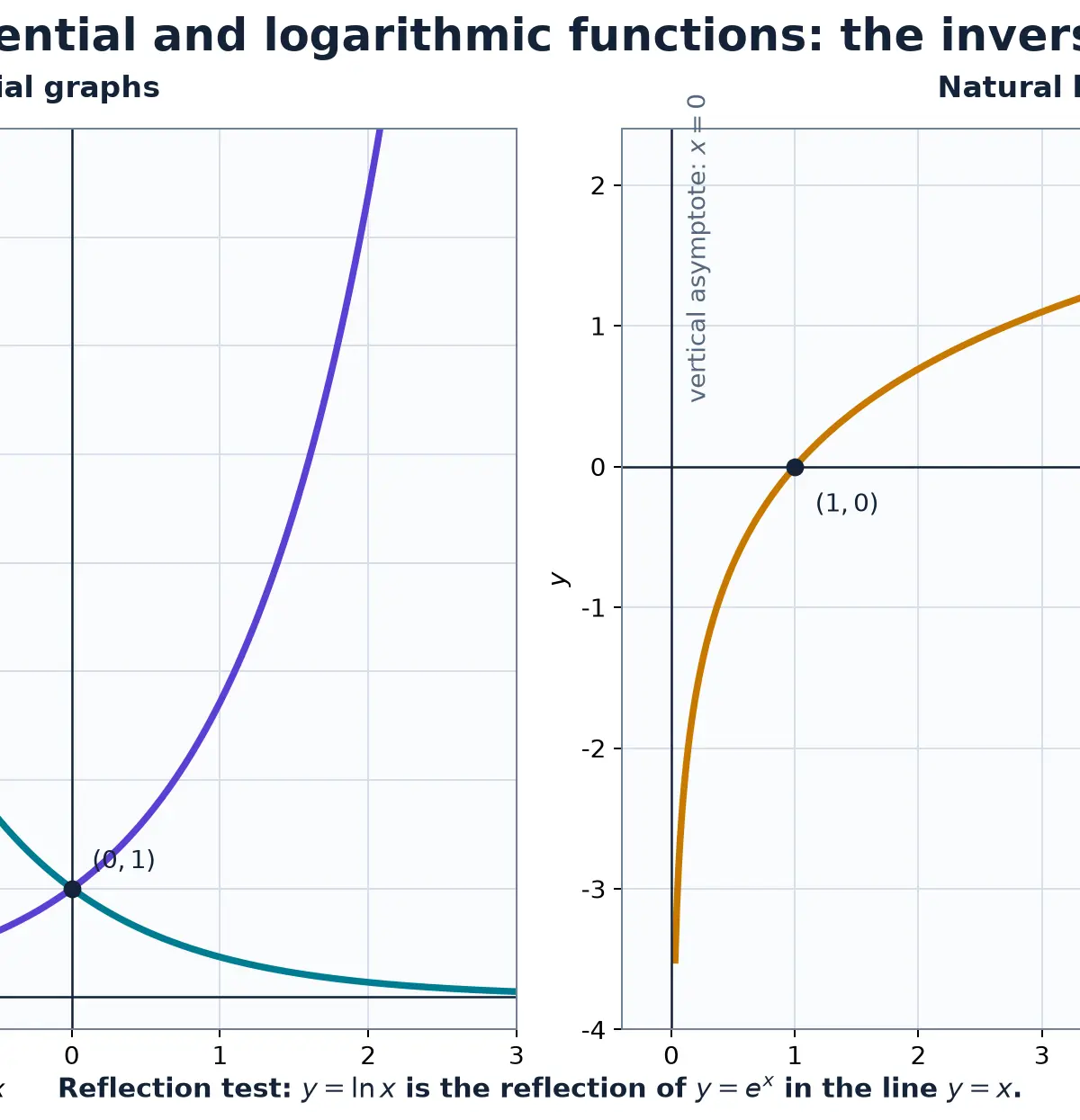
Graph checklist for marks: label axes; give the intercept or a known point; draw the asymptote as a dashed line where helpful; state a domain or range only when asked; and move the asymptote whenever the graph is translated.
2. Natural logarithms are inverse functions
log_a x means “the power to which a must be raised to obtain x”. For example, log_2 32 = 5 because 2^5 = 32. The natural logarithm, ln x, is log base e. It is the inverse of e^x, so:
ln(e^x) = xfor every realx.e^(ln x) = xonly whenx > 0.
Inverse functions swap input and output. Graphically, y = ln x is the reflection of y = e^x in the line y = x. The point (0,1) on e^x therefore becomes (1,0) on ln x. The exponential horizontal asymptote y = 0 becomes the logarithm vertical asymptote x = 0.
The domain restriction is not optional wording. In real-valued A-level Mathematics, ln x is defined only for x > 0. This is why ln(-3) is not an acceptable real answer and why a model such as y = ln(x-4) has domain x > 4. Credit is given for rejecting extraneous values created by algebra where the original expression is undefined.
3. Logarithm laws: derive, do not guess
The laws of logarithms are index laws written in reverse. Suppose u = log_a x and v = log_a y. Then x = a^u and y = a^v. Multiplying gives xy = a^(u+v), hence log_a(xy) = u+v. Similar reasoning gives the quotient and power laws.
log_a(xy) = log_a x + log_a ylog_a(x/y) = log_a x − log_a ylog_a(x^n) = n log_a x
All arguments must be positive, and a > 0, a ≠ 1. The most common error is inventing a rule for addition: log_a(x+y) is not log_a x + log_a y. Test it with base 10: log(2+3) = log 5, whereas log 2 + log 3 = log 6. They are different.
Memory hook: Products add, quotients subtract, powers come down, but sums stay put. Say it before manipulating an expression. It prevents the most expensive one-line mistake in this topic.
4. Solving exponential and logarithmic equations
When the unknown is in the power, isolate the exponential first and then take logs of both sides. For 5^(2x-1) = 18, natural logs give (2x-1) ln 5 = ln 18, so x = [1 + ln 18 / ln 5] / 2. Use ln consistently, or use log consistently. Mixing bases is still valid only if each side uses the same base at that step.
Show the logarithm step. An answer from a calculator without working risks losing method marks. Retain full precision until the final answer, then round only as requested. If a question gives ln(x-1) = 2, exponentiate to obtain x-1 = e^2 before finding x; the domain check x > 1 is then automatically satisfied.
5. Differentiation and proportional-rate models
d/dx(e^x) = e^x. By the chain rule, d/dx(e^(kx)) = k e^(kx). If y = Ae^(kt), then dy/dt = A k e^(kt) = ky. The rate of change is proportional to the amount. A positive k describes growth; a negative k describes decay.
For a context model, interpret A as the value at t = 0 and give k with its time-unit meaning. For instance, in C = 40e^(-0.3t), C starts at 40 and its instantaneous rate is -0.3C per time unit. The negative sign shows decay. This does not mean that exactly 30% is removed at the end of each unit. It means the continuous proportional rate is 0.3 per unit.
6. Linearising data with logarithms
AQA expects candidates to use logarithmic graphs to estimate parameters. For the exponential relationship y = ab^x, take natural logs:
ln y = ln a + x ln b.
Plot ln y vertically against x horizontally. A straight line has gradient ln b and intercept ln a. Therefore b = e^(gradient) and a = e^(intercept).
For the power relationship y = ax^n, take natural logs:
ln y = ln a + n ln x.
Plot ln y against ln x. Its gradient is n; its intercept is ln a. A frequent error is to report the gradient as b in the first model or a in either model. Translate it back to the parameter the question asks for.
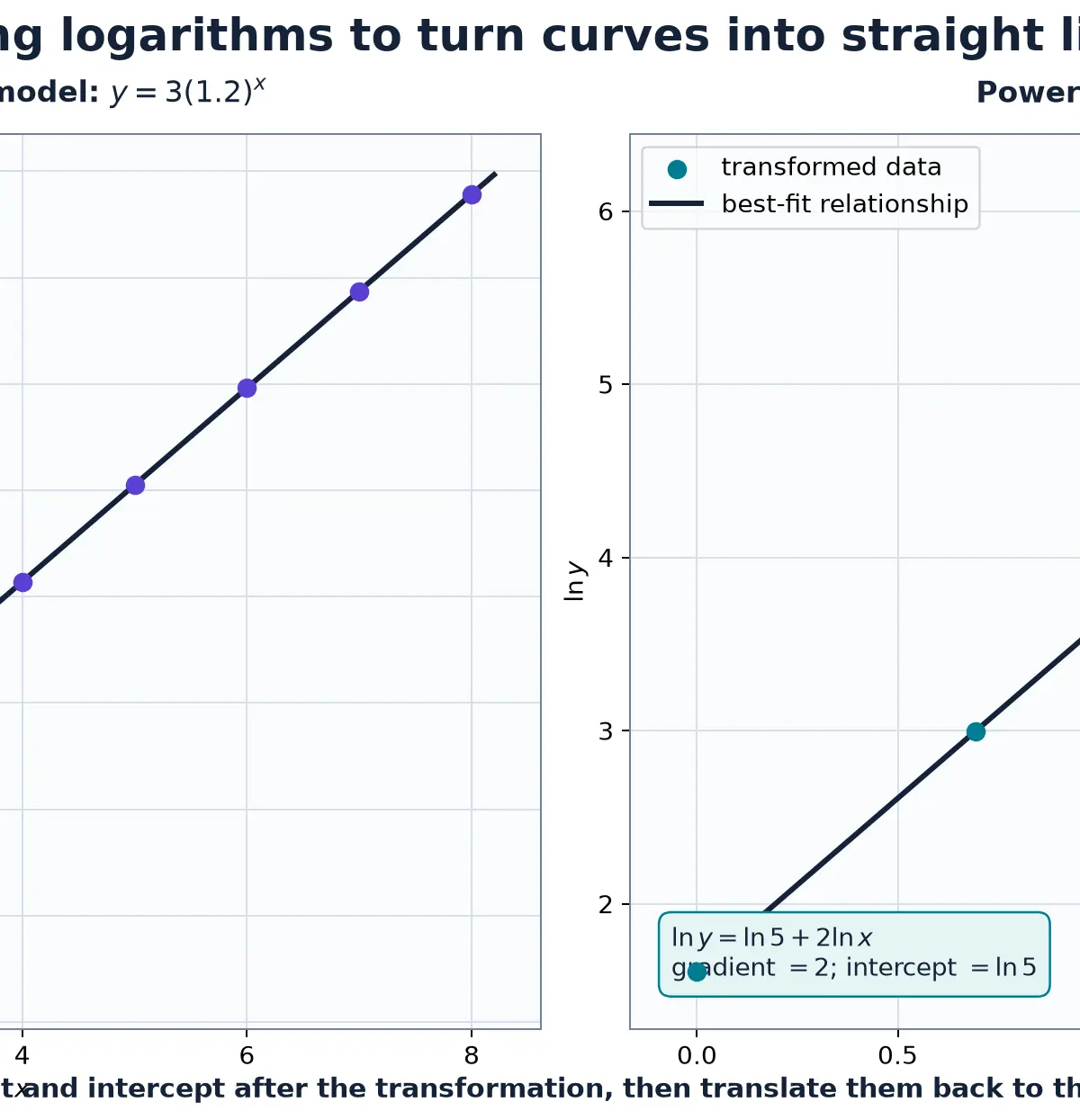
7. Model criticism earns modelling marks
Exponential models assume a constant proportional rate. That can be reasonable over a limited interval, but it can fail. A population may be restricted by food, space or disease. A drug may have changing absorption and elimination rates. Financial growth can vary as the interest rate changes. State a specific reason linked to the context, rather than writing only “the model is unrealistic”. A refinement may be a piecewise model, a changing rate, or a logistic model where a limiting value is plausible.
Formulae and relationships
| Relationship | Status for AQA 7357 | When to use it |
|---|---|---|
log_a(xy) = log_a x + log_a y | Must memorise | Combine or expand products of positive quantities. |
log_a(x/y) = log_a x − log_a y | Must memorise | Combine or expand quotients of positive quantities. |
log_a(x^n) = n log_a x | Must memorise | Bring a power down or collect a coefficient into one log. |
ln(e^x) = x; e^(ln x) = x for x > 0 | Must memorise | Simplify inverse-function expressions and solve log equations. |
d/dx[e^(kx)] = k e^(kx) | Must memorise | Differentiate exponential functions and show proportional rate. |
ln y = ln a + x ln b | Must memorise / derive | Straight-line plot for y = ab^x. |
ln y = ln a + n ln x | Must memorise / derive | Straight-line plot for y = ax^n. |
AQA Appendix B says these logarithm laws and core derivatives must be used without being provided, except where a formula is the starting point or result of a proof. Do not rely on a formula sheet for this topic.
Practical applications
Exponential decay is used in drug concentration. If a dose is repeatedly reduced by the same proportion in equal time intervals, an exponential model may fit early data. Continuous compound interest uses A = Pe^(rt), where P is the initial investment, r is the continuous rate and t is time. Radioactive decay and population growth can use the same mathematical form, although the model is only defensible while its assumptions are reasonable.
There is no required practical for AQA 7357 section 3.7F. The assessed practical-style skill is data handling: transform data, produce a correctly labelled graph, identify gradient and intercept, estimate original parameters, and evaluate the model. No unit conversions are intrinsic to the topic, but time units must be consistent with the rate constant in a model.
Active recall before moving on
Cover the formula table. Sketch e^x and ln x with their key points and asymptotes. Then say the three log laws aloud and explain why a logarithm cannot accept a non-positive argument. If you cannot do those four things unaided, return to the worked examples rather than reading the notes again.
Listen: 10-minute tutor recap
Visual Resources
2 diagrams and illustrations
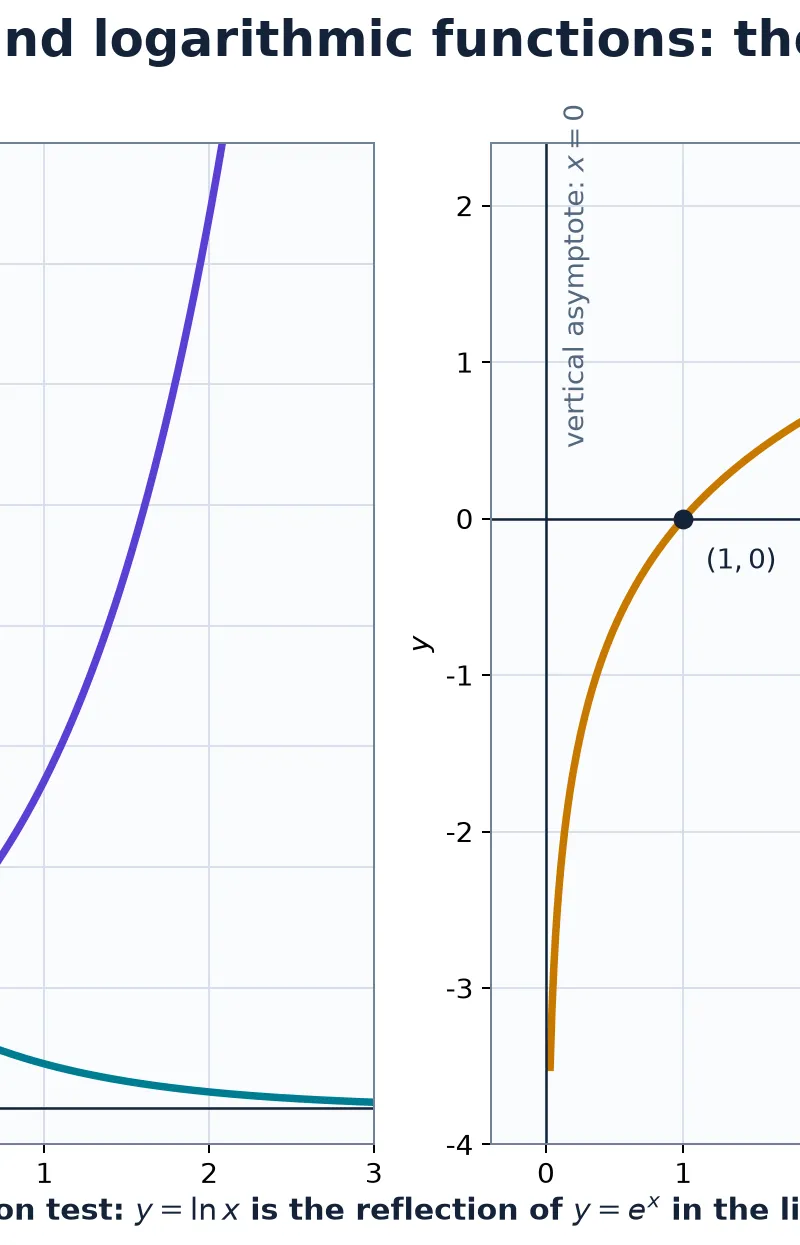
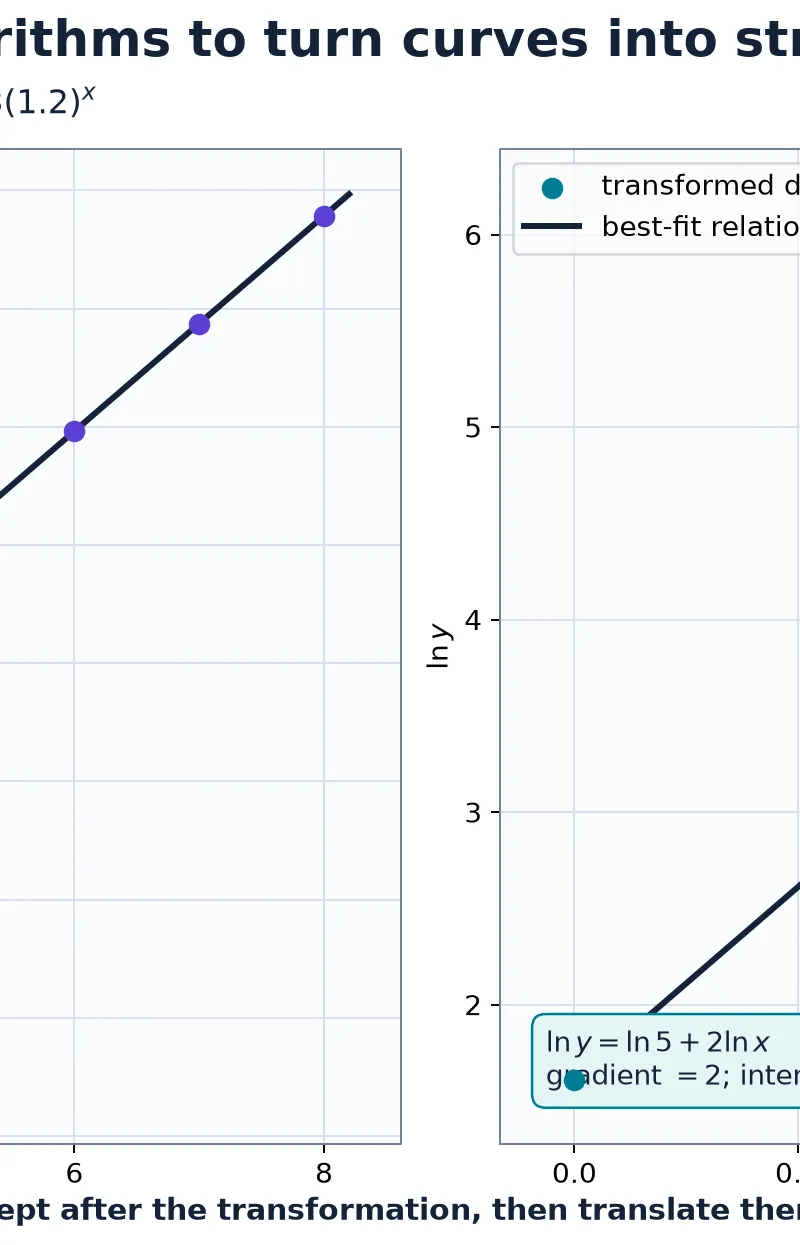
Interactive Diagrams
2 interactive diagrams to visualise key concepts
Conceptual Flow Outline
Reliable sequence for solving an equation with an unknown exponent after isolating the exponential expression.
Conceptual Flow Outline
How an exponential model becomes a straight line and how the original parameters are recovered.
Worked Examples
4 worked examples — open one to explore the question and available guidance.
Practice Questions
Try the question, then reveal an answer plan or example response
State the domain and range of y = ln(x-3). [3 marks]
Hint: The input of a natural logarithm must be positive. The output of ln can be any real number.
Solve 5^x = 42, giving x to 3 significant figures. [3 marks]
Hint: Take the same logarithm of both sides, then use the power law.
The function is y = 4e^(2x). Find dy/dx and hence the gradient when x = 1. [4 marks]
Hint: Differentiate e^(2x) using the chain rule, then substitute x = 1.
Given ln(2x-1) + ln 3 = ln 21, solve for x. [4 marks]
Hint: Use the product law before exponentiating. Check the original log argument is positive.
A population is modelled by P = 1200e^(0.06t), where t is in years. Find the percentage growth rate and state one limitation of the model. [4 marks]
Hint: Differentiate or compare with P = Ae^(kt). A limitation must mention the context and the constant proportional-rate assumption.
For a model y = ax^n, a plot of ln y against ln x has gradient 1.75 and intercept 0.916. Find a and n, then write the model. [5 marks]
Hint: Compare ln y = ln a + n ln x with Y = mX + c, then exponentiate the intercept.
Exam technique
How to turn what you know into marks
How to approach the question
Identify the mathematical object first. A graph question needs key point plus asymptote. An unknown exponent needs isolation then logs. A rate question needs the chain rule. A transformed-data question needs the correct axes and a translation back from gradient/intercept to the original parameters. Write one justified algebraic change per line.
How to structure your answer
For 1-2 marks, give the requested value, condition or graph feature precisely. For 3-4 marks, show each algebraic or calculus step so method marks can be credited. For 5-6 marks, calculate, state the mathematical interpretation, then evaluate the context or model assumption if asked.
Timing
Each AQA 7357 paper is 120 minutes for 100 marks, so the average is 1.2 minutes (72 seconds) per mark. Treat this as a pacing guide, not a reason to rush a multi-step problem.
Common pitfalls
- Writing log(x+y) = log x + log y. Avoid it by saying 'sums stay put' and checking with a numerical counterexample.
- Forgetting the chain-rule coefficient in d/dx[e^(kx)]. Circle the inner coefficient before differentiating.
- Reporting a straight-line graph gradient as b rather than ln b. Use a comparison line before substituting numbers.
- Giving a logarithm of zero or a negative number in a real-valued answer. State the domain from the original expression.
- Rounding before the final step. Store the calculator value and round only on the requested line.
What the command words want
- Compare
- Give a linked similarity and difference, such as both inverse graphs having an asymptote but in perpendicular directions.
- Explain
- Link a fact to a reason. For example, 'C decreases because dC/dt = -0.25C, which is negative for C > 0.'
- Describe
- Use mathematical direction and behaviour: increasing/decreasing, approaches, passes through, reflected, translated or asymptotic.
- Evaluate
- State a context-specific assumption or limitation, explain its likely effect, then make a justified judgement about the model interval.
- Calculate
- Show the relevant law or formula, substitute accurately, retain precision, then give the requested rounding and units where applicable.
- Show that
- Begin from the supplied expression, use reversible steps, keep exact forms where possible, and arrive at the stated result without assuming it.
- State/Give
- Supply the exact feature requested, such as 'vertical asymptote x = 0' or 'domain x > 0'. Do not add a derivation unless it is needed.
Watch or listen (optional)
Test your understanding of F: Exponentials and logarithms
Active recall beats re-reading. Take an instant quiz now to test what you’ve learned and lock it into long-term memory.
7 days Premium · Then the free plan continues · No card, no charge