AQA · A-Level · Mathematics
Course version: 7357 · Version from Sept 2017
G: Differentiation
Differentiation is the AQA A-Level toolkit for describing instantaneous change: the gradient of a curve, a velocity, an optimum or a model. Mastering the rule choice and the interpretation turns a formula-heavy topic into reliable marks across all three papers.
- 9 min read
- 3 worked examples
- 5 practice questions
- 8 key terms
Try the lesson
The start of the G: Differentiation lesson, made from checked teaching notes for this specification point.
Have a go first
A curve is defined parametrically by x = 2t³ and y = 3t⁴. Find dy/dx in terms of t.
There is more to this lesson
The full lesson goes on to check your understanding and help you earn the marks. Create a free account to carry on, with your progress saved.
7 days Premium · Then the free plan continues · No card, no charge
Check what you remember
Read the wording for your board, then hide it and explain Derivative in your own words. Rough notes are fine. This is a self-check, with no mark or grade.
Reference: AQA
The instantaneous rate of change of a function with respect to its variable; geometrically, the gradient of the tangent to the curve.
Study Notes
AQA A-Level Mathematics: G Differentiation (3.8)
Overview
Differentiation is the mathematics of instantaneous change. It turns a function into a new function that tells you the gradient of the original curve at every point. In AQA 7357 this begins with tangents and rates of change, but it quickly becomes the tool behind maxima and minima, normals, graph behaviour, parametric curves, connected rates and simple differential equations. It is an important exam topic because the same method can be assessed as a short AO1 skills question, a multi-step pure problem or a contextual AO3 modelling question. A candidate who can choose a rule, show the link between their derivative and the question, and interpret the result gains marks far more reliably than one who only memorises formulas. Differentiation links directly to functions, trigonometry, exponentials and logarithms, coordinate geometry, kinematics and later integration.
Listen: 10-minute revision podcast
Key concepts
1. The derivative: gradient and rate of change
For y = f(x), f'(x) or dy/dx is the gradient of the tangent at a general point on the curve. A secant joins two points. As the second point moves towards the first, its gradient approaches the tangent gradient. This limiting idea is why the derivative is an instantaneous, rather than average, rate of change.
If s is displacement in metres and t is time in seconds, ds/dt is velocity in metres per second. The notation tells you both what changes and what it changes with respect to. Read it as “rate of change of s with respect to t”. Positive derivative means increasing; negative derivative means decreasing; zero derivative means horizontal tangent.
First principles. For a small positive integer n, the derivative can be established from
f'(x) = lim(h→0) [f(x+h) - f(x)] / h.
For example, with f(x) = x²,
[(x+h)² - x²]/h = [2xh + h²]/h = 2x + h, so the limit is 2x.
Credit is given for expanding accurately, cancelling the factor h, and only then applying the limit. Never substitute h = 0 at the beginning because that produces division by zero.
2. Standard derivatives and the power rule
The power rule is d/dx(x^n) = nx^(n-1) for rational n. It works for roots and reciprocals because these are powers: √x = x^(1/2) and 1/x² = x^(-2). Rewrite awkward fractions as powers before differentiating where this reduces risk.
Example. y = 5x^(3/2) - 4x^(-1) gives dy/dx = (15/2)x^(1/2) + 4x^(-2). The last sign is positive because -4 × -1 = +4.
The AQA specification also requires exponential, logarithmic and trigonometric derivatives. The standard forms are shown in the formula bank below. For sin(kx), cos(kx), tan(kx), e^(kx) and a^(kx), the factor k appears because the inside function has gradient k.
3. Choosing and executing a differentiation rule
Use the chain rule for a function inside a function. Differentiate the outer function, leave the inner expression in place, then multiply by the derivative of the inner expression. For y = (3x² - 5)^4,
dy/dx = 4(3x² - 5)^3 × 6x = 24x(3x² - 5)^3.
Use the product rule when two expressions are multiplied: d(uv)/dx = u'v + uv'. For y = x²sin x, dy/dx = 2x sin x + x² cos x. Do not multiply the two derivatives together.
Use the quotient rule when one expression is divided by another: d(u/v)/dx = (vu' - uv')/v². Candidates should label numerator u and denominator v before substitution. This makes the order of the subtraction unambiguous and exposes method marks.
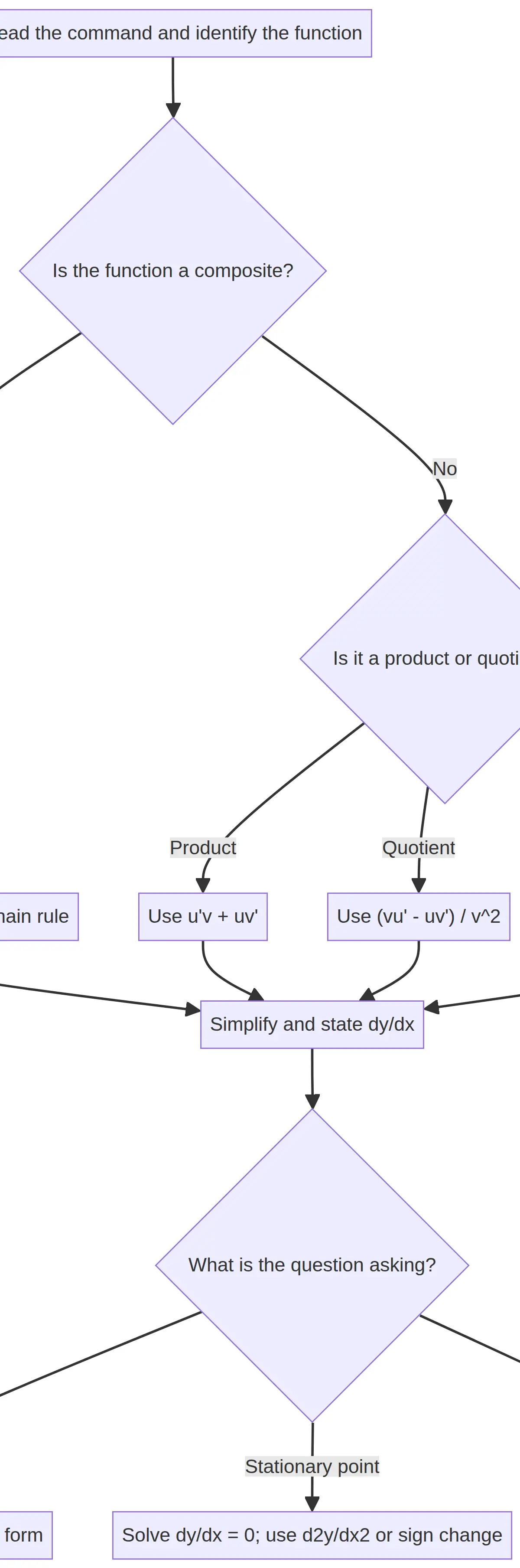
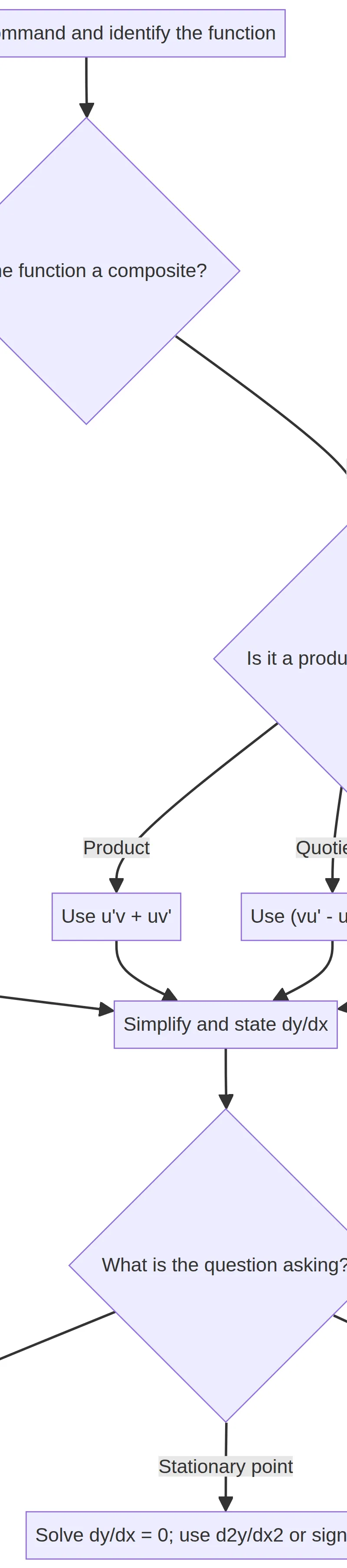
Rule-selection check. One expression inside another? Chain. Two expressions multiplied? Product. One divided by another? Quotient. Otherwise, differentiate each term using standard results. Simplify first only when it genuinely makes the structure safer.
4. Tangents, normals and stationary points
To find a tangent at x = a, calculate m = f'(a) and the point (a, f(a)). Then use point-gradient form:
y - y₁ = m(x - x₁).
For a normal, the gradient is the negative reciprocal: m_normal = -1/m_tangent, provided the tangent is neither horizontal nor vertical. A normal question needs the point as well as its gradient.
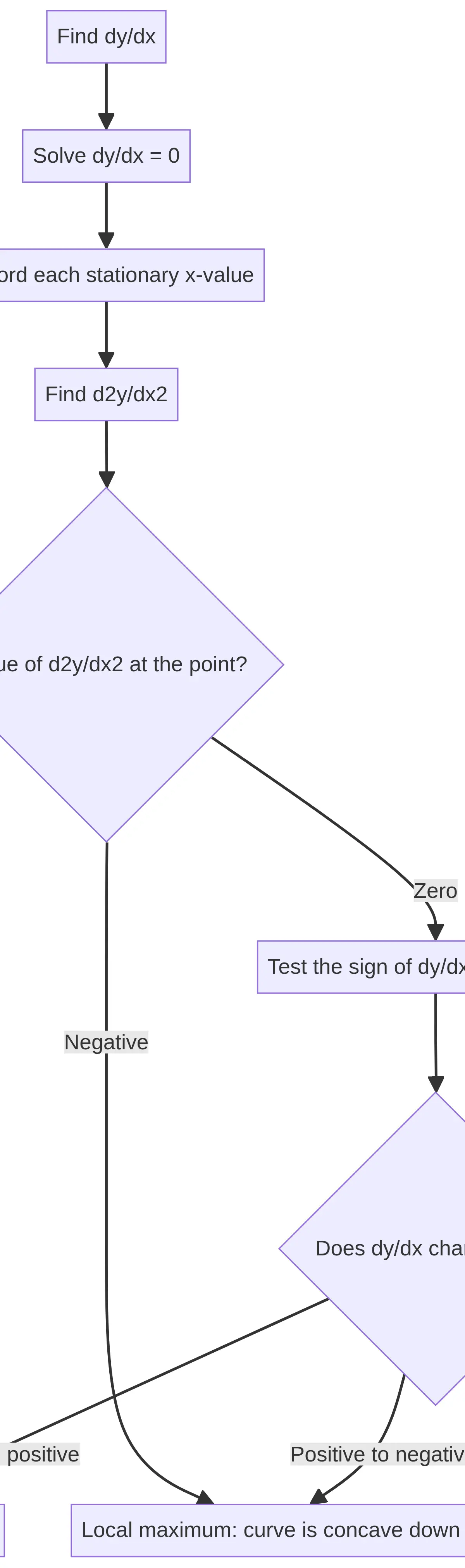
Stationary points satisfy dy/dx = 0. Solve for all x-values, then obtain y-values from the original function. The second derivative classifies them:
d²y/dx² > 0: local minimum, because the curve is concave up.d²y/dx² < 0: local maximum, because the curve is concave down.d²y/dx² = 0: inconclusive. Test the sign ofdy/dxon either side.
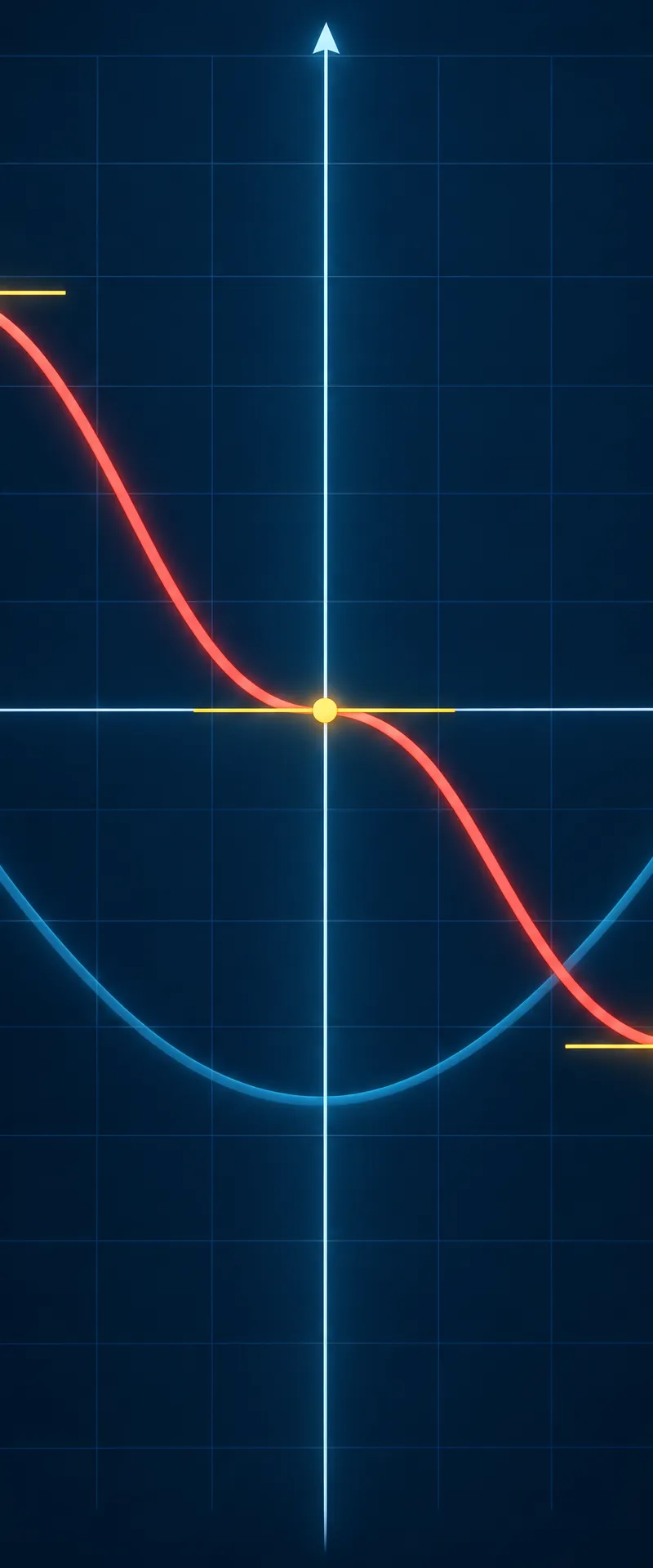
A stationary point of inflection has a horizontal tangent but dy/dx does not change sign. A point of inflection need not be stationary: it is where concavity changes.
5. Graph behaviour and the derivative function
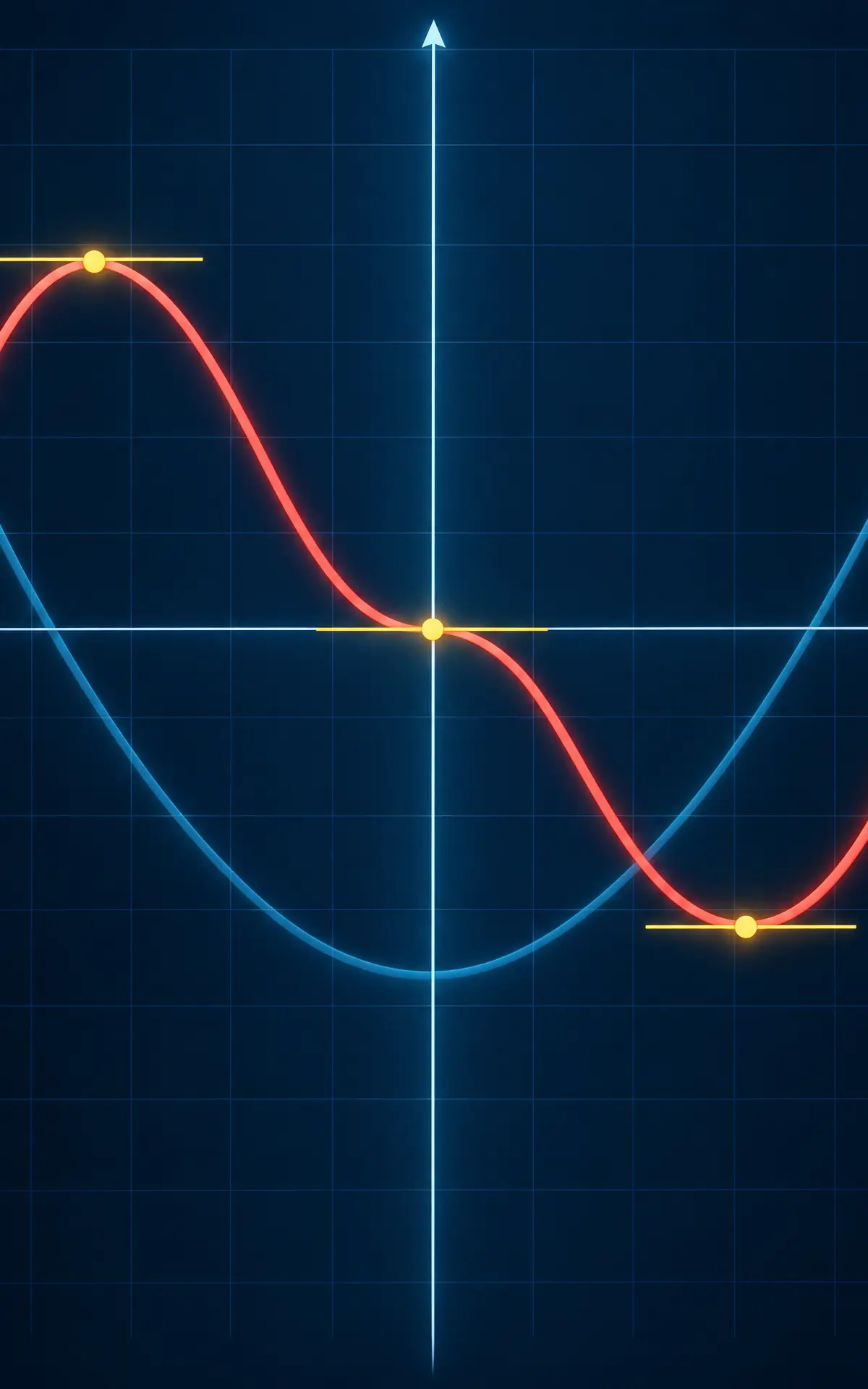
f'(x) is itself a function. Sketch it above the x-axis where f is increasing and below the x-axis where f is decreasing. A root of f' is a candidate stationary point. If f' changes from positive to negative, f has a local maximum. If it changes from negative to positive, f has a local minimum. This is often faster and more informative than looking only at the original graph.
For graphical questions, label relevant intercepts, stationary coordinates and the sign of the gradient. A sketch does not need a scale unless one is supplied, but it must show the correct overall behaviour. Use the second derivative to describe concavity: positive means gradients are increasing; negative means gradients are decreasing.
6. Implicit and parametric differentiation
For an implicit relation, differentiate every term with respect to x. Whenever you differentiate a term containing y, multiply by dy/dx because y depends on x. From x² + y² = 25,
2x + 2y(dy/dx) = 0, hence dy/dx = -x/y.
At (3, 4), the gradient is -3/4. The common error is treating y as a constant and writing the derivative of y² as 2y.
For parametric equations x = f(t) and y = g(t), use
dy/dx = (dy/dt) / (dx/dt).
Differentiate x and y separately with respect to t, divide, then substitute a particular t-value. For a tangent or normal, also substitute that t-value into the original parametric equations to locate the point. AQA G5 requires first derivative only.
7. Connected rates and simple differential equations
In a connected-rates problem, variables are linked and change with time. Differentiate the relationship with respect to time before inserting values. For a sphere, V = (4/3)πr³ gives
dV/dt = 4πr²(dr/dt).
If r = 5 cm and dr/dt = 0.4 cm s⁻¹, then dV/dt = 40π cm³ s⁻¹. Units matter: a rate of volume must be cubic units per unit time.
To construct a simple differential equation, state variables and translate the relationship precisely. “The rate of increase of P is proportional to P” becomes dP/dt = kP. The sign and units of constants should make sense in context. AQA may use kinematics, population growth or price-demand modelling. Constructing the equation is the G6 requirement; solving separable equations belongs to integration.
Formula bank: learn these, do not wait for a formula sheet
All differentiation results below should be treated as must memorise for AQA A-Level Mathematics. The specification’s formulae appendix lists required knowledge rather than a set of routine differentiation formulas supplied in the examination.
| Relationship | Status | Use and meaning |
|---|---|---|
d/dx(x^n) = nx^(n-1) | Must memorise | Power rule for rational n. |
d/dx(e^(kx)) = ke^(kx) | Must memorise | Exponential with linear inner function. |
d/dx(a^(kx)) = k ln(a)a^(kx) | Must memorise | General exponential base a. |
d/dx(sin(kx)) = kcos(kx) | Must memorise | Remember the inner gradient. |
d/dx(cos(kx)) = -ksin(kx) | Must memorise | The negative sign earns accuracy marks. |
d/dx(tan(kx)) = ksec²(kx) | Must memorise | Trigonometric derivative. |
d/dx(ln x) = 1/x | Must memorise | Defined for x > 0. |
(uv)' = u'v + uv' | Must memorise | Product rule. |
(u/v)' = (vu' - uv')/v² | Must memorise | Quotient rule, v ≠ 0. |
dy/dx = (dy/du)(du/dx) | Must memorise | Chain rule. |
dy/dx = (dy/dt)/(dx/dt) | Must memorise | Parametric gradient. |
y - y₁ = m(x - x₁) | Must memorise | Tangent or normal equation. |
Practical applications and modelling
Differentiation is used to optimise a design, predict velocity, quantify marginal cost and model population change. In a modelling answer, define variables, preserve units, make any reasonable domain restrictions explicit and interpret the sign or size of the derivative. For example, a negative dp/dt means price is falling, not that price is negative. If a maximum occurs at an endpoint of a restricted interval, compare endpoint values as well as stationary values.
There is no required practical for this pure mathematics topic and there are no Foundation/Higher tiers at A-Level. The transferable skills are representing a situation algebraically, differentiating accurately, testing whether a mathematical result is valid in its context, and communicating a conclusion with the correct units.
Examiner-style final check
Before moving on, ask: have I selected the rule from the structure, used brackets around a composite inner function, kept every minus sign, supplied a coordinate as well as a gradient where needed, classified stationary points rather than merely found them, and given units for a contextual rate? Those checks protect the most accessible marks.
Visual Resources
3 diagrams and illustrations

Interactive Diagrams
2 interactive diagrams to visualise key concepts
Conceptual Flow Outline
Rule-selection workflow: choose the structure before differentiating, then apply the derivative to the command word.
Conceptual Flow Outline
Stationary-point classification sequence using the second derivative, then a first-derivative sign test if necessary.
Worked Examples
3 worked examples — open one to explore the question and available guidance.
Practice Questions
Try the question, then reveal an answer plan or example response
Differentiate y = 5x^(3/2) − 4/x. [3 marks]
Hint: Rewrite 4/x as 4x^(−1) before differentiating.
For y = x² + 3x, find the equation of the normal at x = 1. [3 marks]
Hint: Find the tangent gradient first, then use the negative reciprocal.
Differentiate y = x²sin(3x). [4 marks]
Hint: It is a product, and sin(3x) is also a composite function.
The curve x² + y² = 25 passes through (3, 4). Find the gradient of the tangent at (3, 4). [4 marks]
Hint: When differentiating y², y depends on x.
The radius r cm of a sphere is increasing at 0.4 cm s⁻¹. Find the rate of increase of its volume when r = 5 cm. Give your answer in terms of π. [4 marks]
Hint: Start from V = (4/3)πr³ and differentiate with respect to time.
Exam technique
How to turn what you know into marks
How to approach the question
Underline the instruction and identify the function structure before differentiating. State or make the chosen rule visible, keep composite expressions bracketed, then link the derivative to the requested application: substitute for a gradient, set equal to zero for a stationary point, take a negative reciprocal for a normal, or retain units for a rate.
How to structure your answer
1–2 marks: write the derivative cleanly and simplify only if helpful. 3–4 marks: show rule selection, derivative, substitution and the requested conclusion. 5–6 marks: organise a logical chain with intermediate equations, coordinates and a written classification or contextual interpretation.
Timing
AQA papers are 120 minutes for 100 marks, so budget about 1.2 minutes per mark. Spend longer only where a multi-step problem earns it.
Common pitfalls
- Forgetting the derivative of the inner expression in a chain-rule question. Avoid it by identifying the inside before differentiating.
- Using the tangent gradient for a normal. Write m_normal = −1/m_tangent explicitly.
- Calling every solution of dy/dx = 0 a maximum or minimum. Use the second derivative or a sign change.
- Losing the negative sign in d/dx(cos x) = −sin x. Build a sign check into the final review.
- Substituting numerical values before differentiating a connected-rates relationship. Differentiate with respect to time first, then add units.
What the command words want
- Find
- Produce the requested mathematical object and show enough working for a method mark, especially where a derivative must be applied.
- Sketch
- Show the correct qualitative features: intercepts where known, stationary points, increasing/decreasing intervals and concavity where relevant.
- Justify
- Name the mathematical test used and state the evidence, for example ‘d²y/dx² = 6 > 0, so this is a local minimum’.
- Determine
- Calculate, then give a precise conclusion such as a coordinate, classification or equation.
- Interpret
- Translate the derivative into the context, including direction and units.
- Show that
- Start from the supplied information and make each algebraic or calculus step visible until the stated result is reached.
Watch or listen (optional)
Test your understanding of G: Differentiation
Active recall beats re-reading. Take an instant quiz now to test what you’ve learned and lock it into long-term memory.
7 days Premium · Then the free plan continues · No card, no charge