AQA · A-Level · Mathematics
Course version: 7357 · Version from Sept 2017
H: Integration
Integration is AQA’s toolkit for rebuilding quantities from rates of change, finding exact accumulated areas and solving simple models. Mastering the method-selection decisions in H1–H8 turns apparently different questions into recognisable mark-scoring routines.
- 11 min read
- 4 worked examples
- 6 practice questions
- 9 key terms
Try the lesson
The start of the H: Integration lesson, made from checked teaching notes for this specification point.
Have a go first
A particle moves along a straight line. Its velocity v m/s at time t seconds satisfies dv/dt = 6 and v = 4 when t = 0. What does the constant of integration represent in the solution v = 6t + 4?
There is more to this lesson
The full lesson goes on to check your understanding and help you earn the marks. Create a free account to carry on, with your progress saved.
7 days Premium · Then the free plan continues · No card, no charge
Check what you remember
Read the wording for your board, then hide it and explain Antiderivative in your own words. Rough notes are fine. This is a self-check, with no mark or grade.
Reference: AQA
A function \(F(x)\) whose derivative is the given function: \(F'(x)=f(x)\).
Study Notes

Overview
Integration turns a rate of change back into a quantity. In AQA A-level Mathematics 7357, H: Integration is not a single routine: it connects antidifferentiation, definite integrals, areas, the limit of a sum, substitution, parts, partial fractions and separable differential equations. The unifying idea is reversal. If differentiation tells you how quickly a quantity is changing, integration rebuilds the original function or total accumulated change.
This matters because Integration can be assessed in the Pure core on all three A-level papers. Each paper lasts 2 hours and carries 100 marks, so candidates should budget roughly 1.2 minutes per mark across the paper. Questions range from a one-mark antiderivative to a multi-stage modelling problem in which an integral, an initial condition and interpretation are all required. A strong answer is not merely an answer: it shows the method clearly enough for method credit to be awarded if arithmetic later slips. 1 2
Exam map: the AQA H1–H8 sequence
AQA requires the Fundamental Theorem of Calculus (H1), standard antiderivatives (H2), definite integrals and areas (H3), integration as a limit of a sum (H4), substitution and parts (H5), partial fractions with linear denominators (H6), separable first-order differential equations (H7), and contextual interpretation including kinematics (H8). The question to ask before writing anything is: what has differentiation produced, and which reverse process undoes it?
Key concepts
1. Fundamental Theorem of Calculus: the endpoint engine
If (F'(x)=f(x)), then
[\int_a^b f(x),dx=F(b)-F(a)=\left[F(x)\right]_a^b.]
The theorem says that a definite integral can be found from an antiderivative. The square bracket notation means “substitute the upper limit, then subtract the value at the lower limit”. It is not optional decoration: it protects the order of evaluation. For a definite integral, there is no arbitrary constant because any constant would cancel in (F(b)-F(a)).
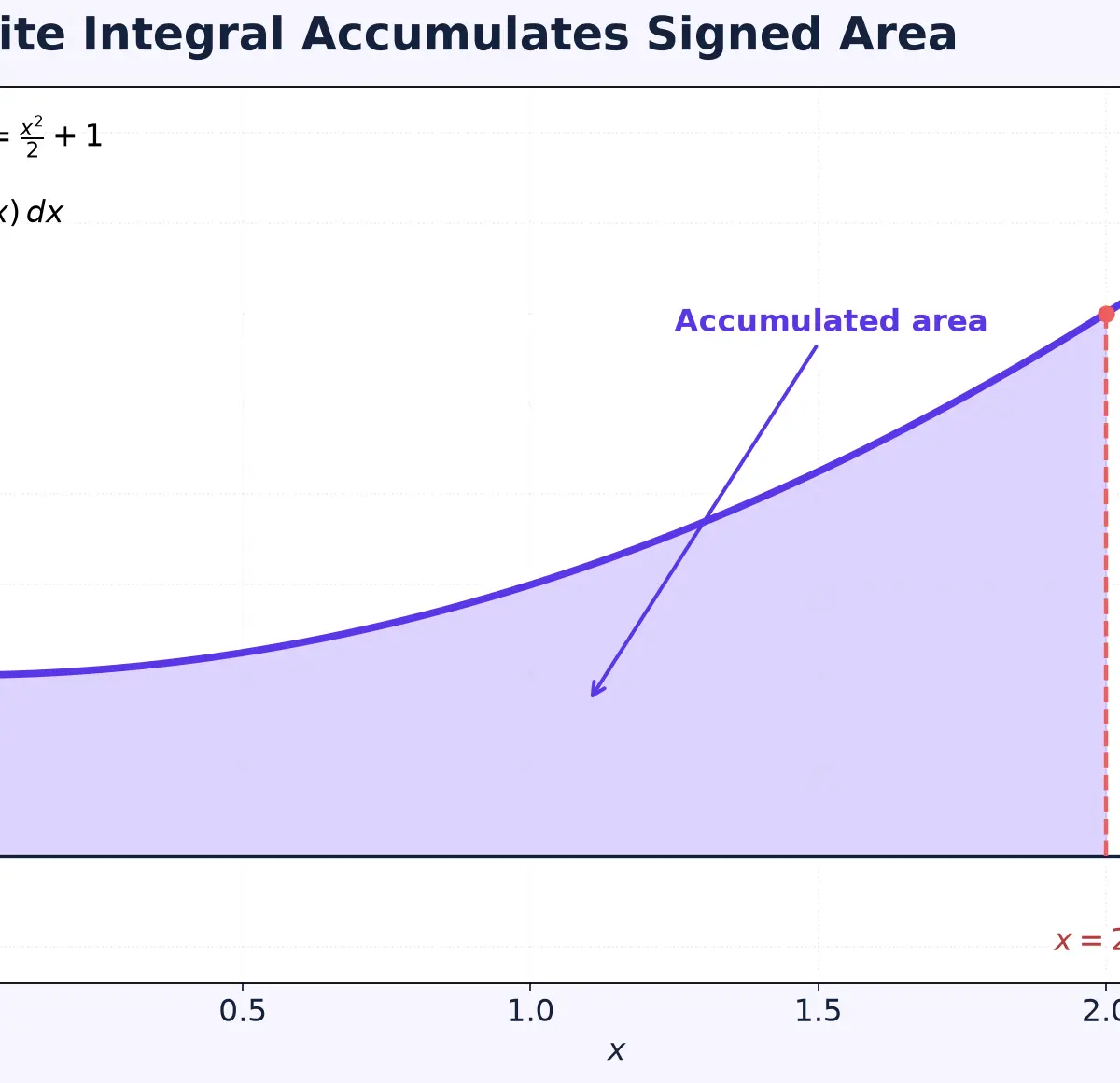
The integral is signed area. A region above the (x)-axis contributes positively; one below contributes negatively. Therefore an integral can be zero even when there is visible space between a curve and the axis. If a question asks for area, sketch first and split at every root. Then make each region positive, either by reversing limits or by integrating the negative of a below-axis function. In the June 2025 report, AQA highlighted incorrect limits, sign errors and failure to split regions as common reasons for lost marks. 3
2. Standard antiderivatives: reverse differentiation accurately
For (n
e -1),
[\int x^n,dx=\frac{x^{n+1}}{n+1}+C.]
The power increases by one and then you divide by that new power. This is why (\int x^{-2},dx=-x^{-1}+C), not (-2x^{-3}). Constant multiples remain attached: (\int 7x^3,dx=\frac{7}{4}x^4+C). Integrate each term separately only after simplifying indices, fractions and surds.
The special logarithmic case is (\int \frac1x,dx=\ln|x|+C). Also learn the reverse derivatives (\int e^{kx},dx=\frac1k e^{kx}+C), (\int \sin(kx),dx=-\frac1k\cos(kx)+C), and (\int \cos(kx),dx=\frac1k\sin(kx)+C). A quick differentiation check is powerful: differentiate your answer mentally before moving on. For an indefinite integral, the final (+C) is a mark-protecting habit. AQA’s 2025 examiner report specifically noted candidates who integrated correctly but omitted the arbitrary constant. 3
3. Definite integrals, area under a curve and area between curves
For area between curves, find intersections first. They are the limits and they reveal which graph is upper on each interval. The working must show
[\text{Area}=\int_a^b\bigl(\text{upper function}-\text{lower function}\bigr),dx.]
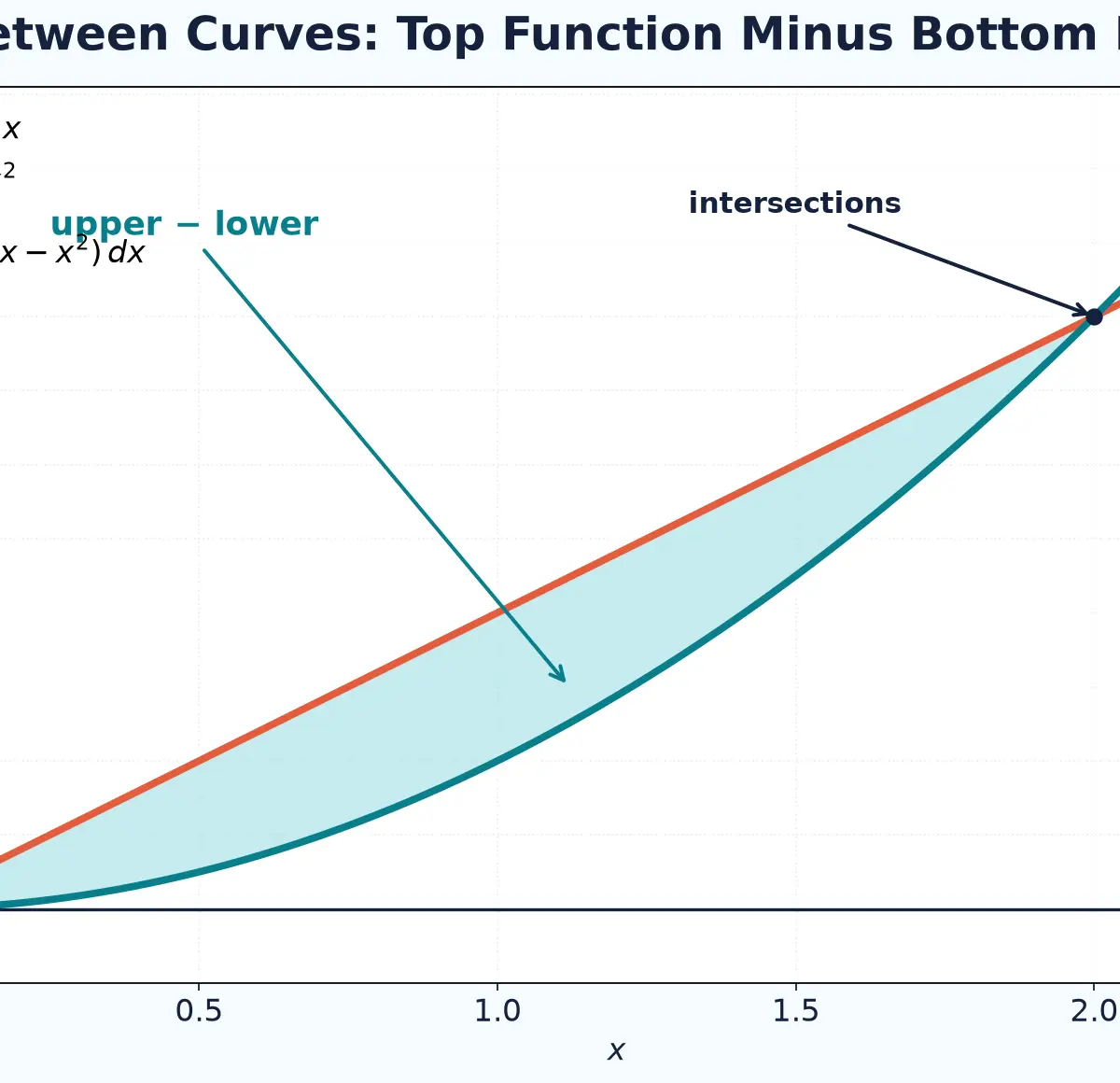
A sketch earns no standalone marks in most questions, but it prevents a costly negative area. Do not assume a named function is always upper. Test one point in every interval between intersections. If the curves exchange position, split the integral. In an exam, labels such as “(y=2x) is above (y=x^2) for (0<x<2)” make your mathematical decision visible to the examiner.
4. Integration as the limit of a sum
A definite integral is the exact value approached by adding infinitely many very thin rectangles:
[\int_a^b f(x),dx=\lim_{n\to\infty}\sum_{r=1}^{n} f(x_r),\Delta x.]
For a uniform partition, (\Delta x=\frac{b-a}{n}). A finite sum is an approximation; the limit removes the approximation. In an AQA question, first identify the width, write the rectangle height in terms of (r), simplify the sigma expression, use the supplied or memorised sum formulae, and only then take the limit. Keep brackets around the whole summand. This topic is a bridge to numerical methods: a trapezium-rule estimate uses finitely many strips, whereas integration evaluates the limiting total exactly when an antiderivative is available.
5. Choosing a technique: diagnose before calculating
Most integration mistakes begin before the first line of algebra. Use the structure of the integrand as your cue.
- A straightforward sum of powers, exponentials or trig functions needs standard integration.
- A composite function with its derivative, or a constant multiple of it, suggests substitution.
- A product where one factor becomes simpler when differentiated suggests integration by parts.
- A rational expression whose denominator factorises into linear factors suggests partial fractions first.
- A differential equation with a product of an (x)-expression and a (y)-expression suggests separation of variables.
This is an exam decision, not an acronym contest. Credit is given for a valid method even if later arithmetic fails, but only when the method is set out clearly.
6. Substitution and integration by parts
For substitution, choose (u=g(x)) so that both the integrand and (dx) can be rewritten wholly in (u). Write (u=\dots), then (\frac{du}{dx}$=\dots), rearrange for the required piece and substitute every occurrence of (x). For a definite integral, change the limits into (u)-limits immediately or change back to (x) before evaluating, but never mix systems. AQA limits this to cases where one suitable substitution produces an integrable function. 1$
For parts, use the inverse product rule:
[\int u\frac{dv}{dx},dx=uv-\int v\frac{du}{dx},dx.]
Make a four-line choice box: (u), (\frac{du}{dx}), (\frac{dv}{dx}$), (v). Choose (u) to become simpler when differentiated, normally a polynomial before an exponential or trigonometric factor. The memory phrase is “UV minus VDU”. In a definite integral, retain the limits throughout and combine the completed terms into one bracket before substituting the limits. This reduces sign errors. AQA permits more than one use of parts but excludes reduction formulae. 1$
7. Partial fractions and separable differential equations
If a rational function is improper, divide first. Then factor the denominator. For distinct linear factors, write
[\frac{P(x)}{(x-a)(x-b)}=\frac{A}{x-a}+\frac{B}{x-b}.]
Find (A) and (B) by equating coefficients or substituting convenient values after multiplying through. Only then integrate to logarithms, using absolute values: (\int\frac{1}{x-a},dx=\ln|x-a|+C). AQA H6 specifies linear denominators, so do not spend revision time on unsupported quadratic-factor methods.
For a separable equation, move every (y)-term with (dy) and every (x)-term with (dx):
[\frac{1}{g(y)},dy=f(x),dx.]
Integrate both sides, include one constant, then use the initial condition before presenting the particular solution. Finally, interpret it. A model may be mathematically defined beyond the situation it represents: for example, time cannot be negative, a population model may become unrealistic, or a velocity expression may only apply until an object hits the ground. That contextual limitation is explicitly part of H8.
Mathematical relationships and formula status
AQA states that candidates must be able to use its Appendix B formulae and identities without them being supplied, except where they are a starting point for a proof or a result to prove. Treat every relationship below as Must memorise, not as a formula-booklet rescue. 4
| Relationship | Use | Status |
|---|---|---|
| (\int x^n dx=\frac{x^{n+1}}{n+1}+C,\ n | ||
| e-1) | Powers | Must memorise |
| (\int\frac1x dx=\ln | x | +C) |
| (\int e^{kx}dx=\frac1k e^{kx}+C) | Exponentials | Must memorise |
| (\int\sin(kx)dx=-\frac1k\cos(kx)+C), (\int\cos(kx)dx=\frac1k\sin(kx)+C) | Trig functions | Must memorise |
| (\int_a^b f(x)dx=[F(x)]_a^b) | Definite integrals | Must memorise |
| (\int u\frac{dv}{dx}dx=uv-\int v\frac{du}{dx}dx) | Products | Must memorise |
| (\int_a^b[\text{upper}-\text{lower}]dx) | Area between curves | Must memorise |
| (\lim_{n\to\infty}\sum f(x_r)\Delta x) | Limit of a sum | Must memorise |
Graph, data and unit skills
$Integration questions reward a purposeful sketch. Draw axes, mark every intercept or intersection used as a limit, and shade the intended region. The sketch is your sign check: a region below the axis must be treated differently when the command word is area rather than evaluate the integral. On calculator questions, use graphing or numerical integration only as a check after writing the exact method. A decimal screen value is not a replacement for a valid setup, and candidates should keep exact values such as (\frac43), (\pi) and (\ln 2) until the question asks for a decimal.$
There are no Foundation/Higher tiers in A-level Mathematics. Integration itself contains no special unit conversions, but applied questions do. In kinematics, if acceleration is in (\mathrm{m,s^{-2}}), integrating with respect to seconds gives velocity in (\mathrm{m,s^{-1}}); integrating velocity gives displacement in metres. Write a unit beside a final physical area, displacement or accumulated quantity. Units make the meaning of a constant visible and can expose an implausible answer.
Practical applications and modelling
In mechanics, integrate acceleration to obtain velocity, then integrate velocity to obtain displacement. The constant represents a physical initial velocity or position, so dropping it changes the model. In economics, a marginal cost can be integrated to recover total cost up to a fixed constant. In science, a rate function accumulates quantity. The exam skill is the same in each case: name the units, use the condition, and state a limitation rather than pretending a model works for all inputs.
Listen and recall
After listening, close this guide and answer the quick-fire questions from the podcast without writing formulas first. Retrieval, then correction, is much stronger revision than reading the worked solutions again.
References
Visual Resources
2 diagrams and illustrations
Interactive Diagrams
2 interactive diagrams to visualise key concepts
Conceptual Flow Outline
Technique-selection flowchart: identify the structure before committing to algebra.
Conceptual Flow Outline
AQA H7–H8 routine for a separable differential equation in context.
Worked Examples
4 worked examples — open one to explore the question and available guidance.
Practice Questions
Try the question, then reveal an answer plan or example response
Calculate (\int(4x^3-6x+5)dx). [3 marks]
Hint: Integrate one term at a time and add the arbitrary constant.
Evaluate (\int_1^3(2x+1)dx). [3 marks]
Hint: Use one square bracket before substituting both limits.
Use the substitution (u=x^2+5) to find (\int\frac{2x}{x^2+5}dx). [4 marks]
Hint: Differentiate the stated substitution and replace \(2x\,dx\) completely.
Using integration by parts, evaluate (\int_0^1xe^x dx). [5 marks]
Hint: Choose the polynomial as \(u\).
Express (\frac{3x+5}{x^2+x-2}) in partial fractions and hence integrate it. [5 marks]
Hint: Factorise the denominator as \((x+2)(x-1)\).
Solve (\frac{dy}{dx}=3xy), given that (y=2) when (x=0). [5 marks]
Hint: Divide by \(y\) before integrating.
Exam technique
How to turn what you know into marks
How to approach the question
Read the integrand structurally before calculating. Mark roots and intersections for area. For a composite, locate an inner function and its derivative; for a product, decide whether one factor simplifies on differentiation; for a rational expression, factorise before integrating; for a differential equation, make separation explicit. Put a box round the final exact answer and include units for an area or applied quantity.
How to structure your answer
For 1–2 marks, write the antiderivative and any \(+C\) or bracket evaluation. For 3–4 marks, declare the technique, show the transformation and then evaluate. For 5–6 marks, include setup decisions such as intersections, \(u\) and \(dv/dx\), partial-fraction identity or separation, then show every major algebraic step and state the requested conclusion.
Timing
Across AQA 7357 papers, 120 minutes for 100 marks is approximately 1.2 minutes per mark. A 5-mark integration question therefore deserves about 6 minutes, including a brief sketch or checking step.
Common pitfalls
- Omitting \(+C\) after an indefinite integral. Make it automatic as the last symbol of every indefinite answer.
- Using a signed integral as an area. Sketch, split at all roots and state why any below-axis portion is made positive.
- Mixing \(x\)-limits with a \(u\)-integrand after substitution. Change both limits or revert fully to \(x\), never half-and-half.
- Applying parts in the wrong order or losing the minus sign. Build a \(u, du/dx, dv/dx, v\) choice box before substitution.
- Leaving a differential-equation answer in a form different from the requested particular solution. Substitute the condition and present the final form clearly.
What the command words want
- Compare
- Identify the common process and the key difference, for example signed integral versus positive area, or approximate finite sum versus limiting exact integral.
- Explain
- State the mathematical reason. For example, “the integral is split because the curve crosses the x-axis, so the signed contributions would otherwise cancel”.
- Describe
- For a graph or model, identify the relevant interval, shape or behaviour using mathematical language such as increasing, below the axis or bounded.
- Evaluate
- Carry out the required substitutions and arithmetic in a single clear chain. For a model, also judge whether the result is meaningful in context.
- Calculate
- Show the method, substitutions and bracket evaluation. Retain exact values such as \(\pi\), fractions and logs unless a decimal is specifically requested.
- Show that
- Begin from the supplied expression, make each transformation reversible and finish with a concluding statement that exactly matches the required result.
- State/Give
- Write the requested value or expression precisely. Do not add unsupported working, but include \(+C\) if the answer is an indefinite integral.
Watch or listen (optional)
Test your understanding of H: Integration
Active recall beats re-reading. Take an instant quiz now to test what you’ve learned and lock it into long-term memory.
7 days Premium · Then the free plan continues · No card, no charge