AQA · A-Level · Mathematics
Course version: 7357 · Version from Sept 2017
J: Vectors
Vectors turn movements, positions and forces into exact mathematics. Master the journey from one point to another, component arithmetic and magnitude, and you can unlock both pure vector questions and mechanics marks on AQA Paper 2.
- 11 min read
- 3 worked examples
- 5 practice questions
- 8 key terms
Try the lesson
The start of the J: Vectors lesson, made from checked teaching notes for this specification point.
Have a go first
Points P and Q have position vectors p = 2i − 3j + k and q = 5i + j − 2k. Calculate the exact distance PQ.
There is more to this lesson
The full lesson goes on to check your understanding and help you earn the marks. Create a free account to carry on, with your progress saved.
7 days Premium · Then the free plan continues · No card, no charge
Check what you remember
Read the wording for your board, then hide it and explain vector in your own words. Rough notes are fine. This is a self-check, with no mark or grade.
Reference: AQA
A quantity with both magnitude and direction.
Study Notes
Overview
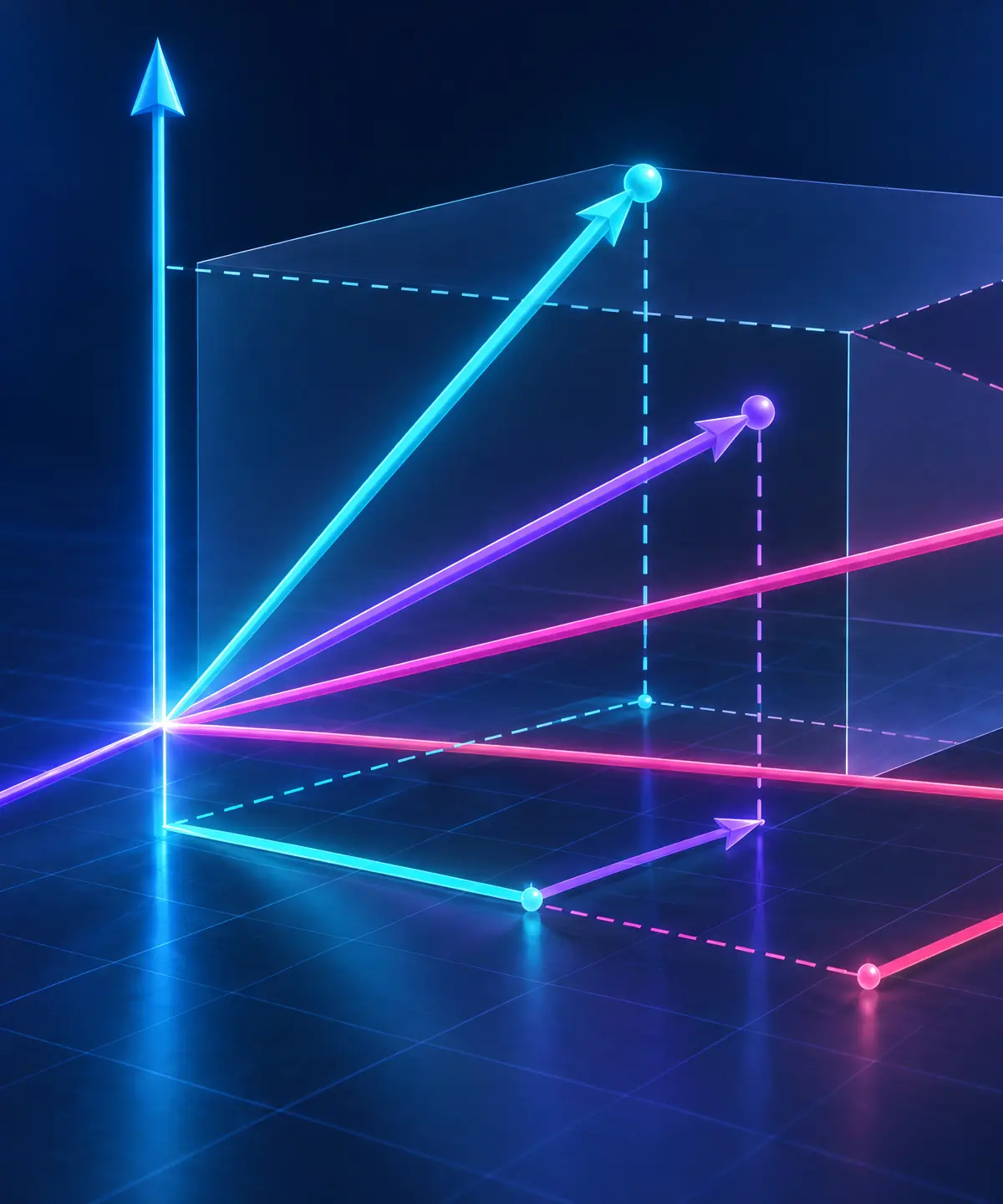
Vectors give mathematics a way to describe movement, position and force precisely. Unlike a scalar, which has size only, a vector has both magnitude and direction. AQA assesses this in specification 3.11 J: Vectors, including 2D and 3D components, magnitude and direction, vector algebra, position vectors, and applications in pure mathematics, forces and kinematics. It is examinable in Paper 2, so candidates must expect vectors to be embedded in mechanics as well as appearing as a stand-alone pure question.
The key to high marks is not memorising isolated tricks. A strong candidate sees the journey first, writes the vector relationship second, and calculates only then. For example, the vector from A to B is always position of B minus position of A. This same idea explains coordinate displacement, distance between points, a particle's movement and force resolution. In a 100-mark, two-hour Paper 2, work at about 72 seconds per mark. The examiner can award marks efficiently when your arrows, component arithmetic and conclusion are all visible.
Specification target: J1–J5 require vectors in 2D and 3D; magnitude/direction and conversion; addition and scalar multiplication; position vectors and distances; and problems in pure mathematics, forces and kinematics.
Key Concepts
1. Vectors, scalars and components
A vector records a directed change. Write it as a column vector, for example (\begin{pmatrix}3\-4\end{pmatrix}), or in 3D as (3\mathbf{i}-4\mathbf{j}+2\mathbf{k}). The first component is horizontal or x, the second is vertical or y, and the third is z. The signs matter: (\begin{pmatrix}3\-4\end{pmatrix}) means 3 in the positive x direction and 4 in the negative y direction.
A scalar has magnitude only. Distance, speed, mass and time are scalars. Displacement, velocity, acceleration and force are vectors. This distinction is regularly tested in context questions because it determines whether direction is required in the answer.
Exam habit:state the representation the question asks for. A vector should be a column vector or use (\mathbf{i},\mathbf{j},\mathbf{k}). A magnitude or distance must be a positive scalar, not a column vector.
2. Magnitude and direction
The magnitude of (\mathbf{a}=\begin{pmatrix}x\y\end{pmatrix}) is (|\mathbf{a}|=\sqrt{x^2+y^2}). In 3D, use (|\mathbf{a}|=\sqrt{x^2+y^2+z^2}). This is Pythagoras: the components form perpendicular sides and the vector is the resultant hypotenuse. For (\begin{pmatrix}3\-4\end{pmatrix}), the magnitude is (\sqrt{3^2+(-4)^2}=5).
For a 2D vector with direction (\theta) measured anticlockwise from the positive x-axis, (\tan\theta$=y/x). Your calculator supplies a reference angle, not necessarily the final direction. Inspect the signs of both components to identify the quadrant. A positive x and negative y component place the vector in quadrant IV, so a negative calculator angle may be expressed as a clockwise angle or converted into an angle between 0° and 360°, depending on the command word.$
The reverse conversion is equally important: magnitude (r) and direction (\theta) give components (\begin{pmatrix}r\cos\theta\r\sin\theta\end{pmatrix}). Cosine matches the horizontal adjacent component; sine matches the vertical opposite component when the angle is from the positive x-axis.
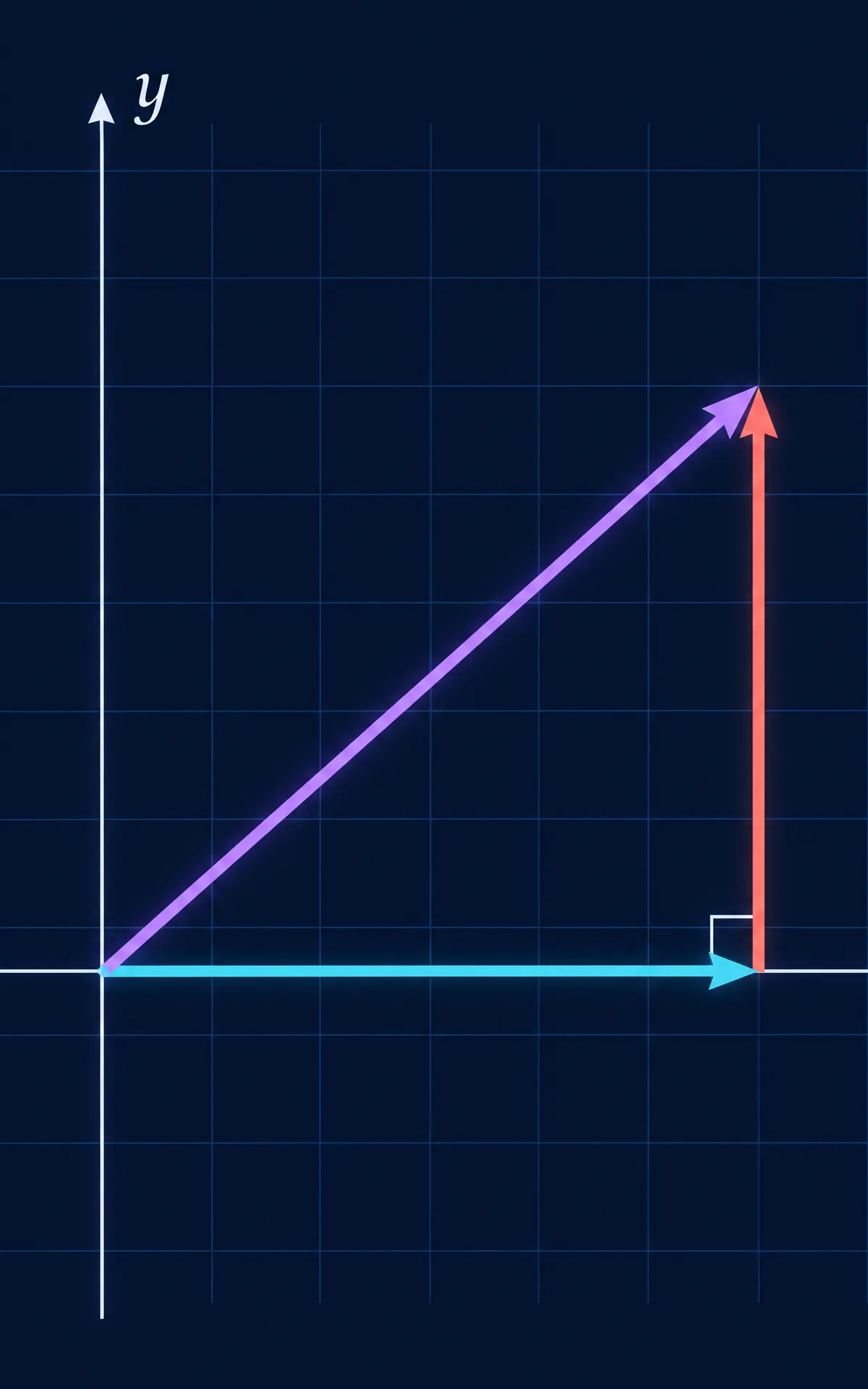
Visual check: the cyan and coral arrows are the components. Their head-to-tail sum is the purple resultant. If the arrows do not reconstruct the resultant, your signs or trigonometric function are wrong.
3. Addition, subtraction and scalar multiplication
Add and subtract component by component. If (\mathbf{a}=\begin{pmatrix}3\-4\end{pmatrix}) and (\mathbf{b}=\begin{pmatrix}-1\6\end{pmatrix}), then (\mathbf{a}+\mathbf{b}=\begin{pmatrix}2\2\end{pmatrix}). Diagrammatically, place (\mathbf{b}) head to tail after (\mathbf{a}); the resultant runs from the first tail to the final head.
Subtraction requires brackets: (\mathbf{a}-\mathbf{b}=\begin{pmatrix}3-(-1)\-4-6\end{pmatrix}=\begin{pmatrix}4\-10\end{pmatrix}). Candidates lose straightforward marks by treating subtraction as if it were addition. Write the subtraction before simplifying.
Multiplication by a scalar stretches or reverses a vector. (3\mathbf{a}) has three times the magnitude and the same direction. (-2\mathbf{a}) has twice the magnitude but the opposite direction. The magnitude is never negative. Scalar multiplication provides the algebraic test for parallel vectors: non-zero vectors are parallel precisely when one is a scalar multiple of the other.
4. Position vectors, displacement and distance
A position vector locates a point relative to the origin. If (\overrightarrow{OA}=\mathbf{a}) and (\overrightarrow{OB}=\mathbf{b}), then
[
\overrightarrow{AB}=\overrightarrow{OB}-\overrightarrow{OA}=\mathbf{b}-\mathbf{a}.
]
Say the route: destination minus start. For (\overrightarrow{BA}), reverse it: (\mathbf{a}-\mathbf{b}). This language prevents the common error of finding the vector in the wrong direction.
The distance (AB) is the magnitude of (\overrightarrow{AB}). First calculate the displacement vector, then take its magnitude. If A has position vector (\begin{pmatrix}2\1\-3\end{pmatrix}) and B has (\begin{pmatrix}6\-2\5\end{pmatrix}), then (\overrightarrow{AB}=\begin{pmatrix}4\-3\8\end{pmatrix}) and (AB=\sqrt{4^2+(-3)^2+8^2}=\sqrt{89}). The vector and its magnitude answer different questions.
A point dividing AB in a ratio can be found by travelling a fraction of (\overrightarrow{AB}) from A. The midpoint M has position vector (\frac12(\mathbf{a}+\mathbf{b})). In a proof-style question, establish a direction vector for each line and show one is a scalar multiple of the other. The diagram may guide you, but it is the scalar-multiple statement that earns the conclusion mark.
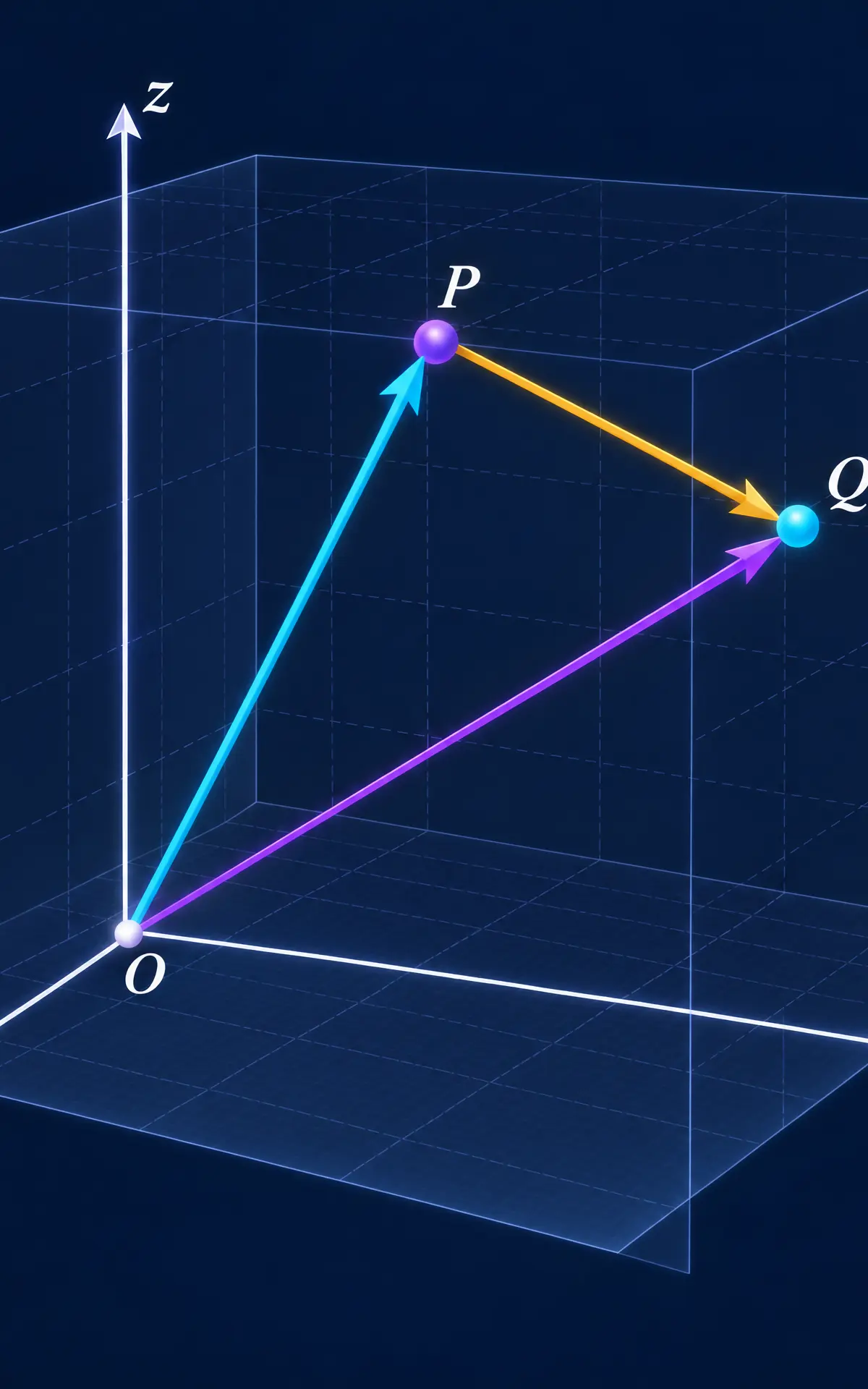
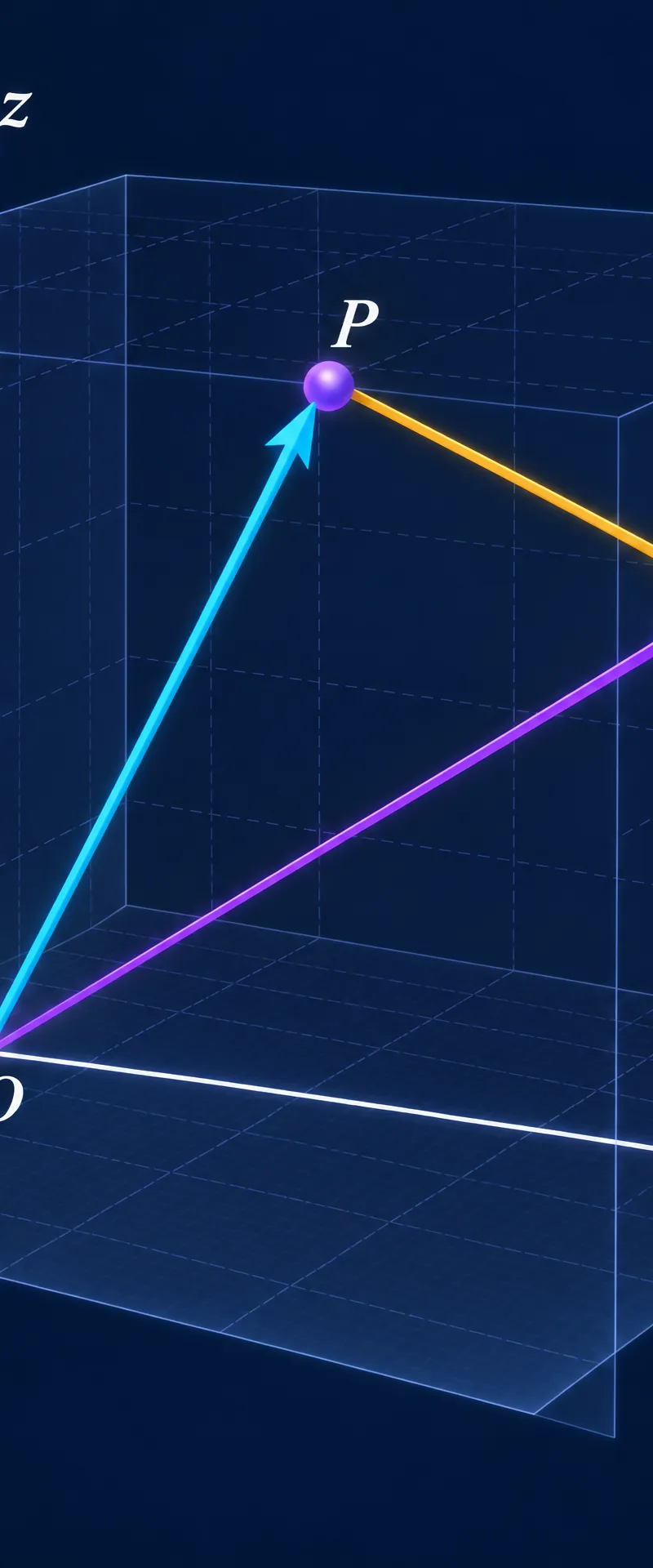
Visual check:the displacement from P to Q is (\overrightarrow{OQ}-\overrightarrow{OP}). The two vectors from O are position vectors; the yellow arrow is the displacement.
5. Vectors in forces and kinematics
Vectors are the bridge from pure maths to mechanics. In kinematics, displacement is a vector and distance is a scalar; velocity has direction and speed does not. In forces, resolve a force into perpendicular components before applying Newton's laws. For a force (F) at an angle (\theta) above the horizontal, horizontal component (=F\cos\theta), vertical component (=F\sin\theta). If the angle is measured from the vertical, swap the functions because the adjacent and opposite sides have swapped.
Choose positive directions before calculating. A force to the left is negative if right is positive. In a worded problem, units must be consistent before components are combined: 1 m = 100 cm and 1 km = 1000 m. Marks are awarded for a correct vector model, so write the component equation even if calculator arithmetic follows.
Mathematical Relationships and Formulae
All vector relationships below should be treated as must memorise and be able to derive/use. Do not rely on a supplied vector formula. Pythagoras is also a core prior relationship you must deploy correctly.
- Magnitude in 2D: (|\mathbf{a}|=\sqrt{x^2+y^2}), where (x,y) are components. Must memorise.
- Magnitude in 3D: (|\mathbf{a}|=\sqrt{x^2+y^2+z^2}). Must memorise.
- 2D component form from magnitude/direction: (\begin{pmatrix}r\cos\theta\r\sin\theta\end{pmatrix}), where (r) is magnitude and (\theta) is measured from the positive x-axis. Must memorise.
- Direction from components: (\tan\theta=y/x), then use component signs to choose the quadrant. Must memorise.
- Vector algebra: (\begin{pmatrix}x\y\end{pmatrix}\pm\begin{pmatrix}p\q\end{pmatrix}=\begin{pmatrix}x\pm p\y\pm q\end{pmatrix}) and (k\begin{pmatrix}x\y\end{pmatrix}=\begin{pmatrix}kx\ky\end{pmatrix}). Must memorise.
- Displacement:(\overrightarrow{AB}=\mathbf{b}-\mathbf{a}).Must memorise.
- Distance: (AB=|\mathbf{b}-\mathbf{a}|). Must memorise.
- Midpoint position vector: (\overrightarrow{OM}=\frac{\mathbf{a}+\mathbf{b}}2). Must memorise.
Exam-Focused Method
Use the S-J-C-M-C routine: Sketch, Journey, Components, Method, Conclusion. Sketch the arrows, say the journey, carry out component arithmetic, choose magnitude or scalar multiple as required, then state an answer that matches the command word. In a three-mark magnitude question, the marks normally reward correct substitution, correct calculation and a stated length. In a proof or “show that” question, candidates need the algebra and the reason it establishes the claim.
When a question says calculate, show the formula or vector relationship before the numerical answer. When it says show that, begin from the given information and state the exact equality or scalar multiple which proves the result. When it says hence, use a result already obtained rather than restarting with an unrelated method. Keep surds exact until a decimal accuracy is requested. A rounded intermediate angle can move a final direction into the wrong form.
Practical Applications and Graph/Data Skills
There is no required practical for this A-Level mathematics topic and no Foundation/Higher tier split. Nevertheless, diagrams are assessment evidence. On a coordinate sketch, label axes, arrow direction and any named points. Read a vector from tail to head, not from its position on the page. In navigation, a displacement combines horizontal and vertical movement. In engineering or mechanics, several forces combine to a resultant. In computer graphics, a 3D position vector places an object, while a displacement vector moves it.
Final Examiner Checks
Before moving on, run a 20-second audit. Have you written AB = b - a, rather than merely subtracting two columns without a stated route? Have you used brackets around a negative component? In a magnitude calculation, have you included every component and squared negative values correctly? In a direction question, does the stated angle agree with the signs of x and y? In a mechanics question, have you declared which way is positive and used compatible units?
For proof questions, candidates should circle the exact fact being shown. If the target is parallel, the final line needs a scalar multiple. If the target is a midpoint or ratio, the final expression must match the required fraction of the journey. Do not bury a correct result in working: write a complete sentence, for example, “(\overrightarrow{CM}=\frac32\overrightarrow{AB}), therefore CM is parallel to AB.” That single conclusion often carries the final communication mark.
Use error analysis after each practice attempt. If you reverse a vector, label tail and head next time. If you miss a quadrant, make a four-quadrant sign box before pressing inverse tangent. If your force components are swapped, redraw the triangle with the angle marked before choosing sine or cosine. Correcting the cause makes the mark secure under exam pressure.
10-minute audio recap
Listen once with the guide open, then listen again with the text covered. Pause during the quick-fire questions and answer aloud before the tutor supplies the answer.
Visual Resources
2 diagrams and illustrations
Interactive Diagrams
2 interactive diagrams to visualise key concepts
Conceptual Flow Outline
Head-to-tail component construction: horizontal and vertical components combine to give the resultant vector from the origin to the endpoint.
Conceptual Flow Outline
Position-vector relationship: the displacement from A to B is b minus a.
Worked Examples
3 worked examples — open one to explore the question and available guidance.
Practice Questions
Try the question, then reveal an answer plan or example response
Given a = (2, -5) and b = (-3, 4), calculate 2a + b. [3 marks]
Hint: Calculate 2a first, then add matching components.
Vector c = (-8, 15). Calculate |c| and give its direction anticlockwise from the positive x-axis to 1 decimal place. [3 marks]
Hint: The negative x and positive y components locate the vector in quadrant II.
A has position vector (4, -2, 1) and B has position vector (-1, 3, 5). Find AB and the distance AB. [4 marks]
Hint: Find B minus A before calculating a magnitude.
A force of 60 N acts at 35 degrees above the horizontal. Resolve it into horizontal and vertical components, giving answers to 3 significant figures. [4 marks]
Hint: The angle is from the horizontal, so horizontal is adjacent.
A, B, C and D have position vectors a, b, c and d. Given b - a = -2(d - c), show that AB is parallel to CD and state the ratio of their magnitudes. [5 marks]
Hint: Translate each difference into the named direction vector.
Exam technique
How to turn what you know into marks
How to approach the question
Draw a minimal labelled sketch. Translate words into an arrow journey, write the vector expression before calculating, retain exact values, and match the final object to the command word: vector, scalar distance or direction.
How to structure your answer
For 1–2 marks, give the relationship and the answer. For 3–4 marks, show component arithmetic and the method. For 5–6 marks, build a logical chain: define the required vector(s), simplify line by line, then state the mathematical reason, such as “a scalar multiple, therefore parallel”.
Timing
Paper 2 is 120 minutes for 100 marks: approximately 72 seconds per mark. A 6-mark vector proof should usually take about 7 minutes, including a final check.
Common pitfalls
- Reversing AB and BA: say “destination minus start” before subtracting.
- Using a calculator angle without checking the quadrant: inspect the signs of both components.
- Giving a column vector for distance or magnitude: take the magnitude and state a positive scalar.
- Dropping the z component in 3D: write all three squared terms before calculating.
- Rounding too early: keep exact surds and unrounded angles until the requested accuracy.
What the command words want
- Hence
- Use the preceding result explicitly; do not restart the question with an unrelated calculation.
- Compare
- Identify both magnitude and direction, or both scalar/vector status, where relevant.
- Explain
- Link the vector relationship to a reason, for example “because AB is a scalar multiple of CD, the lines are parallel”.
- Describe
- Use directional language and components, for example “3 in positive x and 4 in negative y”.
- Evaluate
- Check reasonableness: direction quadrant, units, sign convention and whether a distance is non-negative.
- Calculate
- Show the vector relationship or formula, substitute accurately and give the requested final form.
- Show that
- Start from the given data, display exact algebra and finish with the stated property or equality.
- State/Give
- Provide the requested vector, magnitude or direction concisely, using the correct form.
Watch or listen (optional)
Test your understanding of J: Vectors
Active recall beats re-reading. Take an instant quiz now to test what you’ve learned and lock it into long-term memory.
7 days Premium · Then the free plan continues · No card, no charge