AQA · A-Level · Mathematics
Course version: 7357 · Version from Sept 2017
P: Quantities and units in mechanics
Quantities and units are the grammar of AQA mechanics: they tell the examiner what a number means and protect accuracy marks in longer Paper 2 problems. Master SI base units, derived units and conversions now, and kinematics, forces and moments become much easier to model, calculate and check.
- 10 min read
- 3 worked examples
- 5 practice questions
- 10 key terms
Try the lesson
The start of the P: Quantities and units in mechanics lesson, made from checked teaching notes for this specification point.
Have a go first
Which of the following is a fundamental quantity in the SI system?
There is more to this lesson
The full lesson goes on to check your understanding and help you earn the marks. Create a free account to carry on, with your progress saved.
7 days Premium · Then the free plan continues · No card, no charge
Check what you remember
Read the wording for your board, then hide it and explain quantity in your own words. Rough notes are fine. This is a self-check, with no mark or grade.
Reference: AQA
A measurable property of an object, system or motion, such as length, time or mass.
Study Notes

Overview
AQA A-level Mathematics specification 3.17 P1 is the small mechanics topic with a large influence on your Paper 2 mark. It requires candidates to understand and use SI fundamental quantities, length, time and mass, and the derived quantities velocity, acceleration, force, weight and moment. The list looks straightforward, but these ideas are used in almost every kinematics, forces and moments question. A candidate who controls units can protect marks across longer multi-step problems; a candidate who mixes kilometres with seconds, or kilograms with newtons, can lose the final mark even when the algebra is sound.
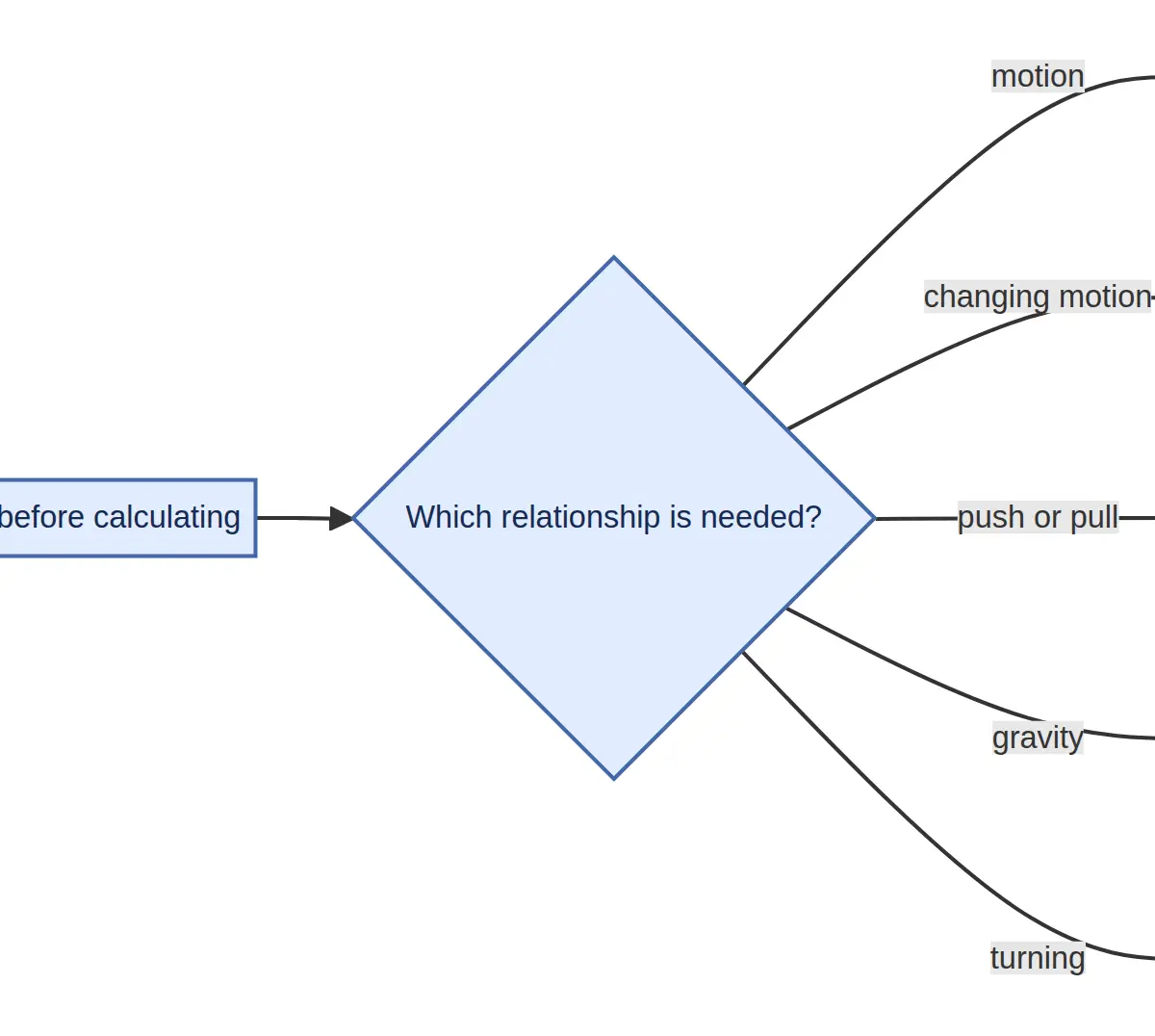
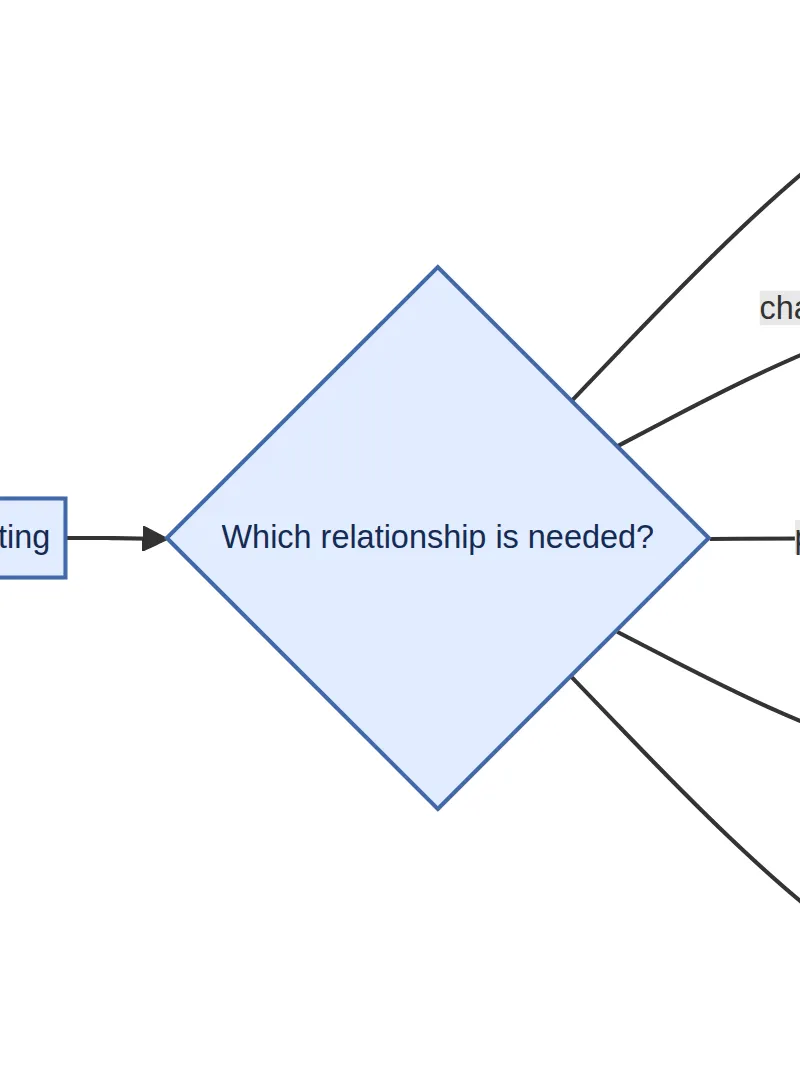
This is not a topic to revise by reading a glossary. Train a routine: identify the quantity, convert to SI, choose the relationship, calculate, then state the unit. On AQA Paper 2, questions range from one-mark unit recalls to calculations embedded in a larger modelling problem. The examiner can give credit for a correct conversion or relationship even where later arithmetic goes wrong, but only if the working is visible. Paper 2 is two hours for 100 marks, so use approximately one minute per mark as a first timing guide and reserve a final check for units.
Key Concepts
Concept 1: Quantity, unit and the SI system
A quantity is a property that can be measured. Length, time and mass are quantities. A unit is the agreed standard used to report that measurement. A length might be 3.2 metres, where length is the quantity and metre, m, is the unit. This distinction matters when a question asks for a unit rather than a numerical answer.
For AQA P1, the three fundamental SI quantities are:
| Fundamental quantity | SI unit | Unit symbol |
|---|---|---|
| Length | metre | m |
| Time | second | s |
| Mass | kilogram | kg |
They are called fundamental because mechanics builds other quantities from them. SI is a coherent system: when base units are used consistently, the derived unit follows naturally from the relationship. For example, displacement divided by time gives metre per second. You do not insert a hidden conversion factor if both inputs are already in SI.
Why it works: units behave like algebraic labels. In v = s/t, if s is measured in metres and t in seconds, then v carries m/s. Treat the labels as a parallel calculation. If the labels do not combine into the unit you expect, stop and check the data or formula.
Exam trigger: the word SI, a mixture of kilometres and seconds, grams and kilograms, or a request for an answer in a named unit should make you convert before substitution.
Concept 2: Unit conversion is part of the method
Convert before you use a formula unless the question explicitly requests a non-SI unit. The common conversions are 1 km = 1000 m, 1 m = 100 cm = 1000 mm, 1 hour = 3600 s, 1 minute = 60 s, and 1 kg = 1000 g. Write the converted value on a separate line. It is easy for an examiner to award method credit for a visible, correct conversion; it is difficult to credit a correct thought that is not shown.
A safe rule is to move from a larger unit to a smaller unit by multiplying. Thus 3.6 km = 3600 m and 0.45 kg = 450 g. Move from a smaller unit to a larger unit by dividing. Thus 7200 s = 2 h and 350 g = 0.350 kg. Do not depend on a vague feeling about which way to move the decimal point. Ask a sense-check question: should the numerical value become larger when I measure the same distance in millimetres rather than metres? Yes, so multiply.
Example: A runner covers 1500 m in 5 min. The time must become 300 s. Velocity is 1500/300 = 5 m s⁻¹. The answer 300 m min⁻¹ describes the same physical motion, but the question has asked for the SI unit and the expected final form is 5 m s⁻¹.
Concept 3: Derived quantities and their units
A derived quantity is built by combining fundamental quantities. You must know both its meaning and its unit.
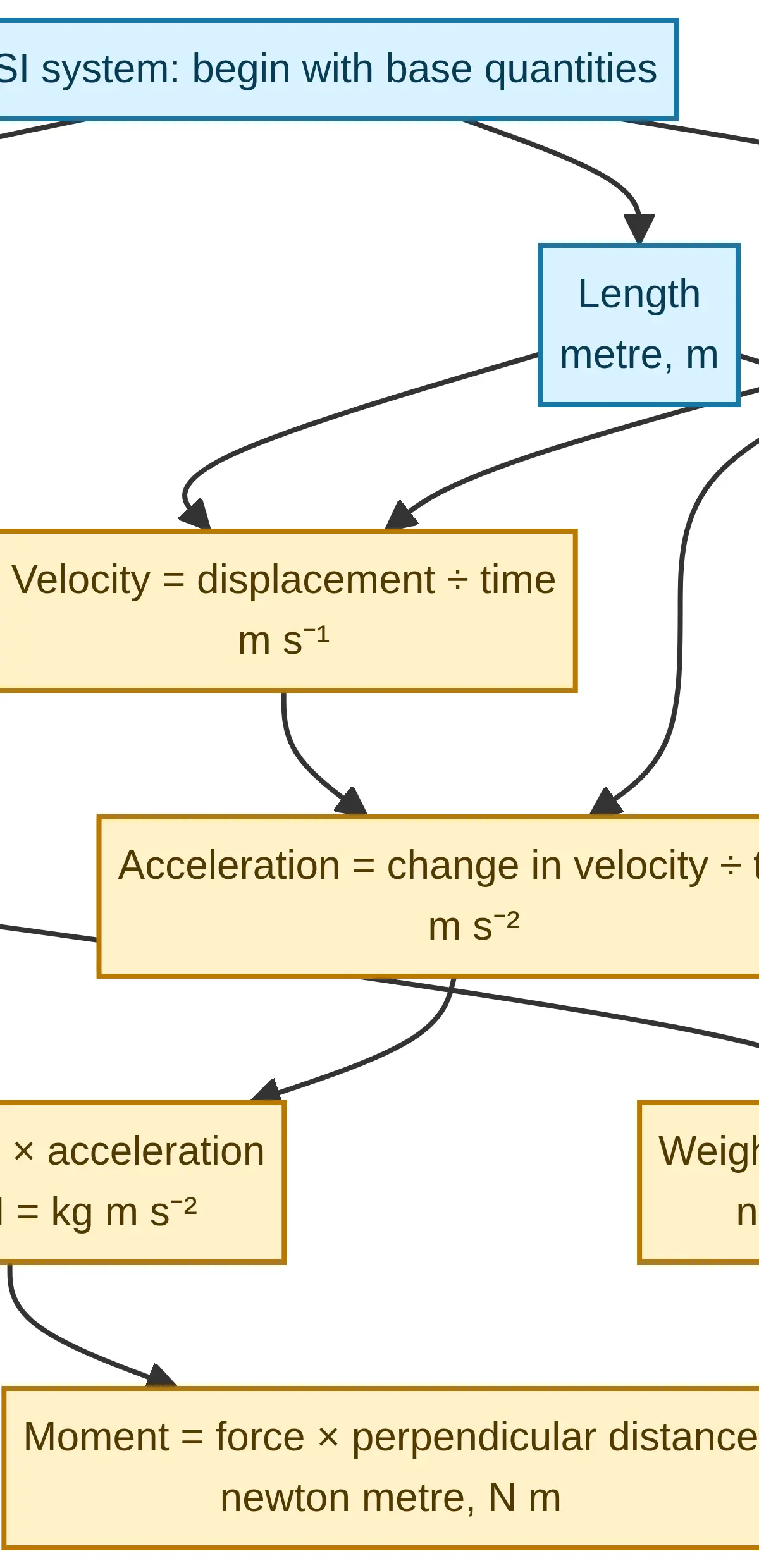
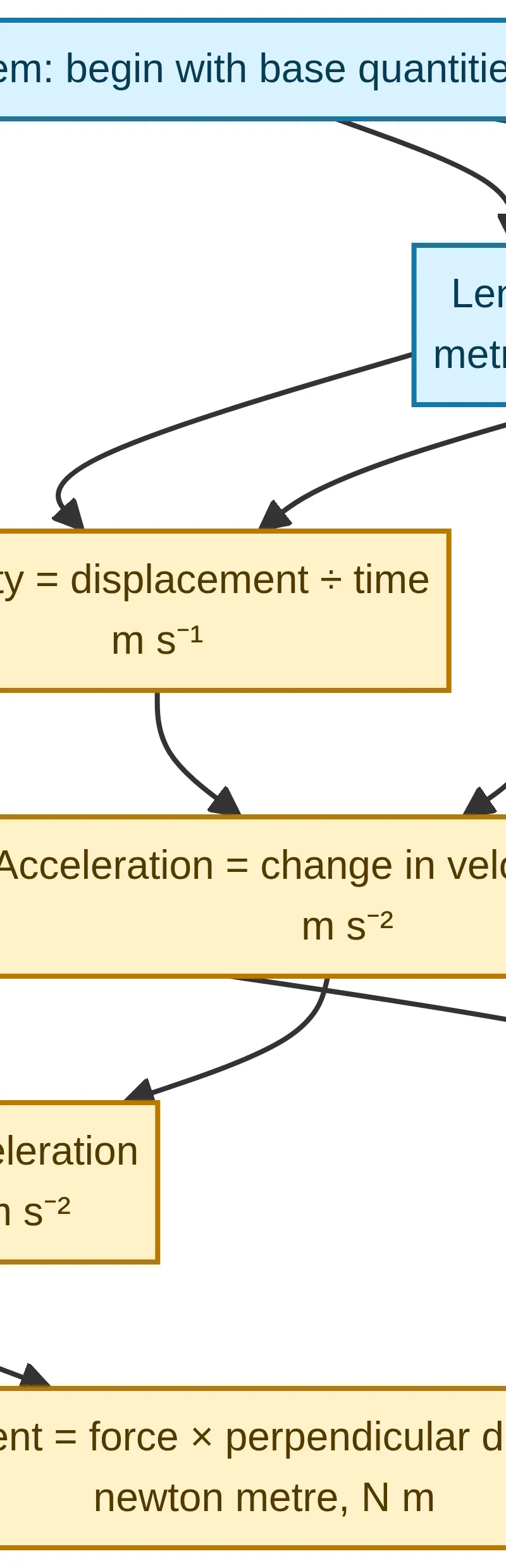
Velocity is displacement per unit time: v = s/t. Its SI unit is m s⁻¹, often read as metres per second. Velocity includes direction. A negative velocity may simply show motion opposite to the chosen positive direction.
Acceleration is change in velocity per unit time: a = Δv/t. Its SI unit is m s⁻². The s⁻² is not decoration. One division by time changes metres to metres per second; a second division by time changes metres per second to metres per second squared.
Force is a push or pull that can change motion. Newton's second law gives F = ma. Its SI unit is the newton, N. In base units, 1 N = 1 kg m s⁻². This explains why a force cannot be given in kilograms. Kilograms measure mass, not force.
Weight is the gravitational force acting on a mass. Use W = mg. Weight is measured in newtons because it is a force. Mass is measured in kilograms. Near the Earth's surface, take g = 9.8 m s⁻² unless the question specifies another value. A 6 kg object has a mass of 6 kg wherever it is, but on Earth its weight is 6 × 9.8 = 58.8 N.
Moment is the turning effect of a force about a pivot. Use M = Fd⊥, where d⊥ is the perpendicular distance from the pivot to the line of action of the force. Its unit is newton metre, N m. It is not N/m: that would mean newtons per metre, a completely different unit. Candidates lose marks when they use a sloping distance drawn to the force rather than the perpendicular distance.
Concept 4: Dimensional sense-checking
Dimensional checking is a quick way to catch a wrong unit before it costs a mark. Start with the base-unit form:
- velocity:
m ÷ s = m s⁻¹ - acceleration:
(m s⁻¹) ÷ s = m s⁻² - force:
kg × m s⁻² = kg m s⁻² = N - weight: force, therefore
N - moment:
N × m = N m
This check is particularly useful in multi-step questions. If you calculate a force and your calculator answer is labelled kg m s⁻¹, you have velocity units, not force units. Revisit the formula or the input units. Dimensional checking cannot prove that an equation is physically correct, but it is an efficient alarm for many slips.
Concept 5: Mass and weight are not interchangeable
Mass measures the amount of matter or inertia of an object. It is a scalar quantity and its unit is kilogram. Weight is the force due to gravity on that mass. It is a force and its unit is newton. The relationship W = mg links them, but it does not make them the same thing.
An examiner may set a question where a parcel has a stated mass, ask for its weight, and then use the weight in an equilibrium calculation. The correct route is first calculate W in newtons, then include the downward force in your model. Writing 5 kg as a force in a force diagram is not a minor wording issue: it uses the wrong quantity and can break the rest of the calculation.
Mathematical Relationships
| Relationship | Meaning of symbols | Unit check | Formula status |
|---|---|---|---|
v = s/t | v velocity, s displacement, t time | m/s = m s⁻¹ | Must memorise |
a = Δv/t | a acceleration, Δv change in velocity, t time | (m s⁻¹)/s = m s⁻² | Must memorise |
F = ma | F resultant force, m mass, a acceleration | kg × m s⁻² = N | Must memorise |
W = mg | W weight, m mass, g gravitational field strength | kg × m s⁻² = N | Must memorise |
M = Fd⊥ | M moment, F force, d⊥ perpendicular distance | N × m = N m | Must memorise |
AQA's specification appendix states that students must be able to use the listed formulae and identities without them being supplied, apart from special proof situations. Do not rely on a formula being printed. Learn the relationship with the meaning and unit of every symbol. Notice that g has the same unit as acceleration, m s⁻², because it is an acceleration due to gravity.
A model calculation layout
For a Calculate command, make your reasoning markable:
- Convert all given values to SI.
- State the relationship before using numbers.
- Substitute clearly, including brackets for negative values or powers of ten.
- Calculate with sensible accuracy.
- Write the numerical answer and exact unit.
For example, if m = 750 g and a = 2.4 m s⁻², write m = 0.750 kg, then F = ma = 0.750 × 2.4 = 1.8 N. A final answer of 1800 N shows that grams were treated as kilograms, so the conversion line protects you.
Practical Applications and Modelling
Although this mathematics topic has no required practical, the modelling is real. A car's dashboard speed is commonly displayed in miles per hour, but mechanics equations usually need metres per second. A construction engineer considers a force and a perpendicular distance when checking a turning effect. A lift cable must support a weight in newtons, not a mass in kilograms. These contexts are useful because they make the unit a statement about what is physically being measured.
When modelling, decide what an idealised quantity means before calculating. In a mechanics question, a particle has mass but negligible size. A light string has negligible mass. These assumptions appear more often in later topics, but your unit discipline begins here. If a question gives a mass in grams, an acceleration in metres per second squared and asks for a force, the model has already signalled the correct equation and the necessary conversion.
Graph and data skills
There is no separate graph technique in P1, but the units prepare you for kinematics graphs in 3.18. The gradient of a displacement-time graph has unit m s⁻¹, so it represents velocity. The gradient of a velocity-time graph has unit m s⁻², so it represents acceleration. Learning to derive the unit from the axes makes those later interpretations faster and more reliable.
Scope check
A-level Mathematics has no Foundation or Higher tier split. This content is assessed as part of the full A-level, chiefly through Paper 2 mechanics. There is no required practical for this mathematics specification point. Your target is precise mathematical communication: correct quantity, correct formula, correct conversion and correct final unit.
Visual Resources
2 diagrams and illustrations
Interactive Diagrams
2 interactive diagrams to visualise key concepts
Conceptual Flow Outline
The three fundamental SI quantities combine to produce the mechanics quantities AQA names in P1.
Conceptual Flow Outline
A mark-friendly calculation routine for mechanics quantities and units.
Worked Examples
3 worked examples — open one to explore the question and available guidance.
Practice Questions
Try the question, then reveal an answer plan or example response
State the SI unit for each quantity: mass, acceleration and moment. [3 marks]
Hint: One is fundamental, one involves velocity changing per second, and one is a force multiplied by a distance.
A drone flies 540 m in 1.5 minutes. Calculate its average velocity in m s⁻¹. [3 marks]
Hint: Convert the time before using velocity equals displacement divided by time.
A climber has mass 62 kg. Take g = 9.8 m s⁻². Calculate the climber's weight and state why the answer is not 62 kg. [4 marks]
Hint: Weight is a force, so use mass multiplied by gravitational field strength.
A trolley of mass 1.25 kg accelerates from rest to 6.0 m s⁻¹ in 2.0 s. Calculate the resultant force. [4 marks]
Hint: Find acceleration first from change in velocity divided by time, then use F = ma.
A 45 N force acts at the end of a 0.80 m handle. The handle makes an angle of 30° to the force. The perpendicular distance from the pivot to the force's line of action is 0.40 m. Calculate the moment about the pivot and explain why 0.80 m must not be used. [5 marks]
Hint: The question supplies the perpendicular distance explicitly. Moment equals force times that distance.
Exam technique
How to turn what you know into marks
How to approach the question
Circle the required quantity and its requested unit. List the given values with units, convert every non-SI input, state the relationship, substitute clearly, calculate, then sense-check the size and write the final unit.
How to structure your answer
For 1-mark unit questions, give the exact unit and symbol where requested. For 2-3 mark calculations, show conversion if needed, formula and answer with unit. For 4-6 mark mechanics problems, label the model or diagram, show every conversion and relationship, explain a key physical choice such as perpendicular distance, then give a clear final statement.
Timing
Use about 1 minute per mark as an initial Paper 2 guide. A 3-mark conversion calculation should normally take about 3 minutes, with a final unit check before moving on.
Common pitfalls
- Mixing km, cm, min, h, g or kg with SI quantities in one substitution. Avoid it by writing a dedicated conversion line before the formula.
- Writing weight in kg. Avoid it by asking 'is this a mass, or a force due to gravity?' Weight must be in N.
- Writing N/m for a moment. Avoid it by remembering that a moment is force multiplied by distance, so the unit is N m.
- Using an ordinary drawn length rather than the perpendicular distance for a moment. Mark the pivot and line of action before calculation.
- Omitting the final unit. Treat the unit as part of the final answer, not a decoration added only if there is time.
What the command words want
- Compare
- Name both quantities and both units. For example: 'mass is in kg and is unchanged by location; weight is in N and changes if g changes.'
- Explain
- Link the physics to the unit or relationship with because. For example: 'Weight is in N because it is a force caused by gravity.'
- Describe
- Say what changes and use correct quantity names. For example: 'the velocity increases by 12 m s⁻¹'.
- Evaluate
- Check the model, units and reasonableness, then give a justified judgement. For example, comment on whether a calculated force has a plausible scale.
- Calculate
- Convert to SI, write the formula, substitute, calculate and state the final answer with a unit.
- State/Give
- Give the precise unit or definition only. For example: 'newton, N' or 'perpendicular distance from the pivot to the line of action'.
Watch or listen (optional)
Test your understanding of P: Quantities and units in mechanics
Active recall beats re-reading. Take an instant quiz now to test what you’ve learned and lock it into long-term memory.
7 days Premium · Then the free plan continues · No card, no charge