AQA · A-Level · Mathematics
Course version: 7357 · Version from Sept 2017
Q: Kinematics
Kinematics turns movement into a rigorous mathematical model: candidates describe position and velocity, interpret graphs, use constant or variable acceleration, and resolve projectiles into components. In AQA Paper 2, the strongest answers make the direction convention and model explicit before applying a formula or calculus, so every line of working can earn credit.
- 10 min read
- 3 worked examples
- 5 practice questions
- 10 key terms
Try the lesson
The start of the Q: Kinematics lesson, made from checked teaching notes for this specification point.
Have a go first
A car starts from rest and accelerates uniformly at 3 m/s² for 4 s. Which calculation gives its final velocity?
There is more to this lesson
The full lesson goes on to check your understanding and help you earn the marks. Create a free account to carry on, with your progress saved.
7 days Premium · Then the free plan continues · No card, no charge
Check what you remember
Read the wording for your board, then hide it and explain position in your own words. Rough notes are fine. This is a self-check, with no mark or grade.
Reference: AQA
The location of a particle relative to a chosen origin, usually represented by a signed coordinate or position vector.
Study Notes

Overview
Specification reference: AQA A-level Mathematics 7357, section 3.18 Q: Kinematics, Q1–Q5. Kinematics is the mathematics of describing motion without first explaining its cause. In AQA Paper 2, it can appear alone or inside a multi-step mechanics problem involving vectors, trigonometry, forces or calculus. Paper 2 lasts 2 hours for 100 marks, so candidates should budget approximately 1.2 minutes per mark and show a coherent model, not merely obtain a calculator answer.
This topic moves from precise language, through graphs and constant-acceleration formulae, to calculus and projectile motion. The unifying idea is simple: choose a positive direction, define your variables, then make every sign agree with that choice. Marks are commonly awarded for a correct model, an appropriate equation, valid substitution and a conclusion with units. A diagram, a variable table and a final sentence are therefore productive use of time.
Key Concept 1: Language, direction and units
Position is where an object is relative to an origin. Displacement is the signed change in position, while distance travelled is the total path length and cannot be negative. Velocity is the signed rate of change of displacement; speed is its non-negative magnitude. Acceleration is the rate of change of velocity. These distinctions matter most when a particle reverses direction: its displacement can be zero even though it has travelled a substantial distance.
Before using any equation, write a one-line convention such as: take upwards as positive. For vertical motion, gravity is then (a=-9.8\ \mathrm{m\ s^{-2}}). If downwards is positive, write (a=+9.8\ \mathrm{m\ s^{-2}}). Either is valid. Credit is given for consistency, not for a preferred direction. Use SI units: metres (m), seconds (s), metres per second (m s⁻¹) and metres per second squared (m s⁻²). Convert kilometres per hour to metres per second by dividing by 3.6.
Exam checkpoint
A negative velocity means the particle is moving in the chosen negative direction. A negative acceleration does not automatically mean it is slowing down. It slows only when velocity and acceleration have opposite signs.
Key Concept 2: Reading kinematics graphs
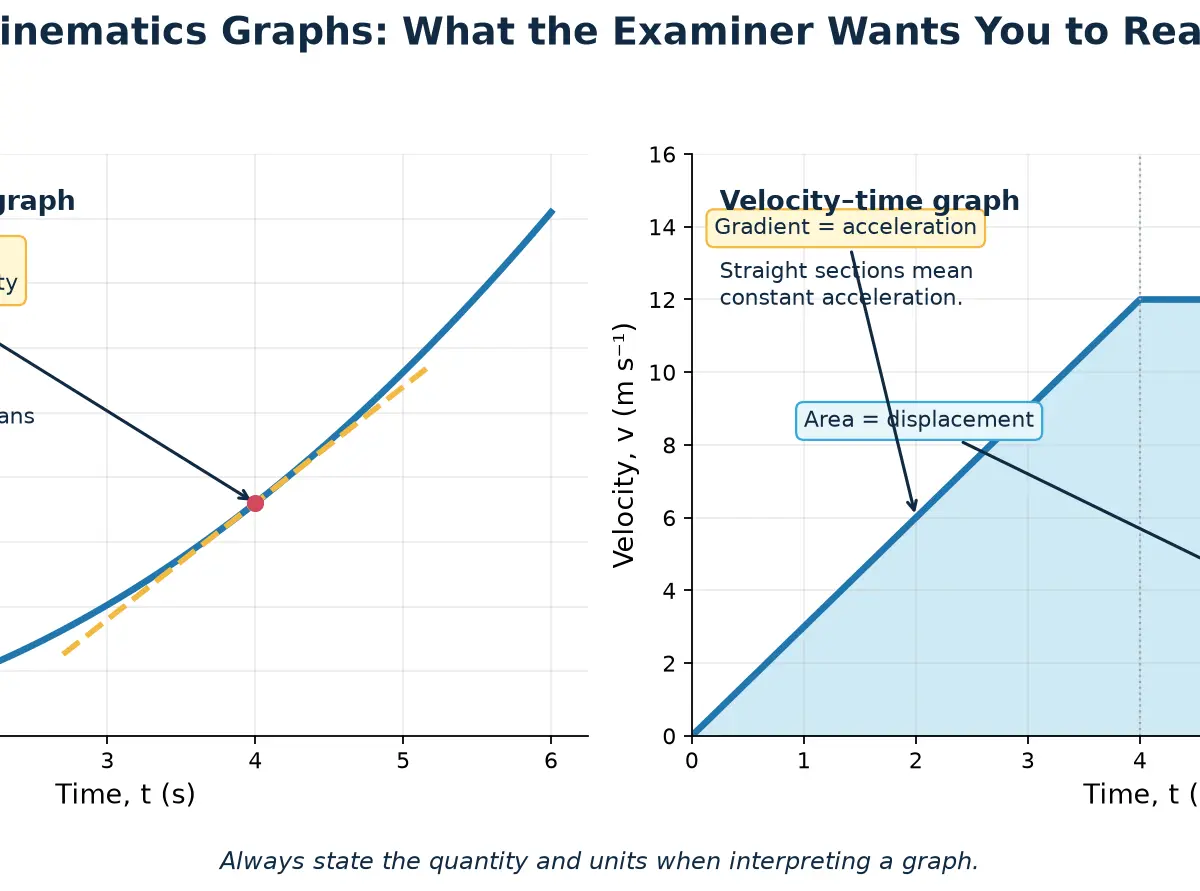
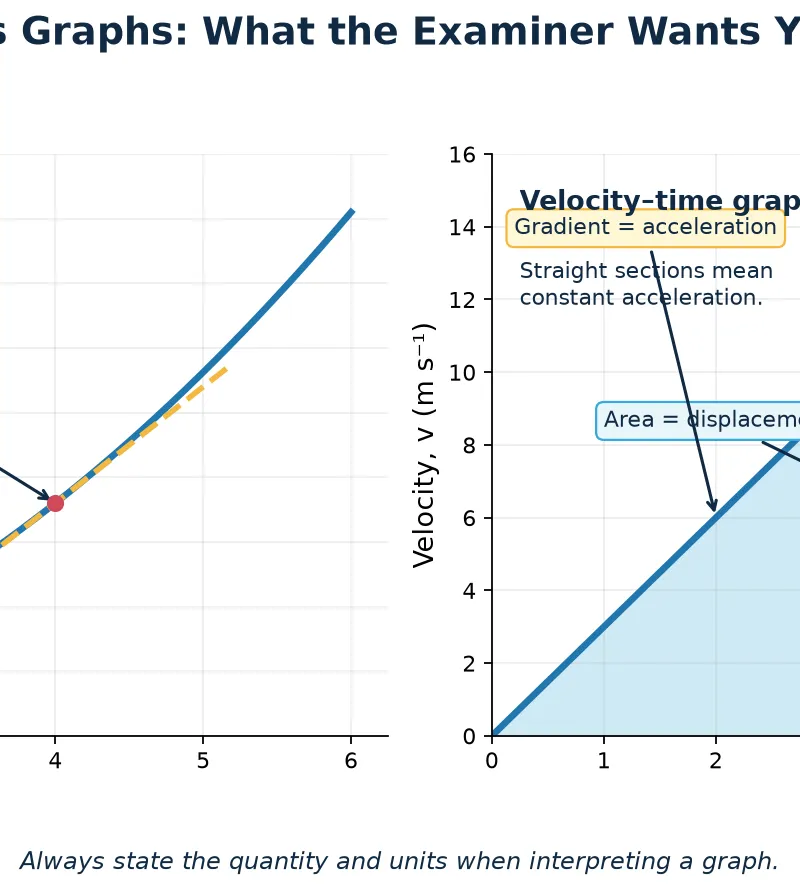
For a displacement–time graph, the gradient is velocity. A straight line has constant velocity. A horizontal line means the particle is stationary. On a curve, the gradient of a tangent gives instantaneous velocity, not the gradient of a chord drawn across a time interval.
For a velocity–time graph, the gradient is acceleration and the signed area between the graph and the time axis is displacement. Area above the axis is positive; area below is negative. To find total distance travelled, add the magnitudes of all areas, splitting the graph at every crossing of the time axis. Candidates lose easy marks when they write “area = distance” without checking whether velocity changes sign.
A useful chain is (s \rightarrow v \rightarrow a): differentiate displacement to obtain velocity, then differentiate velocity to obtain acceleration. Integrating moves in the reverse direction. This is why a displacement–time curve getting steeper has increasing velocity, and a velocity–time line with positive gradient has positive acceleration.
Key Concept 3: Constant acceleration and SUVAT
The five constant-acceleration equations apply only when acceleration is constant and the motion is one-dimensional along your chosen axis. The AQA Formulae booklet supplies these equations, but candidates must select and apply them correctly.
| Formula | Best use | Status in AQA formula booklet |
|---|---|---|
| (v=u+at) | no displacement needed | Given on formula sheet |
| (s=ut+\tfrac12at^2) | no final velocity needed | Given on formula sheet |
| (s=\tfrac12(u+v)t) | no acceleration needed | Given on formula sheet |
| (v^2=u^2+2as) | no time needed | Given on formula sheet |
| (s=vt-\tfrac12at^2) | no initial velocity needed | Given on formula sheet |
Here (u) is initial velocity, (v) final velocity, (a) constant acceleration, (s) displacement and (t) time. SUVAT is not a formula hunt. First list the values you know, including signs, then choose an equation containing the three known quantities and the one required quantity, while avoiding a variable you do not know. If a question says acceleration varies with time or gives (s(t)), use calculus instead.
Key Concept 4: Calculus with motion
For rectilinear motion, if displacement from the origin is (s(t)), then
[v=\frac{ds}{dt}, \qquad a=\frac{dv}{dt}=\frac{d^2s}{dt^2}.]
Conversely,
[v=\int a,dt, \qquad s=\int v,dt.]
The derivative relationships and the need for an integration constant must be recalled and used accurately. After integrating, use the initial condition immediately. For example, if (a=6t-12) and (v(0)=5), then (v=3t^2-12t+5), not simply (3t^2-12t). When asked for distance travelled, solve (v=0) to find each change of direction, calculate the displacement at those times, and add the positive lengths of the separate journeys.
Key Concept 5: Two dimensions and projectile motion
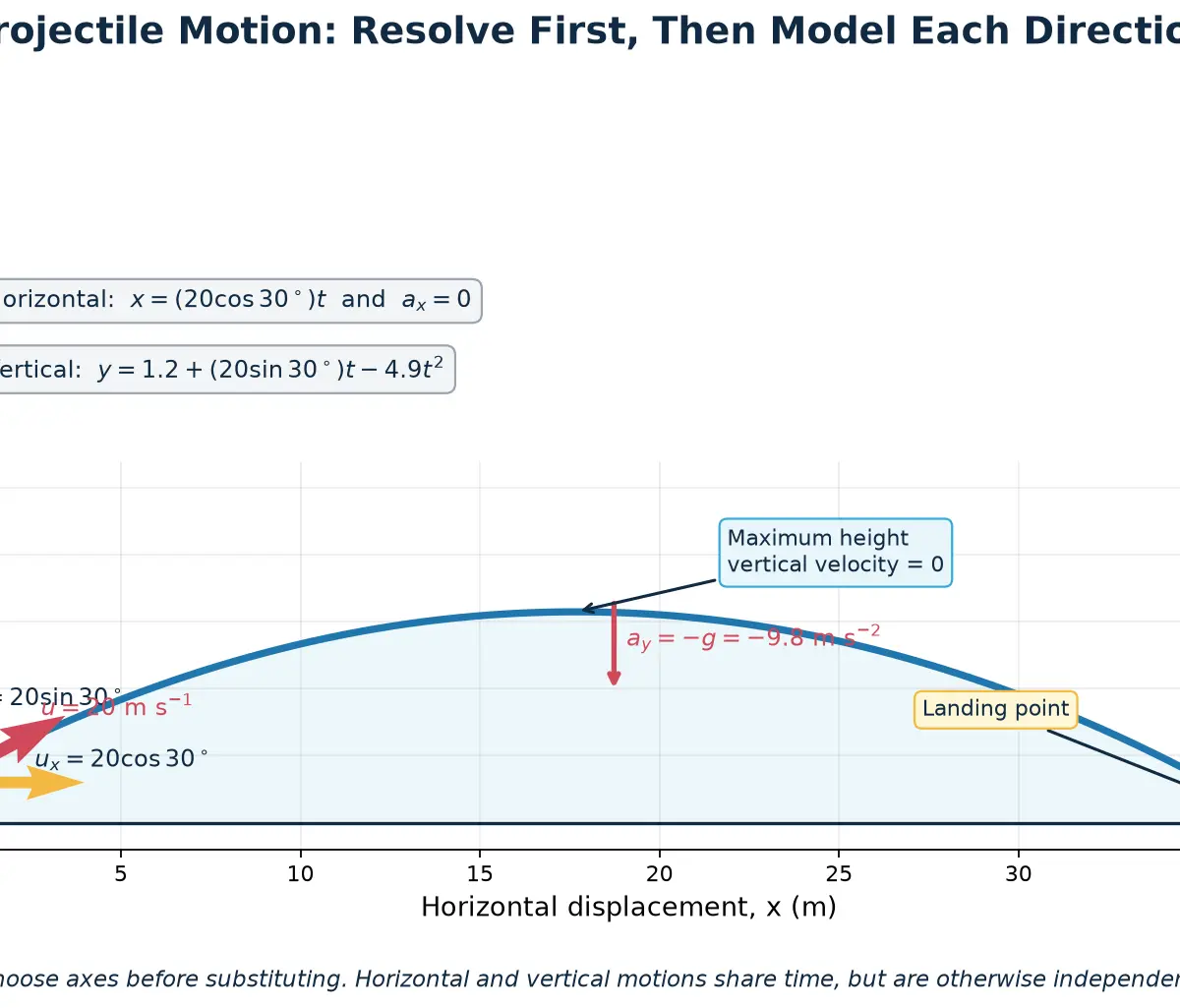
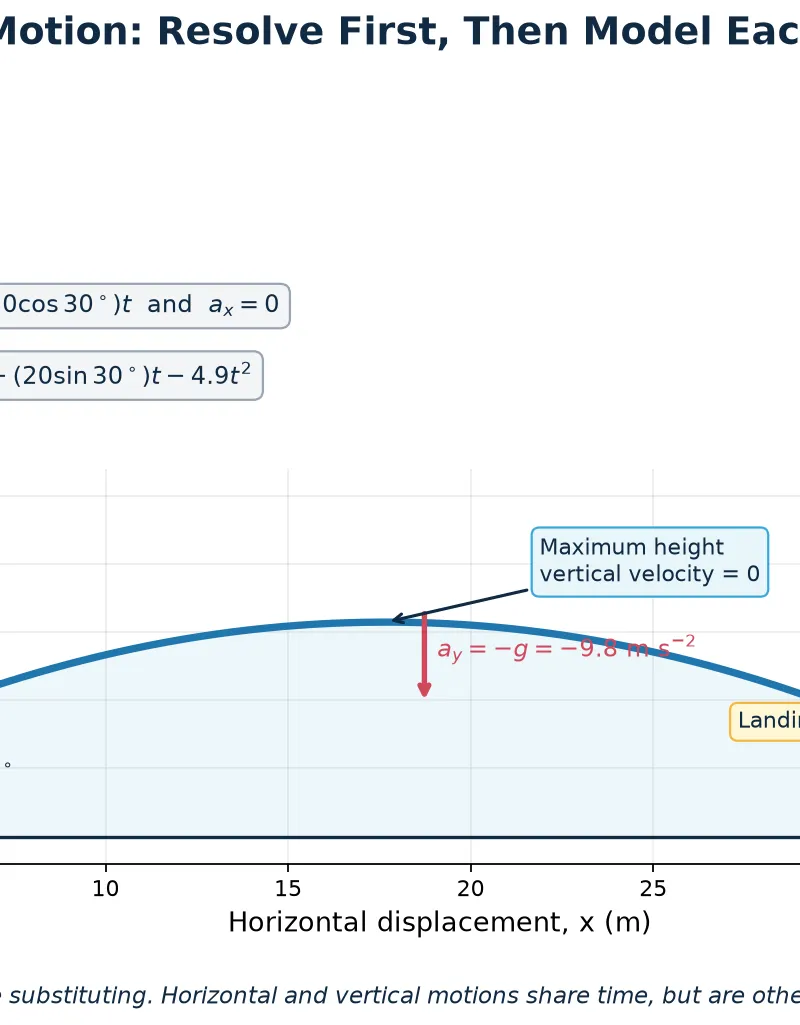
A projectile model assumes gravity is the only acceleration, air resistance is negligible, and motion is in a vertical plane. Choose horizontal (x) and vertical (y) axes. Resolve the initial velocity (u) at angle (\theta) above the horizontal into (u_x=u\cos\theta) and (u_y=u\sin\theta). The components share the same time but are otherwise independent.
Horizontally, (a_x=0), so (x=(u\cos\theta)t). Vertically, with up positive, (a_y=-g), so (y=y_0+(u\sin\theta$)t-\tfrac12gt^2). Solve the vertical equation first when the question asks when or where the particle lands. Reject a negative time as physically irrelevant. Then substitute the positive time into the horizontal equation to find range. At maximum height, the vertical component of velocity is zero, but the horizontal component generally remains non-zero.$
Mathematical relationships: formula status and selection
- (v=ds/dt), (a=dv/dt=d^2s/dt^2): Must recall and use for variable acceleration.
- (\Delta v=\int a,dt) and (\Delta s=\int v,dt): Must recall and use, including constants of integration or stated limits.
- (u_x=u\cos\theta), (u_y=u\sin\theta): Must construct using trigonometry.
- (x=x_0+u_xt) when (a_x=0): Derived from the supplied constant-acceleration equations.
- (y=y_0+u_yt-\tfrac12gt^2) for an upward-positive projectile:Derived from the supplied constant-acceleration equations.
Use (g=9.8\ \mathrm{m\ s^{-2}}) only when the question instructs that value or supplies an equivalent value. Do not round intermediate values prematurely. Keep at least three or four significant figures until the final line, then use the precision requested by the question.
Graph and data skills that earn marks
Label both axes with the quantity and unit. State a gradient calculation as a fraction with units, for example ((12-0)/(4-0)=3\ \mathrm{m\ s^{-2}}). Identify the relevant geometrical area before calculating it, and give its unit as metres when it represents displacement. On a curve, draw a tangent rather than reading a gradient from the curve by eye. If a graph crosses the axis, write separate signed areas and then decide whether the command word requires displacement or distance.
Practical applications and model limits
Kinematics underpins vehicle braking, sports trajectories, animation and navigation systems. In an exam, these contexts are models rather than practical experiments. State a sensible assumption when invited to assess a model: for instance, “air resistance is neglected, so horizontal velocity is taken as constant”. AQA A-level Mathematics has no required practical for Q: Kinematics. Instead, exam questions test modelling choices, clear diagrams and mathematical justification.
A high-mark routine
- Sketch the path or graph and choose positive axes.
- Record a variable table, including units and signs.
- State the model: constant acceleration, variable acceleration, or projectile.
- Select, derive or integrate the relevant relation and show substitution.
- Interpret the numerical result in context, with units and an appropriate physical root.
Memory hook: Direction first, data second, equation third. This avoids the most common sign and formula-selection errors.
Checking an answer like an examiner
Before moving on, run three quick checks. First, units.In (v=u+at), acceleration multiplied by time must have the same unit as velocity. In a velocity–time graph, ((\mathrm{m\ s^{-1}})(\mathrm{s})) gives metres, which confirms why area represents displacement. A unit check will often expose an accidental mix of kilometres per hour and metres per second.
Second, sign and size. If you choose right or up as positive, a negative displacement is a location in the opposite direction, not necessarily an error. In contrast, a negative time for a landing event is normally rejected because the event is being modelled after (t=0). Ask whether the result matches the sketch: a braking distance should be positive if the direction of travel is positive, while an object projected upwards should initially rise when its vertical initial velocity is positive.
Third, conditions. Check that a constant-acceleration formula was not used on a changing acceleration, and that a projectile solution used vertical components for height and horizontal components for range. When a quadratic produces two roots, substitute or interpret both roots rather than automatically taking the first calculator value. In longer questions, a brief statement such as “the negative root is rejected since it is before projection” turns correct mathematics into a fully communicated answer.
Independent revision routine
Spend ten minutes with the formula sheet closed: redraw the two graph rules, write the five SUVAT equations, and create one example in which velocity changes sign. Then spend ten minutes on a projectile, forcing yourself to label (u\cos\theta), (u\sin\theta), (a_x=0) and (a_y=-g) before any substitution. Finish with the retrieval cues below. This alternates recall, application and explanation, which is far more exam-effective than repeatedly reading a worked solution.
Listen and recall
Use the podcast once with the guide open, then a second time with the guide closed. Pause at the quick-fire recall section and answer aloud before the response is given. This is deliberately active practice: it reveals whether a relationship is retrievable under time pressure.
Source basis
This guide follows AQA 7357 section 3.18 (Q1–Q5). AQA’s Paper 2 assessment is a 2-hour, 100-mark paper. The five constant-acceleration equations are supplied in AQA’s Formulae for A-level Mathematics booklet.
Visual Resources
2 diagrams and illustrations
Interactive Diagrams
2 interactive diagrams to visualise key concepts
Conceptual Flow Outline
A decision route for selecting the correct kinematics model before calculation.
Conceptual Flow Outline
The derivative and integral relationships that connect functions of time to graph interpretation.
Worked Examples
3 worked examples — open one to explore the question and available guidance.
Practice Questions
Try the question, then reveal an answer plan or example response
A cyclist travels 100 m east and then 40 m west along a straight road. State the distance travelled and displacement, taking east as positive. [2 marks]
Hint: Distance counts both parts positively. Displacement is final position minus initial position.
A particle accelerates uniformly from rest at 3 m s⁻² for 4 s, then continues at the velocity reached for 6 s. Calculate its total displacement. [3 marks]
Hint: Find the velocity after 4 s, then add the displacement in the acceleration and constant-velocity stages.
A train travelling at 20 m s⁻¹ brakes uniformly with acceleration −4 m s⁻². Calculate its stopping distance. [3 marks]
Hint: At rest, \(v=0\). Choose the supplied equation containing \(u\), \(v\), \(a\) and \(s\).
For a particle moving in a straight line, (v=3t^2-12t+9) m s⁻¹ for (0≤t≤4). Find its acceleration and the times at which it is instantaneously at rest. [3 marks]
Hint: Differentiate for acceleration. Set velocity equal to zero to find rest times.
A particle is projected at 18 m s⁻¹ at an angle of 40° above horizontal ground and lands at the same level. Taking (g=9.8) m s⁻², find its greatest height and time of flight. [5 marks]
Hint: Resolve vertically. At greatest height, vertical velocity is zero. For time of flight at the same level, use the vertical displacement equation.
Exam technique
How to turn what you know into marks
How to approach the question
Read for the model first. Draw the motion, choose and state a positive direction, then list s, u, v, a and t with units. Decide whether the situation is constant acceleration, variable acceleration or a projectile. Show the chosen relation before substituting and reject non-physical roots in words.
How to structure your answer
For 1–2 marks, give the requested mathematical statement with units. For 3–4 marks, show variable selection, equation and substitution. For 5–6 marks, add a labelled diagram or components, justify the model, preserve precision, interpret signs or roots, and conclude in context.
Timing
AQA Paper 2 is 120 minutes for 100 marks, so budget approximately 1.2 minutes per mark. A 6-mark kinematics problem merits about 7 minutes, including a diagram and final interpretation.
Common pitfalls
- Calling total signed area under a velocity–time graph ‘distance’. Split at zero velocity and add magnitudes for distance.
- Applying SUVAT to an acceleration that depends on time, position or velocity. Differentiate or integrate instead.
- Using \(g=+9.8\) after declaring upwards positive. Write the sign of acceleration before calculation.
- Setting the whole projectile velocity to zero at maximum height. Only the vertical component is zero.
- Omitting an integration constant or failing to use an initial condition to find it.
- Giving a negative time as a landing time. Reject it and explain why it is outside the physical interval.
What the command words want
- Hence
- Use the preceding result explicitly, at its stated precision where appropriate, in the next stage.
- Compare
- Identify similarities and differences with quantities and conditions, not vague visual statements. Mention gradient, area, sign or acceleration as appropriate.
- Explain
- Link the mathematical evidence to the conclusion. Use phrases such as ‘because the gradient is positive’ or ‘because the signed area is negative’.
- Describe
- Use the mathematical language of motion, including sign and direction. For example, ‘velocity is positive but decreasing’ is more precise than ‘it slows down’.
- Evaluate
- State the modelling assumptions, identify their effect, and make a reasoned judgement. For example, neglecting air resistance overestimates projectile range.
- Calculate
- Show the model, equation and substitution. Retain accuracy and attach units to the final numerical value.
- Show that
- Work from the given information, preserve full calculator accuracy, and make the stated result emerge. Do not begin by assuming the target is true.
- State/Give
- Provide a concise correct value, definition or relationship with a unit where relevant. Do not add contradictory working.
Watch or listen (optional)
Test your understanding of Q: Kinematics
Active recall beats re-reading. Take an instant quiz now to test what you’ve learned and lock it into long-term memory.
7 days Premium · Then the free plan continues · No card, no charge