AQA · A-Level · Mathematics
Course version: 7357 · Version from Sept 2017
R: Forces and Newton’s laws
Forces and Newton’s laws is where AQA mechanics becomes a repeatable method: model each particle, draw every force, resolve with care and apply the resultant-force equation. It rewards precise diagrams as well as accurate algebra, making it a high-return topic for candidates who communicate their model clearly. Master the difference between equilibrium, limiting friction and acceleration, and slopes and pulley questions become structured rather than mysterious.
- 9 min read
- 3 worked examples
- 5 practice questions
- 9 key terms
Try the lesson
The start of the R: Forces and Newton’s laws lesson, made from checked teaching notes for this specification point.
Have a go first
Two horizontal forces act at a point: 6 N due east and 8 N due north. Find the magnitude of the resultant force.
There is more to this lesson
The full lesson goes on to check your understanding and help you earn the marks. Create a free account to carry on, with your progress saved.
7 days Premium · Then the free plan continues · No card, no charge
Check what you remember
Read the wording for your board, then hide it and explain force in your own words. Rough notes are fine. This is a self-check, with no mark or grade.
Reference: AQA
A push or pull on a particle, measured in newtons, which can change its motion by producing acceleration.
Study Notes

Overview
AQA A-Level Mathematics R: Forces and Newton’s laws (3.19) is the part of mechanics where candidates explain why a particle moves, rests or accelerates. You will translate a physical situation into a force diagram, resolve any angled forces and use Newton’s laws to build equations. This is high-value material because it combines algebra, trigonometry, vectors and modelling: one diagram can unlock several marks before any arithmetic begins.
Questions range from a short calculation of weight or tension to multi-step problems with particles on slopes, friction, smooth pulleys and motion in a plane. A strong candidate makes the model visible: one clear force diagram per particle, a stated positive direction, then a resultant-force equation in each required direction. The topic links directly to Q: Kinematics, because the acceleration found using forces is often fed into SUVAT or variable-acceleration work, and to E: Trigonometry and J: Vectors through resolution.
Specification coverage: R1–R6: forces and Newton’s first law; Newton’s second law in one and two dimensions; weight; Newton’s third law; equilibrium, pulleys, connected particles and motion in a plane; resultant forces; and the friction model.
Key Concepts
1. Model the particle before calculating
A particle is an idealised object whose size, shape and rotation are ignored. This lets the question focus on translational motion. Read every modelling word. Smooth means no friction. Rough means friction may act. A light string has negligible mass, an inextensible string does not stretch, and a smooth fixed pulley allows the same tension on both sides. Unless a question says otherwise, treat a string as taut.
Draw a separate free-body diagram for every particle. Include only forces acting on that particle: weight, tension, normal reaction, friction and any applied force. Never place an acceleration arrow on the force diagram as if it were a force. It is useful to write a small motion arrow separately so that your friction direction and signs are consistent.
Examiner lens: credit is given for a force model that is complete and correctly directed. A missing normal reaction or a friction arrow pointing with the tendency to move can prevent later method marks.
2. Newton’s laws and resultant force
Newton’s first law says that a particle remains at rest or moves with constant velocity in a straight line when the resultant external force is zero. It does not say that zero resultant force means the particle must be stationary. Constant velocity is also zero acceleration.
Newton’s second law is used as (\sum F$=ma), separately in each chosen direction. The summation sign means the resultant force, not one selected force. Choose an axis and a positive direction, state it and retain it. For example, taking up the slope as positive gives (T-mg\sin\theta-F=ma). If the calculation produces a negative acceleration, the particle accelerates opposite to the assumed positive direction. That is a meaningful result, not automatically an error.$
Newton’s third law pairs are equal in magnitude, opposite in direction and act on different bodies. The Earth pulls a book down with its weight; the book pulls the Earth up with the partner force. Weight and normal reaction are not a third-law pair because both act on the book.
3. Weight and reactions
Weight is the gravitational force (W=mg), vertically downward. Mass is measured in kg; weight is measured in N. Use (g=9.8\text{ m s}^{-2}) unless another value is stated. AQA specifies that (g) can vary with location, so it is an assumed local value rather than a universal constant.
The normal reaction (R) is exerted by a surface and is always perpendicular to that surface. It equals (mg) only in special situations, such as a particle resting on a horizontal surface with no other vertical forces. An angled pull, a slope or vertical acceleration changes the perpendicular balance. Find (R) from the equation perpendicular to the surface instead of assuming it.
4. Resolving forces on slopes and in two dimensions
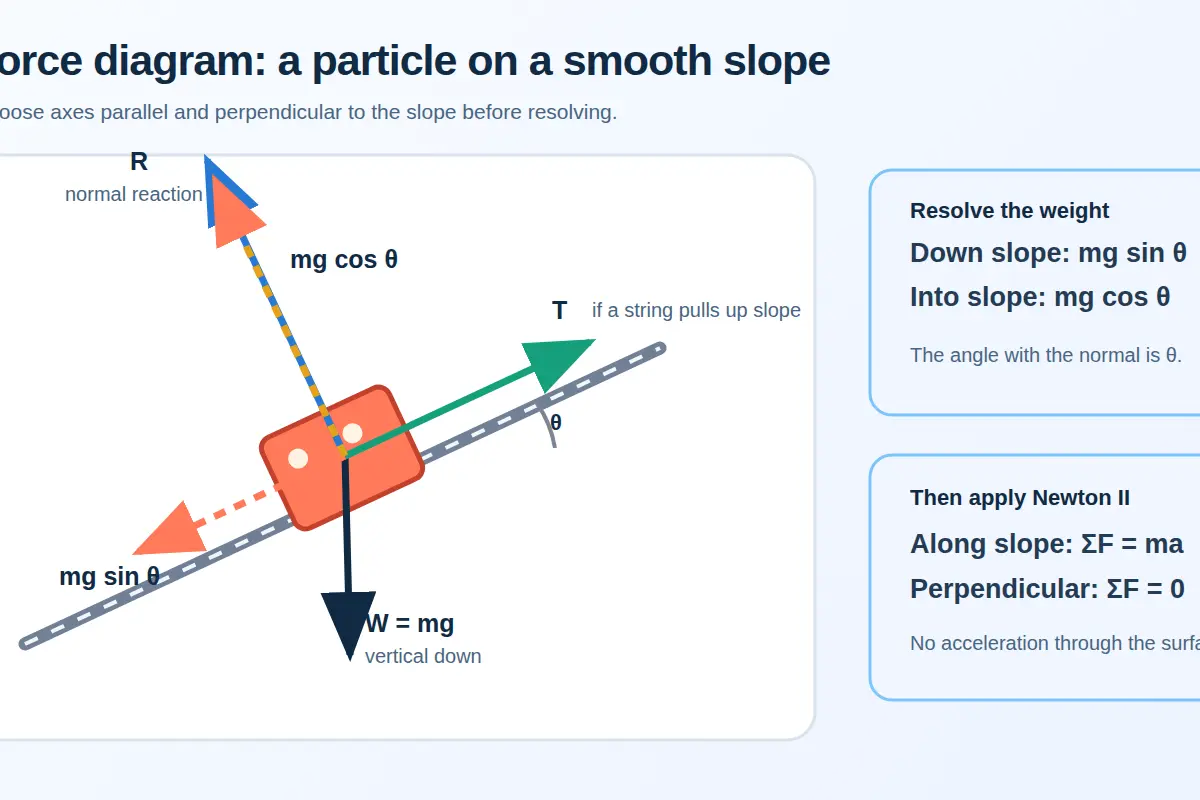
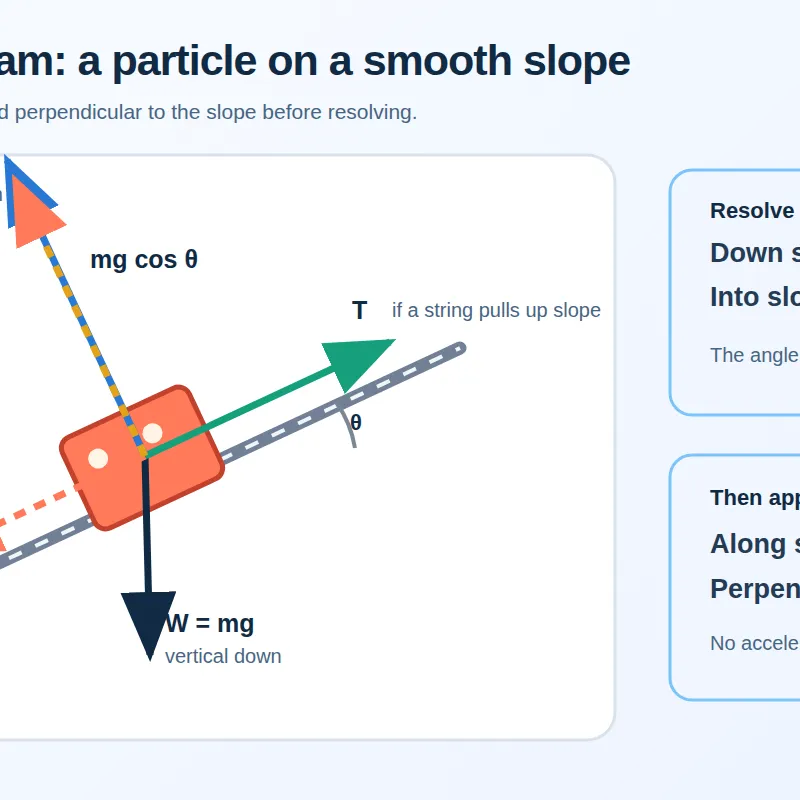
For a slope at angle (\theta) to the horizontal, choose axes parallel and perpendicular to the slope. The weight is vertical, so resolve it:
- component down the slope: (mg\sin\theta);
- component into the slope: (mg\cos\theta).
This works because the angle between the weight vector and the inward normal direction is (\theta). Do not use a memorised sine/cosine rule without checking the triangle. Draw the weight vector and its perpendicular components, then identify adjacent and opposite sides. If a force (P) makes angle (\alpha) with your selected axis, the component along that axis is (P\cos\alpha), provided (\alpha) is genuinely the angle to that axis.
For equilibrium, use (\sum F=0) in both perpendicular directions. For motion in a plane, use (\sum F_x=ma_x) and (\sum F_y=ma_y). Keep components from the two axes in separate equations. Candidates lose credit when they combine a horizontal component with a vertical acceleration.
5. Connected particles and smooth pulleys
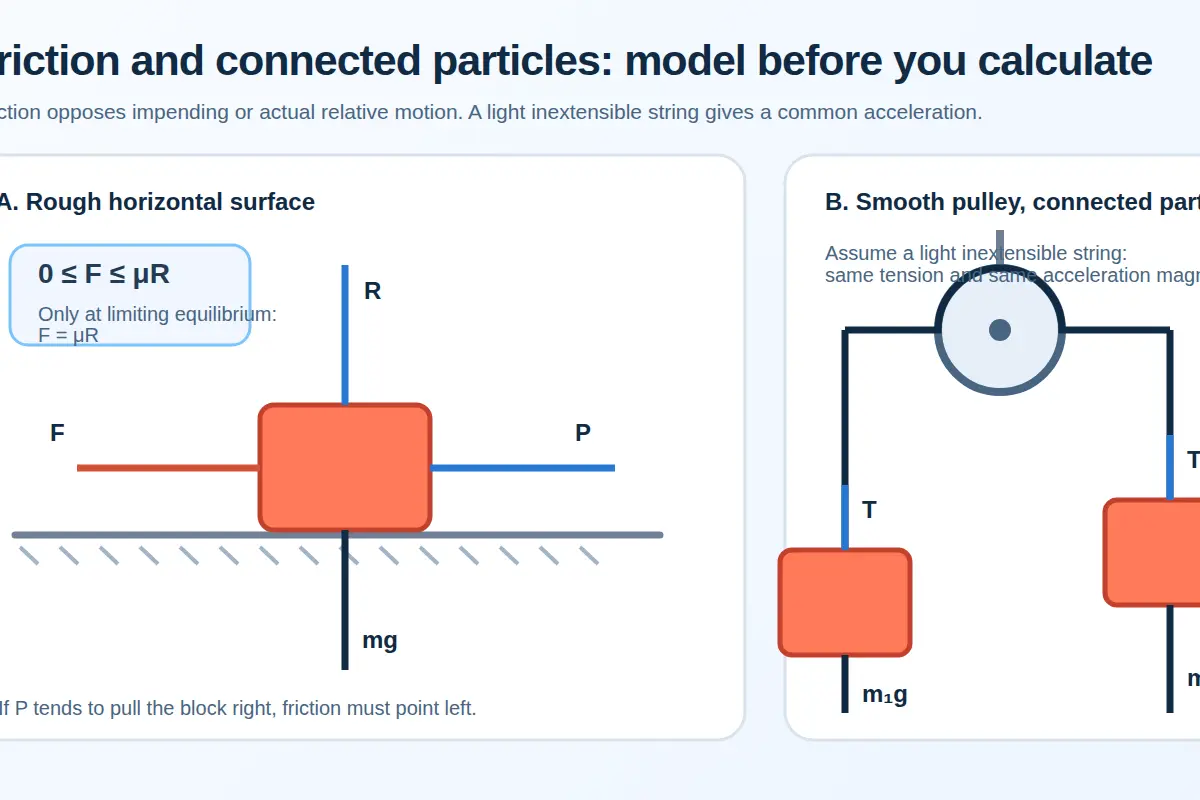
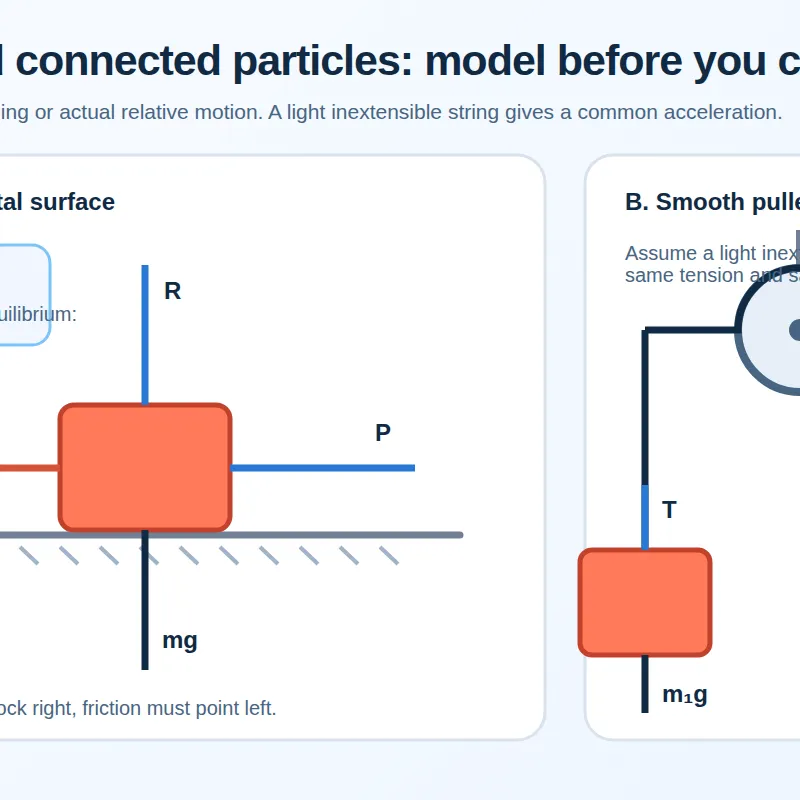
$For a light inextensible string passing over a smooth fixed pulley, the tension is the same throughout the string and connected particles have equal magnitudes of acceleration. Their directions may be opposite. Start with two diagrams. Apply (\sum F=ma) to each particle using a direction that matches its own motion. You may then solve simultaneously or add equations to eliminate tension.$
For example, if a mass (m_1) is on a smooth table and a hanging mass (m_2) moves down, write (T=m_1a) for the table mass and (m_2g-T=m_2a) for the hanging mass. Adding gives (m_2g=(m_1+m_2)a). Only add equations once your signs describe compatible directions and both equations use the same acceleration magnitude.
6. Friction: a condition, not a reflex
The friction model is (F\leq\mu R), where (F) is friction, (\mu) is the coefficient of friction and (R) is the normal reaction. Friction opposes actual relative motion or the tendency for relative motion. First imagine the situation without friction. The direction in which the surfaces would slide relative to one another tells you the friction direction.
At limiting equilibrium, the body is on the point of slipping and (F=\mu R). For a sliding body under the simple model, use the limiting value. In ordinary static equilibrium, friction has whatever magnitude is needed, provided it does not exceed (\mu R). Therefore, do not automatically write (F=\mu R) merely because the surface is rough. Find the friction required by the balance and check the inequality.
Mathematical Relationships
| Relationship | Meaning and exam use | Formula status |
|---|---|---|
| (W=mg) | Weight of a mass (m); weight acts vertically down. | Given on AQA formula sheet |
| (\sum F=ma) | Newton’s second law, used in a stated direction. | Given on AQA formula sheet |
| (F\leq\mu R) | Friction cannot exceed its limiting value. Use equality only when limiting/sliding. | Given on AQA formula sheet |
| (\sum F=0) | Equilibrium or no acceleration in the selected direction. | Must memorise as a consequence of (\sum F=ma) |
| (mg\sin\theta, mg\cos\theta) | Weight components parallel and perpendicular to a slope. | Must memorise/derive by resolution |
| (P\cos\alpha, P\sin\alpha) | Components of an angled force; match the ratio to the actual angle. | Must memorise/derive by resolution |
Units and conversions: force is N, mass is kg, acceleration is m s⁻², velocity is m s⁻¹, and (\mu) has no unit. Convert grams to kilograms before applying (F=ma): (1\text{ kg}=1000\text{ g}). Keep (g) in m s⁻² so (mg) is in N.
Practical Applications
The particle model helps engineers estimate cable tensions, braking forces, hill-climbing loads and the pull required to move equipment. A mountain-rescue crate pulled on a slope is a useful mental model: gravity supplies a component down the slope, the surface provides a normal reaction, rope tension acts along the rope and rough contact provides friction opposing the possible slide.

There is no AQA required practical for this pure mechanics topic. Instead, exam questions assess mathematical modelling. State the assumptions that matter: particle, light inextensible string, smooth pulley, smooth or rough surface, taut string and neglected air resistance. If a real situation would violate an assumption, say how, for example, “a heavy string could have unequal tension” or “air resistance would depend on speed.”
Graph and data skill: when a force-time graph is given, its vertical value is resultant force. With known mass, (a=F/m). A graph of acceleration against resultant force for fixed mass should be a straight line through the origin with gradient (1/m). Always identify the axis and units before interpreting a gradient.
A-Level note: this qualification is not divided into Foundation and Higher tiers. All content above is in the A-Level specification; R5–R6 extend the AS content with resolving forces in 2D, dynamics in a plane and friction.
Exam Checklist
- Identify each particle and draw one complete force diagram per particle.
- Mark the proposed motion or tendency, especially before setting the friction direction.
- Choose sensible perpendicular axes, usually parallel/perpendicular to a slope.
- State the positive direction and resolve angled forces accurately.
5. Apply (\sum F=ma) in each direction, or (\sum F=0) for equilibrium. - Solve, include a unit, then test whether the sign and magnitude make physical sense.
Visual Resources
3 diagrams and illustrations

Interactive Diagrams
2 interactive diagrams to visualise key concepts
Conceptual Flow Outline
A reliable force-problem workflow: model first, then choose the correct equilibrium or dynamics equation.
Conceptual Flow Outline
The decision path for selecting the correct friction equation and direction.
Worked Examples
3 worked examples — open one to explore the question and available guidance.
Practice Questions
Try the question, then reveal an answer plan or example response
State Newton’s first law and explain what it says about a particle moving with constant velocity.
Hint: Use the phrase ‘resultant external force’ and remember that constant velocity means zero acceleration.
A 1.8 kg lamp hangs at rest from a vertical string. Calculate the tension in the string, taking g = 9.8 m s⁻².
Hint: The lamp is in equilibrium. Identify its weight and set the vertical resultant to zero.
A 5 kg particle is pulled up a smooth plane inclined at 20° to the horizontal by a force of 30 N parallel to the plane. Calculate its acceleration.
Hint: Take up the plane as positive and resolve only the weight.
A 6 kg crate is at rest on a rough horizontal floor. A horizontal pull of 9 N acts to the right. The coefficient of friction is 0.20. Determine the frictional force and state its direction.
Hint: Calculate the maximum possible friction before deciding whether the crate moves.
Particles A and B of masses 2 kg and 3 kg are attached to the ends of a light inextensible string over a smooth fixed pulley. A is on a smooth horizontal table and B hangs freely. Find the acceleration and the tension.
Hint: Use one equation for A towards the pulley and one for B downwards, both with acceleration magnitude a.
Exam technique
How to turn what you know into marks
How to approach the question
Underline model words first. Sketch and label each particle separately. Choose positive axes before writing ΣF = ma. Resolve only the forces that are not aligned with an axis. For friction, decide the tendency to move before choosing its direction and test whether limiting friction is reached.
How to structure your answer
For 1–2 marks, state the law or evaluate the required component with units. For 3–4 marks, show a force diagram or stated direction, the resultant-force equation and the calculation. For 5–6 marks, use separate labelled diagrams/equations for each particle, state modelling assumptions if relevant and finish with a numerical answer and direction.
Timing
Allow approximately 1 minute per mark. A 6-mark connected-particles calculation should take about 6–7 minutes, including diagrams and a final check.
Common pitfalls
- Writing R = mg automatically. Instead, resolve perpendicular to the surface and use zero perpendicular acceleration where appropriate.
- Using F = μR for every rough surface. Use F ≤ μR unless the body is limiting or sliding.
- Calling weight and reaction a Newton’s third-law pair. They both act on the same particle, so they cannot be a pair.
- Using the wrong trigonometric component on a slope. Rebuild the component triangle rather than guessing.
- Forgetting that a connected-particle system has equal acceleration magnitudes, not necessarily the same direction.
What the command words want
- Compare
- Refer to both systems and state a similarity and a difference, such as equal tension but opposite directions of acceleration.
- Explain
- Use a cause-and-effect chain: identify the resultant force, then link it to acceleration through Newton’s second law.
- Describe
- Set out what happens to the particle using mechanics vocabulary, for example ‘accelerates down the slope’ rather than ‘goes faster’.
- Evaluate
- Discuss the suitability of the model assumptions, for example the effect of neglecting air resistance or assuming a string is light.
- Calculate
- Show the force component or formula, substitute values, retain units and round sensibly at the end.
- State/Give
- Provide the precise quantity, law or direction requested, with a unit where relevant. Do not add unrelated working.
Watch or listen (optional)
Test your understanding of R: Forces and Newton’s laws
Active recall beats re-reading. Take an instant quiz now to test what you’ve learned and lock it into long-term memory.
7 days Premium · Then the free plan continues · No card, no charge