Algebra
Algebra is the mathematical language of variables and unknowns, forming the foundation of GCSE Mathematics. Mastering these concepts is essential for accessing higher marks across the entire specification, as algebra connects deeply to geometry, statistics, and number problems.
Study Notes
Overview
Algebra is the cornerstone of secondary mathematics. It is the study of mathematical symbols and the rules for manipulating them. In your GCSE examination, algebra accounts for a significant proportion of the total marks—often up to 30% of the paper. It is not just an isolated topic; algebraic skills are synoptic, meaning examiners will test your ability to apply algebra to geometry (such as finding unknown angles or sides), statistics (calculating the mean from a frequency table with algebraic frequencies), and probability.
Examiners typically test algebra through a progression of difficulty. Foundation tier questions often focus on substituting values into formulae, collecting like terms, and solving linear equations. Higher tier candidates must demonstrate fluency in more complex manipulations, such as algebraic fractions, completing the square, and solving simultaneous equations involving quadratics. The command words are critical here: "Solve" requires a numerical answer for the variable, "Simplify" requires collecting terms without solving, and "Factorise" requires inserting brackets. Misinterpreting these command words is a common reason candidates drop marks.
Listen to our revision podcast for a complete audio summary of this topic:
Key Concepts
Concept 1: Simplifying Expressions and Collecting Like Terms
Algebraic expressions are simplified by grouping together "like terms"—terms that have the exact same variables and powers. For example, 3x and 5x are like terms, but 3x and 5x^2 are not. Examiners often test this by mixing positive and negative terms, assessing your ability to manage directed numbers alongside algebra.
Example: Simplify 4a + 3b - 2a + 5b.
Grouping the a terms (4a - 2a = 2a) and the b terms (3b + 5b = 8b) gives the final simplified expression: 2a + 8b.
Concept 2: The Laws of Indices
The laws of indices dictate how we handle powers (exponents) when multiplying, dividing, or raising a power to another power. These rules only apply when the "base" (the large number or letter) is the same.
- Multiplication: Add the indices (x^a \times x^b = x^{a+b})
- Division: Subtract the indices (x^a \div x^b = x^{a-b})
- Power of a Power: Multiply the indices ((x^a)^b = x^{ab})
A frequent examiner comment is that candidates incorrectly add indices when a power is raised to another power.
Concept 3: Expanding Brackets
Expanding brackets means removing the brackets by multiplying the term outside by every term inside. For a single bracket, this is straightforward distribution. For double brackets, such as (x+a)(x+b), every term in the first bracket must be multiplied by every term in the second bracket. The FOIL method (First, Outer, Inner, Last) is a reliable strategy for this. Sign errors, particularly when multiplying a negative by a negative to get a positive, are the most common source of lost marks in these questions.
Concept 4: Factorisation
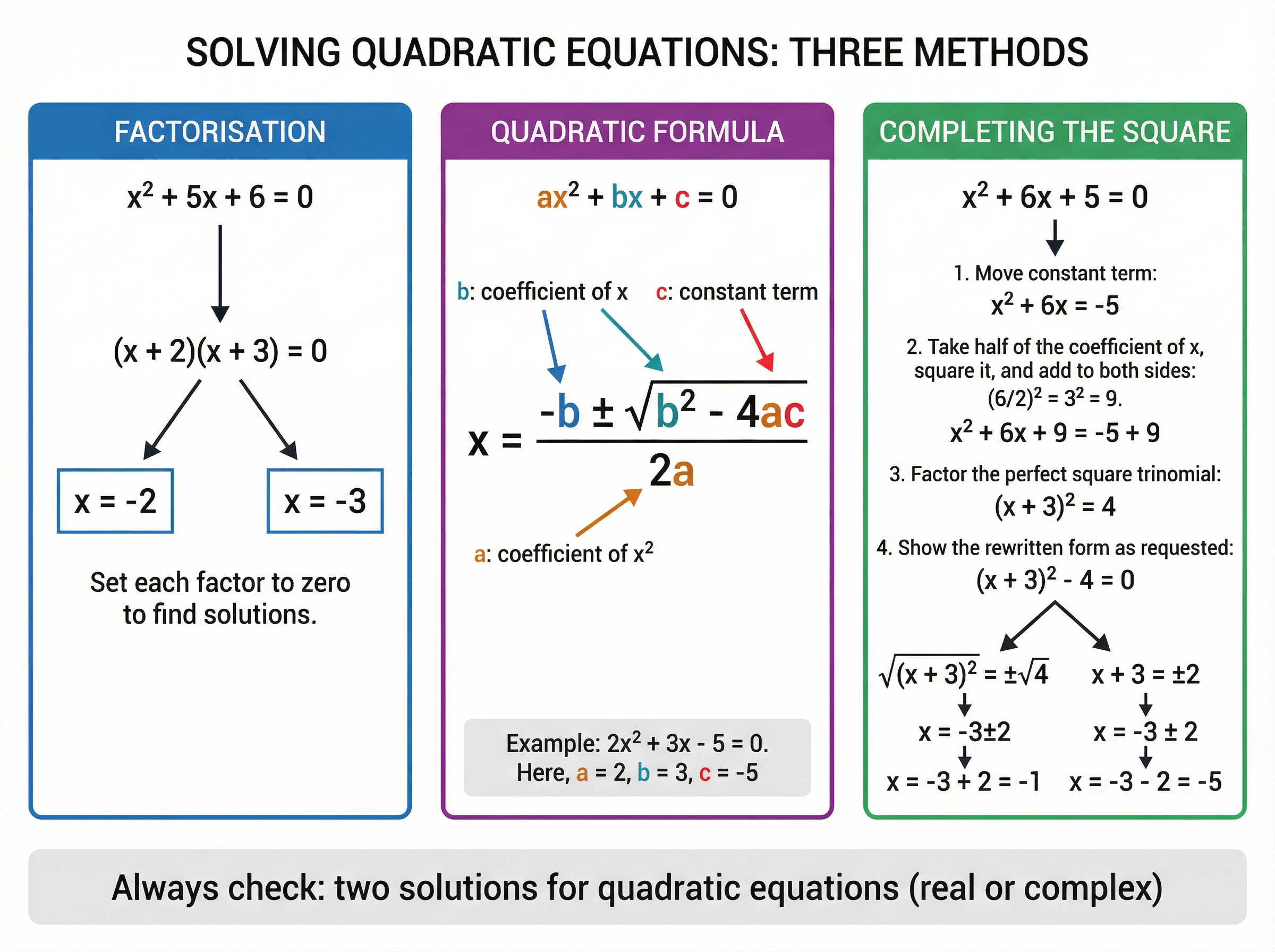
Factorisation is the reverse process of expanding brackets; it involves finding the highest common factors and placing them outside a bracket. For quadratic expressions in the form ax^2 + bx + c, factorising involves finding two numbers that multiply to give c and add to give b. This skill is frequently tested as the first step in solving a quadratic equation.
Concept 5: Solving Equations
Solving an equation means finding the numerical value(s) of the unknown variable that makes the equation true. The fundamental principle is balance: whatever operation you perform on one side of the equals sign, you must perform on the other. For linear equations, the goal is to isolate x. For quadratic equations, you generally need to rearrange the equation so that it equals zero (ax^2 + bx + c = 0) before solving via factorisation, the quadratic formula, or completing the square. Examiners award method marks for showing clear, logical steps, even if a final arithmetic error occurs.
Concept 6: Linear Graphs
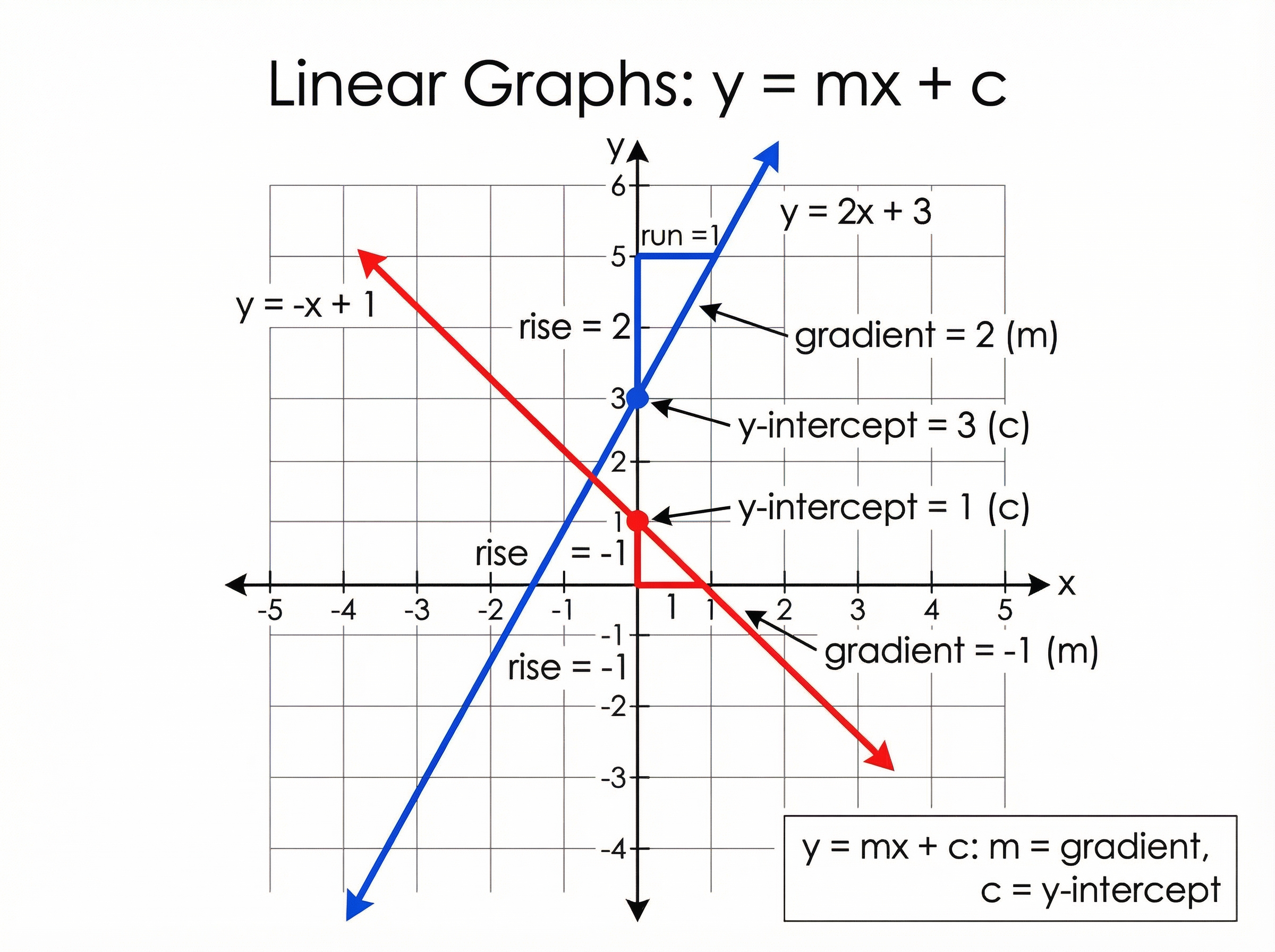
Linear graphs represent straight lines on a Cartesian coordinate system. The general equation of a straight line is y = mx + c, where m represents the gradient (steepness) and c represents the y-intercept (where the line crosses the y-axis). Examiners frequently ask candidates to find the equation of a line given two points, or to identify parallel lines (which have identical gradients) and perpendicular lines (where the product of their gradients is -1).
Mathematical Relationships
- Linear Equation: y = mx + c
- y and x are coordinates.
- m is the gradient \frac{\text{change in } y}{\text{change in } x}.
- c is the y-intercept.
- Quadratic Formula (Must memorise for most boards):
x = \frac{-b \pm \sqrt{b^2 - 4ac}}{2a}- Used to solve ax^2 + bx + c = 0.
- Difference of Two Squares:
a^2 - b^2 = (a+b)(a-b)
Practical Applications
Algebra is not merely abstract; it models real-world phenomena. For instance, calculating the trajectory of a thrown object (projectile motion) uses quadratic equations. Determining the break-even point for a business (where cost equals revenue) relies on solving simultaneous linear equations. In physics, substituting values into formulas like v = u + at (kinematics) is a direct application of algebraic substitution and rearrangement.
Visual Resources
2 diagrams and illustrations
Interactive Diagrams
2 interactive diagrams to visualise key concepts
Conceptual Flow Outline
Map of key algebra topics covered in the specification. Items marked with a star (★) are typically Higher tier only.
Conceptual Flow Outline
Decision flowchart for solving quadratic equations. Always try factorisation first as it is the fastest method.
Worked Examples
3 detailed examples with solutions and examiner commentary
Practice Questions
Test your understanding — click to reveal model answers
Simplify the expression: 5x^2y \times 3xy^4. (2 marks)
Hint: Multiply the numbers first, then apply the index laws for the $x$ terms, and finally for the $y$ terms.
Solve the inequality: 4x - 7 < 2x + 5. (3 marks)
Hint: Treat the inequality sign like an equals sign. Get all the $x$ terms on one side and the numbers on the other.
Expand and simplify: (x - 4)(x + 7). (2 marks)
Hint: Use the FOIL method to ensure you get four terms before simplifying.
Solve the simultaneous equations:
3x + 2y = 18
2x - y = 5
(4 marks)
Hint: Make the coefficients of either $x$ or $y$ the same. Multiplying the second equation by 2 is the easiest route.
Make u the subject of the formula: v^2 = u^2 + 2as. (2 marks)
Hint: You need to isolate $u$. First move the $+2as$ term, then deal with the squared power.