AQA · GCSE · Mathematics
Course version: 8300 · Version from Sept 2015
Fractions, decimals and percentages: change recurring decimals into their corresponding fractions and vice versa (Higher tier only)
This higher tier skill means converting a recurring decimal to its exact fraction and converting a fraction to a recurring decimal.
- 2 key terms
Study notes
From the checked teaching notes for this specification point.
The idea
This higher tier skill means converting a recurring decimal to its exact fraction and converting a fraction to a recurring decimal. A recurring decimal has a digit or block of digits that repeats forever, shown by dots or a bar. For example, 0.7̇ means 0.777…, and 0.4̇5̇ means 0.454545…. To convert 0.7̇ to a fraction, let x = 0.777…, multiply by 10 to get 10x = 7.777…, subtract x to obtain 9x = 7, so x = 7/9. To convert 5/11 to a decimal, divide 5 by 11 to get 0.454545… = 0.4̇5̇. The method works because multiplying by a power of ten shifts the repeating block so subtraction eliminates the infinite tail. In multiple-choice questions, you must identify the exact fraction or recurring decimal, not a rounded value.
What earns the marks
- A recurring decimal has a repeating digit or block of digits that continues indefinitely, indicated by dots or a bar over the repeating part.
- To convert a recurring decimal to a fraction, set x equal to the decimal, multiply by a power of ten that shifts one full repeating block, subtract the original equation, and solve for x.
- For a single repeating digit such as 0.7̇, multiplying by 10 gives 10x = 7.777…, and subtracting x = 0.777… gives 9x = 7, so x = 7/9.
- For a repeating block of two digits such as 0.4̇5̇, multiplying by 100 gives 100x = 45.4545…, and subtracting x = 0.4545… gives 99x = 45, so x = 45/99 = 5/11.
- To convert a fraction to a recurring decimal, divide the numerator by the denominator and identify the repeating block; for example 5 ÷ 11 = 0.454545… = 0.4̇5̇.
- In a multiple-choice question, check exact equivalence by converting the option to the other form or by substituting into the original equation.
Common mistakes and how to put them right
Using a rounded decimal such as 0.78 for 0.7̇ instead of the exact recurring form.
Put it right: Keep the recurring notation or the exact fraction 7/9.
Multiplying by the wrong power of ten when the repeating block has more than one digit.
Put it right: Multiply by 10ⁿ where n is the number of digits in the repeating block.
Subtracting the equations in the wrong order and losing the sign.
Put it right: Subtract the smaller expression from the larger so the coefficient of x is positive.
Forgetting to simplify the resulting fraction.
Put it right: Divide numerator and denominator by their highest common factor, as 45/99 simplifies to 5/11.
Exam tips
- Write the recurring decimal with a clear dot or bar notation before starting, so you can see exactly which digits repeat.
- After solving for x, substitute back into the original recurring decimal to check that the fraction is exact.
- In multiple-choice questions, eliminate options that are rounded or have the wrong repeating block before doing a full conversion.
Try the lesson
The start of the Fractions, decimals and percentages: change recurring decimals into their corresponding fractions and vice versa (Higher tier only) lesson, made from checked teaching notes for this specification point.
Have a go first
Which of the following is the correct decimal representation of the fraction 5/12?
Listen
This higher tier skill means converting a recurring decimal to its exact fraction and converting a fraction to a recurring decimal. A recurring decimal has a digit or block of digits that repeats forever, shown by dots or a bar. For example, 0.7̇ means 0.777…, and 0.4̇5̇ means 0.454545…. To convert 0.7̇ to a fraction, let x = 0.777…, multiply by 10 to get 10x = 7.777…, subtract x to obtain 9x = 7, so x = 7/9. To convert 5/11 to a decimal, divide 5 by 11 to get 0.454545… = 0.4̇5̇. The method works because multiplying by a power of ten shifts the repeating block so subtraction eliminates the infinite tail. In multiple-choice questions, you must identify the exact fraction or recurring decimal, not a rounded value.
See it
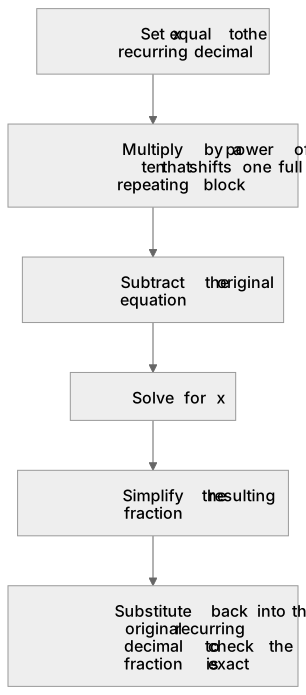
Put it in order
Put these steps in the order they happen.
- 1. Multiply by a power of ten that shifts one full repeating block
- 2. Subtract the original equation
- 3. Solve for x
- 4. Simplify the resulting fraction
- 5. Substitute back into the original recurring decimal to check the fraction is exact
- 6. Set x equal to the recurring decimal
Key words
Say what each word means before you turn the card.
Recurring decimal
Try answering aloud or in your head before turning the card.
Repeating block
Try answering aloud or in your head before turning the card.
See every definition
- Recurring decimal
- A decimal with a digit or block of digits that repeats forever, shown by dots or a bar over the repeating part.
- Repeating block
- The digit or block of digits that repeats indefinitely in a recurring decimal, indicated by dots or a bar.
Label the diagram
Some boxes have lost their names. Pick the right name for each number.
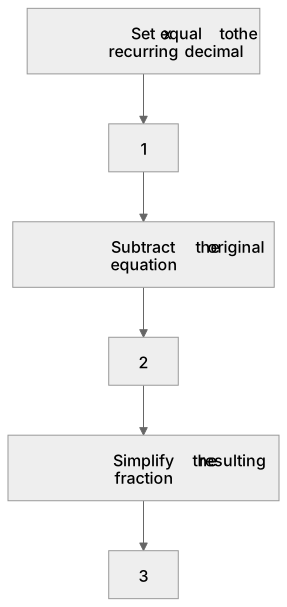
1Box 1
2Box 2
3Box 3
There is more to this lesson
The full lesson goes on to check your understanding and help you earn the marks. Create a free account to carry on, with your progress saved.
7 days Premium · Then the free plan continues · No card, no charge
Test your understanding of Fractions, decimals and percentages: change recurring decimals into their corresponding fractions and vice versa (Higher tier only)
Active recall beats re-reading. Take an instant quiz now to test what you’ve learned and lock it into long-term memory.
7 days Premium · Then the free plan continues · No card, no charge