AQA · GCSE · Mathematics
Course version: 8300 · Version from Sept 2015
Fractions, decimals and percentages: identify and work with fractions in ratio problems
Ratio compares quantities part-to-part or part-to-whole, while a fraction expresses a part relative to a whole.
- 4 key terms
Study notes
From the checked teaching notes for this specification point.
The idea
Ratio compares quantities part-to-part or part-to-whole, while a fraction expresses a part relative to a whole. To identify fractions in a ratio problem, determine the whole: for a ratio 3 : 5 the whole is 3 + 5 = 8 equal parts, making the shares 3/8 and 5/8 of the total. To work with fractions, convert between forms. A share given as a fraction of the total becomes a ratio using a common denominator. A ratio becomes fractions by dividing each part by the total parts. For example, if money is split in the ratio 2 : 3 and the smaller share is £40, then 2 parts = £40, so 1 part = £20. The larger share is 3 × £20 = £60, and the total is £100, representing 2/5 and 3/5 of the whole. Always verify that the fractions sum to 1.
What earns the marks
- Recognises that in a ratio a : b the whole is a + b equal parts, so the shares are a/(a + b) and b/(a + b) of the total.
- Converts a ratio to fractions of the total by dividing each part by the sum of the parts, and converts fractions of a total back to a ratio using a common denominator.
- Uses one known share to find the value of one part, then scales to find the other share and the total.
- Checks that the fractions found sum to 1 and that the shares are in the stated ratio.
Common mistakes and how to put them right
Writing the ratio 3.
Put it right: Divide each part by the total number of parts, a + b.
Treating the first number of the ratio as the numerator over the second number as the denominator.
Put it right: Remember that a fraction of the total uses the sum of the parts as the denominator.
Forgetting to add the parts to find the whole before forming fractions.
Put it right: Calculate a + b first and use it as the denominator.
Assuming a fraction of a total and a ratio share are the same thing without checking the whole.
Put it right: State clearly what the whole represents before converting.
Exam tips
- Underline the word total in the question, because fractions in ratio problems are almost always fractions of the total, not of the other share.
- Write the sum of the parts as the denominator before doing any arithmetic, so the fractions are formed correctly from the start.
- Where a share is given in pounds or items, find the value of one part first, then multiply by the number of parts required.
Try the lesson
The start of the Fractions, decimals and percentages: identify and work with fractions in ratio problems lesson, made from checked teaching notes for this specification point.
Have a go first
A bag contains 3 red counters and 5 blue counters. What fraction of the counters are red?
Listen
Ratio compares quantities part-to-part or part-to-whole, while a fraction expresses a part relative to a whole. To identify fractions in a ratio problem, determine the whole: for a ratio 3 : 5 the whole is 3 + 5 = 8 equal parts, making the shares 3/8 and 5/8 of the total. To work with fractions, convert between forms. A share given as a fraction of the total becomes a ratio using a common denominator. A ratio becomes fractions by dividing each part by the total parts. For example, if money is split in the ratio 2 : 3 and the smaller share is £40, then 2 parts = £40, so 1 part = £20. The larger share is 3 × £20 = £60, and the total is £100, representing 2/5 and 3/5 of the whole. Always verify that the fractions sum to 1.
See it
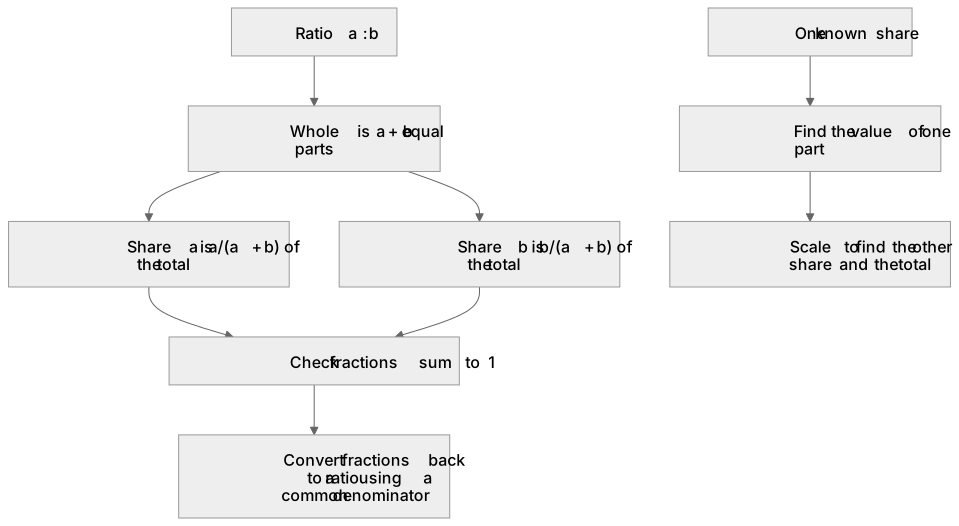
Key words
Say what each word means before you turn the card.
Part-to-part and part-to-whole comparison
Try answering aloud or in your head before turning the card.
Equivalent fractions and ratio notation
Try answering aloud or in your head before turning the card.
Scaling using a unitary method
Try answering aloud or in your head before turning the card.
Checking reasonableness of shares
Try answering aloud or in your head before turning the card.
See every definition
- Part-to-part and part-to-whole comparison
- Ratio compares quantities part-to-part or part-to-whole, while a fraction expresses a part relative to a whole.
- Equivalent fractions and ratio notation
- A share given as a fraction of the total becomes a ratio using a common denominator, and a ratio becomes fractions by dividing each part by the total parts.
- Scaling using a unitary method
- One known share is used to find the value of one part, then scaled to find the other share and the total.
- Checking reasonableness of shares
- Always verify that the fractions sum to 1 and that the shares are in the stated ratio.
Label the diagram
Some boxes have lost their names. Pick the right name for each number.
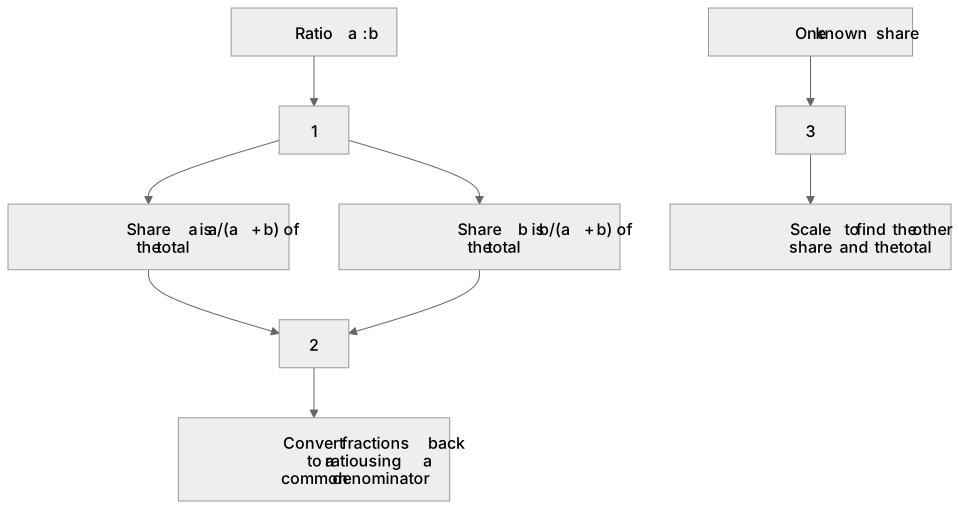
1Box 1
2Box 2
3Box 3
There is more to this lesson
The full lesson goes on to check your understanding and help you earn the marks. Create a free account to carry on, with your progress saved.
7 days Premium · Then the free plan continues · No card, no charge
Test your understanding of Fractions, decimals and percentages: identify and work with fractions in ratio problems
Active recall beats re-reading. Take an instant quiz now to test what you’ve learned and lock it into long-term memory.
7 days Premium · Then the free plan continues · No card, no charge