AQA · GCSE · Mathematics
Geometry and measures
Geometry and Measures is a foundational pillar of GCSE Mathematics, testing both your spatial reasoning and algebraic application. Mastering these concepts is essential for accessing the highest grades, as they appear consistently across multiple papers.
- 5 min read
- 3 worked examples
- 5 practice questions
- 6 key terms
Study Notes
Overview
Geometry and Measures is one of the most significant topics in the GCSE Mathematics specification, accounting for roughly 15-20% of the marks in Foundation tier and up to 20-25% in Higher tier. This topic bridges the gap between abstract mathematical concepts and the physical world around us.
It is vital because it frequently integrates with other topics. You will often need to use algebra to find a missing angle, or solve a quadratic equation to find the side length of a triangle. Examiners love these synoptic questions because they test multiple Assessment Objectives simultaneously (AO1, AO2, and AO3).
Typical exam questions range from simple 1-mark recall questions (e.g., 'State the formula for the area of a circle') to complex 5-6 mark problem-solving scenarios (e.g., 'Calculate the total surface area of a composite solid, giving your answer in terms of π').
Listen to our comprehensive podcast summary here:
Key Concepts
Concept 1: Angle Properties and Reasoning
Angles are the building blocks of geometry. The key to securing marks in angle questions is not just calculating the correct value, but stating the geometric reason.
Examiners are instructed to withhold marks if the reason is missing or incorrectly phrased. For example, 'Z-angles' will not earn the mark; you must write 'alternate angles are equal'.
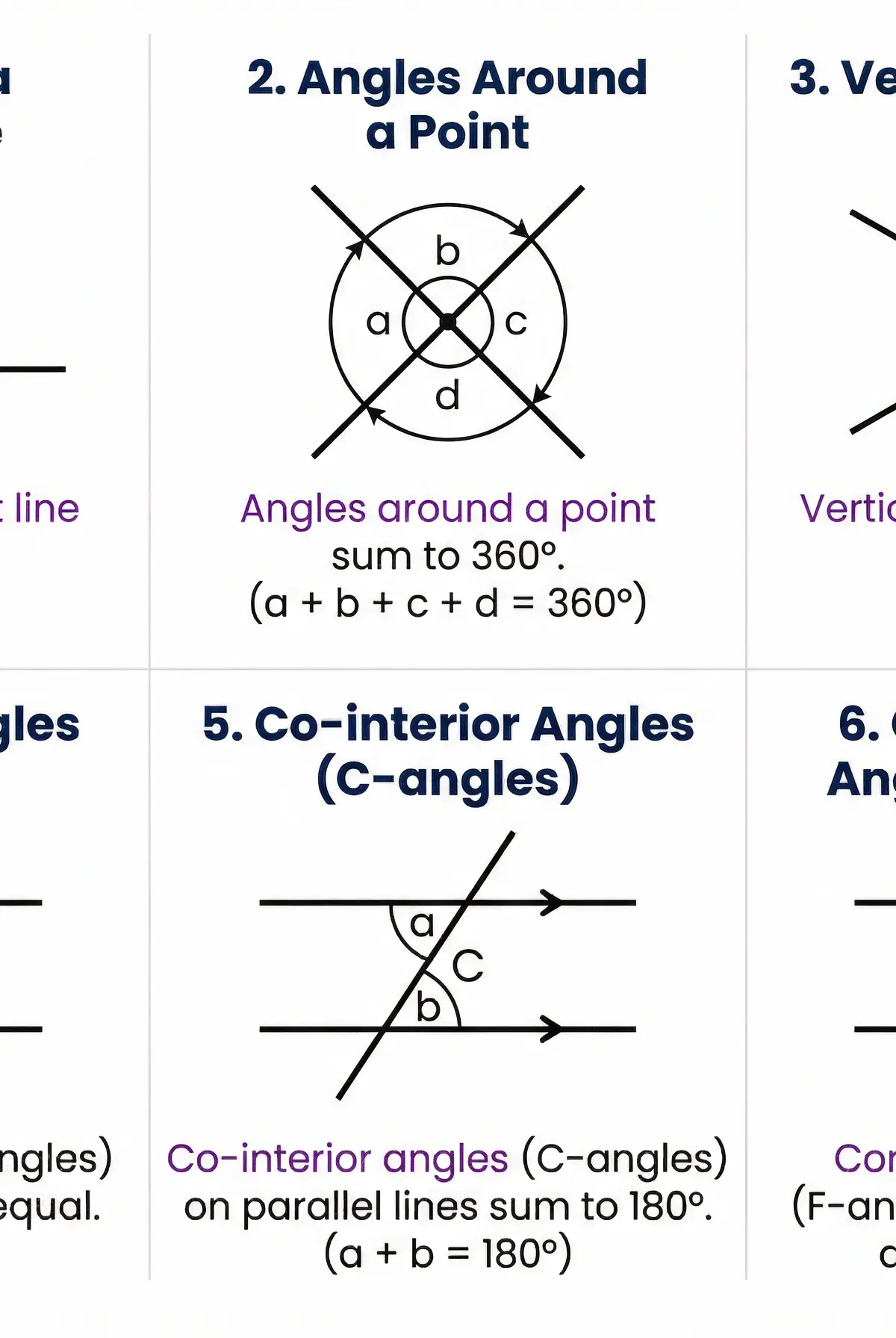
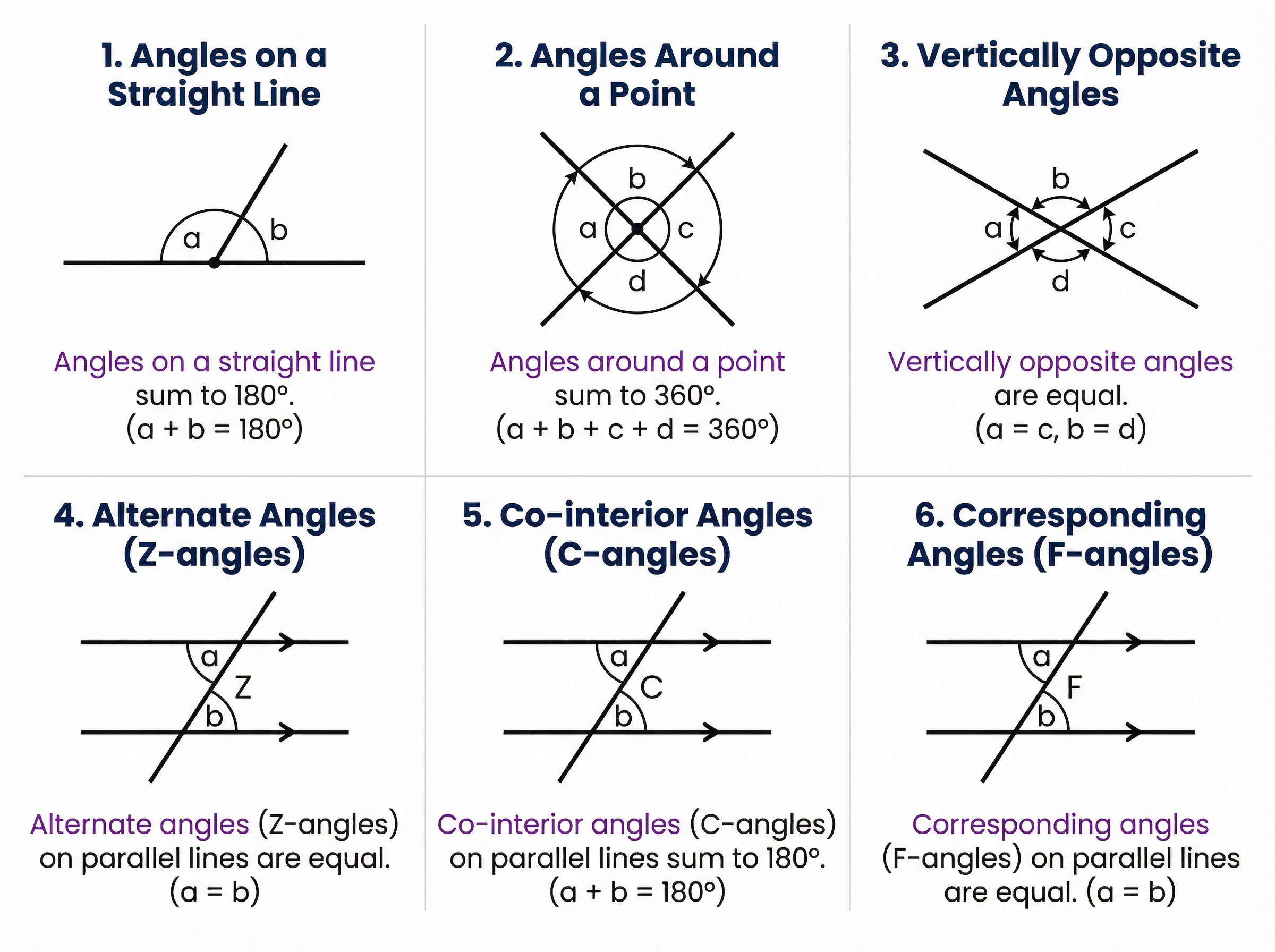
Key Rules to Memorise:
- Angles on a straight line sum to 180°
- Angles around a point sum to 360°
- Vertically opposite angles are equal
- Angles in a triangle sum to 180°
- Angles in a quadrilateral sum to 360°
For parallel lines intersected by a transversal:
- Alternate angles are equal
- Corresponding angles are equal
- Co-interior angles sum to 180°
Example: A triangle has angles x, 2x, and x+20. Find the value of x.
Calculation: x + 2x + x + 20 = 180 \Rightarrow 4x + 20 = 180 \Rightarrow 4x = 160 \Rightarrow x = 40^\circ.
Reasoning: Angles in a triangle sum to 180°.
Concept 2: Area, Perimeter, and Volume
Perimeter is the total distance around the outside of a 2D shape. Area is the amount of 2D space inside the shape. Volume is the amount of 3D space inside a solid.
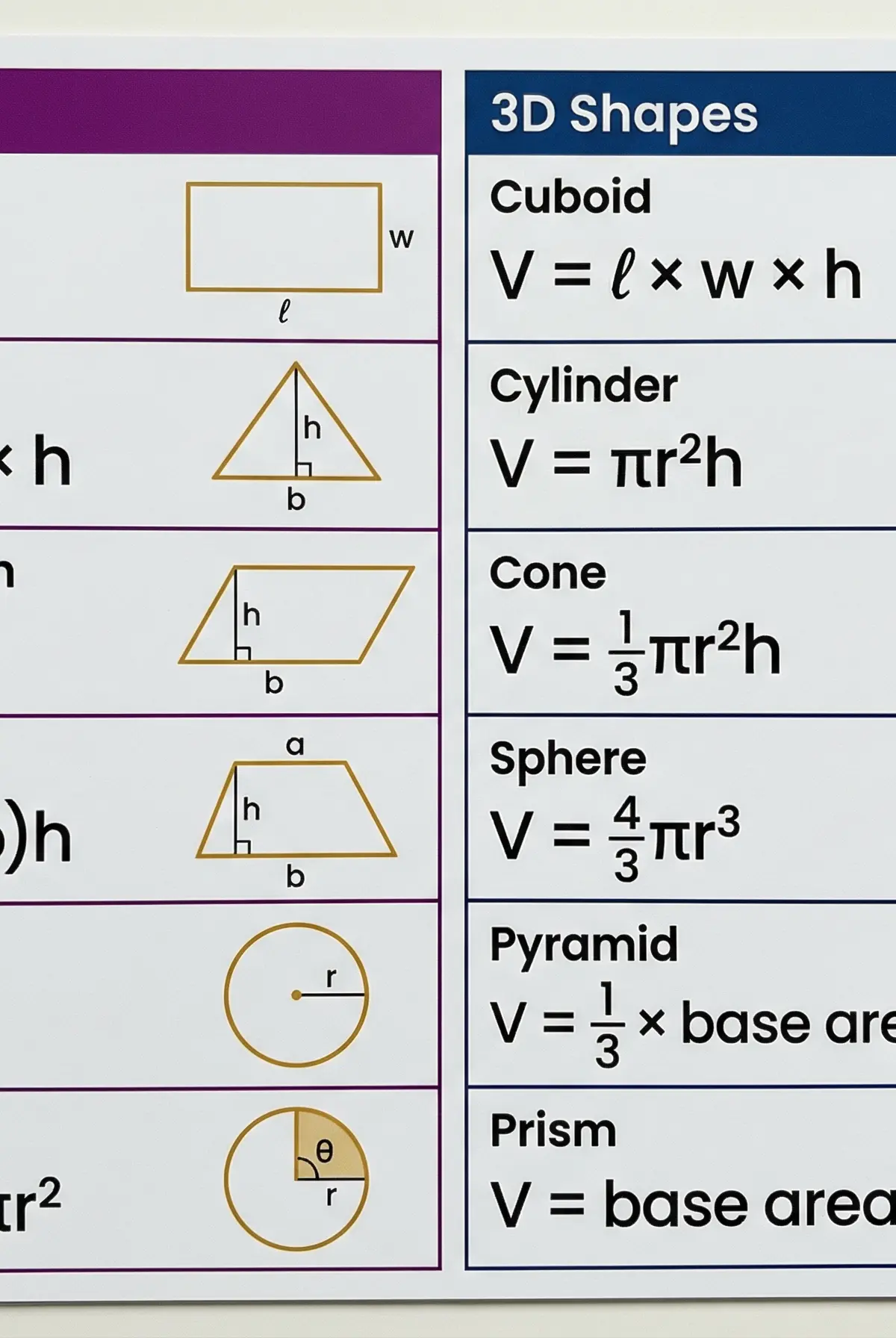
For circles, the perimeter is called the circumference. The relationship between the circumference and the diameter is the constant \pi (pi).
Example: Calculate the area of a circle with a diameter of 10cm. Give your answer to 1 decimal place.
Calculation: Radius r = 5cm. Area = \pi \times 5^2 = 25\pi \approx 78.5 cm².
Common Error: Using the diameter (10) instead of the radius (5) in the area formula.
Concept 3: Pythagoras' Theorem and Trigonometry
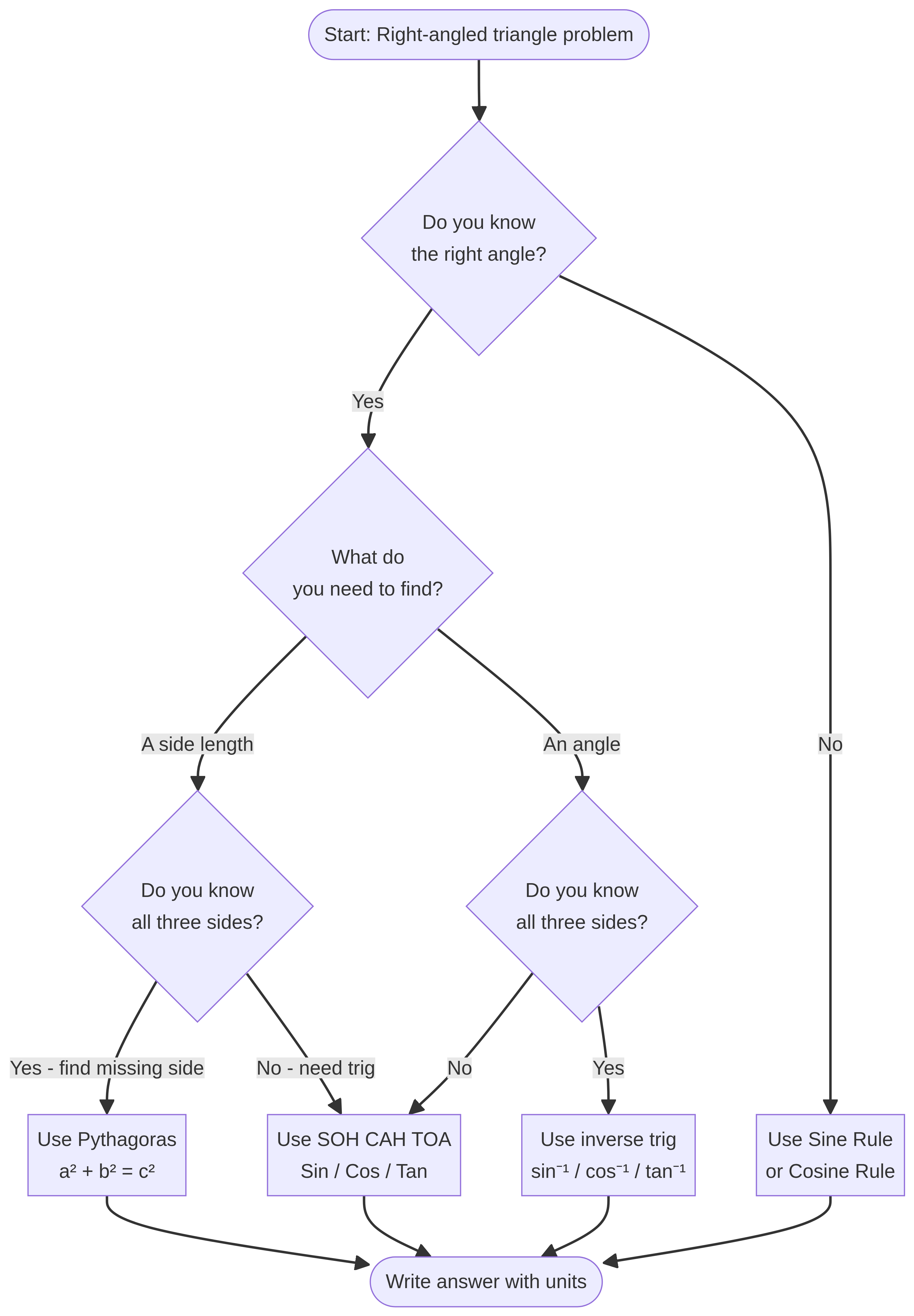
Pythagoras' Theorem (a^2 + b^2 = c^2) applies strictly to right-angled triangles. It relates the lengths of the three sides. The hypotenuse (c) is always the longest side, opposite the right angle.
Trigonometry (SOH CAH TOA) relates the side lengths of a right-angled triangle to its interior angles.
- \sin(\theta) = \frac{\text{Opposite}}{\text{Hypotenuse}}
- \cos(\theta) = \frac{\text{Adjacent}}{\text{Hypotenuse}}
- \tan(\theta) = \frac{\text{Opposite}}{\text{Adjacent}}
Example: A ladder of length 5m leans against a vertical wall. The base of the ladder is 2m from the wall. Calculate the angle the ladder makes with the ground.
Calculation: We have the Adjacent (2m) and Hypotenuse (5m). We use Cosine.
\cos(\theta) = \frac{2}{5} = 0.4
\theta = \cos^{-1}(0.4) \approx 66.4^\circ
Concept 4: Transformations
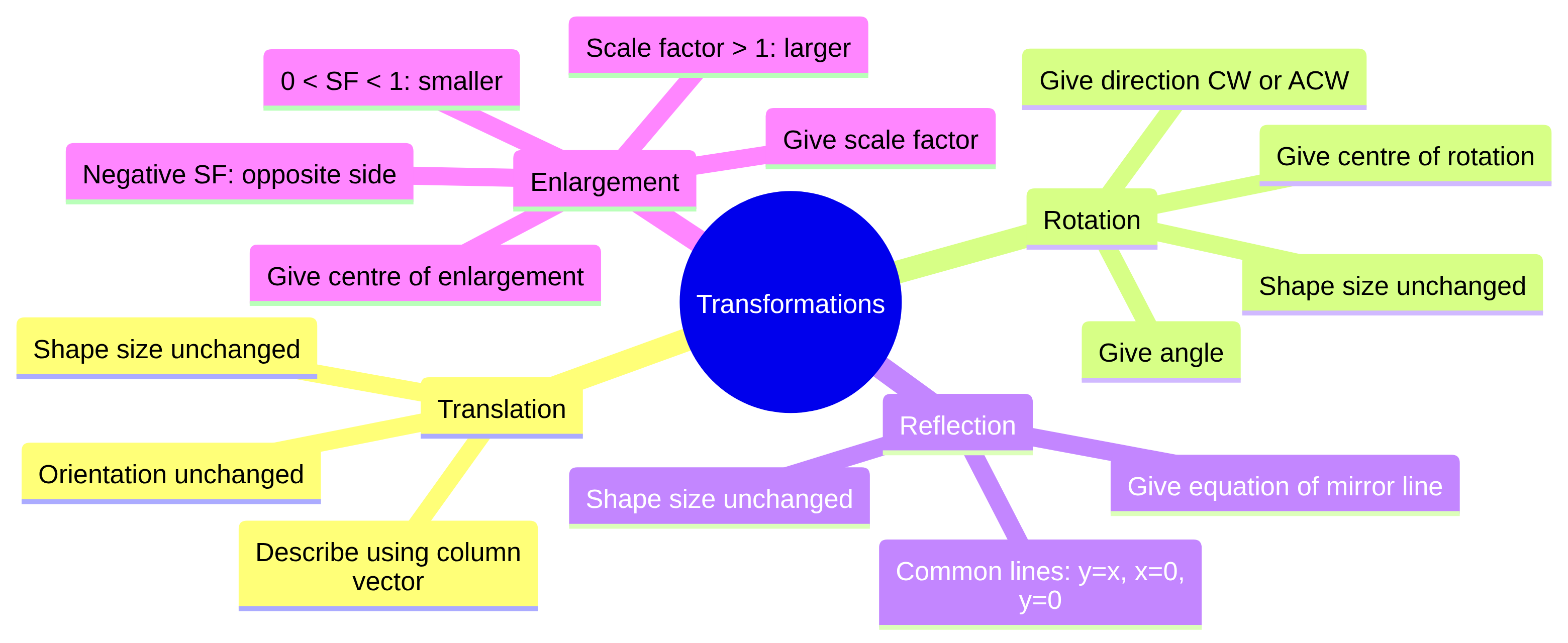
Transformations describe how a shape is moved or altered on a coordinate grid. There are four types:
- Translation: Described by a column vector \begin{pmatrix} x \ y \end{pmatrix}.
- Rotation: Requires a centre of rotation (e.g., (0,0)), an angle (e.g., 90°), and a direction (clockwise/anticlockwise).
- Reflection: Requires the equation of the mirror line (e.g., y = x).
- Enlargement: Requires a centre of enlargement and a scale factor.
Mathematical Relationships and Formulas
Must Memorise:
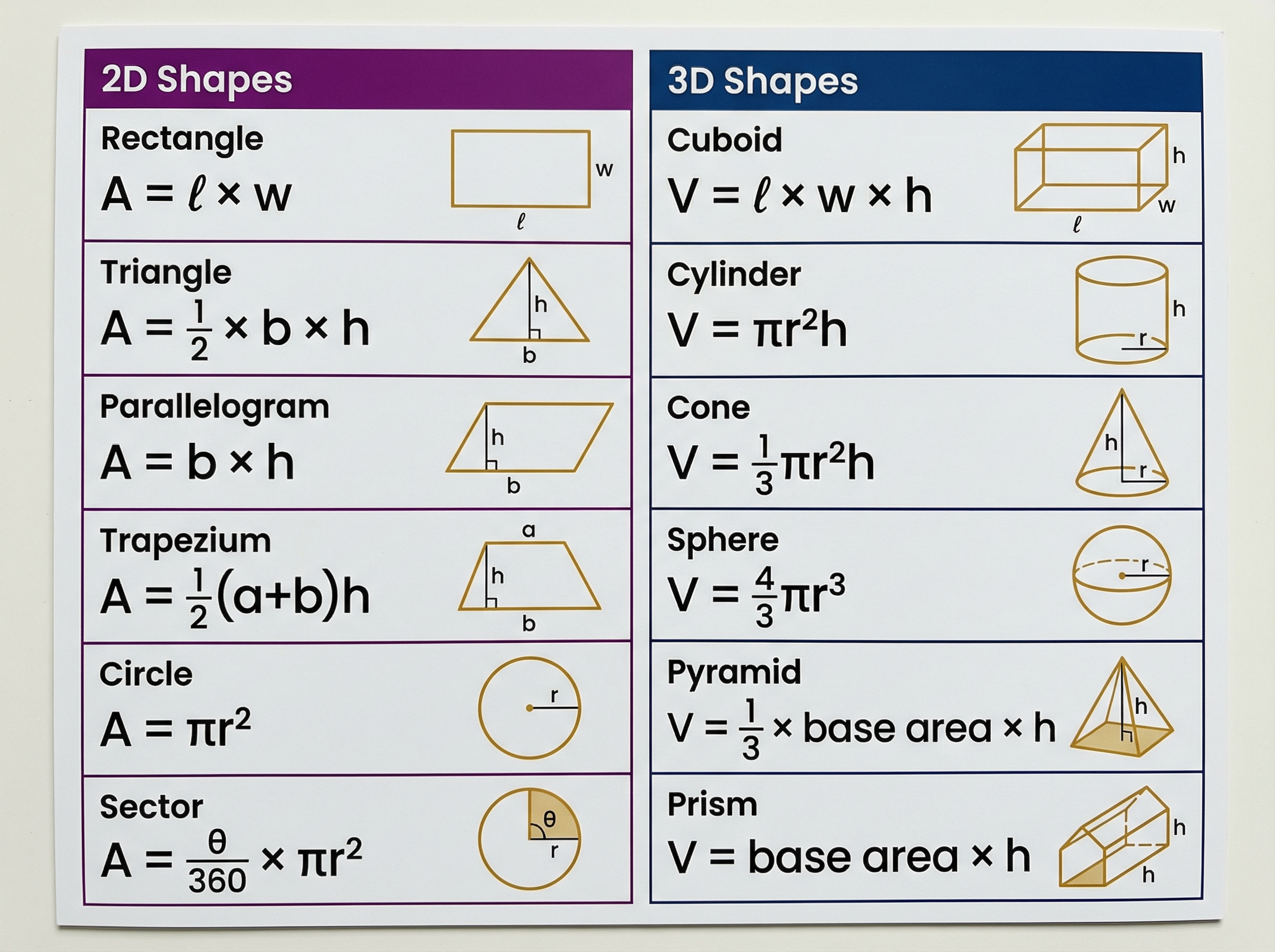
- Area of a Rectangle: A = l \times w
- Area of a Triangle: A = \frac{1}{2}bh
- Area of a Parallelogram: A = bh
- Area of a Trapezium: A = \frac{1}{2}(a+b)h
- Circumference of a Circle: C = \pi d or C = 2\pi r
- Area of a Circle: A = \pi r^2
- Volume of a Prism: V = \text{cross-sectional area} \times \text{length}
- Volume of a Cylinder: V = \pi r^2 h
- Pythagoras' Theorem: a^2 + b^2 = c^2
- Trigonometric Ratios: SOH CAH TOA
- Speed, Distance, Time: s = \frac{d}{t}
- Density, Mass, Volume: \rho = \frac{m}{V}
Given on Formula Sheet (Higher Tier):
- Volume of a Sphere: V = \frac{4}{3}\pi r^3
- Surface Area of a Sphere: A = 4\pi r^2
- Volume of a Cone: V = \frac{1}{3}\pi r^2 h
- Curved Surface Area of a Cone: A = \pi r l
- Sine Rule: \frac{a}{\sin A} = \frac{b}{\sin B} = \frac{c}{\sin C}
- Cosine Rule: a^2 = b^2 + c^2 - 2bc \cos A
- Area of a Triangle: A = \frac{1}{2}ab \sin C
Practical Applications
Geometry is deeply rooted in practical applications:
- Architecture and Construction: Using Pythagoras to ensure walls are perfectly square (the 3-4-5 triangle method).
- Navigation: Using bearings (angles measured clockwise from North) and trigonometry to calculate distances between ships or aircraft.
- Manufacturing: Calculating the volume of material required to cast a solid metal component, and using density to find its mass.
Visual Resources
4 diagrams and illustrations
Interactive Diagrams
2 interactive diagrams to visualise key concepts
Conceptual Flow Outline
Decision flowchart for choosing between Pythagoras and Trigonometry.
Conceptual Flow Outline
Concept map detailing the four types of geometric transformations.
Worked Examples
3 worked examples — open one to explore the question and available guidance.
Practice Questions
Test your understanding — click to reveal model answers
Calculate the area of a trapezium with parallel sides of length 8 cm and 12 cm, and a perpendicular height of 5 cm. (2 marks)
Hint: Use the formula $A = \frac{1}{2}(a+b)h$. Remember to add the parallel sides first.
A cylinder has a volume of 500 cm³ and a radius of 4 cm. Calculate the height of the cylinder. Give your answer to 1 decimal place. (3 marks)
Hint: Write down the volume formula for a cylinder, substitute the numbers you know, then rearrange to make $h$ the subject.
A ship sails 40 km on a bearing of 060°, then sails 30 km on a bearing of 150°. Calculate the direct distance from the start point to the end point. (4 marks)
Hint: Draw a sketch. The angle between the two paths is 90° (150° - 60°). This forms a right-angled triangle.
Describe fully the single transformation that maps triangle A onto triangle B, where A is at (1,1), (3,1), (1,4) and B is at (-1,-1), (-3,-1), (-1,-4). (3 marks)
Hint: The shape has been turned upside down but hasn't changed size. What transformation is this? What point did it turn around?
A solid hemisphere has a radius of 6 cm. Calculate the total surface area of the hemisphere. Give your answer as a multiple of \pi. (3 marks)
Hint: A hemisphere has two parts to its surface: the curved bowl shape (half a sphere) AND the flat circular base.