AQA · GCSE · Mathematics
Course version: 8300 · Version from Sept 2015
Graphs: use the formy = mx + c to identify parallel lines find the equation of the line through two given points, or through one point with a given gradient
Turn two coordinates into a complete equation and spot parallel lines without drawing them. This guide makes y = mx + c a reliable route to marks on both AQA GCSE Mathematics tiers. [Download the complete JSON guide](/home/ubuntu/study_guide/straight_line_graphs_study_guide.json)
- 12 min read
- 4 worked examples
- 7 practice questions
- 2 key terms
Try the lesson
The start of the Graphs: use the formy = mx + c to identify parallel lines find the equation of the line through two given points, or through one point with a given gradient lesson, made from checked teaching notes for this specification point.
Have a go first
Line L has equation y = 4x + 7. Which equation represents a line that is parallel to L?
Listen
In the form y = mx + c, m is the gradient and c is the y-intercept. Parallel lines have equal gradients, so if two equations have the same m but different c, they are parallel. To find the equation of a line through two given points, first calculate the gradient using m = (y₂ − y₁)/(x₂ − x₁), then substitute one point into y = mx + c to find c. For example, through (1, 5) and (3, 11), m = (11 − 5)/(3 − 1) = 3, so 5 = 3(1) + c gives c = 2 and y = 3x + 2. Through one point with a given gradient, substitute the point and gradient directly to find c. Always check by substituting the other point.
Key words
Say what each word means before you turn the card.
Gradient and y-intercept
Try answering aloud or in your head before turning the card.
Parallel lines
Try answering aloud or in your head before turning the card.
See every definition
- Gradient and y-intercept
- In the form y = mx + c, m is the gradient and c is the y-intercept.
- Parallel lines
- Lines that have equal gradients, so if two equations have the same m but different c, they are parallel.
There is more to this lesson
The full lesson goes on to check your understanding and help you earn the marks. Create a free account to carry on, with your progress saved.
7 days Premium · Then the free plan continues · No card, no charge
Study Notes

Overview
A straight-line equation is a compact set of instructions for every point on a graph. In y = mx + c, the gradient m tells you how y changes when x increases, while c tells you where the line crosses the y-axis. This guide develops three dependable exam skills: recognising parallel lines, finding an equation through two points, and finding an equation through one point when the gradient is known.
These skills combine coordinates, substitution, negative numbers and rearranging equations. They also support simultaneous equations, linear sequences and interpreting real-life rates. Candidates may be asked to write down a gradient, explain why lines are parallel, work out an equation or interpret a graph in context. The method matters because visible, correct working can receive credit even when a later calculation goes wrong, subject to the question's mark scheme.
The relevant reference is AQA GCSE Mathematics 8300, 3.2.2 Graphs, A9, supported by A8 and A10. This topic is assessed on both Foundation and Higher tiers. Identifying perpendicular lines is a separate Higher-only extension. 1
Key Concepts
1. Understand the roles of m and c
For y = 2x + 3, m = 2 and c = 3. The line crosses the y-axis at (0, 3), not (3, 0). This follows directly from substitution: at the y-axis, x = 0, so y = 2(0) + 3 = 3. The gradient is not the height of the line. It describes a rate of change.
Increase x from 1 to 2. The corresponding y-values change from 5 to 7, an increase of 2. Every one-unit increase in x produces the same two-unit increase in y. That constant rate makes the graph straight. In y = -2x + 3, the gradient is -2 and the intercept is still +3. Read the sign with its number.
A fractional gradient is equally meaningful. For m = 3/2, moving two units right moves three units up. Do not confuse m = 3/2 with 2/3. Gradient compares vertical change with horizontal change, in that order. A larger absolute gradient means a steeper line when graphs use the same axis scales.
Cover and recall: what remains of y = mx + c when x = 0? Explain why that identifies the intercept without drawing anything.
2. Calculate gradient from two points
For points (x₁, y₁) and (x₂, y₂), calculate m = (y₂ - y₁)/(x₂ - x₁). The numerator is the change in y; the denominator is the corresponding change in x. Keep the subtraction order consistent.
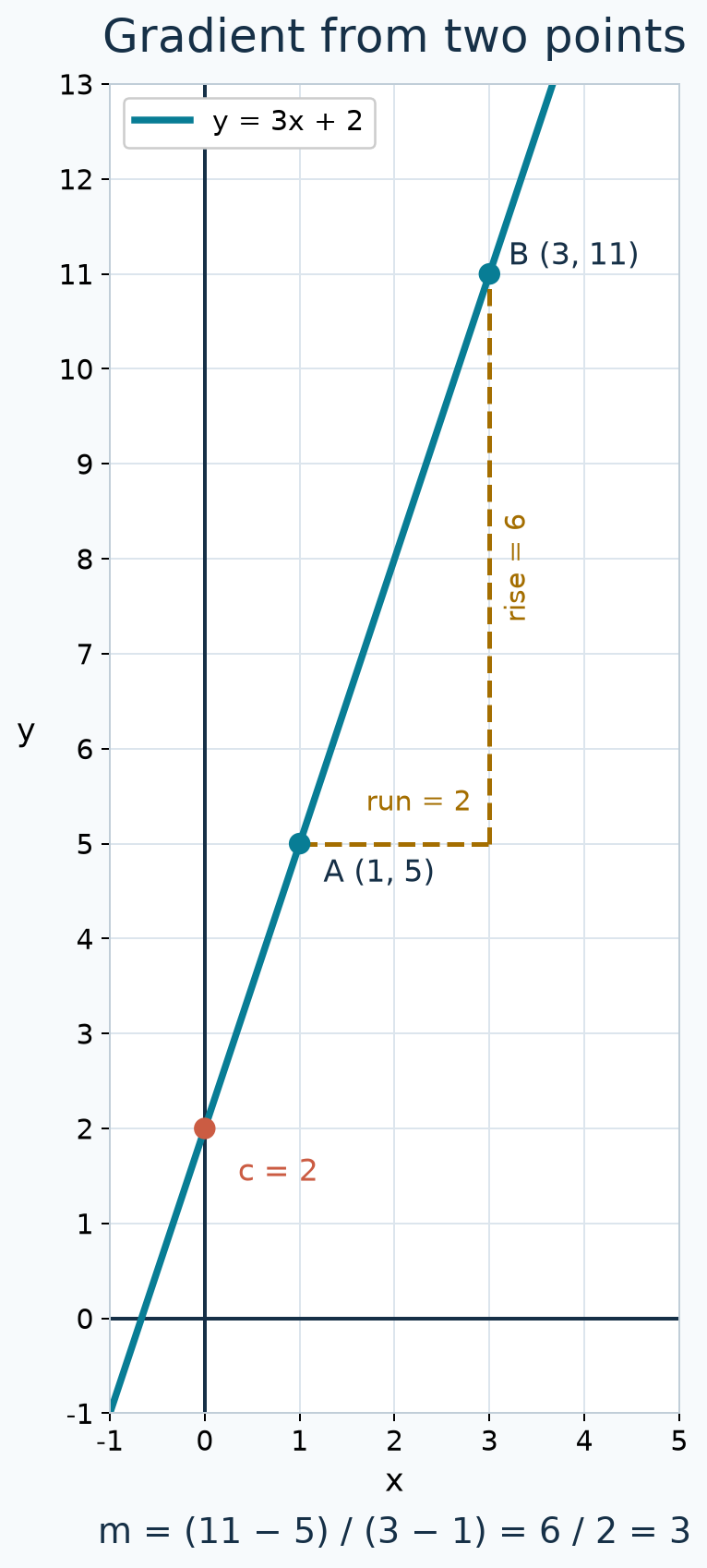
Through (1, 5) and (3, 11), m = (11 - 5)/(3 - 1) = 6/2 = 3. Reversing both subtractions gives (5 - 11)/(1 - 3) = -6/-2 = 3, the same result. Reversing only one produces -3 incorrectly. Write the substituted fraction before simplifying so the examiner can see the method used.

The dashed triangle shows a run of 2 and rise of 6. Its sloping side is not used in the gradient calculation. On a graph, choose two accurately readable, well-separated points on the line. A larger triangle reduces the effect of small reading errors. Count coordinate units, not simply squares, if the axes have different scales.
Why does this work? Subtract y₁ = mx₁ + c from y₂ = mx₂ + c. The intercept cancels, leaving y₂ - y₁ = m(x₂ - x₁). Dividing by the non-zero horizontal change gives the gradient formula.
3. Find the equation through two points
Use GSC: Gradient, Substitute, Check. First calculate m. Then put one complete coordinate pair into y = mx + c and solve for c. Finally write the equation and test the other point.
Through (1, 5) and (3, 11), the gradient is 3. Substitute (1, 5): 5 = 3(1) + c, giving c = 2. Therefore y = 3x + 2. Check (3, 11): 3(3) + 2 = 11. Finding m = 3 and c = 2 without writing an equation does not fully answer 'Work out the equation'.
For negative coordinates, preserve brackets. Through (-2, 5) and (4, 2), m = (2 - 5)/(4 - (-2)) = -3/6 = -1/2. Using (4, 2), 2 = (-1/2)(4) + c, so c = 4. The equation is y = -x/2 + 4. Checking (-2, 5) gives -(-2)/2 + 4 = 5.
Keep exact fractions unless rounding is requested. Decimal 0.5 is exact, but 0.33 is not exactly 1/3. Premature rounding can change the intercept and lose accuracy. Candidates are credited for valid alternative algebraic methods; this guide's suggested mark allocations are not universal AQA rules. 4
4. Find the equation through one point with a known gradient
When m is given, skip the gradient calculation. For a line of gradient 3 through (2, -1), begin y = 3x + c. Substitute the coordinates in their correct positions: -1 = 3(2) + c. Therefore c = -7, and y = 3x - 7. Check: 3(2) - 7 = -1.
A known point is not automatically the intercept. The point (2, -1) lies on the line, but its x-coordinate is not zero. Writing c = -1 mistakes an ordinary y-coordinate for the y-intercept. If the given point is (0, -1), however, c really is -1.
The equivalent point-gradient form is y - y₁ = m(x - x₁). For this example, y + 1 = 3(x - 2), which expands to y = 3x - 7. This is a useful alternative, not a requirement to learn a separate method. Return the form requested in the question.

5. Identify parallel lines, including disguised equations
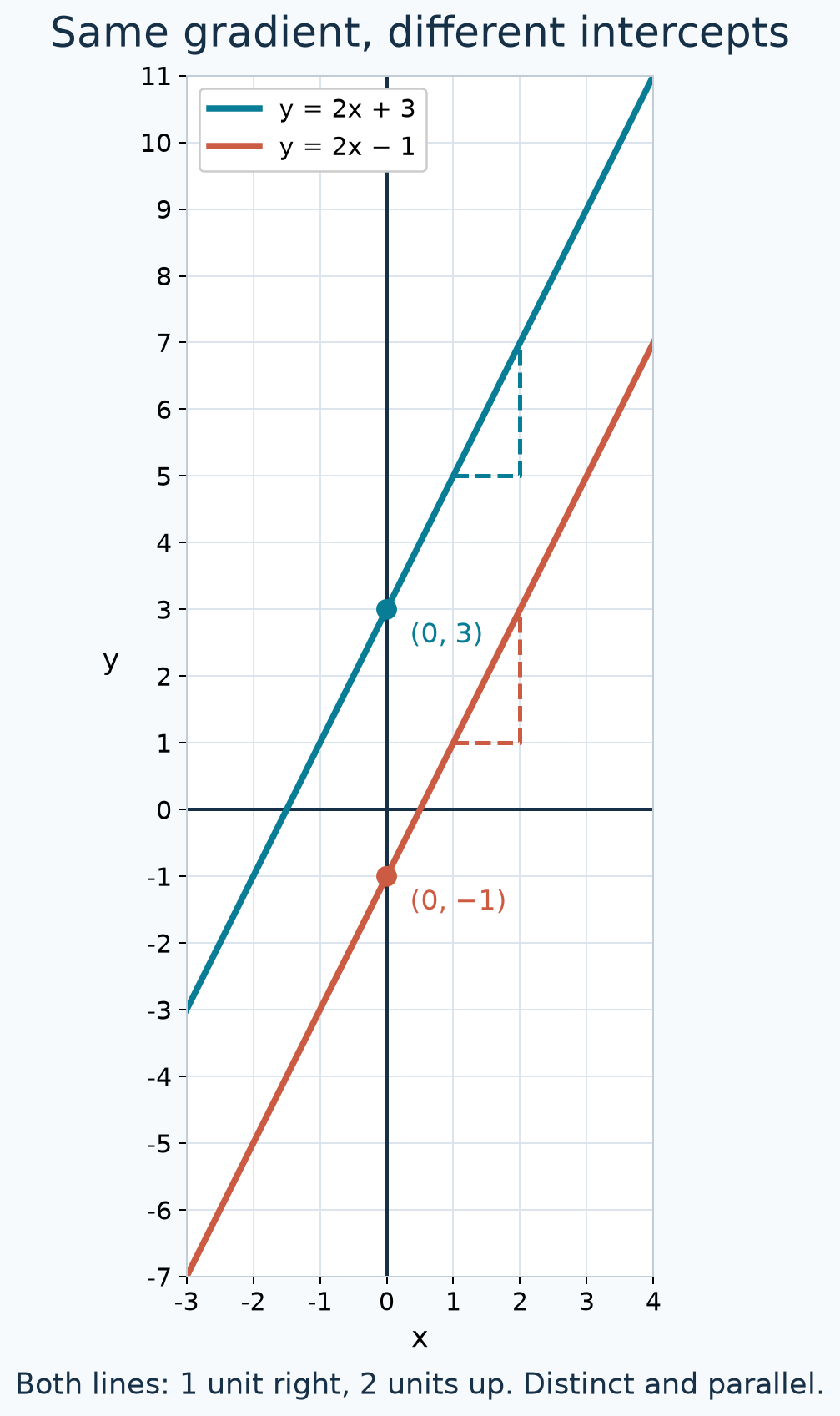
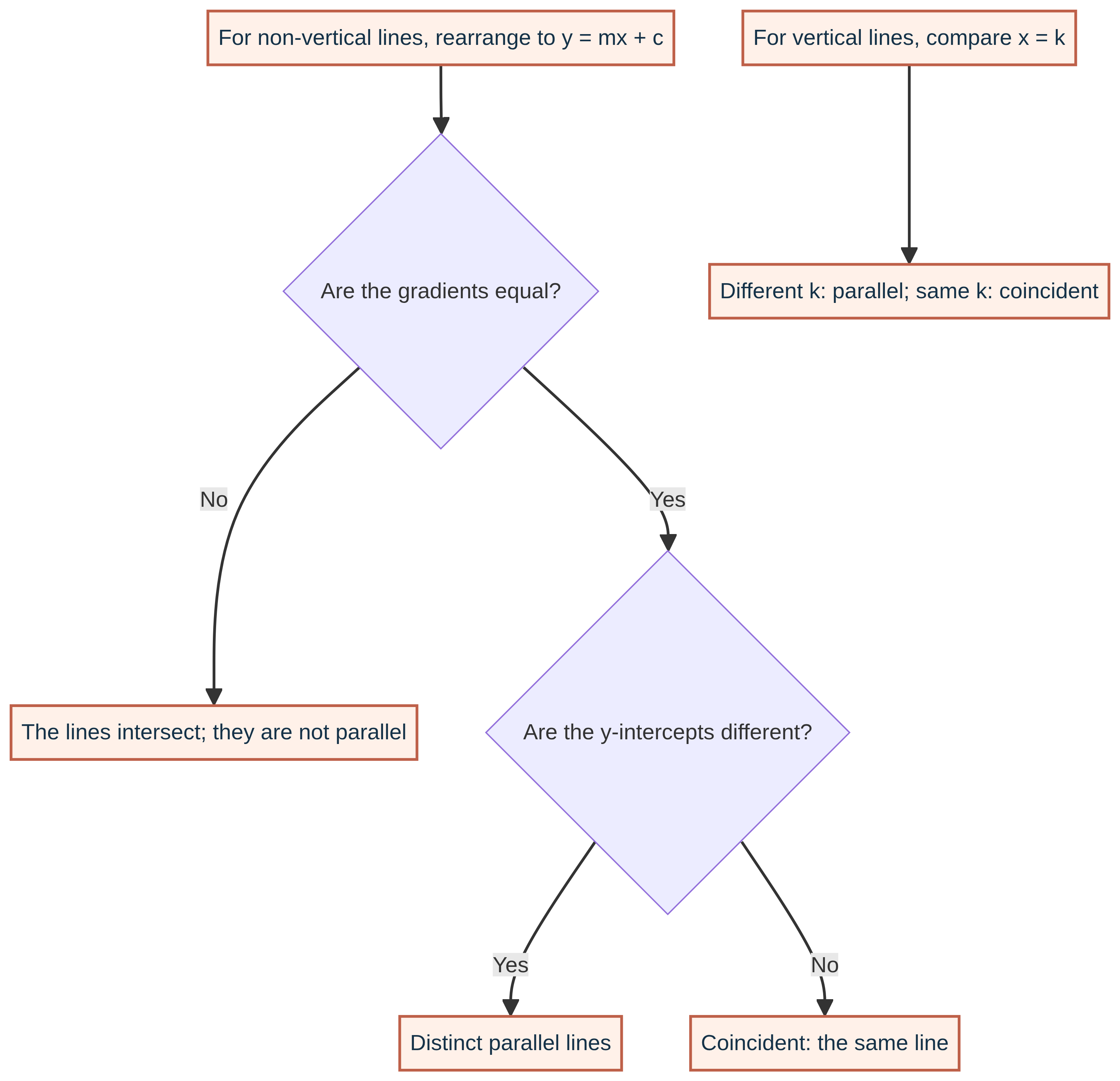
Two distinct non-vertical straight lines are parallel when their gradients match. Thus y = 2x + 3 and y = 2x - 1 are parallel: both have m = 2, but their intercepts differ. Equal intercepts alone do not establish parallelism. For example, y = 2x + 3 and y = -x + 3 meet at (0, 3).

The vertical gap between the two illustrated lines is always 4 because (2x + 3) - (2x - 1) = 4. The intercept changes the starting height, not the rate. If both m and c match, the equations represent the same, coincident line, rather than two distinct parallel lines.
Always make y the subject before comparing coefficients. For 2y = 6x - 4, divide every term by 2: y = 3x - 2. Its gradient is 3, not 6. Likewise, 3x + 2y = 8 becomes 2y = -3x + 8, then y = -3x/2 + 4. The gradient is -3/2.
To find a parallel line through a specified point, copy the gradient and find a new intercept. A line parallel to 2y = 6x - 4 through (1, 7) has y = 3x + c. Then 7 = 3 + c gives y = 3x + 4. Explain parallelism using equal gradients, not appearance alone.

6. Handle horizontal and vertical lines correctly
A horizontal line such as y = 4 has gradient 0: y does not change as x changes. It fits y = mx + c with m = 0 and c = 4. Distinct horizontal lines are parallel.
A vertical line such as x = 4 has an undefined gradient, not zero. The horizontal change is zero, so the gradient fraction would divide by zero. It cannot be expressed as y = mx + c with finite m. Through (2, 1) and (2, 7), the line is x = 2. Distinct vertical lines are parallel to one another. A horizontal and a vertical line are perpendicular, not parallel.
Higher-only extension: for non-vertical, non-horizontal perpendicular lines, m₁m₂ = -1, so one gradient is the negative reciprocal of the other. A gradient of 2 gives a perpendicular gradient of -1/2. This is not the rule for parallel lines and is beyond the requested core. 1
Mathematical Relationships and Formula-Sheet Status
The published 2027 Foundation and Higher formula sheets do not print the straight-line formulas below. 'Must memorise' here means they are not supplied there; simple rearrangements can be derived from the core equation rather than learnt separately. Check the sheet for your examination year. 3 5 6
Must memorise: y = mx + c. x and y are coordinates, m is gradient and c is the y-intercept value. Use for non-vertical lines.
Must memorise: m = Δy/Δx = (y₂ - y₁)/(x₂ - x₁). Δ means change. Use two distinct points with x₂ ≠ x₁, or a gradient triangle.
Must memorise, or derive: c = y₁ - mx₁ and y - y₁ = m(x - x₁). Both follow from substituting a known point. The intercept point is (0, c).
Must memorise: m₁ = m₂ for parallel non-vertical lines. For distinct lines, c₁ ≠ c₂. Matching both values means coincident lines.
Must memorise, or derive: y = k is horizontal with m = 0; x = k is vertical with undefined gradient. Here k is a fixed constant.
Must memorise, or derive: x = -c/m for the x-intercept when m ≠ 0. Set y = 0. A horizontal line y = c ≠ 0 has no x-intercept; y = 0 is the x-axis itself.
Higher-only, must memorise: m₁m₂ = -1, equivalently m₂ = -1/m₁, for the perpendicular-gradient extension where these gradients are defined and non-zero.
Graph Skills: Plot, Read and Interpret
For y = 2x - 1, use x = -1, 0 and 2 to obtain y = -3, -1 and 3. Plot (-1, -3), (0, -1) and (2, 3), then draw one ruled straight line over the required interval. Two points determine a line; a third helps detect a substitution error. Label axes, read scales and distinguish a sketch from an accurate plot.
To recover an equation from a graph, read the y-intercept, calculate the gradient from two clear points and combine them. For negative gradients, the rise is negative when moving right. If the intercept lies outside the visible grid, calculate m from visible points and substitute one to find c. Do not guess an unseen crossing.
In AQA June 2024 8300/3H question 7, the three-mark scheme credits two correct points, plotting the candidate's points and the correct straight line across the required interval. This is a genuine example of method and accuracy marks, not a fixed allocation for all graph questions. 4
Practical Applications and Units
A taxi model C = 2d + 4 has gradient £2 per kilometre and a £4 starting charge. A second model C = 2d + 7 is parallel: the same per-kilometre charge, but £3 more for every distance. State what the gradient and intercept mean in the context, not just their numerical values.
On a distance-time graph, gradient has distance units divided by time units. A rise of 120 metres in 2 minutes is 60 m/min, or 1 m/s. Convert 2 minutes to 120 seconds before calculating in m/s. For cost, 250 pence is £2.50, so mixing pounds and pence changes the numerical gradient by a factor of 100. Pure coordinate questions need no invented physical units.
There is no required practical for this mathematics topic. These applications develop modelling and interpretation, not a science practical method. For costs or travel, consider the meaningful domain: negative distance may be mathematically possible but irrelevant to the real model.
Listen, Retrieve and Revisit
The ten-minute female-tutor podcast follows introduction, core concepts, exam tips, recall quiz and summary. Pause before quiz answers and calculate rather than just listening. Afterwards, cover the guide and write the complete GSC method from memory. Solve one equation question now, another tomorrow and a mixed question several days later.
Elaborate: why does subtracting the two point equations remove c? What changes if c increases but m stays fixed? What if both points have the same x-coordinate? Explain each answer using the mathematics. This links retrieval to understanding and helps distinguish similar-looking exam questions.
References
Visual Resources
4 diagrams and illustrations
](https://xnnrgnazirrqvdgfhvou.supabase.co/storage/v1/render/image/public/study-guide-assets/guide_4f7293d9-f257-440b-b400-8ef86ea7b119/gradient_triangle.png?width=800&format=webp&resize=cover&quality=80)
](https://xnnrgnazirrqvdgfhvou.supabase.co/storage/v1/render/image/public/study-guide-assets/guide_4f7293d9-f257-440b-b400-8ef86ea7b119/parallel_lines.png?width=800&format=webp&resize=cover&quality=80)
](https://xnnrgnazirrqvdgfhvou.supabase.co/storage/v1/render/image/public/study-guide-assets/guide_4f7293d9-f257-440b-b400-8ef86ea7b119/equation_route.png?width=800&format=webp&resize=cover&quality=80)
](https://xnnrgnazirrqvdgfhvou.supabase.co/storage/v1/render/image/public/study-guide-assets/guide_4f7293d9-f257-440b-b400-8ef86ea7b119/parallel_route.png?width=800&format=webp&resize=cover&quality=80)
Interactive Diagrams
2 interactive diagrams to visualise key concepts
Conceptual Flow Outline
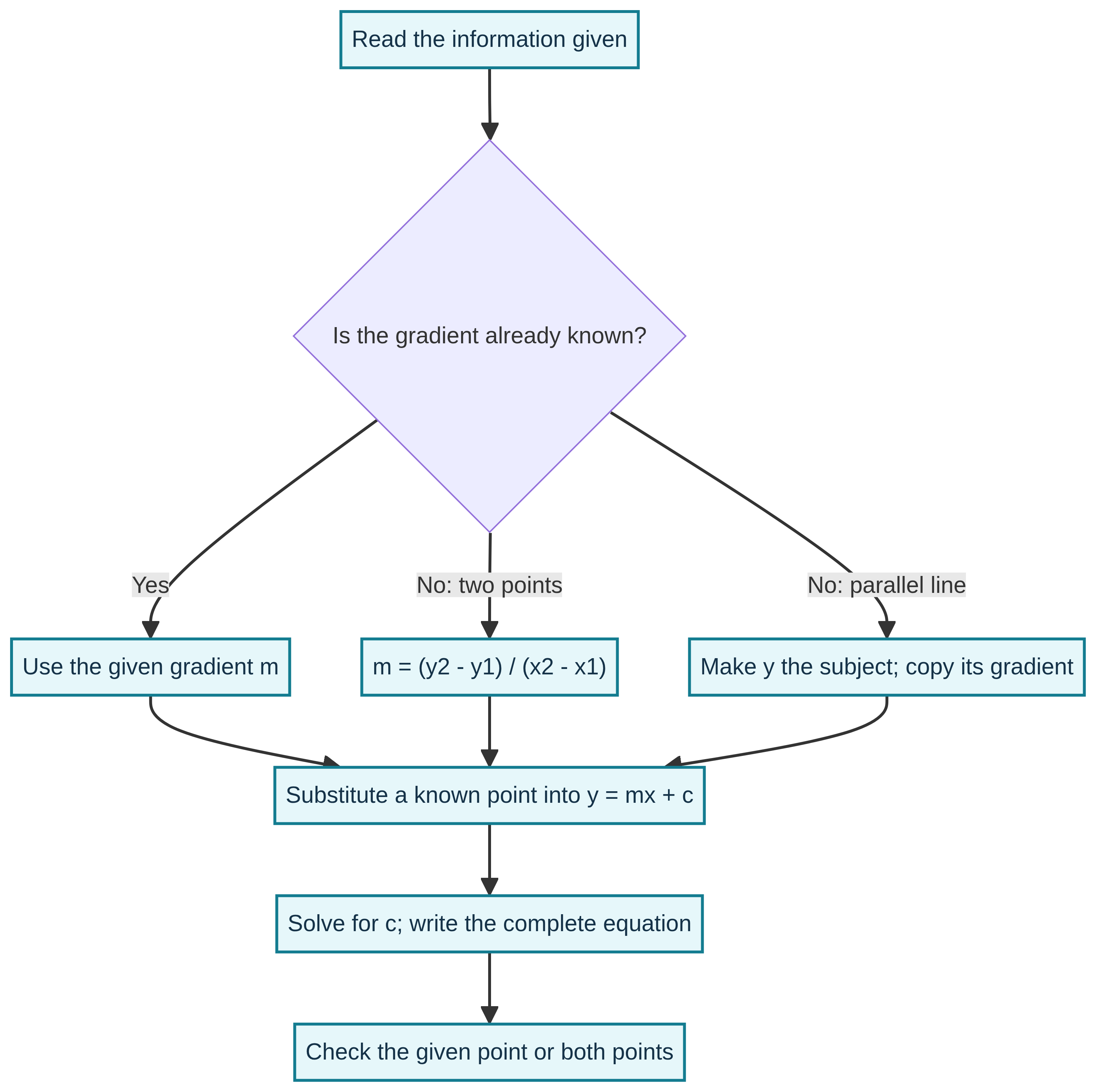
Decision route for finding an equation. Non-vertical two-point cases require non-zero horizontal change.
Conceptual Flow Outline
Identify parallel, coincident or intersecting lines, with a separate vertical-line branch.
Worked Examples
4 worked examples — open one to explore the question and available guidance.
Practice Questions
Try the question, then reveal an answer plan or example response
Write down the gradient and y-intercept value of y = -4x + 6. [2 marks]
Hint: Read the signed coefficient of x, then the constant term.
Lines A, B and C have equations y = 3x + 1, y = 3x - 8 and y = -3x + 1 respectively. Identify the parallel pair and explain your choice. [2 marks]
Hint: Compare gradients, not intercepts.
A line has gradient -2 and passes through (-1, 5). Work out its equation in y = mx + c form. Show your working. [3 marks]
Hint: Substitute x = -1 and y = 5; a negative times a negative is positive.
A straight line passes through (-1, 0) and (3, 8). Work out its equation. Show your working. [4 marks]
Hint: Find the two changes before substituting either point.
A line is parallel to 4y = 8x + 12 and passes through (2, 1). Work out its equation in y = mx + c form. Show your working. [4 marks]
Hint: First divide the given equation by 4.
A line passes through (-3, 7) and (5, 1). (a) Work out the gradient. [2 marks] (b) Work out its equation. [2 marks] (c) Verify the equation using (5, 1). [1 mark] Total: 5 marks.
Hint: Keep the gradient as an exact fraction and use c = y - mx.
A line passes through (2, -1) and (2, 6). Work out its equation and explain why the usual gradient calculation cannot give a finite value. [3 marks]
Hint: Both x-coordinates are the same.
Exam technique
How to turn what you know into marks
How to approach the question
Read the command word and identify whether you have two points, one point plus a gradient, or a parallel-line condition. Obtain m, making y the subject first when necessary. Substitute a correctly ordered point to find c, write the complete equation and check. All practice questions and their allocations in this guide are author-written AQA-style teaching material, not official questions or official mark schemes.
How to structure your answer
For a given-gradient equation, show substitution, solve for c and state the equation. For two points, show the substituted gradient fraction before simplifying, then substitution and the final equation. In a multipart task, answer each labelled part separately. AQA uses M for method, A for accuracy and B for independent marks; the June 2024 8300/3H Q7 example has M1, M1, A1 for a graph, while Higher-only Q15(b) has three method marks and one accuracy mark for a perpendicular-line equation. Valid alternative methods can receive credit. No fixed allocation or automatic checking mark applies to every question.
Timing
AQA papers last 90 minutes and contain 80 marks, a whole-paper allowance of 1.125 minutes per mark. Aim for about 1 minute per mark while working, preserving checking time: about 3 minutes for 3 marks, 4 minutes for 4 marks and 6 minutes for 6 marks. These are pacing suggestions, not question-specific AQA time limits. Paper 1 is non-calculator; Papers 2 and 3 allow calculators. See reference [2] in content.
Common pitfalls
- Comparing unrearranged coefficients: make y the subject and divide every term by its coefficient.
- Reversing only one subtraction: use the same point order for numerator and denominator.
- Swapping coordinates: in (x, y), the first coordinate replaces x and the second replaces y.
- Treating any y-coordinate as c: it is the intercept only when x = 0.
- Confusing parallel with perpendicular: parallel gradients are equal; negative reciprocals are a Higher-only perpendicular extension.
- Rounding fractions early: preserve exact values unless instructed otherwise.
- Stopping at m and c: finish with the requested complete equation.
- Calling a vertical gradient zero: vertical is undefined; horizontal is zero.
What the command words want
- Find
- Determine the requested equation or coordinate. An equation answer must include the equality, not just m and c.
- Verify
- Substitute the specified coordinates and show equality. A verification mark is awarded only when the scheme assesses it.
- Compare
- Compare gradients and intercepts explicitly. Distinguish equal steepness from equal gradient: gradients 2 and -2 have different signs.
- Explain
- Give a mathematical reason. For parallel lines, state that their gradients are equal; mention different intercepts if distinctness is assessed.
- Describe
- Describe the graph precisely: straight, increasing or decreasing, with stated intercepts where relevant.
- Evaluate
- If asked to evaluate an expression, substitute and calculate its numerical value. Do not write a generic pros-and-cons essay.
- Work out
- Calculate the result and show clear working, especially if the question explicitly requires it.
- Calculate
- Use the correct numerical or algebraic relationship, retain exact values and state meaningful units only in contextual questions.
- Show that
- Demonstrate the stated result from the supplied information. Copying the target answer is not a demonstration.
- State/Give
- Provide the requested value, coordinate or equation directly. If giving a gradient, retain its sign.
- Write down
- Read off the requested information, such as m or c, once the equation is in the correct form.
Test your understanding of Graphs: use the formy = mx + c to identify parallel lines find the equation of the line through two given points, or through one point with a given gradient
Active recall beats re-reading. Take an instant quiz now to test what you’ve learned and lock it into long-term memory.
7 days Premium · Then the free plan continues · No card, no charge