AQA · GCSE · Mathematics
Course version: 8300 · Version from Sept 2015
Mensuration and calculation
How much paint covers a dome, and how much liquid fills a cone? Master surface area and volume by choosing the right dimensions, splitting composite solids and showing clear working that can earn method marks in AQA GCSE Mathematics.
- 13 min read
- 5 worked examples
- 7 practice questions
- 12 key terms
Try the lesson
The start of the Mensuration and calculation lesson, made from checked teaching notes for this specification point.
Have a go first
A sphere has a radius of 6 cm. Work out the volume of the sphere. Give your answer in cm³, correct to one decimal place.
Listen
For a sphere, use volume = (4/3)πr³ and surface area = 4πr². For a cone, volume = (1/3)πr²h and curved surface area = πrl, where l is the slant height; total surface area adds the base circle πr². For a pyramid, volume = (1/3) × base area × perpendicular height; surface area is the sum of the base and triangular faces. Composite solids are split into these simpler parts, calculating each part and adding or subtracting as appropriate. Always use the perpendicular height for volume, not a slant edge, and keep units consistent, converting lengths before calculating areas or volumes. For example, a cone with radius 3 cm and perpendicular height 4 cm has slant height 5 cm, volume 12π cm³ and curved surface area 15π cm².
There is more to this lesson
The full lesson goes on to check your understanding and help you earn the marks. Create a free account to carry on, with your progress saved.
7 days Premium · Then the free plan continues · No card, no charge
Check what you remember
Read the wording for your board, then hide it and explain Mensuration in your own words. Rough notes are fine. This is a self-check, with no mark or grade.
Reference: AQA
The calculation or measurement of lengths, areas and volumes.
Study Notes
Overview
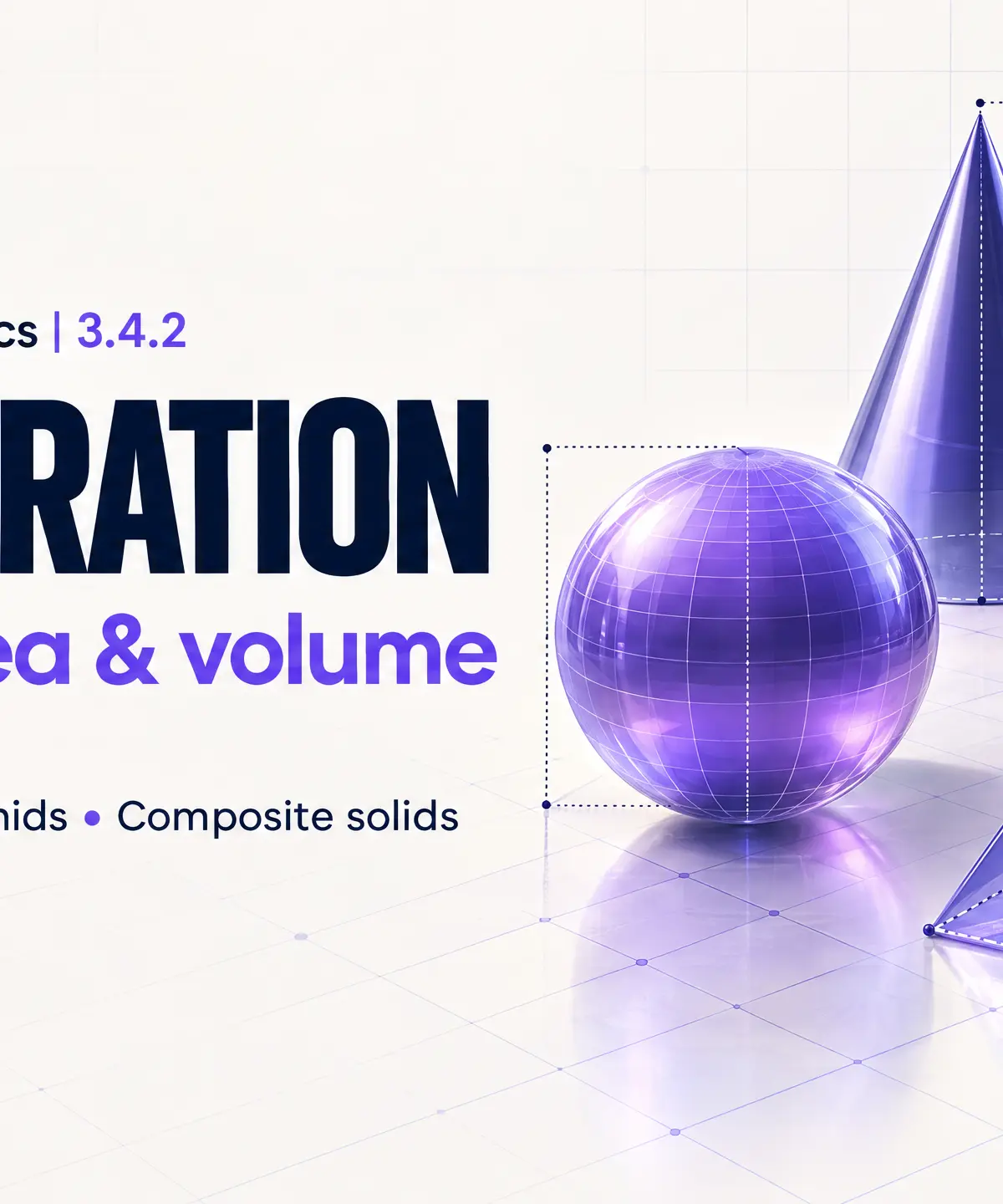
Mensuration means measuring lengths, areas and volumes. This guide focuses on spheres, pyramids, cones and composite solids in AQA GCSE Mathematics 8300, section 3.4.2, G17. Surface area tells you how much material covers an object; volume tells you how much space it occupies. The distinction matters because candidates must choose different formulas, dimensions and units before doing any arithmetic.
Expect questions asking you to calculate a single solid, combine several solids, remove a smaller solid, find a missing dimension or justify a comparison. A question may give a diameter rather than a radius, mix centimetres and metres, or require an exact answer in terms of π. These details are deliberate tests of understanding, not decoration.
The topic connects to circle area, triangular faces, substitution, rearranging formulas, Pythagoras, similarity and unit conversion. Strong candidates make those connections visible in their working. You will practise selecting the correct height, excluding hidden joining faces and retaining accuracy until the final line. Use the recall prompts before looking at solutions: explaining a method from memory is more useful than recognising it when you reread.
Scope, tiers and assessment accuracy
The named solids and composite-solid calculations are additional Foundation content, so they are assessed at both Foundation and Higher. AQA includes frustums within G17. Higher-only extensions here are area/volume scale-factor relationships in G19 and genuinely three-dimensional Pythagoras or trigonometry in G20. A supplied two-dimensional right-angled cross-section can support ordinary Pythagoras work without requiring a separate 3D argument. 1
This guide uses the published 2027 formula arrangements because no exam year was specified. The questions and exact mark allocations below are original AQA-style practice, not reproduced AQA questions or official mark schemes. Credit described is credit within the illustrative schemes. Official awards depend on the particular question; no formula line or unit automatically guarantees a separate mark.
Key Concepts
1. Surface area, volume and the dimensions that matter
Think of covering versus filling. Surface area measures exposed two-dimensional surfaces, in cm² or m². Volume measures three-dimensional space, in cm³ or m³. Painting a tank asks for area; calculating its capacity asks for volume. Neither quantity is a perimeter.
Mark the radius, r, from centre to circumference. If the diameter is d, use r = d/2. A sphere with diameter 12 cm has radius 6 cm, not 12 cm. Since volume involves r³, using diameter as radius makes the calculated volume eight times too large.
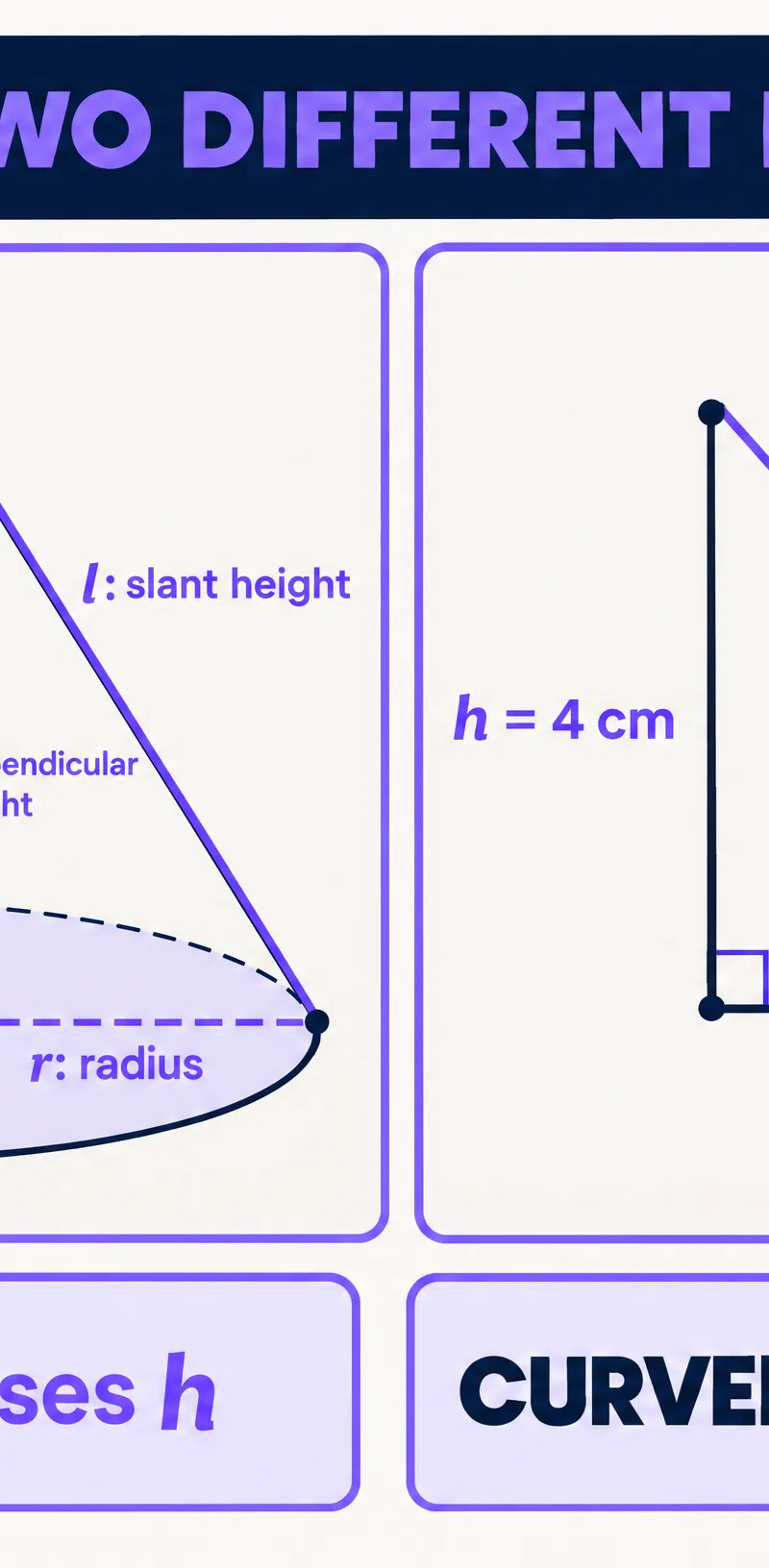
A perpendicular height meets the base at 90°. A slant height runs along a surface. These are not interchangeable. Do not infer lengths from how large a sketch looks: diagrams need not be drawn to scale.
Cover and recall: without looking at a formula, say which units belong to paint coverage and which belong to water capacity. Explain why the powers differ.
2. Spheres and hemispheres
A sphere has one continuous curved surface and no flat base. Use V = (4/3)πr³ for volume and A = 4πr² for surface area. The powers give a useful dimensional check: three length factors for volume, two for area.
Example: for r = 6 cm, V = (4/3)π × 216 = 288π cm³, while A = 4π × 36 = 144π cm². Keep these exact values unless a decimal answer is requested.
A hemisphere is half a sphere. Its volume is (2/3)πr³ and its curved area is 2πr². A separate closed hemisphere also exposes a circular base, so its total area is 2πr² + πr² = 3πr². If it forms the roof of another solid, that circle is an internal join and must not be included in the exterior area.
Why does this work? Halving a sphere halves its volume and curved surface, but cutting creates an additional flat face. Ask whether that new face is exposed in the question.
3. Cones: perpendicular height versus slant height
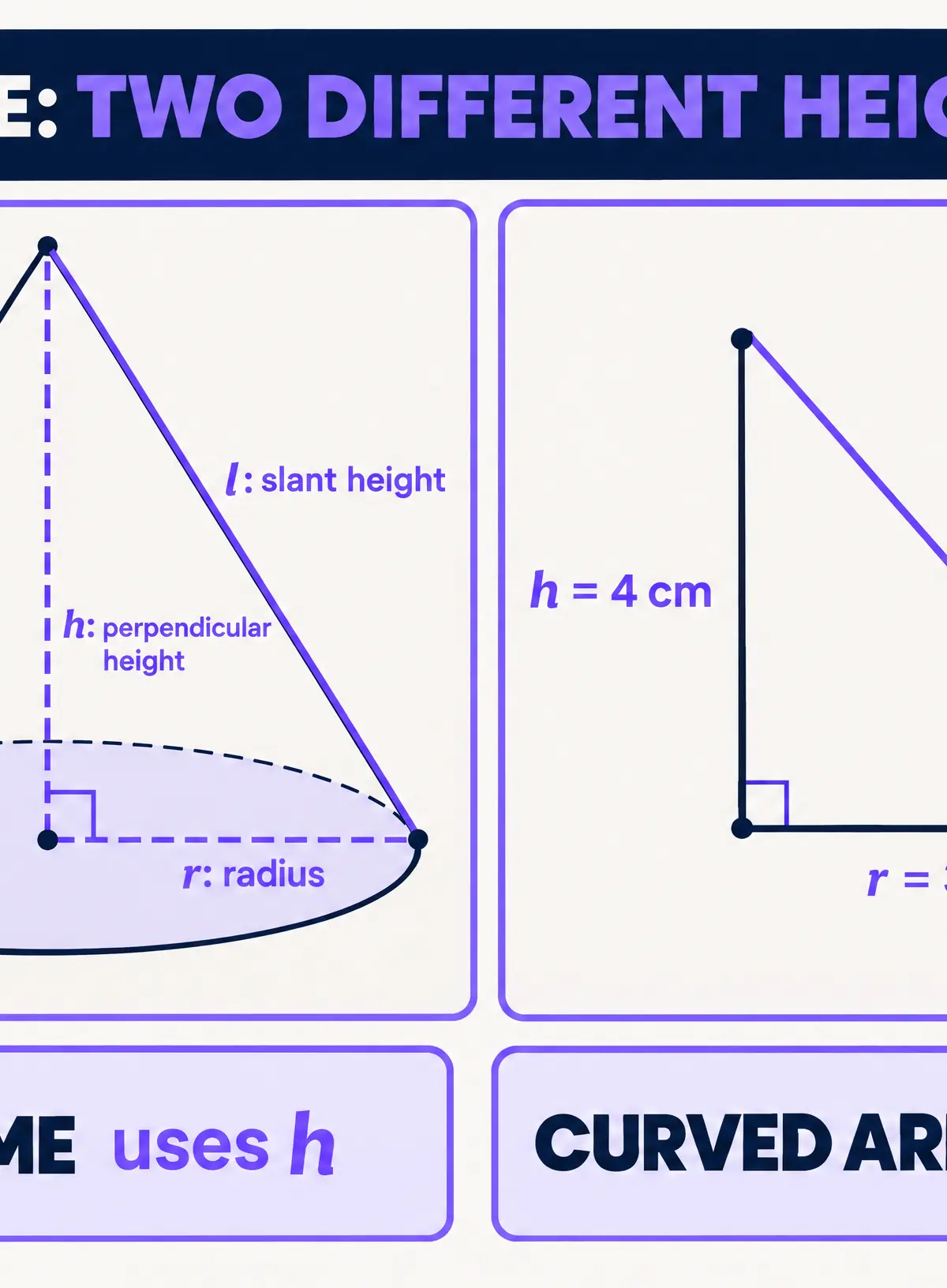
For a right circular cone, V = (1/3)πr²h, where h is perpendicular height. The matching cylinder has volume πr²h; the cone occupies one third of that volume. The one-third factor is a geometric result, not a reason to divide every surface area by three.
Curved surface area is πrl, where l is slant height. A cone's curved surface opens into a sector, so the distance along the slope matters when covering it. For a closed cone, add the circular base: A = πrl + πr². For an open cone-shaped container, include only the surfaces specified, not an imaginary lid.
In the right-angled section through the apex and base centre, l² = r² + h². With r = 3 cm and h = 4 cm, l = 5 cm. Volume is 12π cm³, curved area is 15π cm² and total area is 24π cm². State which quantity you calculated.
What if? If r stays fixed and h increases, volume increases in direct proportion to h. Curved area also changes because l changes, but not in the same direct proportion.
4. Pyramids: base first, then faces
For any pyramid, V = (1/3)Bh, where B is base area and h is perpendicular height. A rectangular base measuring 8 cm by 6 cm has B = 48 cm². With h = 9 cm, V = 144 cm³. The base need not be square: use the actual polygon's area.
Surface area means base area plus the areas of all triangular faces. For each triangle use half × base × perpendicular height within that face. In a right square-based pyramid, the face height runs from apex to midpoint of a base edge. The slant edge runs to a corner; the vertical height runs to the base centre. These are three different lengths.
If a square base has side s and each triangular face has height t, total area is s² + 4(½st) = s² + 2st. With s = 10 cm and t = 13 cm, this is 100 + 260 = 360 cm². Do not assume a rectangular-based pyramid has four identical faces. If deriving lengths needs a genuinely 3D argument, treat that as a Higher extension.
5. Composite solids: add space, count exposed surfaces
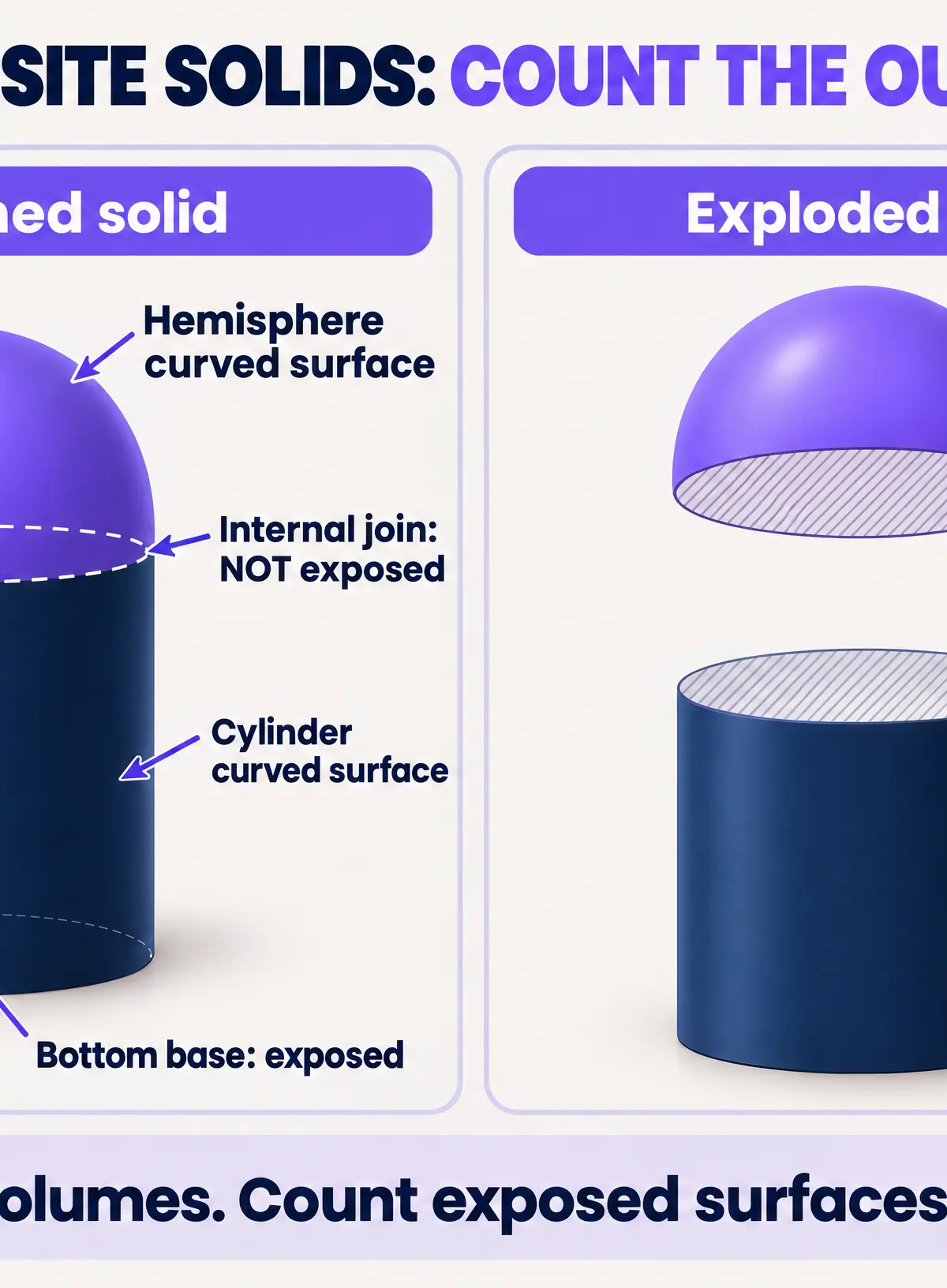
Break a composite into familiar solids and label every component. Add volumes of non-overlapping joined parts; subtract volumes of holes or removed sections. This works because volume measures occupied space. A hollow spherical shell, for example, has volume (4/3)π(R³ − r³), using outer radius R and inner radius r.
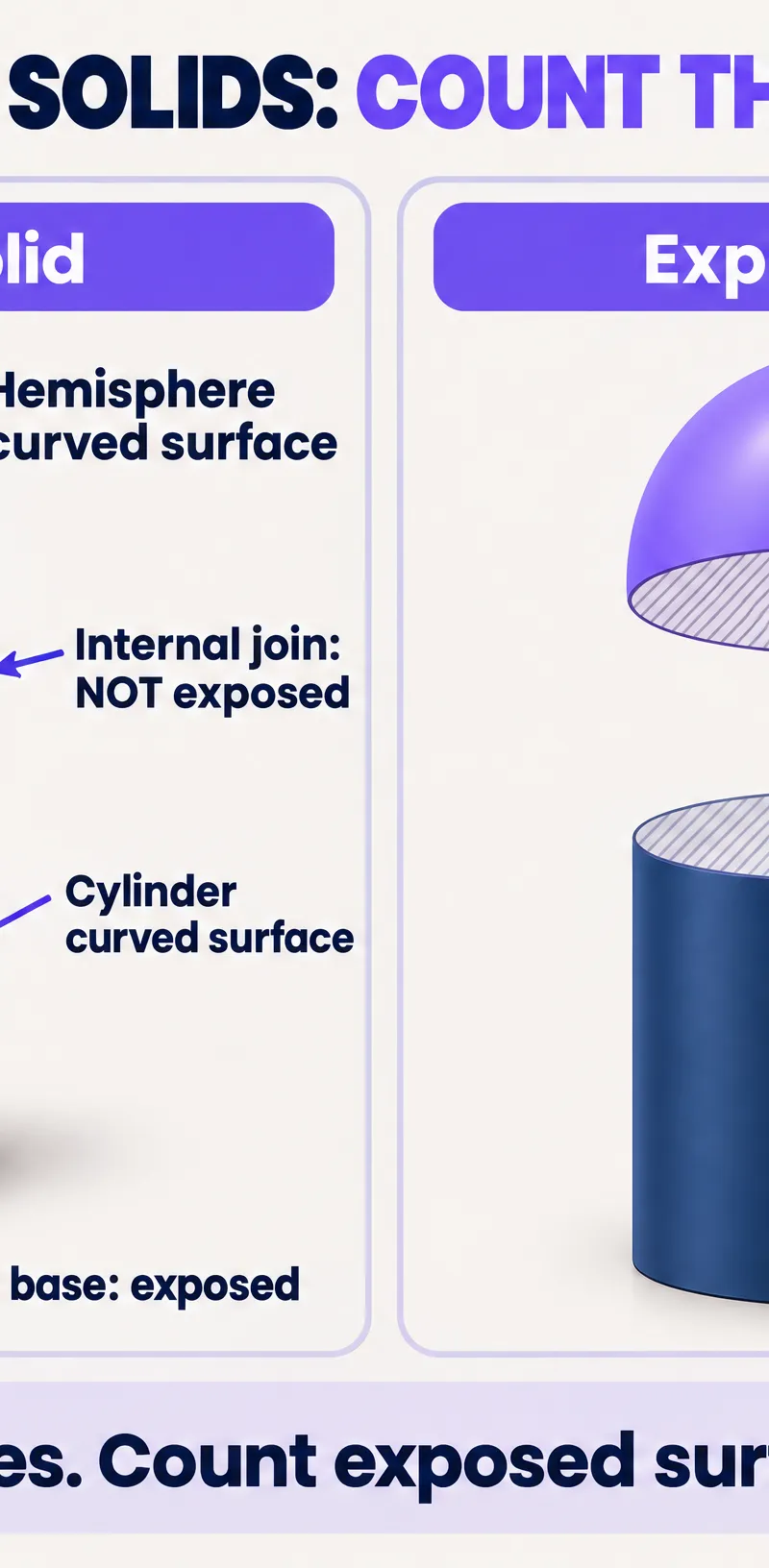
Surface area needs a different checklist. Identify every surface exposed in the requested context. For a cylinder topped by a hemisphere of matching radius, the outside consists of the cylinder's curved surface, the hemisphere's curved surface and the bottom circle. The two joining circles are internal.
With r = 4 cm and cylinder height 10 cm, outside area is 2π × 4 × 10 + 2π × 4² + π × 4² = 128π cm². Starting from complete component surface areas also works, but subtract twice the shared face area: each component counted its own copy.
A hollow or open object may expose inner surfaces and cut rims as well as outer surfaces. For an annular rim, subtract inner circle area from outer circle area. Read whether the question asks for exterior paint, all material surfaces, or just one curved surface.
Cover and recall: sketch the cylinder and hemisphere, then cross out the hidden circles before writing any formula.
6. Frustums and reverse problems
A frustum is what remains when a cone or pyramid is cut parallel to its base. Find volume as complete large solid minus complete small solid. If similar complete cones have radii 6 cm and 3 cm, their perpendicular heights have ratio 2:1. When the large height is 12 cm, the small height is 6 cm; the frustum height is their difference, 6 cm.
Their volumes are 144π and 18π cm³, so the frustum volume is 126π cm³. The frustum height alone is not the height of either complete cone. Its curved area is large cone curved area minus small cone curved area; add both exposed end circles for a closed frustum.
Reverse problems reward algebra. From V = (1/3)πr²h, obtain h = 3V/(πr²). From sphere surface area A = 4πr², obtain r = √(A/(4π)). If solids are melted and recast without loss, equate volumes, not surface areas. The number of complete new objects must be a whole number.
Mathematical Relationships and Formula Availability
For 2027, the insert supplies circle area/circumference, prism volume and Pythagoras. Sphere and cone formulas are supplied in relevant questions, not on that insert. AQA teaching guidance also says pyramid formulas are supplied in relevant questions. It would be misleading to label these either “on the formula sheet” or “must memorise”, so their question-supplied status is explicit below. Understand and practise every formula even when it is provided. 2 3 4 5 6
Given on formula sheet: both tiers, 2027
- Circle: A = πr²; circumference C = 2πr = πd.
- Right prism: V = B × L, with B its constant cross-sectional area and L its length. Hence cylinder V = πr²h.
- Pythagoras: a² + b² = c² in a right triangle, with c the hypotenuse. Hence cone l = √(r² + h²) in the labelled right section.
- Trapezium: A = ½(a + b)h, useful if a base or cross-section is trapezoidal.
Given in relevant question; not on formula sheet; not required to memorise
- Sphere: V = (4/3)πr³ and A = 4πr².
- Cone: V = (1/3)πr²h and curved A = πrl.
- Pyramid: V = (1/3)Bh. Calculate triangular faces using their labelled dimensions when surface area is required.
Must memorise or be able to derive: supporting relationships
- r = d/2; rectangle A = ab; triangle A = ½bt; cuboid V = abc and A = 2(ab + ac + bc).
- Cylinder curved A = 2πrh, from circumference × height; closed total A = 2πrh + 2πr².
- Cone closed total A = πrl + πr²; hemisphere V = (2/3)πr³, curved A = 2πr², closed total A = 3πr².
- Pyramid total A = B + sum of triangular face areas; right square-based pyramid A = s² + 2st.
- Composite V = sum of joined volumes or outer minus removed volume; composite A = sum of exposed areas.
- Frustum V = Vlarge − Vsmall; conical curved Afrustum = πRL − πrl, with L and l the complete cones' slant heights. Closed total adds πR² + πr². An annulus has A = π(R² − r²).
- Higher-only similar solids: length factor k gives area factor k² and volume factor k³. For capacity, 1 cm³ = 1 ml and 1,000 cm³ = 1 litre.
Here A means area, V volume, B base/cross-sectional area, r radius, h perpendicular height and l cone slant height. Letters may mean different things in the question: always read the supplied definitions.
Unit conversions and accuracy
Convert lengths first. For example, 0.12 m = 12 cm. Because area squares the length factor, 1 m² = 10,000 cm². Because volume cubes it, 1 m³ = 1,000,000 cm³. Also, 1 cm² = 100 mm² and 1 cm³ = 1,000 mm³.
On Paper 1, simplify coefficients of π exactly. On calculator Papers 2 and 3, use the π key, keep full intermediate precision and round only the final line. For example, 24π cm² = 75.4 cm² to three significant figures, not 75.4 cm³. A correct numerical value with the wrong quantity is not a complete response.
Exam Method and Practical Applications
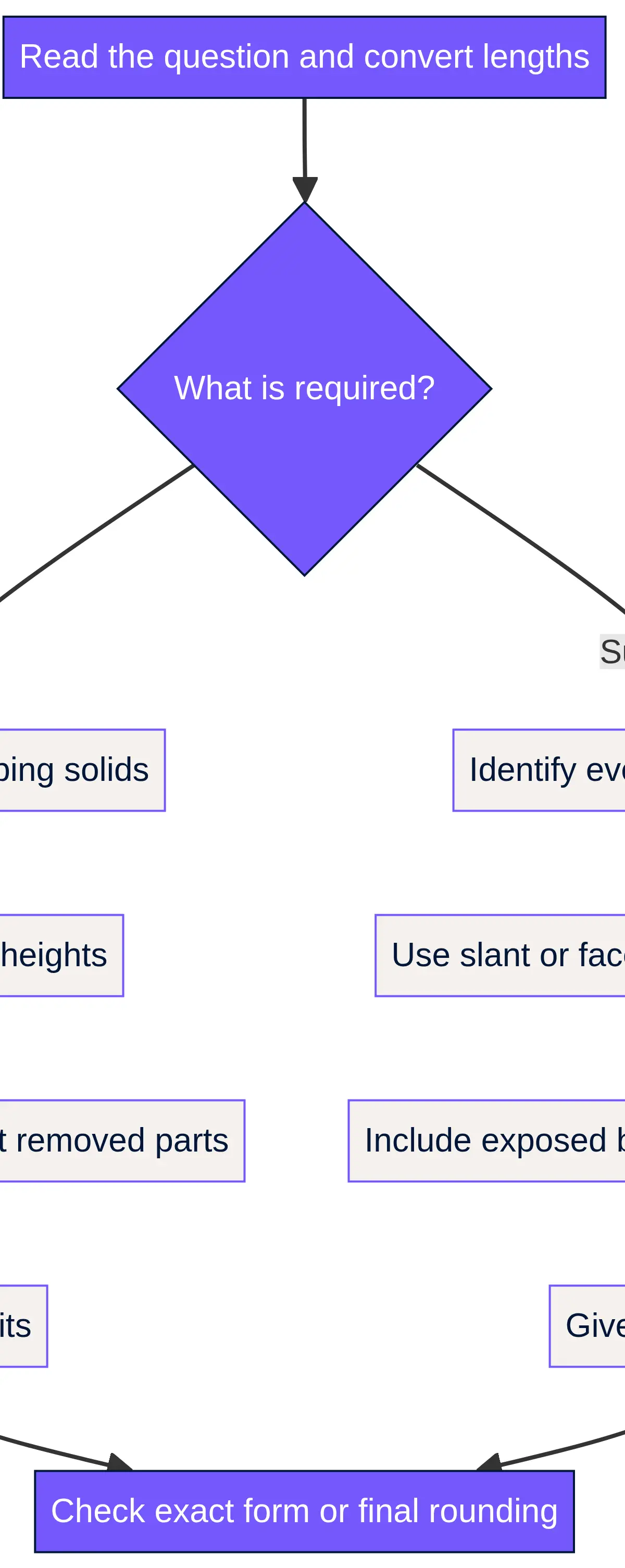
Use SPLIT: Sketch and label; Put lengths in one unit; List required components; Insert formulas and calculate; Total and check. Candidates should leave enough working for the examiner to identify a valid method even after an arithmetic slip. Whether follow-through credit is available depends on the actual scheme. AQA uses M, A and B marking codes; the allocations in this resource are illustrative. 9
Packaging uses surface area to estimate material and volume to estimate capacity. Painting a cone-shaped roof requires curved area only if the underside is excluded. A moulded object recast into cones conserves volume if no material is lost. State any modelling assumption given, such as negligible thickness or no wastage.
There is no required practical attached to this mathematics topic. Nor is graph plotting a core requirement here. As a Higher extension, interpreting A against r as quadratic and V against r as cubic helps explain why doubling dimensions does not double area or volume. Check axis units if a question supplies a graph or table.
Listen, Recall and Revisit
10-minute female-tutor podcast: 00:00 introduction; 01:00 core concepts; 06:00 exam tips; 08:00 recall quiz; 09:00 summary. Listen with the guide closed first, then check anything you could not recall. Redo one worked example from a blank page and attempt the practice questions before opening their model answers. Revisit missed questions tomorrow and again later in the week.
References and Download
Visual Resources
4 diagrams and illustrations
Interactive Diagrams
2 interactive diagrams to visualise key concepts
Conceptual Flow Outline
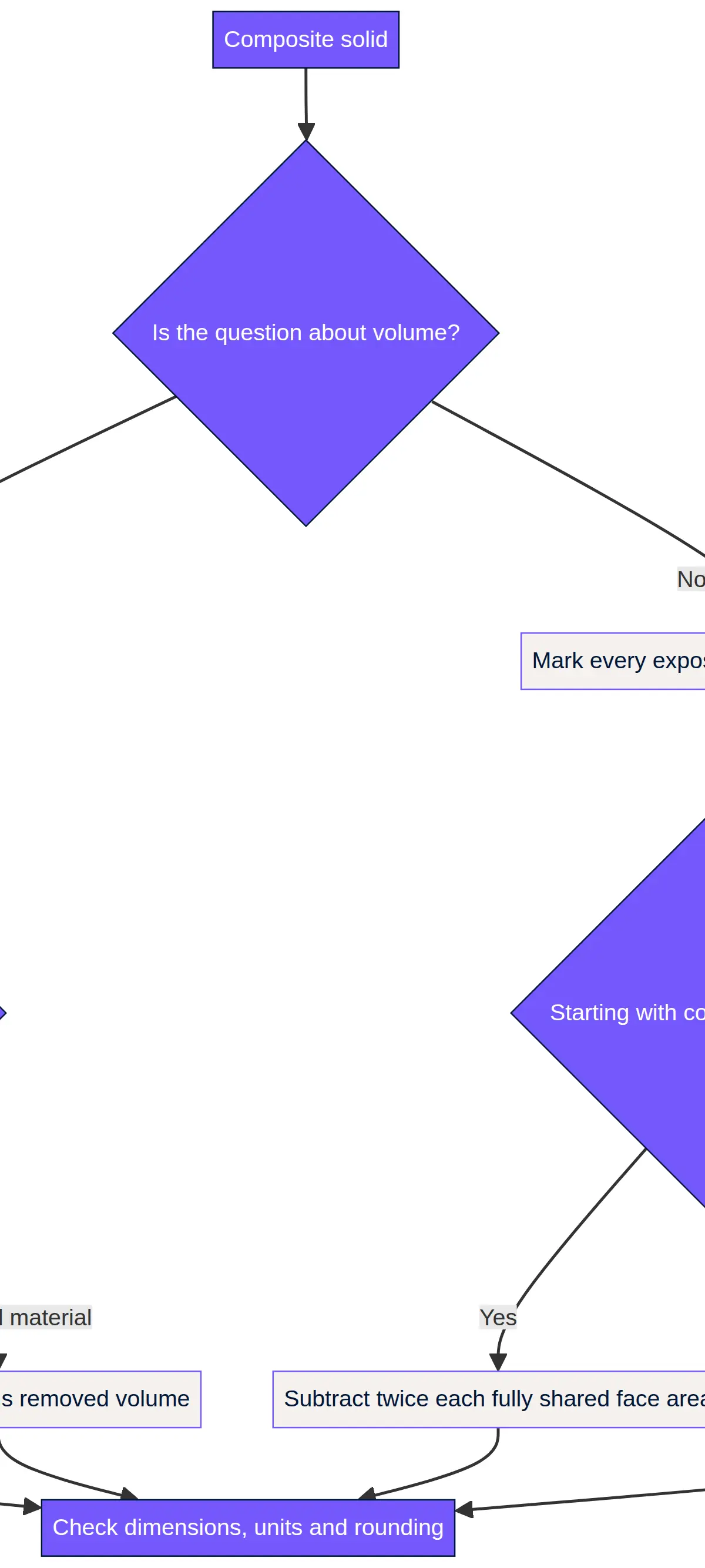
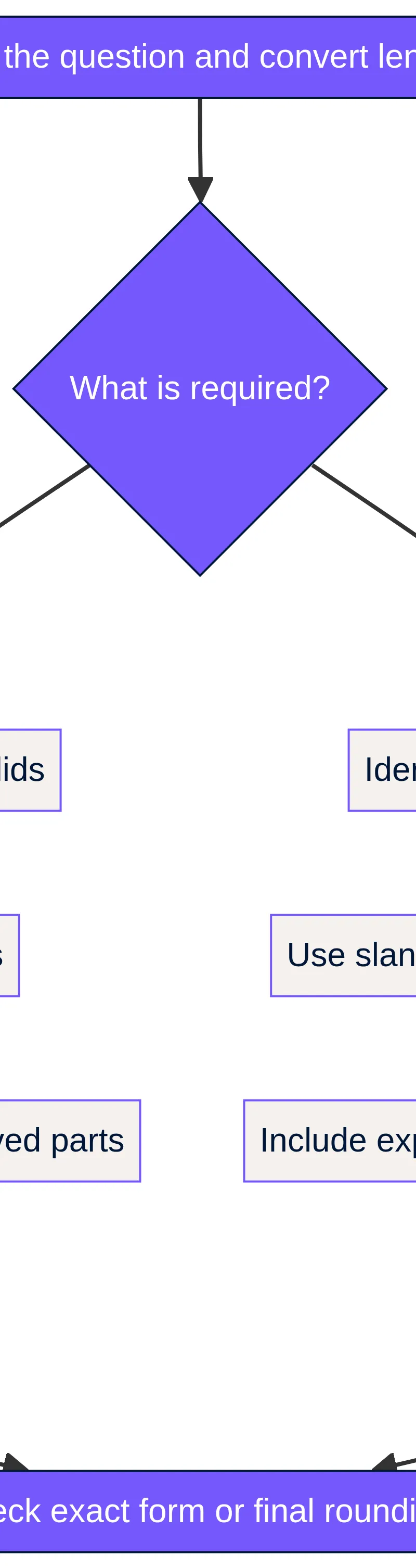
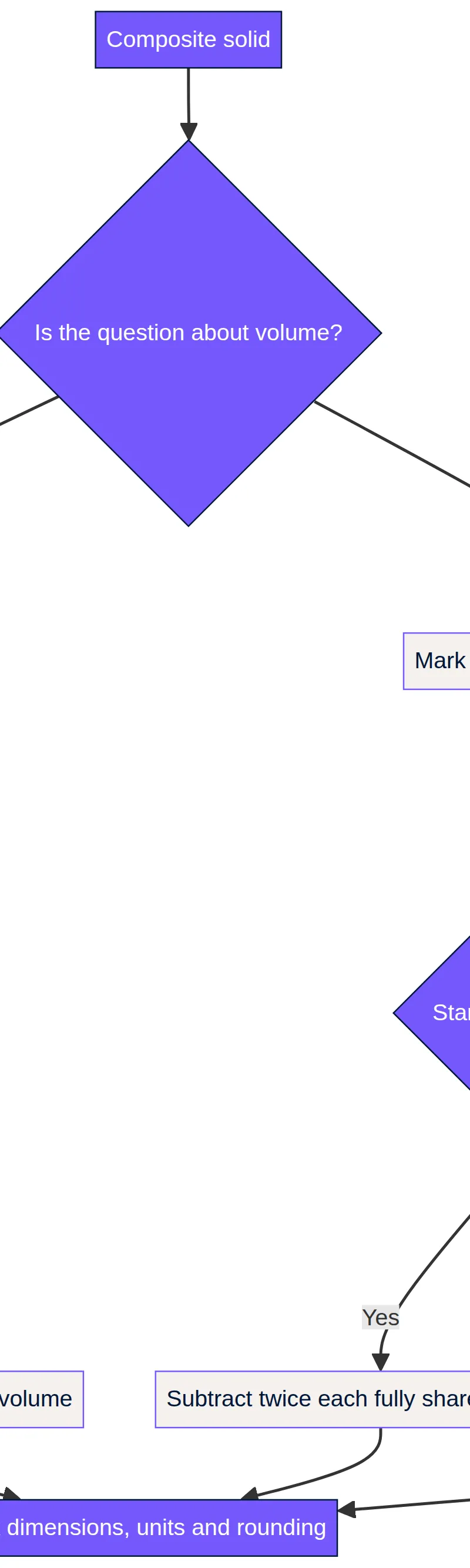
Choose a volume or surface-area route, then check the dimensions, exposed surfaces and units. {{asset:solid_method.png}}
Conceptual Flow Outline
For composite solids, add/subtract volumes but count only the required exposed surfaces. The twice-shared-face rule applies when starting from complete component areas. {{asset:composite_check.png}}
Worked Examples
5 worked examples — open one to explore the question and available guidance.
Practice Questions
Try the question, then reveal an answer plan or example response
Both tiers. A sphere has diameter 10 cm. Work out its volume to 3 significant figures. Use V = (4/3)πr³. [3 marks; calculator practice]
Hint: Identify the radius before substituting.
Both tiers. A closed cone has radius 5 cm and perpendicular height 12 cm. Its labelled central right triangle has legs 5 cm and 12 cm. Work out its total surface area in terms of π. Curved area = πrl. [4 marks]
Hint: First find the hypotenuse of the given right triangle.
Both tiers. A right square-based pyramid has base side 10 cm. Each triangular face has perpendicular height 13 cm measured within the face. Work out the total surface area. [4 marks]
Hint: There are four triangular faces and one square base.
Both tiers. A standalone closed hemisphere has radius 7 cm. Work out (a) its curved surface area and (b) its total surface area, in terms of π. Sphere area = 4πr². [3 marks]
Hint: The cut circular face is exposed in a standalone closed hemisphere.
Both tiers. A cylinder of radius 3 cm and height 8 cm is joined to a cone of the same radius and perpendicular height 4 cm. Work out the total volume in terms of π. Cone volume = (1/3)πr²h. [4 marks]
Hint: The stated heights are component heights, not the overall height.
Both tiers, challenging. A solid sphere of radius 6 cm is melted and recast into cones of radius 3 cm and perpendicular height 8 cm. No material is lost. Work out how many complete cones can be made. Use Vsphere = (4/3)πr³ and Vcone = (1/3)πr²h. [5 marks]
Hint: Compare volumes; π cancels when you divide.
Higher-only extension, G19. Two similar closed cones have small:large radius ratio 2:3. The smaller cone has total surface area 36π cm² and volume 16π cm³. Work out the larger cone's total surface area and volume. [4 marks]
Hint: Use the large-to-small length factor, then square or cube it.
Exam technique
How to turn what you know into marks
How to approach the question
Read the required quantity and answer format first. Underline radius/diameter, perpendicular/slant height and exposed/hidden surfaces. Convert lengths to one unit. Sketch components. Write each formula with substituted values, combine the required quantities and check the requested units and precision. Do not measure a sketch unless explicitly instructed.
How to structure your answer
For 1–2 marks, give the requested value or a clear short calculation. For 3–4 marks, show dimensions, substitution and the intermediate step needed before the final answer. For 5–6 marks, label separate components or parts (a)/(b), show how they combine and explain exclusions or comparisons. M1 means a method mark, A1 an accuracy mark and B1 an independent mark in AQA conventions. All schemes here are illustrative; a formula alone, units or an explanation receive marks only when the question's actual scheme awards them. Paper 1 is non-calculator; Papers 2 and 3 allow a calculator. [8] [9]
Timing
AQA gives 90 minutes for 80 marks: 67.5 seconds per mark before checking. Practise at about 1 minute per mark to leave about 10 minutes for checking. A 6-mark practice question should take about 6 minutes; the raw paper-wide allowance is 6 minutes 45 seconds. These are pacing targets, not official per-question limits. [8]
Common pitfalls
- Using diameter as radius: halve the diameter before substituting.
- Using slant height in volume: identify the 90° height from apex to base.
- Using perpendicular height in cone curved area: find l from the labelled right section or use the given slant height.
- Forgetting an exposed base or adding an imaginary one: read whether the solid is closed, open or joined.
- Counting hidden joins: sum exposed surfaces, or subtract each shared face twice from complete component areas.
- Mixing units: convert all lengths before calculating; square or cube conversion factors for finished areas or volumes.
- Rounding intermediate values or replacing π with 3.14: retain exact values or full calculator precision until the final line.
- Treating an AQA-style practice scheme as official: actual AQA mark allocations and follow-through rules are question-specific.
What the command words want
- Compare
- Calculate or identify the relevant values, then state which is larger/smaller or equal in context. Generic similarities and differences are not a substitute for the comparison. [7]
- Describe
- Use precise mathematical terminology, such as hemisphere, perpendicular height or triangular face.
- Evaluate
- For Evaluate a method/claim, a Higher-tier command, identify an error or justify why the method or claim is correct. In a numerical expression, evaluate means calculate its value. Do not write a generic pros-and-cons essay. [7]
- Show that
- Show every needed step leading to the supplied result; quoting that result does not demonstrate it. [7]
- State/Give
- Provide the information requested, including units or form where required. It is not necessarily a 1–2-word response.
- Calculate/Work out
- Carry out the necessary calculations and show a clear method unless the wording says otherwise.
- Explain/Give a reason
- Support the conclusion with a calculation or mathematical reason. Example: the joining circles are excluded because they are internal, not exposed. [7]
- You must show your working
- A correct unsupported answer does not receive the marks when this instruction applies. Make the method visible. [7]
- Give your answer in terms of π
- Simplify the coefficient and keep π exact, for example 24π cm². [7]
- Give your answer to 3 significant figures
- Keep full precision in working and round only the final answer. Leading zeros are not significant. [7]
Test your understanding of Mensuration and calculation
Active recall beats re-reading. Take an instant quiz now to test what you’ve learned and lock it into long-term memory.
7 days Premium · Then the free plan continues · No card, no charge