AQA · GCSE · Mathematics
Course version: 8300 · Version from Sept 2015
Mensuration and calculation: know the exact values of sin θ and cos θ for θ = 0°, 30°, 45°, 60° and 90° know the exact value of tan θ for θ = 0°, 30°, 45°, 60°
Exact trigonometric values are a compact set of facts that unlock precise answers without a calculator. Learn the table through special triangles, then use it confidently for right-triangle lengths, areas and exact exam calculations, with shared-tier content and Higher extensions clearly identified.
- 13 min read
- 3 worked examples
- 6 practice questions
- 8 key terms
Try the lesson
The start of the Mensuration and calculation: know the exact values of sin θ and cos θ for θ = 0°, 30°, 45°, 60° and 90° know the exact value of tan θ for θ = 0°, 30°, 45°, 60° lesson, made from checked teaching notes for this specification point.
Have a go first
Write down the exact value of sin 30°.
Listen
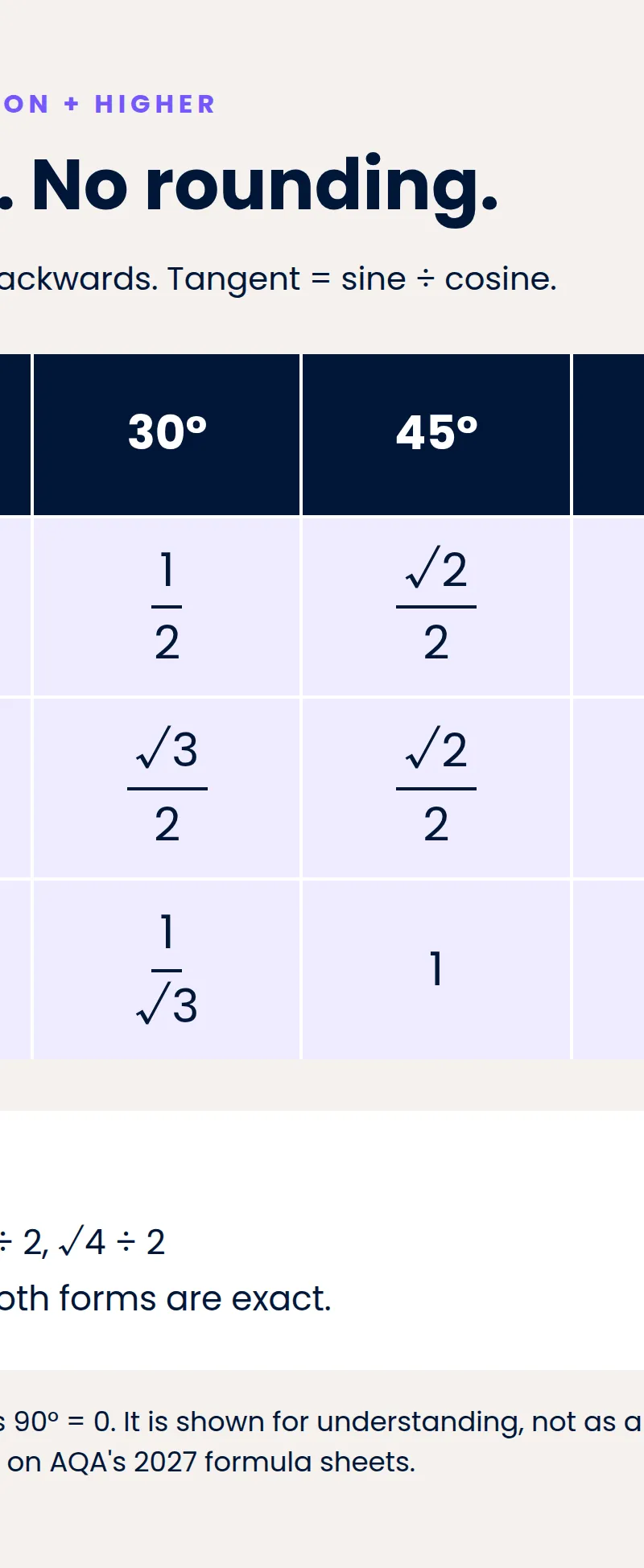
For sin θ, the exact values for 0°, 30°, 45°, 60° and 90° are 0, 1/2, √2/2, √3/2 and 1. For cos θ, the values are 1, √3/2, √2/2, 1/2 and 0. For tan θ, the values for 0°, 30°, 45° and 60° are 0, 1/√3, 1 and √3. Note that tan 90° is undefined and is not required. A reliable method is to sketch the graphs or use the special triangles: a 30°–60°–90° triangle with sides 1, √3 and 2, and a 45°–45°–90° triangle with sides 1, 1 and √2. For example, sin 30° = opposite/hypotenuse = 1/2. Always check the quadrant if the angle is not in the range 0° to 90°, but this statement only covers those angles.
There is more to this lesson
The full lesson goes on to check your understanding and help you earn the marks. Create a free account to carry on, with your progress saved.
7 days Premium · Then the free plan continues · No card, no charge
Check what you remember
Read the wording for your board, then hide it and explain exact value in your own words. Rough notes are fine. This is a self-check, with no mark or grade.
Reference: AQA
A value written without rounding, such as √3/2 or 1/2.
Study Notes
Overview
Exact trigonometric values turn familiar angles into precise answers. For 0°, 30°, 45°, 60° and 90°, you must know the sine and cosine values, and for 0°, 30°, 45° and 60°, the tangent values. This is G21, assessed at both Foundation and Higher, despite the specification describing it as Additional foundation content 1. It matters whenever a question asks for an exact length, area, proof-style simplification or multiple-choice answer: a calculator decimal can lose the precision the question demands. You will connect one right-angled-triangle ratio to surds, Pythagoras, algebraic simplification and, at Higher, general-triangle methods. Typical questions ask you to write down a value, work out an exact expression, find a missing side, show that a result is exact, or explain an error. Treat the values as a small, dependable toolkit rather than five disconnected facts. The special triangles explain the table; the table then saves time in the exam.
Key Concepts
Required angles and the exact-value table
Scope. The required angles are in degrees. G21 requires sin and cos at 0°, 30°, 45°, 60°, 90°, and tan at 0°, 30°, 45°, 60°. tan 90° is undefined, so it is neither zero nor infinity and is not a required table value 1. Use degree mode when a calculator question contains °. G21 is shared by both tiers. Here, foundation difficulty means an accessible question style, not Foundation-tier-only content.
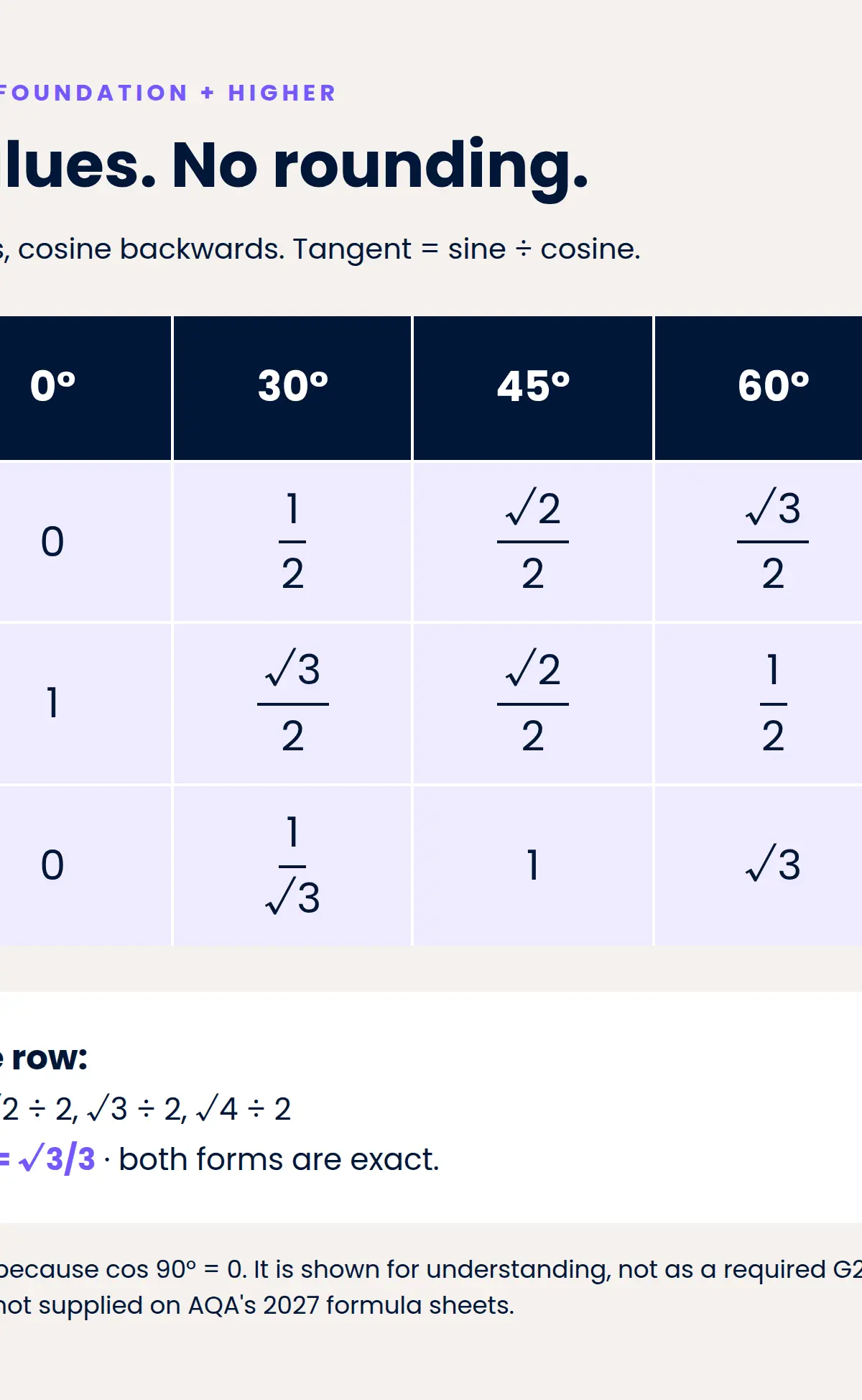
| θ | 0° | 30° | 45° | 60° | 90° |
|---|---|---|---|---|---|
| sin θ | 0 | 1/2 | √2/2 | √3/2 | 1 |
| cos θ | 1 | √3/2 | √2/2 | 1/2 | 0 |
| tan θ | 0 | 1/√3 | 1 | √3 | undefined, not required |
The sin row rises from 0 to 1; the cos row falls from 1 to 0. In particular, sin 30° = cos 60° = 1/2 and sin 60° = cos 30° = √3/2. Read the matching column before choosing a value. 1/√3 and √3/3 are equivalent forms of tan 30°; the former matches the table. In an MCQ, decimal options are not automatically wrong: 0.5 is exactly 1/2, as are 0 and 1. A rounded value such as 0.87 is not an exact replacement for √3/2.
Ratios, special triangles and endpoints
For an acute angle θ in a right-angled triangle, name sides relative to θ, not by where they happen to be drawn. The hypotenuse is opposite the right angle and is always longest. SOHCAHTOA chooses the correct ratio: sin uses opposite and hypotenuse, cos uses adjacent and hypotenuse, tan uses opposite and adjacent.
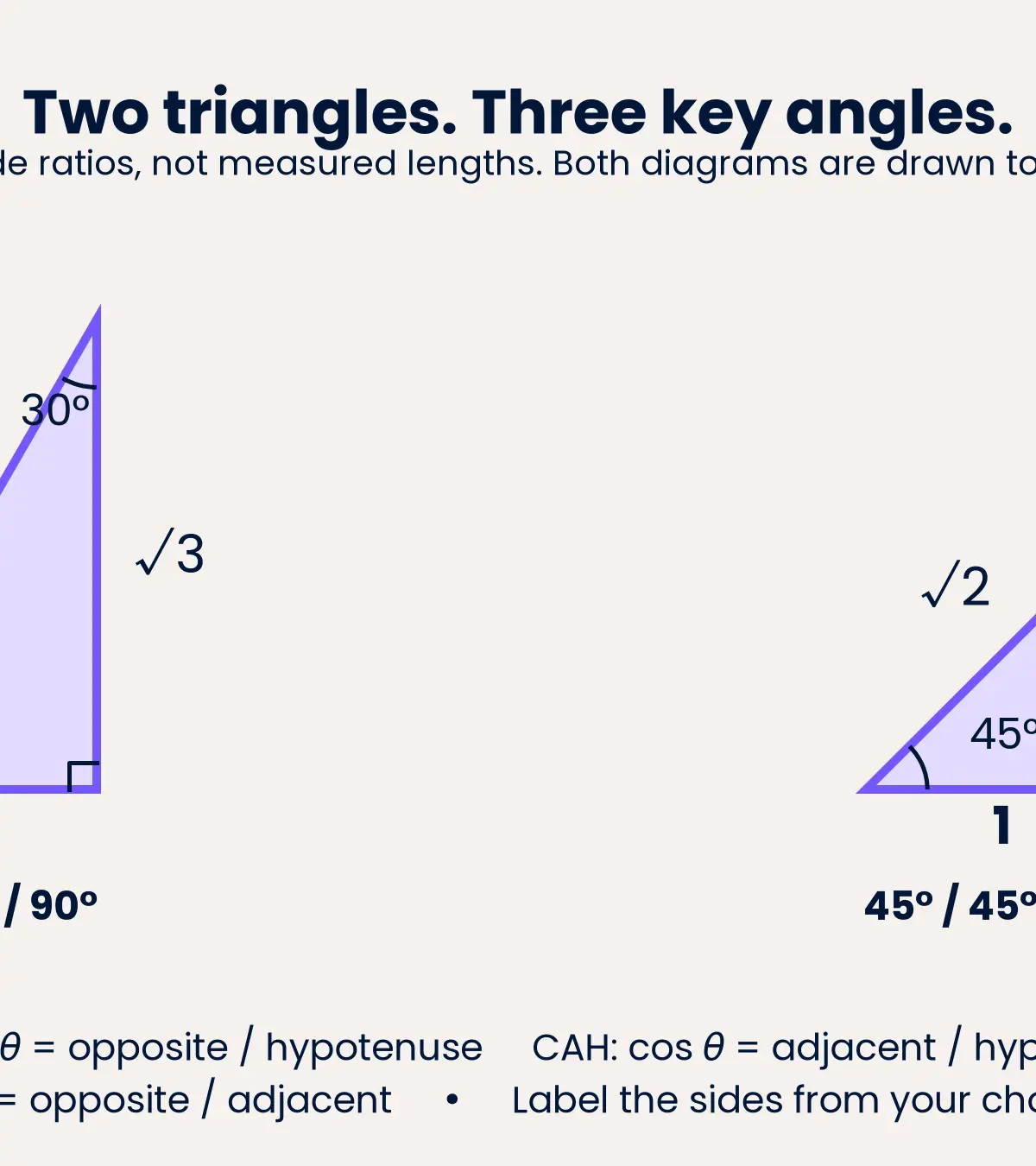
Derive 45°. Start with an isosceles right triangle whose two shorter sides are 1 and 1. Pythagoras gives hypotenuse √2. Therefore sin 45° = cos 45° = 1/√2, written as √2/2 after rationalisation, and tan 45° = 1/1 = 1.
Derive 30° and 60°. Split an equilateral triangle of side 2 down the middle. One half has hypotenuse 2, short side 1 and other side √3 by Pythagoras: it is a 30°-60°-90° triangle. At 30°, sin = 1/2, cos = √3/2 and tan = 1/√3. At 60°, the opposite and adjacent swap, so sin = √3/2, cos = 1/2 and tan = √3. This gives a reasoned rebuild if you forget a table entry.
A normal right triangle cannot represent the endpoints: at 0° or 90° it would collapse. Use the unit-circle endpoint interpretation instead. A point at angle θ has horizontal coordinate cos θ and vertical coordinate sin θ. At 0° it is (1, 0), giving cos 0° = 1 and sin 0° = 0; at 90° it is (0, 1), giving cos 90° = 0 and sin 90° = 1. Since tan θ = sin θ/cos θ, tan 90° would require division by zero, so it is undefined. This is not evidence that tan 90° is a very large number.
Mathematical Relationships and Formula-Sheet Status
Only relationships used here or linked to the stated extensions are listed. The 2027 inserts supply some tools, but not the exact-value table 3 4 5.
| Relationship | Meaning and use | Status |
|---|---|---|
| a² + b² = c² | Right triangle with hypotenuse c; build special-triangle sides. | Given on formula sheet (2027; Foundation and Higher) 4 5 |
| sin θ = opposite/hypotenuse; cos θ = adjacent/hypotenuse; tan θ = opposite/adjacent | SOHCAHTOA for a right triangle. | Given on formula sheet (2027; Foundation and Higher) 4 5 |
| Exact-value table above | Required G21 values. | Must memorise (not given) 4 5 |
| tan θ = sin θ/cos θ | Explains and checks tangent values, including undefined tan 90°. | Must memorise (not given; an identity you can reconstruct) 5 |
| sin(90° − θ) = cos θ and cos(90° − θ) = sin θ | Complementary acute angles exchange opposite and adjacent. | Must memorise (not given; a reconstruction aid, not a claim that every identity is separately demanded by G21) 5 |
| area of triangle = 1/2 × base × perpendicular height | Needed for the right-triangle area example. | Must memorise (not given) 4 5 |
| area = 1/2 ab sin C | General triangle area, where C is included angle. | Given on formula sheet (2027; Higher only) 5; G23 Higher-only extension, not G21 |
| a/sin A = b/sin B = c/sin C | Sine rule; a, b, c lie opposite A, B, C in a general triangle. | Given on formula sheet (2027; Higher only) 5; G22 extension |
| a² = b² + c² − 2bc cos A | Cosine rule; angle A is between sides b and c. | Given on formula sheet (2027; Higher only) 5; G22 extension |
| sin² θ + cos² θ = 1 | Optional check, for example (1/2)² + (√3/2)² = 1. | Must memorise (not given; enrichment, not a separately G21-required identity) 5 |
Rationalising a surd denominator, for example 1/√3 = √3/3, is algebraic N8 Higher-only content 7. It helps present equivalent forms, but the shared G21 value tan 30° may be recalled as 1/√3. Higher-only sine and cosine rules are supplied on the insert but are not used in G21 calculations 5.
Worked Method and Illustrative Examples
Every original example, practice question and mark allocation below is an illustrative teaching scheme, not an official AQA mark scheme. Questions are AQA-style, not reproduced past-paper questions. The worked examples carry 3, 4 and 6 marks with suggested working times of about 3, 4 and 6 minutes. It shows where clear working could earn credit; candidates should still answer the exact question set.
Example 1: basic exact arithmetic, 3 marks
Question: Work out exactly sin 30° + cos 60°.
Solution. 1. sin 30° = 1/2. [1 mark]
2. cos 60° = 1/2. [1 mark]
3. 1/2 + 1/2 = 1. [1 mark]
Examiner commentary. The values must be from the correct rows and columns. Writing 0.5 + 0.5 reaches the same exact number, but fractions make the exact reasoning visible.
Example 2: a 30° right triangle, 4 marks
Higher-style exact-surd application: G21 recall is shared; calculating exactly with surds extends into N8 Higher content 7.
Question: Calculate the two shorter sides of a right-angled triangle with hypotenuse 12 cm and angle 30°. Give exact answers.
Solution. 1. Opposite side = 12 sin 30°. [1 mark]
2. = 12 × 1/2 = 6 cm. [1 mark]
3. Adjacent side = 12 cos 30°. [1 mark]
4. = 12 × √3/2 = 6√3 cm. [1 mark]
Examiner commentary. Assign opposite and adjacent relative to the labelled 30° angle. Keep cm on lengths. A candidate who swaps sin and cos gets the two answers reversed.
Example 3: challenging linked measures, 6 marks
Higher-style exact-surd application: the right-triangle method is shared, but manipulating exact surd answers links to Higher N8 7.
Question: A right-angled triangle has an angle of 60° and adjacent side 6 cm. Work out its perimeter and area exactly.
Solution.
- tan 60° = opposite/adjacent, so opposite = 6 tan 60°. [1 mark]
- Opposite = 6√3 cm. [1 mark]
- cos 60° = adjacent/hypotenuse, so hypotenuse = 6 ÷ (1/2). [1 mark]
- Hypotenuse = 12 cm. [1 mark]
- Perimeter = 6 + 6√3 + 12 = 18 + 6√3 cm. [1 mark]
- Area = 1/2 × 6 × 6√3 = 18√3 cm². [1 mark]
Examiner commentary. Each mark rewards a different mathematical step, not a duplicate statement. Perimeter has cm; area has cm².
A genuine comparison point is AQA November 2022 Higher Paper 1, 8300/1H, Question 23, worth four marks. The AQA-authored mark scheme gives M1 for a relevant exact ratio, dependent M1 for correct substitution into 4 sin 30 tan 30 cos 30, A1 for obtaining 1 with values seen, and final A1 for 90; tan 30° as 1/√3 or √3/3 was accepted 6. This is authentic assessment information, not a template to copy into every answer.
Listen and retrieve: the 10-minute tutor podcast
Introduction 00:00; core concepts 01:00; exam tips 06:00; recall quiz 08:00; summary 09:00. Answer aloud before the tutor reveals each quiz response.
Practical Applications
A ladder makes a 60° angle with level ground. If the ladder is 4 m long, its horizontal distance from the wall is 4 cos 60° = 2 m. Its vertical height is 4 sin 60° = 2√3 m, an exact-surd Higher application. The ground distance is adjacent to the given angle, not opposite it. In an exam, a correctly labelled sketch avoids selecting the wrong ratio. A diagram need not be drawn to scale, so never measure a printed side to replace calculation.
A roof cross-section with a 45° pitch is an isosceles right triangle: height and horizontal run are equal because tan 45° = 1. With run 3 m, its rise is also 3 m. If asked for the sloping length exactly, Pythagoras gives 3√2 m. This context links angle information to a length without changing the underlying ratios. Real measurements are approximate, but a question can define idealised angles and lengths exactly. Follow the precision the question requests.
Cover and recall: explain why doubling a ladder's length doubles both horizontal distance and height without changing sine or cosine. Then explain why a 60° ladder reaches higher than a 30° ladder of the same length. Check: the ratios depend on angle, not size, and sin 60° is greater than sin 30°.
Exam Discipline, Units and Extensions
AQA papers are each 90 minutes for 80 marks: 67.5 seconds per mark on average 2. In timed practice, plan about one minute per mark, then use the remaining time to check. It is a sensible practice plan, not an AQA per-question time rule. For one mark, write the requested exact value. For two or three marks, state the ratio or substitution, then simplify. For Show that, retain exact working so the stated result follows. For Explain, use a reason such as “because cos 90° = 0, this divides by zero”. Simplify asks for an equivalent clean exact form. Work out or Calculate requires computation and visible working. Write down, State and Give need only the requested fact. In maths, if Evaluate appears, it means compute an expression, not balanced judgement; this guide uses no invented command meanings.
Convert units before calculating: 1 m = 100 cm, so use one length unit throughout. A perimeter is in a length unit, while an area is in a squared unit: 1 m² = 10,000 cm². Trigonometric ratios themselves have no units. There is no required practical for this topic.
A12 Higher-only graph-reading extension, not G21. Full sine, cosine and tangent graphs are A12 Higher-only 8. If reading such a graph, use labelled axes and a sensible scale, then identify intercepts, turning points or asymptotes only where the graph topic requires them. For a focused sketch between 0° and 90°, plot the five known angles on a degree-labelled horizontal axis and the exact ratios on the vertical axis. Join with a smooth curve, not straight segments. Sine increases and cosine decreases, meeting at (45°, √2/2). Their curves are not straight lines: sine is concave down and cosine changes slope through the interval. For tangent, plot 0°, 30°, 45° and 60°; draw an increasing curve approaching, but never touching, the vertical asymptote θ = 90°. Do not plot a finite point for tan 90°. This is a Higher graph extension, not extra G21 recall. The endpoint values can be interpreted on the unit circle, but 0° and 90° do not make ordinary, non-degenerate right triangles. G22/G23 Higher-only extensions use sine rule, cosine rule and 1/2 ab sin C for non-right-angled general triangles; do not substitute them for SOHCAHTOA in a right triangle.
References
Visual Resources
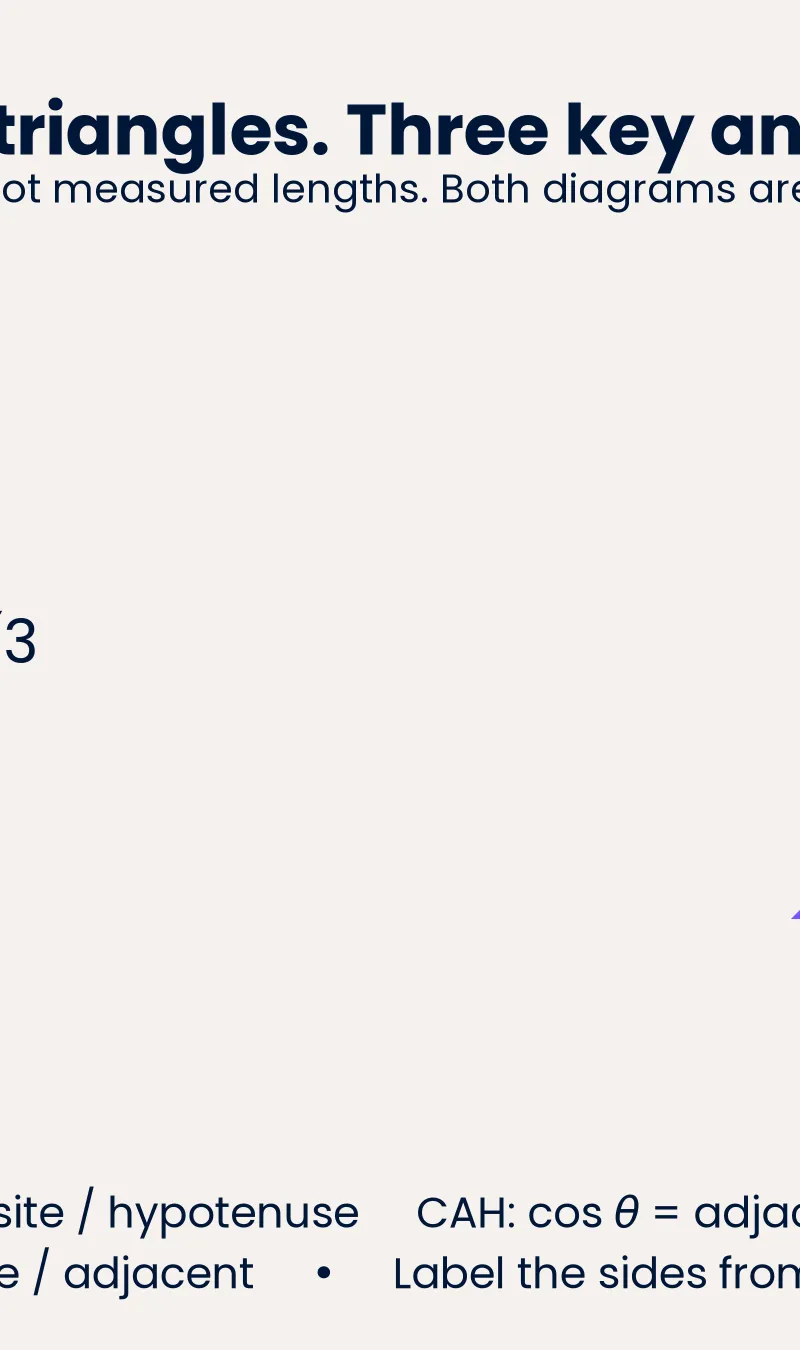
2 diagrams and illustrations
Interactive Diagrams
2 interactive diagrams to visualise key concepts
Conceptual Flow Outline
A fast decision path for an exact-value question. Trigonometric ratios themselves have no units.
Conceptual Flow Outline
How the 30° special triangle produces all three exact ratios.
Worked Examples
3 worked examples — open one to explore the question and available guidance.
Practice Questions
Try the question, then reveal an answer plan or example response
Write down sin 45°, cos 30° and tan 60°. These G21 values are required at both tiers.
Hint: Use one different row of the table for each requested value.
Work out exactly 2 sin 30° + tan 45°.
Hint: Substitute the two exact values before adding.
A right-angled triangle has hypotenuse 10 cm and an angle of 60°. Calculate the adjacent side exactly.
Hint: Adjacent and hypotenuse indicate cosine.
Higher-only N8 extension: Rationalise the denominator in tan 30° = 1/√3.
Hint: Multiply numerator and denominator by √3.
Explain the error in the statement “tan 30° = √3 because the special triangle has sides 1, √3 and 2”.
Hint: Choose opposite and adjacent relative to the 30° angle, not the 60° angle.
Higher-only G23 extension: Two sides of a triangle are 8 cm and 5 cm, with included angle 30°. Calculate its area exactly.
Hint: Use the supplied Higher formula area = 1/2 ab sin C.
Exam technique
How to turn what you know into marks
How to approach the question
Underline ‘exact’, identify the angle and trig function, read the matching table entry or choose SOHCAHTOA, substitute before simplifying, and finish with appropriate units for a measure. Identify the reference angle before labelling opposite and adjacent.
How to structure your answer
For recall, give the requested exact value. For calculations, show the chosen ratio or substitution and then simplify. For show that, preserve exact forms so the conclusion follows. For explain, give a mathematical reason using because. All original mark allocations in this guide are illustrative teaching schemes.
Timing
Each AQA GCSE Mathematics paper is 90 minutes for 80 marks, an average of 67.5 seconds per mark. In practice, one minute per mark leaves checking time. Aim for about 3, 4 and 6 minutes for the worked examples; this is not an official AQA per-question limit.
Common pitfalls
- Reversing 30° and 60°: cross-check that the sin row rises and the cos row falls.
- Writing tan 30° = √3: tan 30° = 1/√3, while tan 60° = √3.
- Giving tan 90° a number: tan θ = sin θ/cos θ would divide by zero at 90°, so it is undefined.
- Replacing an exact surd with a rounded decimal: 0.5 is exact, but 0.87 is only an approximation to √3/2.
- Using the wrong reference angle: opposite and adjacent swap when you change from one acute angle to the other.
- Writing cm² for a side length or cm for an area: lengths and perimeters use length units; areas use squared units.
What the command words want
- Explain
- Use a linked mathematical reason, for example ‘tan 90° is undefined because cos 90° = 0 and this makes a zero denominator’.
- Evaluate
- In mathematics this means calculate the value of an expression, not discuss advantages and disadvantages.
- Simplify
- Write an equivalent clean exact form. Where rationalisation is requested, remove the surd from the denominator without changing the value.
- Show that
- Make each exact step visible so the given conclusion follows. Do not simply copy the answer you are asked to show.
- Work out / Calculate
- Compute the expression. State the ratio or substitution, then simplify exactly and give units for lengths or areas.
- Write down / State / Give
- Supply the requested exact fact directly, for example sin 45° = √2/2. Do not add unnecessary decimal working.
Test your understanding of Mensuration and calculation: know the exact values of sin θ and cos θ for θ = 0°, 30°, 45°, 60° and 90° know the exact value of tan θ for θ = 0°, 30°, 45°, 60°
Active recall beats re-reading. Take an instant quiz now to test what you’ve learned and lock it into long-term memory.
7 days Premium · Then the free plan continues · No card, no charge