AQA · GCSE · Mathematics
Course version: 8300 · Version from Sept 2015
Sequences: deduce expressions to calculate the nth term of linear sequences
A linear sequence changes by the same amount each time.
Study notes
From the checked teaching notes for this specification point.
The idea
A linear sequence changes by the same amount each time. To deduce an expression for the nth term, first find the common difference between consecutive terms; this becomes the coefficient of n. For example, in 5, 8, 11, 14, ... the common difference is 3, so the expression starts as 3n. Compare the first term with 3 × 1 = 3; the sequence starts at 5, so add 2. The nth term is 3n + 2. Check by substituting n = 2: 3 × 2 + 2 = 8, which matches the second term. If the sequence decreases, the common difference is negative, so the coefficient of n is negative. Always test your expression with at least two term numbers to confirm it generates the given sequence.
What earns the marks
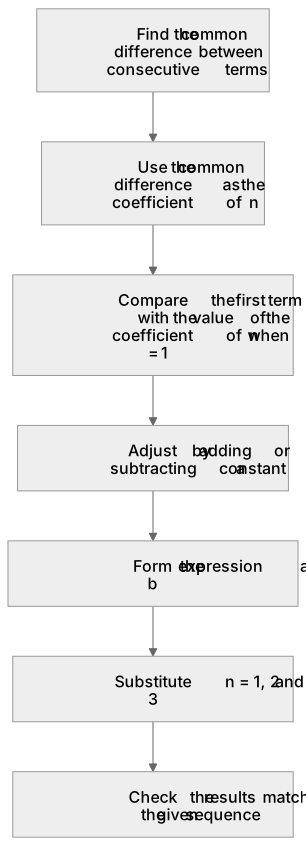
- Find the common difference between consecutive terms and use it as the coefficient of n.
- Compare the first term with the value given by the coefficient of n when n = 1, then adjust by adding or subtracting a constant.
- Form the expression in the form an + b, where a is the common difference and b is the constant adjustment.
- Verify the expression by substituting n = 1, 2 and 3 and checking the results match the given sequence.
Common mistakes and how to put them right
Writing the common difference as the constant term instead of the coefficient of n.
Put it right: The common difference belongs with n, so for 4, 7, 10, ... the expression is 3n + 1, not n + 3.
Forgetting to include the constant adjustment after finding the coefficient.
Put it right: For 2, 5, 8, ... the expression is 3n - 1, not just 3n.
Assuming the first term always equals the constant.
Put it right: The constant is found by comparing the first term with the value of an when n = 1, so it is not always the first term.
Ignoring negative common differences.
Put it right: For 10, 7, 4, ... the common difference is -3, so the expression is -3n + 13, not 3n + something.
Exam tips
- Always write down the common difference first; it immediately gives the coefficient of n.
- Substitute n = 1 into your expression and check it equals the first term before moving on.
- If the sequence decreases, double-check that you have used a negative coefficient for n.
- For multiple-choice questions, test each option with n = 1 and n = 2 rather than trying to spot the answer.
Try the lesson
The start of the Sequences: deduce expressions to calculate the nth term of linear sequences lesson, made from checked teaching notes for this specification point.
Have a go first
A linear sequence begins 4, 7, 10, 13, ... Work out an expression for the nth term of this sequence.
Listen
A linear sequence changes by the same amount each time. To deduce an expression for the nth term, first find the common difference between consecutive terms; this becomes the coefficient of n. For example, in 5, 8, 11, 14, ... the common difference is 3, so the expression starts as 3n. Compare the first term with 3 × 1 = 3; the sequence starts at 5, so add 2. The nth term is 3n + 2. Check by substituting n = 2: 3 × 2 + 2 = 8, which matches the second term. If the sequence decreases, the common difference is negative, so the coefficient of n is negative. Always test your expression with at least two term numbers to confirm it generates the given sequence. A strong answer earns marks for these points. Find the common difference between consecutive terms and use it as the coefficient of n. Compare the first term with the value given by the coefficient of n when n = 1, then adjust by adding or subtracting a constant. Form the expression in the form an + b, where a is the common difference and b is the constant adjustment. Verify the expression by substituting n = 1, 2 and 3 and checking the results match the given sequence. Exam tip: Always write down the common difference first; it immediately gives the coefficient of n.
See it
Put it in order
Put these steps in the order they happen.
- 1. Use the common difference as the coefficient of n
- 2. Compare the first term with the value of the coefficient of n when n = 1
- 3. Adjust by adding or subtracting a constant
- 4. Form the expression an + b
- 5. Substitute n = 1, 2 and 3
- 6. Check the results match the given sequence
- 7. Find the common difference between consecutive terms
Label the diagram
Some boxes have lost their names. Pick the right name for each number.
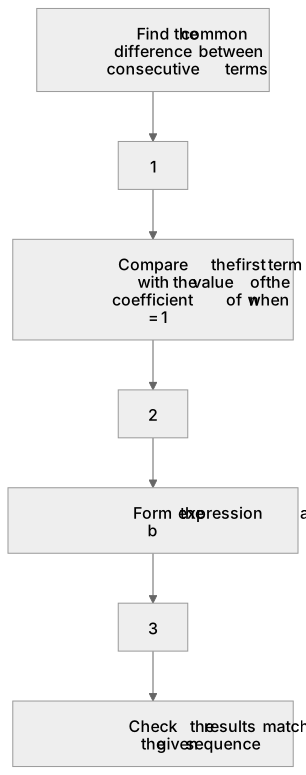
1Box 1
2Box 2
3Box 3
There is more to this lesson
The full lesson goes on to check your understanding and help you earn the marks. Create a free account to carry on, with your progress saved.
A week of Premium from your first lesson · Then the free plan continues · No card, no charge
Test your understanding of Sequences: deduce expressions to calculate the nth term of linear sequences
Active recall beats re-reading. Take an instant quiz now to test what you’ve learned and lock it into long-term memory.
A week of Premium from your first lesson · Then the free plan continues · No card, no charge