AQA · GCSE · Mathematics
Course version: 8300 · Version from Sept 2015
Sequences: generate terms of a sequence from either a term-to-term or a position-to-term rule
A sequence is an ordered list of terms.
- 3 key terms
Study notes
From the checked teaching notes for this specification point.
The idea
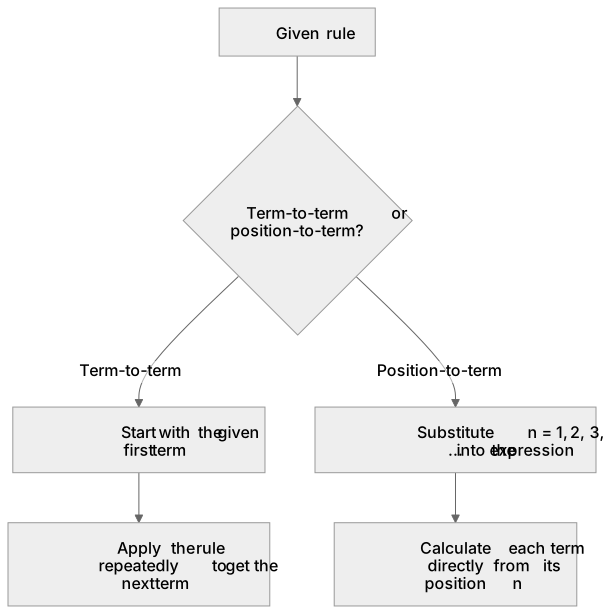
A sequence is an ordered list of terms. A term-to-term rule tells you how to get from one term to the next, for example 'add 4' or 'multiply by 2'. A position-to-term rule, often called the nth term rule, lets you calculate any term directly from its position n, for example the nth term of 3, 7, 11, 15, ... is 4n − 1. To generate terms from a term-to-term rule, start with the given first term and apply the rule repeatedly. To generate terms from a position-to-term rule, substitute n = 1, 2, 3, ... into the expression. For example, if the nth term is 5n + 2, the first three terms are 7, 12 and 17. You must be able to work in both directions and apply the correct rule.
What earns the marks
- Correctly generate terms by repeatedly applying a given term-to-term rule, such as adding or multiplying by a constant.
- Correctly generate terms by substituting n = 1, 2, 3, ... into a given position-to-term rule.
- Distinguish between a term-to-term rule and a position-to-term rule and use the appropriate method.
- Generate a specified term, such as the 10th term, directly from a position-to-term rule without listing all previous terms.
Common mistakes and how to put them right
Confusing term-to-term and position-to-term rules.
Put it right: A term-to-term rule describes the step between consecutive terms, while a position-to-term rule gives a formula in n.
Starting a position-to-term sequence at n = 0 instead of n = 1.
Put it right: The first term corresponds to n = 1, so substitute n = 1 first.
Applying a term-to-term rule to the wrong starting value, such as using the second term as the starting point when the first term is given.
Put it right: Begin with the stated first term.
Arithmetic slips when substituting into a position-to-term rule, for example calculating 4 × 3 − 1 as 8 by subtracting before multiplying, instead of the correct 11.
Put it right: Substitute carefully and follow the correct order of operations.
Exam tips
- Read the question carefully to identify whether you are given a term-to-term rule or a position-to-term rule, and use the matching method.
- For a position-to-term rule, write down the substitution for each required term, especially when the expression involves negative numbers or powers.
- Check your generated terms by testing whether they fit the rule; for a term-to-term rule, verify that the difference or ratio is consistent.
Try the lesson
The start of the Sequences: generate terms of a sequence from either a term-to-term or a position-to-term rule lesson, made from checked teaching notes for this specification point.
Have a go first
A sequence starts at 4 and each term is found by adding 3 to the previous term. What is the 4th term of this sequence?
Listen
A sequence is an ordered list of terms. A term-to-term rule tells you how to get from one term to the next, for example 'add 4' or 'multiply by 2'. A position-to-term rule, often called the nth term rule, lets you calculate any term directly from its position n, for example the nth term of 3, 7, 11, 15, ... is 4n − 1. To generate terms from a term-to-term rule, start with the given first term and apply the rule repeatedly. To generate terms from a position-to-term rule, substitute n = 1, 2, 3, ... into the expression. For example, if the nth term is 5n + 2, the first three terms are 7, 12 and 17. You must be able to work in both directions and apply the correct rule. A strong answer earns marks for these points. Correctly generate terms by repeatedly applying a given term-to-term rule, such as adding or multiplying by a constant. Correctly generate terms by substituting n = 1, 2, 3, ... into a given position-to-term rule. Distinguish between a term-to-term rule and a position-to-term rule and use the appropriate method. Generate a specified term, such as the 10th term, directly from a position-to-term rule without listing all previous terms. A common slip: Confusing term-to-term and position-to-term rules: for example, treating 'add 3' as if it meant the nth term is 3n. Instead, a term-to-term rule describes the step between consecutive terms, while a position-to-term rule gives a formula in n. Exam tip: Read the question carefully to identify whether you are given a term-to-term rule or a position-to-term rule, and use the matching method.
See it
Key words
Say what each word means before you turn the card.
term-to-term rule
Try answering aloud or in your head before turning the card.
position-to-term rule
Try answering aloud or in your head before turning the card.
generate terms
Try answering aloud or in your head before turning the card.
See every definition
- term-to-term rule
- A rule that tells you how to get from one term to the next, for example 'add 4' or 'multiply by 2'.
- position-to-term rule
- A rule, often called the nth term rule, that lets you calculate any term directly from its position n.
- generate terms
- To produce terms from a term-to-term rule by starting with the given first term and applying the rule repeatedly, or from a position-to-term rule by substituting n = 1, 2, 3, ... into the expression.
There is more to this lesson
The full lesson goes on to check your understanding and help you earn the marks. Create a free account to carry on, with your progress saved.
A week of Premium from your first lesson · Then the free plan continues · No card, no charge
Test your understanding of Sequences: generate terms of a sequence from either a term-to-term or a position-to-term rule
Active recall beats re-reading. Take an instant quiz now to test what you’ve learned and lock it into long-term memory.
A week of Premium from your first lesson · Then the free plan continues · No card, no charge