AQA · GCSE · Mathematics
Course version: 8300 · Version from Sept 2015
Sequences: including Fibonacci-type sequences, quadratic sequences, and simple geometric progressions (rⁿ where n is an integer and r is a rational number > 0)
This row covers three sequence families.
- 4 key terms
Study notes
From the checked teaching notes for this specification point.
The idea
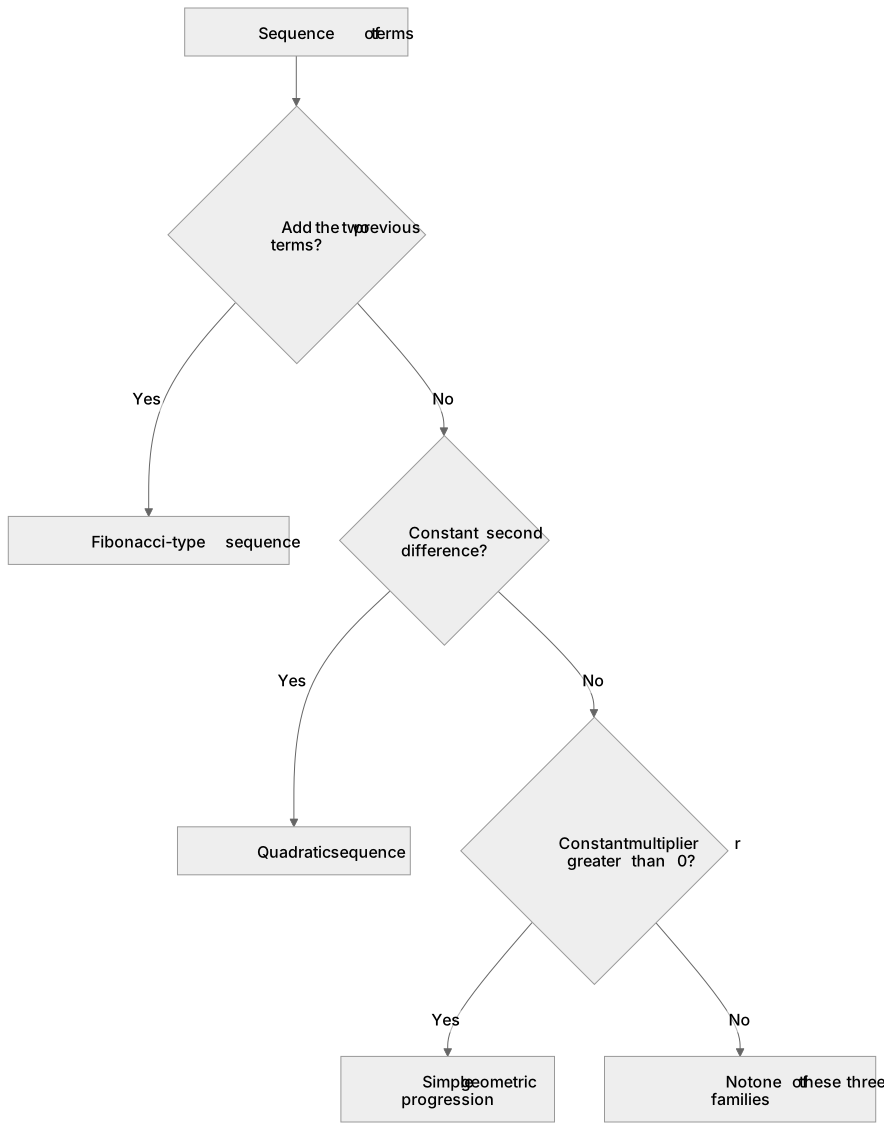
This row covers three sequence families. A Fibonacci-type sequence forms each term by adding the two previous terms, so from 2, 5 the next term is 7 and then 12; the starting terms need not be 1 and 1. A quadratic sequence has a constant second difference, for example 3, 6, 11, 18, 27 with first differences 3, 5, 7, 9 and second difference 2. A simple geometric progression multiplies by a fixed rational ratio r greater than 0, written rⁿ for integer n, so 2, 4, 8, 16 has r = 2 and nth term 2ⁿ. You must recognise each type from its terms, continue it correctly and, where asked, find a stated term in the sequence.
What earns the marks
- Recognises a Fibonacci-type sequence as one built by adding the two preceding terms, and continues it correctly from any given starting pair.
- Recognises a quadratic sequence from a constant second difference and continues the sequence to find the next terms.
- Identifies a simple geometric progression by a constant multiplier r, where r is a rational number greater than 0, and continues it by repeated multiplication.
- Uses the form rⁿ with integer n to generate or check terms of a geometric progression, including fractional ratios such as r = 1/2.
- Distinguishes the three families when several are offered, for example rejecting an arithmetic sequence as Fibonacci-type or quadratic.
- Applies the correct rule to find a named term, such as the 10th term, rather than only the next term.
Common mistakes and how to put them right
Treating any sequence with a pattern as Fibonacci-type.
Put it right: A Fibonacci-type sequence specifically adds the two previous terms, so 4, 7, 10, 13 is arithmetic, not Fibonacci-type.
Assuming every quadratic sequence has second difference 1.
Put it right: The second difference can be any non-zero constant, such as 2 or 6.
Using a constant difference for a geometric progression.
Put it right: A geometric progression has a constant multiplier r, so 2, 4, 8, 16 multiplies by 2 each time.
Allowing r to be zero or negative when the row restricts r to a rational number greater than 0.
Put it right: Check that each term is obtained by multiplying by the same positive rational value.
Exam tips
- Write the first differences, and then the second differences, before deciding whether a sequence is arithmetic, quadratic or neither.
- For a geometric progression, divide a term by the previous term to confirm the multiplier r is constant before using rⁿ.
- Check a Fibonacci-type continuation by confirming each new term equals the sum of the two terms immediately before it.
Try the lesson
The start of the Sequences: including Fibonacci-type sequences, quadratic sequences, and simple geometric progressions (rⁿ where n is an integer and r is a rational number > 0) lesson, made from checked teaching notes for this specification point.
Have a go first
A Fibonacci-type sequence starts 3, 4, 7, 11, 18, ... Each term after the second is the sum of the two previous terms. What is the next term?
Listen
This row covers three sequence families. A Fibonacci-type sequence forms each term by adding the two previous terms, so from 2, 5 the next term is 7 and then 12; the starting terms need not be 1 and 1. A quadratic sequence has a constant second difference, for example 3, 6, 11, 18, 27 with first differences 3, 5, 7, 9 and second difference 2. A simple geometric progression multiplies by a fixed rational ratio r greater than 0, written rⁿ for integer n, so 2, 4, 8, 16 has r = 2 and nth term 2ⁿ. You must recognise each type from its terms, continue it correctly and, where asked, find a stated term in the sequence. A strong answer earns marks for these points. Recognises a Fibonacci-type sequence as one built by adding the two preceding terms, and continues it correctly from any given starting pair. Recognises a quadratic sequence from a constant second difference and continues the sequence to find the next terms. Identifies a simple geometric progression by a constant multiplier r, where r is a rational number greater than 0, and continues it by repeated multiplication. Uses the form rⁿ with integer n to generate or check terms of a geometric progression, including fractional ratios such as r = 1/2. A common slip: Treating any sequence with a pattern as Fibonacci-type. Instead, a Fibonacci-type sequence specifically adds the two previous terms, so 4, 7, 10, 13 is arithmetic, not Fibonacci-type. Exam tip: Write the first differences, and then the second differences, before deciding whether a sequence is arithmetic, quadratic or neither.
See it
Key words
Say what each word means before you turn the card.
Fibonacci-type sequence
Try answering aloud or in your head before turning the card.
Quadratic sequence
Try answering aloud or in your head before turning the card.
Simple geometric progression
Try answering aloud or in your head before turning the card.
Second difference
Try answering aloud or in your head before turning the card.
See every definition
- Fibonacci-type sequence
- A sequence where each term is formed by adding the two previous terms, and the starting terms need not be 1 and 1.
- Quadratic sequence
- A sequence that has a constant second difference, which can be any non-zero constant.
- Simple geometric progression
- A sequence that multiplies by a fixed rational ratio r greater than 0, written rⁿ for integer n.
- Second difference
- The difference found after writing the first differences, which is constant for a quadratic sequence.
There is more to this lesson
The full lesson goes on to check your understanding and help you earn the marks. Create a free account to carry on, with your progress saved.
A week of Premium from your first lesson · Then the free plan continues · No card, no charge
Test your understanding of Sequences: including Fibonacci-type sequences, quadratic sequences, and simple geometric progressions (rⁿ where n is an integer and r is a rational number > 0)
Active recall beats re-reading. Take an instant quiz now to test what you’ve learned and lock it into long-term memory.
A week of Premium from your first lesson · Then the free plan continues · No card, no charge