AQA · GCSE · Mathematics
Course version: 8300 · Version from Sept 2015
Sequences: including other sequences including where r is a surd (Higher tier only)
A multiplier can be irrational while the pattern stays beautifully simple. Master exact surd arithmetic, count the jumps correctly and turn unfamiliar Higher-tier sequences into clear, mark-worthy solutions.
- 13 min read
- 3 worked examples
- 6 practice questions
- 10 key terms
Try the lesson
The start of the Sequences: including other sequences including where r is a surd (Higher tier only) lesson, made from checked teaching notes for this specification point.
Have a go first
A geometric sequence has first term 3 and common ratio √2. Work out the third term of the sequence.
Listen
This Higher tier row extends geometric work to sequences whose common ratio r is a surd, that is a square root such as \sqrt{2} or \sqrt{5} that cannot be written as a rational number. A sequence with r = \sqrt{2} might begin 1, \sqrt{2}, 2, 2\sqrt{2}, 4, because each term is the previous term multiplied by \sqrt{2}. You should recognise that the multiplier is constant, continue the sequence exactly in surd form, and simplify products such as \sqrt{2} \times \sqrt{2} = 2 and \sqrt{2} \times 2\sqrt{2} = 4. Where a term is requested, use ar^{n-1}, for example the 4th term is a \times (\sqrt{2})^3 = 2a\sqrt{2}. Keep answers in exact surd form unless a decimal approximation is asked for. A strong answer earns marks for these points. Recognises that a geometric progression may have a surd common ratio r, such as \sqrt{2} or \sqrt{3}, and that r is then irrational rather than rational. Continues a surd-ratio sequence exactly, for example 1, \sqrt{2}, 2, 2\sqrt{2}, 4 with r = \sqrt{2}. Simplifies products of surds correctly, including \sqrt{2} \times \sqrt{2} = 2 and \sqrt{3} \times \sqrt{3} = 3. Uses ar^{n-1} to find a stated term, for example the 4th term of a sequence with first term a and r = \sqrt{2} is 2a\sqrt{2}. A common slip: Treating \sqrt{2} as 1.4 and multiplying decimals. Instead, keep the exact surd and simplify, since \sqrt{2} \times \sqrt{2} = 2 exactly. Exam tip: Divide each term by the previous term to confirm the surd multiplier is constant before continuing the sequence.
See it
Put it in order
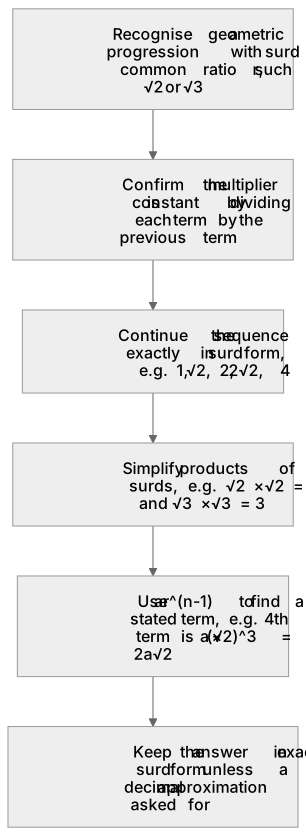
Put these steps in the order they happen.
- 1. Confirm the multiplier is constant by dividing each term by the previous term
- 2. Continue the sequence exactly in surd form, e.g. 1, √2, 2, 2√2, 4
- 3. Simplify products of surds, e.g. √2 × √2 = 2 and √3 × √3 = 3
- 4. Use ar^(n-1) to find a stated term, e.g. 4th term is a × (√2)^3 = 2a√2
- 5. Keep the answer in exact surd form unless a decimal approximation is asked for
- 6. Recognise a geometric progression with surd common ratio r, such as √2 or √3
Label the diagram
Some boxes have lost their names. Pick the right name for each number.
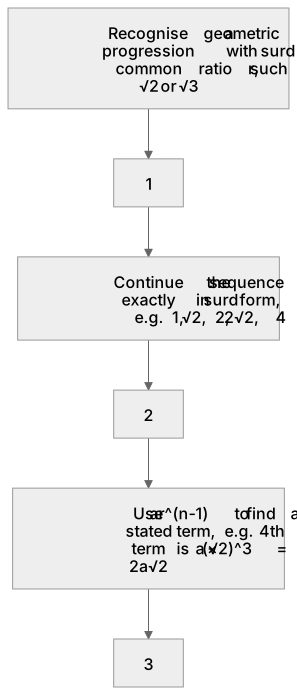
1Box 1
2Box 2
3Box 3
There is more to this lesson
The full lesson goes on to check your understanding and help you earn the marks. Create a free account to carry on, with your progress saved.
A week of Premium from your first lesson · Then the free plan continues · No card, no charge
Check what you remember
Read the wording for your board, then hide it and explain Sequence in your own words. Rough notes are fine. This is a self-check, with no mark or grade.
Reference: AQA
An ordered list of terms generated or described by a rule.
Study Notes
Overview
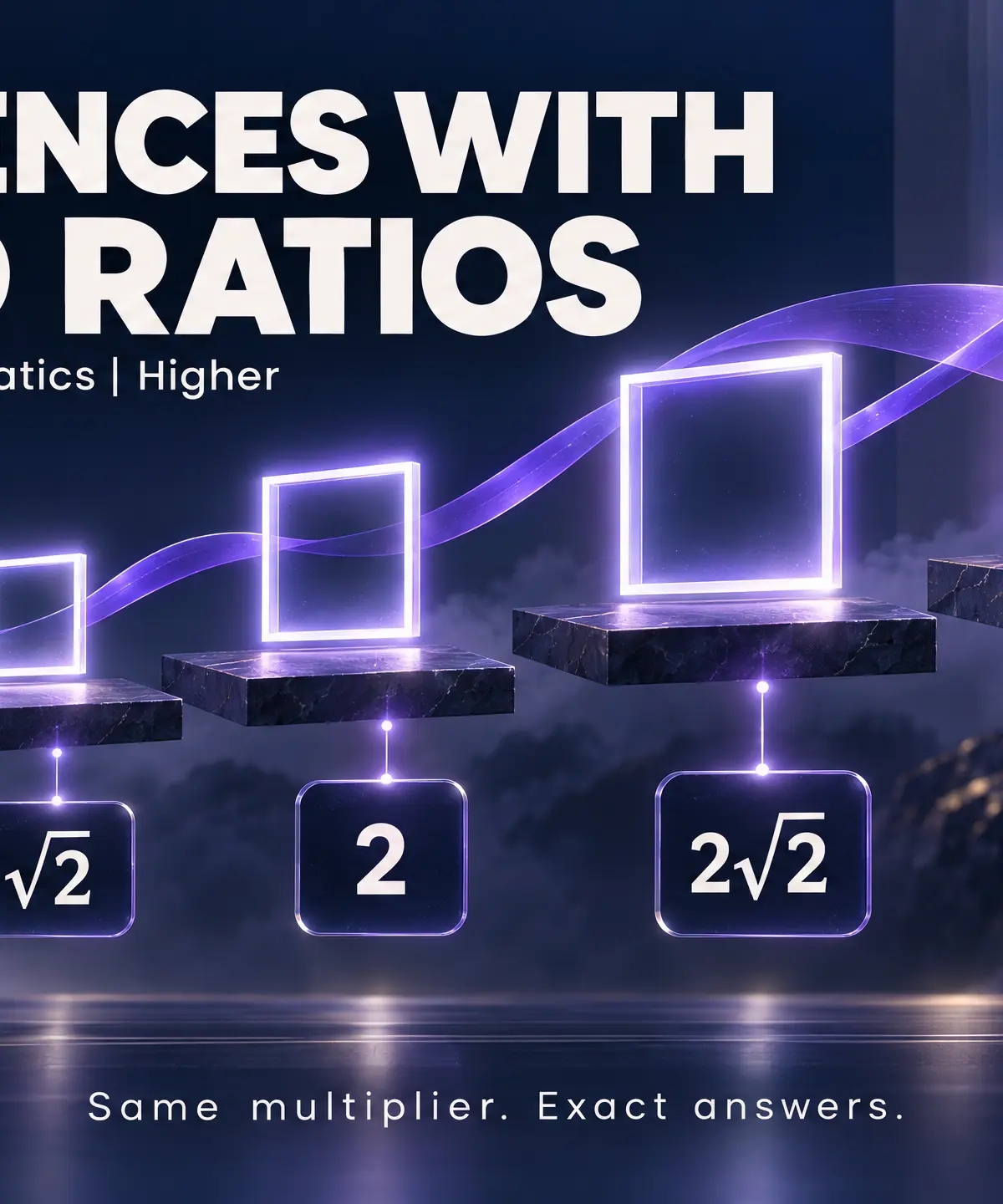
A sequence is an ordered list of terms. In a geometric sequence, each term is found by multiplying the previous term by a constant called the common ratio, r. At Higher tier, that multiplier can be a surd, such as \sqrt{2} or \sqrt{3}. The sequence 1,\sqrt{2},2,2\sqrt{2},4 therefore follows a simple rule despite its unfamiliar appearance.
This guide targets AQA GCSE Mathematics 8300, section 3.2.4, A24: the Higher-only extension to other sequences, including geometric sequences where r is a surd. Generating terms links to A23. General sequence recognition is not all Higher-only, but this surd-ratio extension is. 1
These questions bring together exact arithmetic, simplifying surds, index laws and algebraic reasoning. Candidates may be asked to continue a sequence, identify its multiplier, work backwards, calculate a stated term or explain whether a claim is correct. AQA can assess this content on any of its three papers. 2
Your aim is to recognise the structure and show enough working for a marker to follow it. The questions and allocations in this guide are original AQA-style teaching examples, not official past-paper questions or guaranteed future mark schemes. Practise exact answers first, then tackle missing terms and unfamiliar rules.
Key Concepts
1. Recognise a geometric sequence by its multiplier
The defining feature is a constant ratio, not a constant difference. For 2,2\sqrt{3},6, calculate
\frac{2\sqrt{3}}{2}=\sqrt{3},\qquad \frac{6}{2\sqrt{3}}=\sqrt{3}.
For the second calculation, check that 2\sqrt{3}\times\sqrt{3}=6. Both adjacent ratios agree. The common ratio is \sqrt{3}, so the next term is 6\sqrt{3}.
Compare this with an arithmetic sequence, where the same number is added each time. A geometric sequence multiplies by the same number. Writing “add \sqrt{3}” describes the wrong operation, even if your first calculation happens to look plausible.
Check more than one adjacent pair when recognising a pattern. However, finitely many displayed terms do not determine a unique infinite sequence: use the sequence type or rule stated in the question. Credit given for an explanation should rest on calculations, not “it looks geometric”.
Cover and recall: What operation finds r, and which way round does the division go? Answer: later term divided by the immediately preceding term.
2. Understand why surds must stay exact
A surd is an irrational root written in exact form. For example, \sqrt{2} cannot be written as a fraction of two integers. By contrast, \sqrt{4}=2, so it is not a surd. Square roots of positive non-square integers, such as \sqrt{5}, are the main examples here.
Replacing \sqrt{2} by 1.4 changes the number. In particular, 1.4^2=1.96, whereas (\sqrt{2})^2=2 exactly. Repeated decimal rounding compounds the error. Leave roots in the calculation until a decimal approximation is explicitly required.
An exact answer need not contain a root sign. In 1,\sqrt{2},2,2\sqrt{2},4, the third and fifth terms simplify to integers. The irrational multiplier does not make every term irrational.
Why does this work? A square root is defined so that squaring it returns its original non-negative radicand. That is why two matching square roots simplify so cleanly.
3. Simplify products before moving on
For non-negative u and v,
\sqrt{u}\sqrt{v}=\sqrt{uv}.
In particular, \sqrt{k}\sqrt{k}=k. Multiply any outside coefficients separately:
2\sqrt{3}\times3\sqrt{3}=2\times3\times3=18.
Also remove square factors: \sqrt{12}=\sqrt{4\times3}=2\sqrt{3}. If the multiplier is presented as \sqrt{8}, simplify it to 2\sqrt{2} before using it. Then its square is 8, not 2.
Do not apply multiplication rules to addition. For example, \sqrt{2}+\sqrt{2}=2\sqrt{2}, not 2. AQA expects simplified answers where appropriate; an instruction to simplify is not always needed. 1
Examiner checkpoint: \sqrt{4} is exact but not fully simplified. Write 2 on the answer line. In a question requesting simplest form, finish this final step.
4. Continue the sequence one multiplication at a time
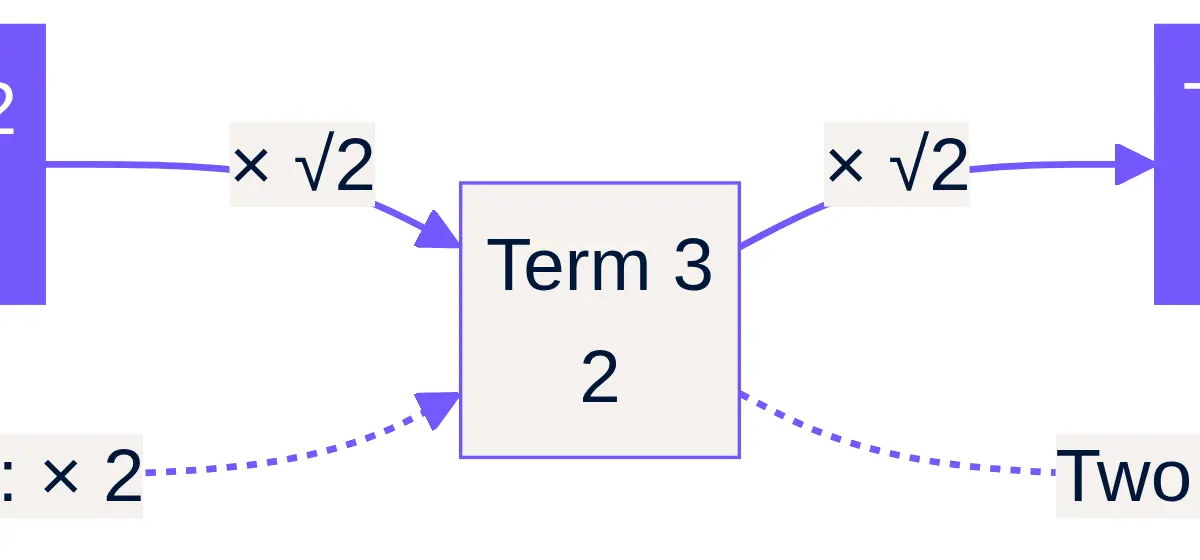
For 1,\sqrt{2},2,2\sqrt{2},4, each arrow means multiply by \sqrt{2}. Continue:
4\times\sqrt{2}=4\sqrt{2},\qquad 4\sqrt{2}\times\sqrt{2}=8.
The diagram also shows a useful shortcut. Two successive multiplications by \sqrt{2} equal one multiplication by 2. Therefore the odd-position terms are 1,2,4,8,\ldots, and the even-position terms are \sqrt{2},2\sqrt{2},4\sqrt{2},\ldots.
This alternation is specific to the starting value and multiplier. If the first term is \sqrt{3} and the ratio is \sqrt{2}, the first terms are \sqrt{3},\sqrt{6},2\sqrt{3},2\sqrt{6}. They are all irrational. Avoid claiming that every surd-ratio sequence alternates between whole numbers and surds.
Memory hook: “Pair the roots; release the whole.” Two factors of \sqrt{2} become 2; two factors of \sqrt{3} become 3.
5. Find a named term without listing everything
A useful position-to-term formula is
t_n=ar^{n-1}.
Here t_n means the term at position n, a is the first term and r is the common ratio. The position n is a positive integer. This formula is a derived tool for geometric sequences, not the separate A25 requirement about linear and quadratic nth terms.
Why n-1 rather than n? The first term is already present: t_1=a. Term 2 needs one multiplication, term 3 needs two, and term 6 needs five. Checking n=1 gives ar^0=a for a non-zero ratio.
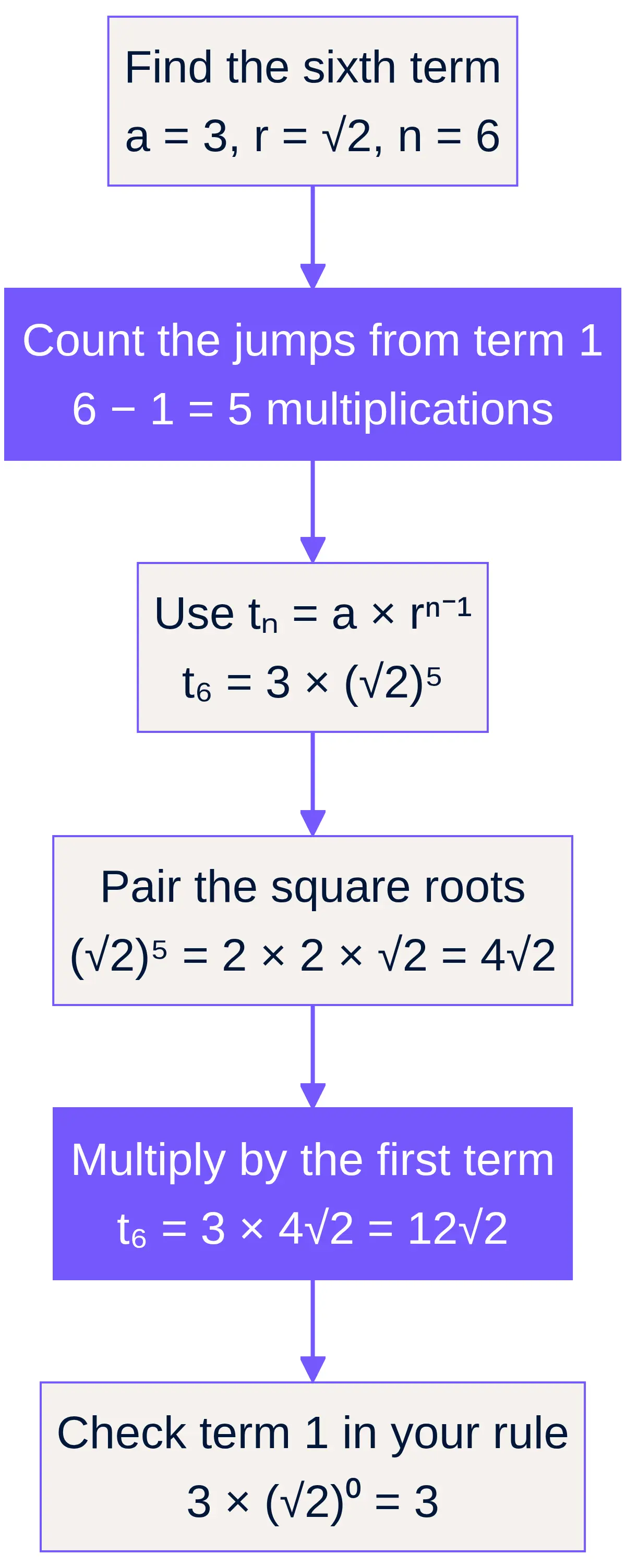
If a=3 and r=\sqrt{2}, then
t_6=3(\sqrt{2})^5=3(2\times2\times\sqrt{2})=12\sqrt{2}.
Keep the multiplier in brackets when raising it to a power. If r=2\sqrt{2}, then r^3=(2\sqrt{2})^3=16\sqrt{2}. Writing 2(\sqrt{2})^3 would miss two of the coefficient factors.
Cover and recall: Explain the exponent without quoting the formula. Answer: count the multiplications from the first position to the required position.
6. Work backwards and handle separated terms
Going forwards multiplies by r; going backwards divides by r. If t_3=18 and r=\sqrt{3},
t_2=\frac{18}{\sqrt{3}}=6\sqrt{3},\qquad t_1=\frac{6\sqrt{3}}{\sqrt{3}}=6.
You can also recognise that two forward steps multiply by (\sqrt{3})^2=3, giving t_1=18/3=6 directly.
When given t_3=18 and t_5=54, the quotient 54/18=3 equals r^2, because the terms are two positions apart. It does not equal r. If the ratio is stated to be positive, r=\sqrt{3}. Without that condition, both signs satisfy r^2=3, so use the rest of the information to decide.
In general, for non-zero terms and positive integer gap k,
\frac{t_{n+k}}{t_n}=r^k.
Candidates gain useful method evidence by writing the term gap before choosing the power.
7. Recognise decreasing and sign-changing examples
A surd ratio can be smaller than one. With a=8 and r=1/\sqrt{2}=\sqrt{2}/2, the terms are
8,\ 4\sqrt{2},\ 4,\ 2\sqrt{2},\ 2.
Positive starting terms decrease when 0<r<1. Rationalising a denominator gives an equivalent exact form: 1/\sqrt{2}=\sqrt{2}/2. Do not turn the multiplier into \sqrt{2}, which would make the sequence grow instead.
If a question supplies r=-\sqrt{2}, the signs alternate: 1,-\sqrt{2},2,-2\sqrt{2},4. Treat this as an extension when the rule is supplied. The root simplification remains the same, but signs must be tracked as well.
8. Distinguish geometric, quadratic and other recursive rules
Arithmetic sequences have constant first differences. Genuine quadratic sequences have constant non-zero second differences. Geometric sequences have constant adjacent ratios. A complicated-looking root does not determine the sequence type.
For example, 1,3,6,10,15 has first differences 2,3,4,5 and second differences 1,1,1. Its adjacent ratios are not constant. By contrast, 1,\sqrt{2},2,2\sqrt{2},4 has a constant multiplier.
Other recursive sequences are defined in the question under AQA's A24 notes. 1 If u_1=1 and u_{n+1}=\sqrt{2}u_n+1, then u_2=\sqrt{2}+1 and u_3=3+\sqrt{2}. The extra addition means it is not a geometric sequence, so do not use ar^{n-1}.
What if? Remove the +1. The resulting rule u_{n+1}=\sqrt{2}u_n is geometric. The operation, not the appearance of the terms, decides the classification.
Mathematical Relationships
Formulas to learn or derive
The 2027 AQA Higher formula sheet does not provide the following sequence, surd or index rules. Each is labelled Must memorise, meaning learn it or be able to derive it reliably. 3
Must memorise: t_{n+1}=rt_n. Use this term-to-term rule to generate the next term.
Must memorise: r=t_{n+1}/t_n, provided $t_n
e0$. Divide adjacent terms to find or check the multiplier.
Must memorise: t_n=ar^{n-1}. Use this derived formula to calculate a stated position.
Must memorise: t_{n-1}=t_n/r, for $r
e0, andt_{n+k}=t_nr^k$. These are the same forward/backward rules applied over one or several steps.
Must memorise: \sqrt{u}\sqrt{v}=\sqrt{uv} for u,v\ge0, and \sqrt{u}/\sqrt{v}=\sqrt{u/v} for u\ge0,v>0. A product with coefficients satisfies (b\sqrt{u})(c\sqrt{v})=bc\sqrt{uv}.
Must memorise: $\sqrt{q^2d}=|q|\sqrt{d}$ for $d\ge0$. With positive integer $q$, this becomes $q\sqrt{d}$. Use it to remove square factors.
Must memorise: (\sqrt{d})^{2m}=d^m and (\sqrt{d})^{2m+1}=d^m\sqrt{d} for positive d and non-negative integer m. These shortcuts pair the roots.
Must memorise: x^px^q=x^{p+q}, (x^p)^q=x^{pq}, (xy)^p=x^py^p and x^0=1, using integer exponents and non-zero bases where needed. They explain the power manipulation above.
Must memorise: 1/\sqrt{d}=\sqrt{d}/d for d>0. Multiply numerator and denominator by \sqrt{d} to rationalise.
Given on formula sheet, synoptic connection only: compound interest uses P(1+i/100)^N, where P is the initial amount, i the percentage rate per period and N the number of periods. 3 It illustrates repeated multiplication. Unlike the sequence formula, period counting begins from an initial amount at time zero. Do not confuse N periods with the term position n.
Geometric-series sums and logarithms are not needed for this guide's A24 skill.
Practical Applications and Graph Skills
A square with side 1 cm has diagonal \sqrt{2} cm by Pythagoras. Make that diagonal the side of a new square, and repeat. The side lengths form 1,\sqrt{2},2,2\sqrt{2},4,\ldots cm. Every two steps double the side length; every single step doubles the area. This explains why a surd multiplier can have a simple geometric meaning.
Use the same unit throughout. A ratio of two lengths is dimensionless. If one length is in metres and another in centimetres, convert before dividing: 1 m equals 100 cm. Pure number-sequence answers have no units. There is no required practical for this mathematics topic.
If asked to plot a sequence, place the position n on the horizontal axis and term value t_n on the vertical axis. For a=1,r=\sqrt{2}, the first points are (1,1),(2,\sqrt{2}),(3,2),(4,2\sqrt{2}),(5,4). Use suitable decimal approximations to locate irrational heights, but keep exact values in algebraic answers. Sequence positions are discrete, so do not automatically join the points. A sketched exponential function is a related but different object.
Exam Technique and Active Revision
Each paper allows 90 minutes for 80 marks, averaging 67.5 seconds per mark. Aim for about one minute per mark while leaving checking time; this is a revision strategy, not an AQA per-question limit. Paper 1 is non-calculator; Papers 2 and 3 allow calculators. 2
Identify the rule, count any position gap, write the calculation, then simplify. Show that requires the steps that reach the printed result. Explain needs a mathematical reason. When evaluating a method or claim, identify the error or justify the claim with evidence, not a generic discussion of advantages and disadvantages. 4
AQA's published marking glossary distinguishes method marks, accuracy marks and independent marks. Valid alternative methods can receive credit, but the detailed allocation depends on the individual question. A bare correct answer is not sufficient when working is explicitly required. 4 5
Cover each worked solution and attempt it from scratch. Then check the multiplier, exponent and exact answer form. Revisit a fresh example tomorrow and again a few days later. If you made an error, name it precisely: adding instead of multiplying, counting n jumps, or rounding too soon. Explaining that error is more useful than copying the solution again.
Listen and Recall
The ten-minute female-tutor episode follows five sections: introduction, core concepts, exam advice, a quick-fire quiz and a closing summary. Answer aloud before each quiz solution. Pause the player if you need more thinking time.
References
Worked Examples
3 worked examples — open one to explore the question and available guidance.
Practice Questions
Try the question, then reveal an answer plan or example response
Original AQA-style practice. A geometric sequence begins 3,3\sqrt{2},6. Write down the next two terms in simplest exact form. [2 marks]
Hint: This is an accessible starter within the Higher-only topic. Find the multiplier, then apply it twice.
Original AQA-style practice. A geometric sequence has first term 2 and common ratio \sqrt{5}. Work out the fourth term, showing your working. [3 marks]
Hint: How many multiplications separate positions 1 and 4?
Original AQA-style practice. A geometric sequence begins 8,4\sqrt{2},4. (a) State the common ratio in simplest form. [1 mark] (b) Work out the next two terms in simplest exact form. [2 marks]
Hint: The positive terms decrease, so the multiplier lies between zero and one.
Original AQA-style practice. A geometric sequence has first term \sqrt{3} and common ratio \sqrt{3}. (a) Work out its eighth term, showing your working. [3 marks] (b) A candidate says “All odd-position terms are rational.” Give one example to show that this claim is incorrect. [1 mark]
Hint: The first term already contains a root. Combine it with the seven multiplier factors.
Original AQA-style practice. A geometric sequence has a positive common ratio. Its second term is 5\sqrt{2} and its fourth term is 10\sqrt{2}. (a) Work out the ratio. [2 marks] (b) Work out the first term. [2 marks] (c) Work out the ninth term. [2 marks]
Hint: The two given terms are separated by two jumps, so their quotient equals r².
Original AQA-style practice. A sequence is defined by u_1=1 and u_{n+1}=\sqrt{2}u_n+1. (a) Work out u_2 and u_3 in simplest exact form. [2 marks] (b) Show that the sequence is not geometric by comparing its actual third term with the third term predicted by the first adjacent ratio. [2 marks]
Hint: Follow the entire recurrence, including +1. If it were geometric, its first ratio would determine the predicted third term.
Exam technique
How to turn what you know into marks
How to approach the question
Read the rule and the requested answer form. Identify a and r. If terms are given, check adjacent ratios. If terms are separated, count the position gap before using a power of r. Choose direct multiplication, backwards division or ar^(n−1). For other recurrences, follow the entire stated rule instead of forcing a geometric formula.
How to structure your answer
For a short continuation task, give the requested simplified terms. When working is required, show the multiplier and multiplication. For a 3-mark named-term task, write the correct power expression, simplify the surd power and give the exact answer. For a 4- to 6-mark multi-part problem, label each part and show the term-gap calculation. Explain or show-that tasks need mathematical evidence. The original questions here use indicative author-created schemes; actual AQA allocations vary.
Timing
AQA allows 90 minutes for 80 marks on each paper: 67.5 seconds per mark on average. As a strategy, aim for about 1 minute per mark and keep checking time. Indicative targets: 3 marks in about 3 minutes, 4 marks in 4 minutes and 6 marks in 6 to 7 minutes. These are not official per-question limits.
Common pitfalls
- Adding r instead of multiplying: write the operation beside each step.
- Using arⁿ instead of ar^(n−1): check the formula returns a when n = 1.
- Rounding √2 to 1.4: preserve exact surds unless approximation is requested.
- Leaving √4 unsimplified: complete the calculation to 2.
- Dividing separated terms and calling the quotient r: count the jumps; it may be r² or r³.
- Assuming all surd-ratio sequences alternate rational and irrational terms: inspect a as well as r.
- Ignoring coefficient powers: (2√2)³ is not 2(√2)³.
- Calling a sequence quadratic because it contains a surd: use ratios or differences to classify it.
What the command words want
- Compare
- Calculate or identify the relevant values and state which is larger, smaller or equal, with context where appropriate.
- Explain
- Support the conclusion with a calculation or a precise reason. Show equal adjacent ratios rather than saying the pattern looks geometric.
- Describe
- Use accurate mathematical terminology, such as “multiply each term by √3”.
- Evaluate
- For a numerical expression, calculate its value. For a method or claim, identify the incorrect step or justify why it is correct using mathematical evidence. It is not a generic “consider both sides” essay.
- Simplify
- Remove square factors and complete surd products; write the final answer in simplest exact form.
- Show that
- Give the complete mathematical steps leading to the supplied result. Simply copying the result is not sufficient.
- State/Give
- Write the requested mathematical information directly, in the specified form. A ratio answer should include the correct surd and sign.
- Write down
- Give information obtainable directly from the question; lengthy working is usually unnecessary.
- Calculate/Work out
- Carry out the necessary calculation and show useful working unless instructed otherwise. Include units only when the sequence is about a measured quantity.
- Give your answer to ...
- Keep sufficient precision in the working and round the final answer to the requested decimal places or significant figures.
Test your understanding of Sequences: including other sequences including where r is a surd (Higher tier only)
Active recall beats re-reading. Take an instant quiz now to test what you’ve learned and lock it into long-term memory.
A week of Premium from your first lesson · Then the free plan continues · No card, no charge