AQA · GCSE · Mathematics
Course version: 8300 · Version from Sept 2015
Sequences: including quadratic sequences (Higher tier only)
A quadratic sequence hides a surprisingly simple rule: constant second differences reveal its n² component. Learn to rebuild the full nth term, handle negative and fractional coefficients, and turn membership questions into marks with clear algebra. The complete resource is available as a [downloadable JSON study guide](/home/ubuntu/study_guide_sequences/quadratic_sequences_study_guide.json).
- 11 min read
- 4 worked examples
- 6 practice questions
- 4 key terms
Try the lesson
The start of the Sequences: including quadratic sequences (Higher tier only) lesson, made from checked teaching notes for this specification point.
Have a go first
A quadratic sequence begins 3, 8, 15, 24, 35, ... Work out the next term of the sequence.
Listen
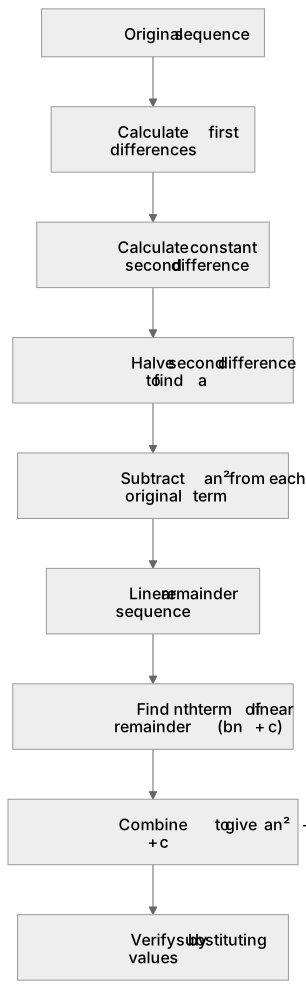
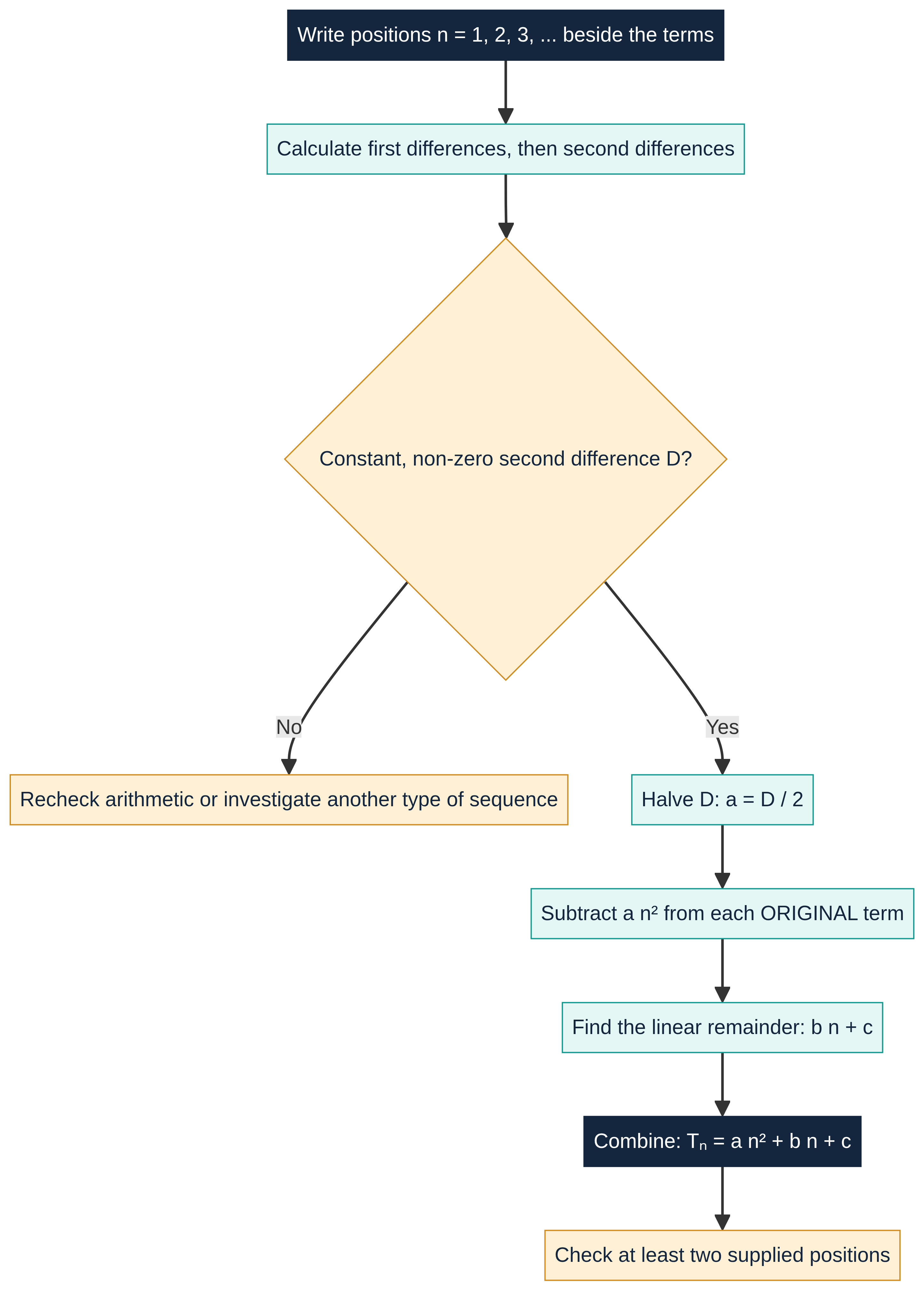
A quadratic sequence features a constant second difference and an nth term of the form an² + bn + c. To find this, calculate the first differences between consecutive terms, then the second differences. The second difference equals 2a, so halve it to find a. For example, in 2, 7, 14, 23, 34, the first differences are 5, 7, 9, 11 and the second difference is 2, meaning a = 1. Subtract n² (1, 4, 9, 16, 25) from the original terms to leave 1, 3, 5, 7, 9. This linear sequence has the nth term 2n - 1. Combining these gives the quadratic nth term: n² + 2n - 1. Always verify the result by substituting at least two values, such as n = 3: 3² + 2(3) - 1 = 14, matching the third term. A strong answer earns marks for these points. Calculate the first differences between consecutive terms and then the constant second difference. Divide the constant second difference by 2 to determine a, the coefficient of n². Subtract the an² component from each original term to generate a linear remainder sequence. Determine the nth term of the linear remainder sequence (bn + c). A common slip: Using the second difference directly as the coefficient of n² instead of halving it. Instead, divide the second difference by 2 to find a. Exam tip: Write out the first and second differences clearly below the sequence to avoid arithmetic slips.
See it
Key words
Say what each word means before you turn the card.
constant second difference
Try answering aloud or in your head before turning the card.
coefficient of n²
Try answering aloud or in your head before turning the card.
linear remainder sequence
Try answering aloud or in your head before turning the card.
verify by substitution
Try answering aloud or in your head before turning the card.
See every definition
- constant second difference
- A quadratic sequence features this, found by calculating the first differences between consecutive terms and then the second differences.
- coefficient of n²
- The second difference equals 2a, so halve it to find a, the coefficient of n².
- linear remainder sequence
- Subtracting the an² component from each original term generates this, whose nth term is bn + c.
- verify by substitution
- Always check the result by substituting at least two values, such as n = 3, to match a term.
Label the diagram
Some boxes have lost their names. Pick the right name for each number.
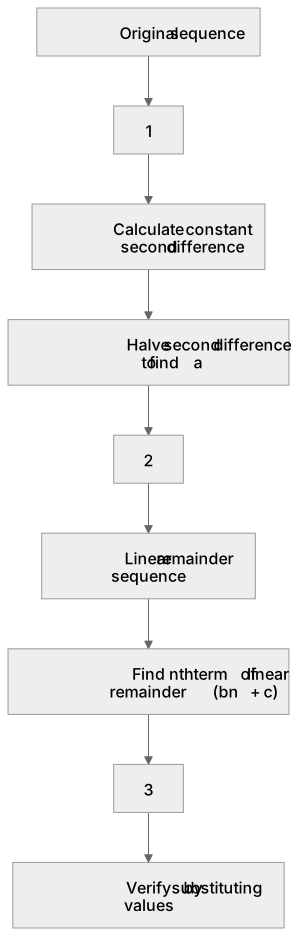
1Box 1
2Box 2
3Box 3
There is more to this lesson
The full lesson goes on to check your understanding and help you earn the marks. Create a free account to carry on, with your progress saved.
A week of Premium from your first lesson · Then the free plan continues · No card, no charge
Study Notes

Overview
A sequence is an ordered list of terms. In this topic, you move from spotting a pattern to writing a rule that calculates any term directly. That makes a question about the hundredth term a short substitution rather than a hundred separate calculations. The key Higher-tier skill is finding the nth term of a quadratic sequence, where the first differences change but the second differences are constant and non-zero.
AQA GCSE Mathematics 8300 places sequences in 3.2.4, A23–A25. Generating terms and finding linear nth terms provide the foundations. Recognising and using quadratic sequences appears in additional Foundation content; deducing a quadratic nth-term expression is Higher-only. Do not confuse these requirements. 1
Candidates may be asked to continue a sequence, describe its rule, derive an nth term, interpret a growing diagram, or decide whether a number occurs. These questions link naturally to substitution, expanding brackets, factorising and solving quadratic equations. Your goal is to show a coherent method, obtain a correct expression and interpret the answer. This guide builds that method, then tests it through examples, recall prompts and a narrated revision lesson.
Key Concepts
1. Position is not the term value
Write positions above the terms: n = 1, 2, 3, 4, … . For 5, 8, 11, 14, the third term is 11, not 3. The notation Tₙ means the value at position n. Unless a question explicitly uses a different starting index, GCSE sequences begin at n = 1.
A term-to-term rule describes how to obtain the next term from previous terms, such as ‘add 3’. A position-to-term rule uses n directly: Tₙ = 3n + 2. The second rule is more useful for a distant term: T₁₀₀ = 302. For a recursive rule, the starting term or terms must also be known.
Cover and recall: explain the difference between ‘the tenth term’ and ‘a term equal to ten’. Your explanation should distinguish a position from a value.
2. Recognise the family before choosing a method
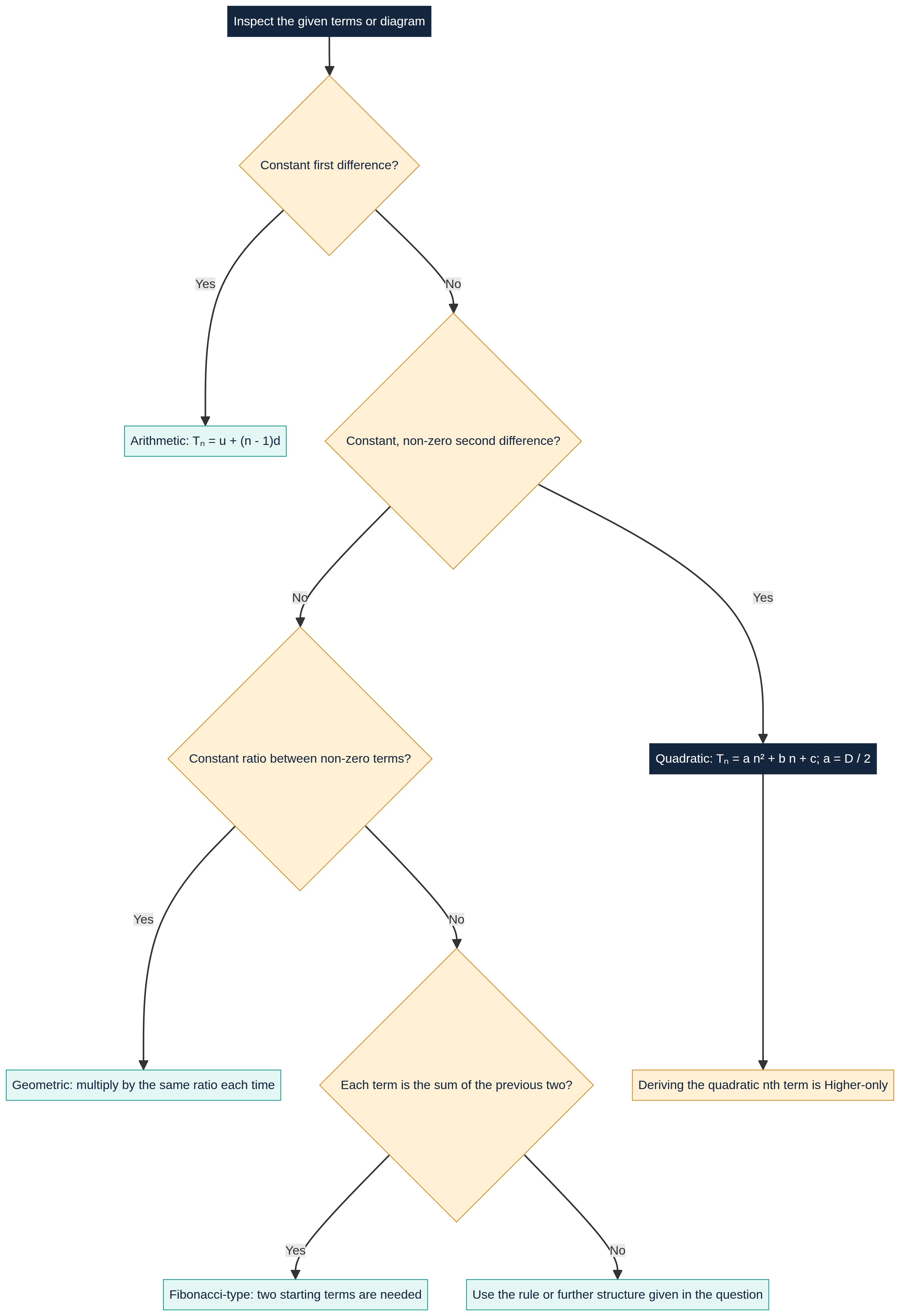
An arithmetic, or linear, sequence has a constant first difference. Square numbers 1, 4, 9, 16, … are quadratic. Cube numbers 1, 8, 27, 64, … do not have constant second differences. Triangular numbers 1, 3, 6, 10, … are quadratic with a fractional leading coefficient.
A geometric sequence multiplies by a fixed ratio, such as 3, 6, 12, 24, … . A Fibonacci-type sequence adds the previous two terms, such as 2, 5, 7, 12, 19, … . Do not force every unfamiliar pattern into a quadratic rule. Other recursive rules will be specified when needed. 1

3. First differences and second differences
Subtract each term from the next, consistently moving left to right. For 2, 7, 14, 23, 34, the first differences are 5, 7, 9, 11. Subtract neighbouring first differences to obtain 2, 2, 2. The constant, non-zero second difference identifies the intended quadratic pattern.
Keep negative signs: 10, 7, 2, −5 has first differences −3, −5, −7 and second differences −2, −2. A quadratic sequence need not increase. If second differences are zero throughout, the sequence is linear or constant, not genuinely quadratic.
A finite list never determines one unrestricted infinite rule uniquely. In GCSE questions, use the stated sequence type or the intended simple structure. Two matching substitutions check your arithmetic; they are not a proof about every imaginable continuation.
4. Why halving gives the quadratic coefficient
A quadratic nth term has the form Tₙ = an² + bn + c, with a ≠ 0. The square numbers have first differences 3, 5, 7, 9 and second differences 2. Therefore, multiplying square numbers by a makes the second difference 2a. Adding bn + c does not change it: a linear sequence has zero second difference.
For an algebraic explanation, Tₙ₊₁ − Tₙ = 2an + a + b. Increasing n by one changes this first difference by 2a. Hence, if the second difference is D, a = D/2. D = 6 gives a = 3, not 6. D = −4 gives a = −2. D = 1 gives a = 1/2.
Why does this work? Explain why changing c shifts every term equally but leaves both difference rows unchanged.
5. Remove the quadratic part, then rebuild
Use Differences, Halve, Subtract, Rebuild, Check. For 2, 7, 14, 23, 34, the second difference is 2, so a = 1. Subtract n², meaning subtract 1, 4, 9, 16, 25 from the corresponding original terms. The remainder is 1, 3, 5, 7, 9.
That remainder increases by 2, so begin with 2n. At n = 1, 2n gives 2 but the remainder is 1; subtract 1. Thus the remainder is 2n − 1, and the complete rule is Tₙ = n² + 2n − 1.
Check n = 1: 1 + 2 − 1 = 2. Check n = 3: 9 + 6 − 1 = 14. Candidates should subtract an² from the original sequence, not from the first differences and not in the opposite order.

6. Find b and c without guessing
After subtracting an², the remainder is linear. Its common difference is b. If its first term is r₁, then c = r₁ − b, since b + c = r₁ at position one. In the original sequence, T₁ = a + b + c. Therefore, c is usually not the first term.
An alternative uses the first original difference d₁ = T₂ − T₁. Since d₁ = 3a + b, calculate b = d₁ − 3a and then c = T₁ − a − b. Another valid route substitutes three known positions into an² + bn + c and solves the resulting equations. Use the method you can execute reliably; AQA accepts valid alternatives according to the question-specific scheme. 5
7. Negative and fractional coefficients
For 10, 7, 2, −5, a = −1. Subtract −n²: 10 − (−1), 7 − (−4), 2 − (−9), −5 − (−16). Each remainder is 11. The rule is Tₙ = −n² + 11. There is no linear term, so b = 0.
For triangular numbers, D = 1 and a = 1/2. Subtracting (1/2)n² leaves 1/2, 1, 3/2, 2, …, which is (1/2)n. Thus Tₙ = (n² + n)/2. Keep fractions exact. A fractional coefficient does not imply fractional terms: n and n + 1 are consecutive integers, so their product is even.
8. Generate terms, test membership and justify conclusions
To find a term, substitute the requested position. For Tₙ = n² + 2n − 1, T₁₀ = 100 + 20 − 1 = 119. Follow the order of operations: square n before multiplying by its coefficient.
To test whether 47 occurs, solve n² + 2n − 1 = 47. Rearranging gives n² + 2n − 48 = 0, so (n + 8)(n − 6) = 0. The roots are −8 and 6. Only n = 6 is a positive integer, so 47 is the sixth term.
For 50, rearrangement gives (n + 1)² = 52. Since 52 is not a perfect square, neither root is an integer. Therefore, 50 is not a term. Credit for reasoning depends on a mathematical justification, not just ‘it is not in the first five terms’. Reject negative, zero or fractional positions unless the question explicitly defines a different index domain.
Mathematical/Scientific Relationships
Formula-sheet status: these labels refer to AQA’s published 2027 Higher insert. AQA confirms that a sheet is supplied, but sequence methods are not on it. 3 4 ‘Must memorise’ below means know the relationship or be able to derive it fluently, not that AQA demands rote recall of every rearrangement.
Must memorise: arithmetic nth term Tₙ = u + (n − 1)d = dn + (u − d), where u is the first term and d the common difference. Use it for a linear sequence or the linear remainder.
Must memorise: quadratic form Tₙ = an² + bn + c; first difference ΔTₙ = Tₙ₊₁ − Tₙ; second difference Δ²Tₙ = Tₙ₊₂ − 2Tₙ₊₁ + Tₙ = 2a; therefore a = D/2. For consecutive positions starting at one, b = (T₂ − T₁) − 3a and c = T₁ − a − b. The remainder is Rₙ = Tₙ − an² = bn + c.
Must memorise: standard square, cube and triangular patterns: Tₙ = n², Tₙ = n³ and Tₙ = n(n + 1)/2. A geometric sequence with first term u and ratio r has Tₙ = urⁿ⁻¹. A Fibonacci-type rule is Tₙ₊₂ = Tₙ₊₁ + Tₙ, together with two starting terms. These are supporting recognition tools; the focus here is quadratic nth terms.
Given on formula sheet: for An² + Bn + C = 0, A ≠ 0, n = (−B ± √(B² − 4AC))/(2A). Use this quadratic equation formula for a membership equation if factorising is unsuitable. Here A, B and C are the coefficients after rearranging the equation, not automatically the original sequence coefficients. Keep exact values until deciding whether a root is an integer.
Graph and Data Skills
Plot position n horizontally and term value Tₙ vertically. For n² + 2n − 1, the first five points are (1, 2), (2, 7), (3, 14), (4, 23), (5, 34). Use equally spaced scales and label both axes. The sequence contains discrete points at positive integer positions. A smooth parabola illustrates the related function but does not add fractional-position terms.

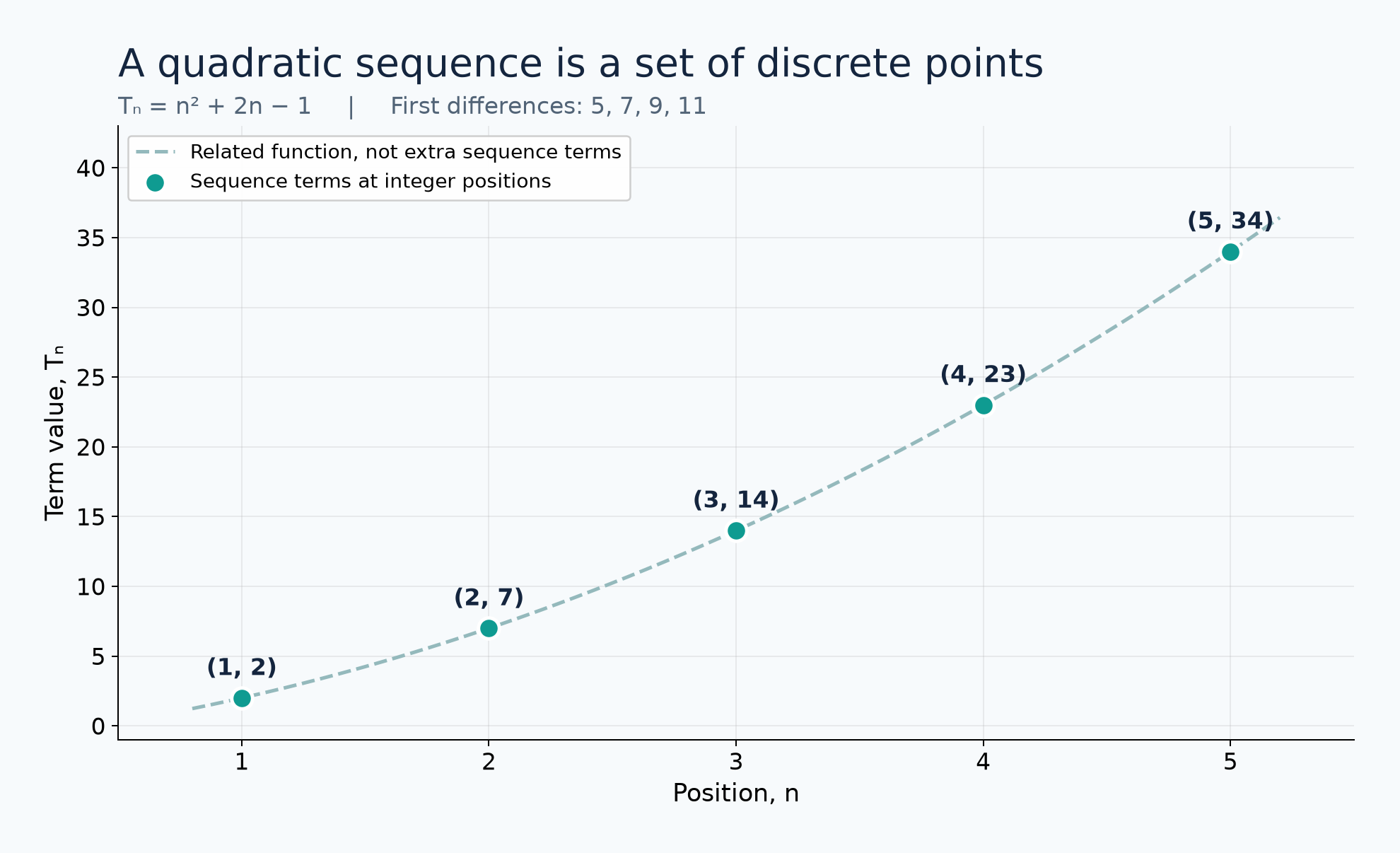
The widening vertical gaps match increasing first differences. Positive a gives an upward-opening underlying parabola; negative a gives a downward-opening one. However, positive a does not guarantee every initial term increases, because b also affects the first differences. Do not replace an exact membership argument with a rough graph reading when an exact conclusion is required.
Practical Applications
Growing tile patterns connect diagrams to algebra. If stage n contains an n-by-n square plus 2n − 1 extra tiles, its total is n² + 2n − 1. Identify non-overlapping parts so that shared corner tiles are not counted twice. A written explanation linking each part to its expression supports a convincing ‘show that’ response.
Triangular arrangements of seats or counters give n(n + 1)/2. Two identical triangular arrangements can be paired to form an n-by-(n + 1) rectangle. This explains the division by two and links the sequence to area and expanding brackets. Such models apply only while the stated construction rule continues.
There is no required practical for this mathematics topic. Positions and tile counts are dimensionless. If terms represent lengths or costs, retain the question’s units; never attach cm² merely because n² appears. Where area conversions arise in a context, 1 cm² = 100 mm², not 10 mm².
Turning the Method into Marks
AQA June 2023 Higher Paper 2, question 19, provides a real four-mark example. Its scheme gives M1 for second difference 10 or a = 5; M1dep for removing 5n² or establishing b = 2; M1dep for a valid substitution to obtain c; and A1 for 5n² + 2n − 4. This is evidence for showing your intermediate reasoning, not a universal scheme. 5
All questions written for this guide have indicative teaching mark schemes, not official AQA allocations. On an actual paper, follow instructions such as ‘show your working’. Do not assume that a separate mark is always awarded for checking, or that follow-through is automatic.
Listen, Retrieve and Revisit
The ten-minute female-voiced lesson follows introduction, core concepts, exam technique, quick-fire recall and summary. After listening, cover the guide and reproduce the five-step method. Attempt one question now, another tomorrow and a mixed question next week. Before revealing an answer, explain why your method applies. This turns recognition into usable exam knowledge.
References
Worked Examples
4 worked examples — open one to explore the question and available guidance.
Practice Questions
Try the question, then reveal an answer plan or example response
Original AQA-style question. (a) Write down the next two terms of 3, 8, 15, 24, … . (b) Explain why the intended pattern is quadratic. [3 marks]
Hint: Write the differences underneath, then continue that difference pattern.
Original AQA-style question. Work out the nth term of the quadratic sequence 5, 12, 23, 38, 57, … . Show your working. [4 marks]
Hint: The second difference is 4. Remove the matching multiple of n² first.
Original AQA-style question. Work out the nth term of the quadratic sequence 1, 3, 6, 10, 15, … . Show your working. [4 marks]
Hint: A second difference of 1 gives a fractional quadratic coefficient.
Original AQA-style question. The nth term is n² + 2n − 1. Determine whether 50 is a term of the sequence. Justify your answer. [3 marks]
Hint: Rearrange the membership equation into a statement about (n + 1)².
Original AQA-style question. A quadratic sequence has second difference 6. Its first two terms are 4 and 13. Work out its nth term. Show your working. [4 marks]
Hint: Find a, then use T₂ − T₁ = 3a + b.
Original AQA-style question. Stage n of a tile pattern contains an n-by-n square and a separate strip of 3n + 2 tiles, with no overlap. (a) Show that the total is n² + 3n + 2. (b) Find the number of tiles at stage 10. (c) Determine the stage containing 182 tiles. Show your working. [6 marks]
Hint: For part (c), set the total equal to 182 and factorise.
Exam technique
How to turn what you know into marks
How to approach the question
Read the command word and required output first. Label positions starting at 1 unless told otherwise. Identify the sequence family. For a quadratic, write first differences, second differences and a = D/2. Remove an², derive the linear remainder, combine and check. For membership, equate the nth term to the proposed value, solve and interpret the roots as possible positions.
How to structure your answer
Use a difference row, a clearly aligned subtraction or equivalent algebra, and a final expression. In a short recognition question, state the requested terms and the mathematical reason. In a longer problem, show the nth-term derivation before substitution or equation solving. All original guide mark allocations are indicative teaching schemes. AQA June 2023 8300/2H Q19 is a real 4-mark example using M1, M1dep, M1dep and A1; future schemes can differ. A correct answer may earn full marks where working is not specifically required, but visible working makes method credit available when the final answer is wrong.
Timing
AQA papers each have 90 minutes for 80 marks, a budget of 1.125 minutes per mark. Aim for about 3–4 minutes for 3 marks, 4–5 minutes for 4 marks, 5–6 minutes for 5 marks and 6–7 minutes for 6 marks. These are revision planning targets, not official AQA question timings. Source: https://www.aqa.org.uk/subjects/mathematics/gcse/mathematics-8300/specification/specification-at-a-glance
Common pitfalls
- Using D as a: divide the second difference by 2 before writing an².
- Finding a linear rule from the original quadratic terms: subtract an² first.
- Subtracting in the wrong order: calculate original term minus corresponding an² term.
- Treating c as T₁: use T₁ = a + b + c.
- Ignoring a negative a: subtracting −n² means adding n².
- Squaring the whole coefficient: −2n² is −2 × n², not (−2n)².
- Rounding a membership root to an integer: only an exact valid position establishes membership.
- Assuming a check always earns a mark or follow-through is guaranteed: marks are question-specific.
- Treating the formula sheet as a sequence-method sheet: nth-term rules and D = 2a are not provided on the 2027 Higher insert.
What the command words want
- Compare
- Identify the relevant mathematical similarity or difference, for example equal second differences but different first terms. Answer the comparison asked; both similarities and differences are not automatically required.
- Explain
- Give a mathematical reason, such as the second difference is constantly 4, rather than merely repeating the answer.
- Describe
- State the precise pattern, such as first differences increasing by 2; avoid vague phrases like it goes up.
- Evaluate
- In mathematics, calculate the numerical value of an expression, rather than writing a balanced discussion.
- Show that
- Start from the given information and establish the supplied result through valid working; copying the target expression earns no demonstration credit.
- State/Give
- Supply the requested term, coefficient or expression concisely. A response may be a complete algebraic expression, not just one or two words.
- Write down
- Usually provide the requested result directly; do not write an unrelated derivation.
- Determine/Justify
- Reach a conclusion supported by algebra. For membership, state whether a positive integer position exists.
- Work out/Calculate
- Obtain the requested value or expression. Show a readable method, especially where working is requested or the question has several stages; retain units only when the context supplies them.
Watch or listen (optional)
Test your understanding of Sequences: including quadratic sequences (Higher tier only)
Active recall beats re-reading. Take an instant quiz now to test what you’ve learned and lock it into long-term memory.
A week of Premium from your first lesson · Then the free plan continues · No card, no charge