AQA · GCSE · Mathematics
Course version: 8300 · Version from Sept 2015
Sequences: recognise and use sequences of triangular, square and cube numbers and simple arithmetic progressions
You need to recognise and continue special sequences.
- 4 key terms
Study notes
From the checked teaching notes for this specification point.
The idea
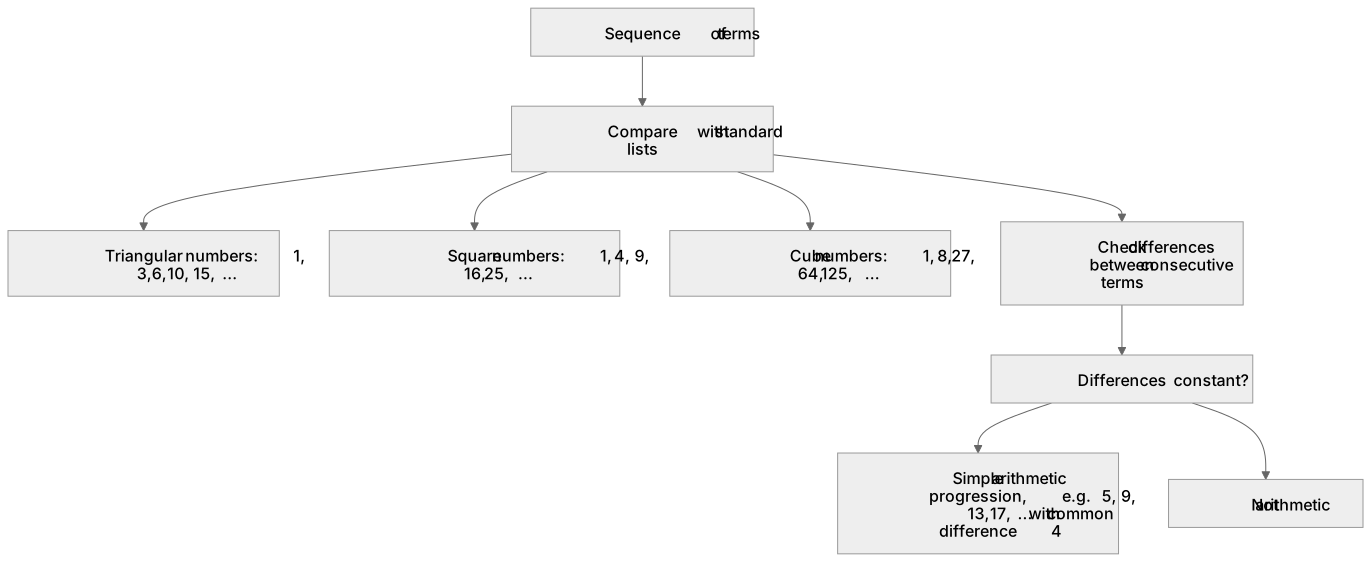
You need to recognise and continue special sequences. Triangular numbers are 1, 3, 6, 10, 15, ...; each term is the sum of the first n natural numbers, and the nth triangular number is n(n + 1)/2. Square numbers are 1, 4, 9, 16, 25, ...; the nth square number is n². Cube numbers are 1, 8, 27, 64, 125, ...; the nth cube number is n³. A simple arithmetic progression is a sequence where the difference between consecutive terms is constant, for example 5, 9, 13, 17, ... with common difference 4. You should be able to identify these sequences from their terms, continue them, and find a specified term or the nth term of an arithmetic progression.
What earns the marks
- Recognise and continue the sequence of triangular numbers: 1, 3, 6, 10, 15, ...
- Recognise and continue the sequence of square numbers: 1, 4, 9, 16, 25, ...
- Recognise and continue the sequence of cube numbers: 1, 8, 27, 64, 125, ...
- Identify a simple arithmetic progression and use its common difference to find further terms or the nth term.
Common mistakes and how to put them right
Mixing up square and cube numbers, for example thinking 8 is a square number.
Put it right: 8 is 2³, a cube number; 9 is 3², a square number.
Confusing triangular numbers with square numbers, for example treating 1, 3, 6, 10 as squares.
Put it right: Triangular numbers are sums of consecutive integers, while square numbers are n².
Assuming a sequence is arithmetic when the differences are not constant.
Put it right: Check that the difference between every pair of consecutive terms is the same before calling it an arithmetic progression.
Forgetting that the first term of a sequence corresponds to n = 1 when using nth term formulas.
Put it right: Substitute n = 1 for the first term, n = 2 for the second, and so on.
Exam tips
- Write out the first few terms of the sequence to help you recognise the pattern before answering.
- For arithmetic progressions, find the common difference by subtracting consecutive terms, and use it to extend the sequence or find a formula.
- Check whether a sequence is triangular, square or cube by comparing its terms with the standard lists you have learned.
Try the lesson
The start of the Sequences: recognise and use sequences of triangular, square and cube numbers and simple arithmetic progressions lesson, made from checked teaching notes for this specification point.
Have a go first
A sequence begins 1, 4, 9, 16, 25, ... What is the next term of this sequence?
Listen
You need to recognise and continue special sequences. Triangular numbers are 1, 3, 6, 10, 15, ...; each term is the sum of the first n natural numbers, and the nth triangular number is n(n + 1)/2. Square numbers are 1, 4, 9, 16, 25, ...; the nth square number is n². Cube numbers are 1, 8, 27, 64, 125, ...; the nth cube number is n³. A simple arithmetic progression is a sequence where the difference between consecutive terms is constant, for example 5, 9, 13, 17, ... with common difference 4. You should be able to identify these sequences from their terms, continue them, and find a specified term or the nth term of an arithmetic progression. A strong answer earns marks for these points. Recognise and continue the sequence of triangular numbers: 1, 3, 6, 10, 15, ... Recognise and continue the sequence of square numbers: 1, 4, 9, 16, 25, ... Recognise and continue the sequence of cube numbers: 1, 8, 27, 64, 125, ... Identify a simple arithmetic progression and use its common difference to find further terms or the nth term. A common slip: Mixing up square and cube numbers, for example thinking 8 is a square number. Instead, 8 is 2³, a cube number; 9 is 3², a square number. Exam tip: Write out the first few terms of the sequence to help you recognise the pattern before answering.
See it
Key words
Say what each word means before you turn the card.
Triangular numbers
Try answering aloud or in your head before turning the card.
Square numbers
Try answering aloud or in your head before turning the card.
Cube numbers
Try answering aloud or in your head before turning the card.
Arithmetic progressions
Try answering aloud or in your head before turning the card.
See every definition
- Triangular numbers
- A sequence such as 1, 3, 6, 10, 15, ... where each term is the sum of the first n natural numbers, and the nth is n(n + 1)/2.
- Square numbers
- A sequence such as 1, 4, 9, 16, 25, ... where the nth term is n².
- Cube numbers
- A sequence such as 1, 8, 27, 64, 125, ... where the nth term is n³.
- Arithmetic progressions
- A sequence where the difference between consecutive terms is constant, for example 5, 9, 13, 17, ... with common difference 4.
Label the diagram
Some boxes have lost their names. Pick the right name for each number.
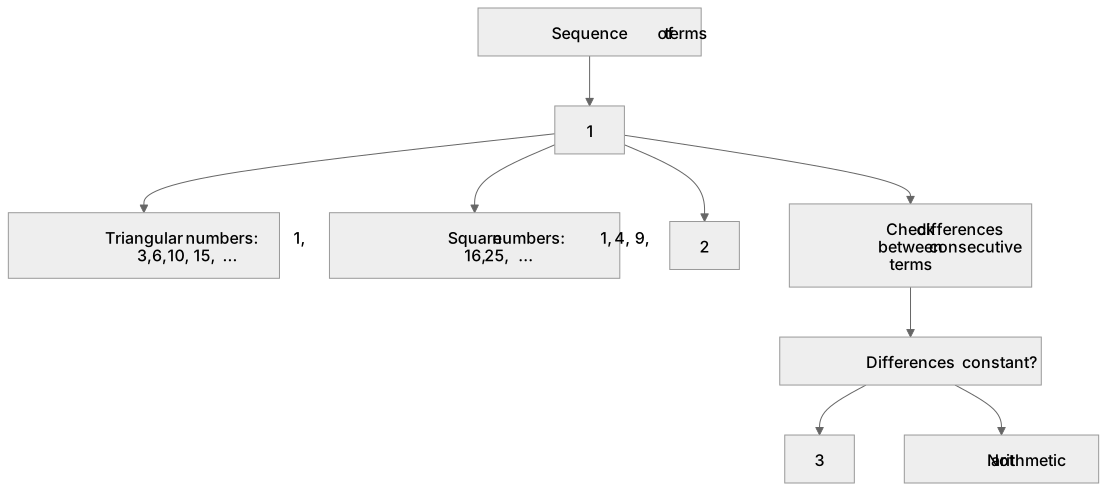
1Box 1
2Box 2
3Box 3
There is more to this lesson
The full lesson goes on to check your understanding and help you earn the marks. Create a free account to carry on, with your progress saved.
A week of Premium from your first lesson · Then the free plan continues · No card, no charge
Test your understanding of Sequences: recognise and use sequences of triangular, square and cube numbers and simple arithmetic progressions
Active recall beats re-reading. Take an instant quiz now to test what you’ve learned and lock it into long-term memory.
A week of Premium from your first lesson · Then the free plan continues · No card, no charge