AQA · GCSE · Mathematics
Course version: 8300 · Version from Sept 2015
Solving equations and inequalities: including linear/quadratic (Higher tier only)
At Higher tier, you must solve simultaneous equations where one is linear and the other is quadratic.
- 3 key terms
Study notes
From the checked teaching notes for this specification point.
The idea
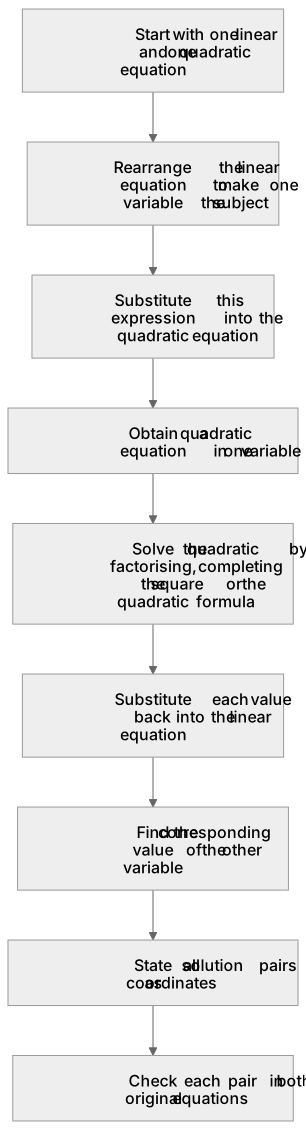
At Higher tier, you must solve simultaneous equations where one is linear and the other is quadratic. The standard method is substitution: rearrange the linear equation to make one variable the subject, then substitute this expression into the quadratic equation. This produces a quadratic equation in one variable, which you solve by factorising, completing the square or using the quadratic formula. Each solution for one variable is then substituted back into the linear equation to find the corresponding value of the other variable. Because a quadratic can have two, one or no real solutions, there may be two, one or no pairs of solutions. Present your final answers as coordinate pairs and check them in both original equations.
What earns the marks
- Rearrange the linear equation to express one variable in terms of the other.
- Substitute this expression into the quadratic equation to obtain a quadratic equation in one variable.
- Solve the quadratic equation correctly, finding both solutions where they exist.
- Substitute each value back into the linear equation to find the corresponding value of the other variable.
- State all solution pairs clearly as coordinates and verify by substitution into both original equations.
Common mistakes and how to put them right
Substituting into the quadratic without rearranging the linear equation correctly, leading to an equation that is not quadratic.
Put it right: Rearrange first and check the substitution.
Losing one of the solutions by dividing by a variable or by not considering both roots.
Put it right: Solve the quadratic fully, using factorisation or the formula, and list both roots.
Forgetting to find the corresponding values of the other variable for each root.
Put it right: Substitute each root back into the linear equation.
Making sign errors when expanding brackets after substitution.
Put it right: Expand carefully and check each term.
Exam tips
- Write down the substitution step clearly so that the examiner can follow your method.
- If the quadratic does not factorise easily, use the quadratic formula and leave answers in surd form if required, unless told to round.
- Always check each solution pair in both original equations to ensure they satisfy both.
Try the lesson
The start of the Solving equations and inequalities: including linear/quadratic (Higher tier only) lesson, made from checked teaching notes for this specification point.
Have a go first
Solve the simultaneous equations y = x² − 3x + 1 and y = 2x − 5.
Listen
At Higher tier, you must solve simultaneous equations where one is linear and the other is quadratic. The standard method is substitution: rearrange the linear equation to make one variable the subject, then substitute this expression into the quadratic equation. This produces a quadratic equation in one variable, which you solve by factorising, completing the square or using the quadratic formula. Each solution for one variable is then substituted back into the linear equation to find the corresponding value of the other variable. Because a quadratic can have two, one or no real solutions, there may be two, one or no pairs of solutions. Present your final answers as coordinate pairs and check them in both original equations. A strong answer earns marks for these points. Rearrange the linear equation to express one variable in terms of the other. Substitute this expression into the quadratic equation to obtain a quadratic equation in one variable. Solve the quadratic equation correctly, finding both solutions where they exist. Substitute each value back into the linear equation to find the corresponding value of the other variable. A common slip: Substituting into the quadratic without rearranging the linear equation correctly, leading to an equation that is not quadratic. Instead, rearrange first and check the substitution. Exam tip: Write down the substitution step clearly so that the examiner can follow your method.
See it
Key words
Say what each word means before you turn the card.
Simultaneous equations
Try answering aloud or in your head before turning the card.
Substitution
Try answering aloud or in your head before turning the card.
Quadratic equations
Try answering aloud or in your head before turning the card.
See every definition
- Simultaneous equations
- Equations solved together where one is linear and the other is quadratic at Higher tier.
- Substitution
- Rearranging the linear equation to make one variable the subject, then substituting this expression into the quadratic equation.
- Quadratic equations
- Equations solved by factorising, completing the square or using the quadratic formula, which can have two, one or no real solutions.
Label the diagram
Some boxes have lost their names. Pick the right name for each number.
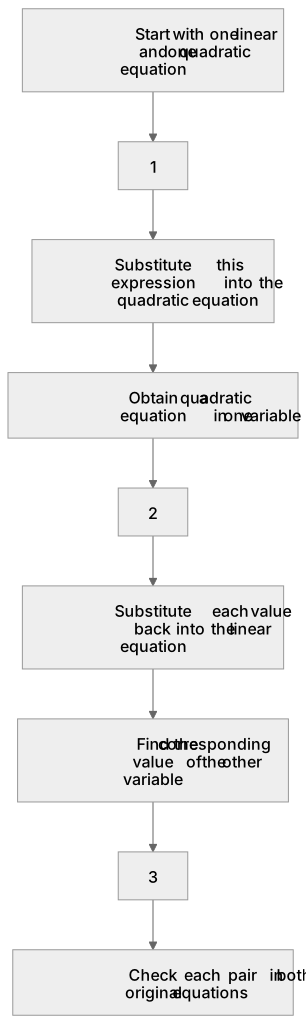
1Box 1
2Box 2
3Box 3
There is more to this lesson
The full lesson goes on to check your understanding and help you earn the marks. Create a free account to carry on, with your progress saved.
A week of Premium from your first lesson · Then the free plan continues · No card, no charge
Test your understanding of Solving equations and inequalities: including linear/quadratic (Higher tier only)
Active recall beats re-reading. Take an instant quiz now to test what you’ve learned and lock it into long-term memory.
A week of Premium from your first lesson · Then the free plan continues · No card, no charge