AQA · GCSE · Mathematics
Course version: 8300 · Version from Sept 2015
Solving equations and inequalities: including those with the unknown on both sides of the equation
When the unknown appears on both sides of a linear equation, first collect the unknown terms on one side and the constant terms on the other.
- 3 key terms
Study notes
From the checked teaching notes for this specification point.
The idea
When the unknown appears on both sides of a linear equation, first collect the unknown terms on one side and the constant terms on the other. For example, to solve 5x + 2 = 3x + 10, subtract 3x from both sides to get 2x + 2 = 10, then subtract 2 from both sides to get 2x = 8, and finally divide by 2 to get x = 4. The same balance principle applies: whatever operation you perform on one side must be performed on the other. You can also solve such equations graphically by plotting each side as a straight line and reading the x-coordinate of their intersection. Always check your solution by substituting it back into the original equation.
What earns the marks
- Collect the unknown terms on one side of the equation by adding or subtracting the same term from both sides.
- Collect the constant terms on the other side by adding or subtracting the same number from both sides.
- Divide or multiply both sides by the coefficient of the unknown to isolate it.
- Check the solution by substituting it back into the original equation and confirming both sides are equal.
- For a graphical approach, plot each side as a straight line and read the x-coordinate of the intersection point.
Common mistakes and how to put them right
Moving a term without changing its sign.
Put it right by remembering that adding or subtracting a term from both sides reverses its sign on the side it is moved from.
Collecting unknowns on the side that makes the coefficient negative.
Put it right by choosing to collect on the side that keeps the coefficient positive where possible, or by carefully handling negative coefficients.
Forgetting to divide the constant term by the coefficient.
Put it right by dividing every term by the coefficient of the unknown.
Reading the y-coordinate of the intersection point on a graph instead of the x-coordinate.
Put it right by identifying that the solution is the x-value where the two lines cross.
Exam tips
- Write down each step of your rearrangement so that method marks can be awarded even if the final answer is incorrect.
- After solving, substitute your value back into the original equation to check both sides are equal.
- In multiple-choice questions, substitute each option into the equation to see which one works, especially if you are unsure of your algebraic method.
Try the lesson
The start of the Solving equations and inequalities: including those with the unknown on both sides of the equation lesson, made from checked teaching notes for this specification point.
Have a go first
Solve the equation 7x + 3 = 3x + 23.
Listen
When the unknown appears on both sides of a linear equation, first collect the unknown terms on one side and the constant terms on the other. For example, to solve 5x + 2 = 3x + 10, subtract 3x from both sides to get 2x + 2 = 10, then subtract 2 from both sides to get 2x = 8, and finally divide by 2 to get x = 4. The same balance principle applies: whatever operation you perform on one side must be performed on the other. You can also solve such equations graphically by plotting each side as a straight line and reading the x-coordinate of their intersection. Always check your solution by substituting it back into the original equation. A strong answer earns marks for these points. Collect the unknown terms on one side of the equation by adding or subtracting the same term from both sides. Collect the constant terms on the other side by adding or subtracting the same number from both sides. Divide or multiply both sides by the coefficient of the unknown to isolate it. Check the solution by substituting it back into the original equation and confirming both sides are equal. A common slip: Moving a term without changing its sign. Instead, remembering that adding or subtracting a term from both sides reverses its sign on the side it is moved from. Exam tip: Write down each step of your rearrangement so that method marks can be awarded even if the final answer is incorrect.
See it
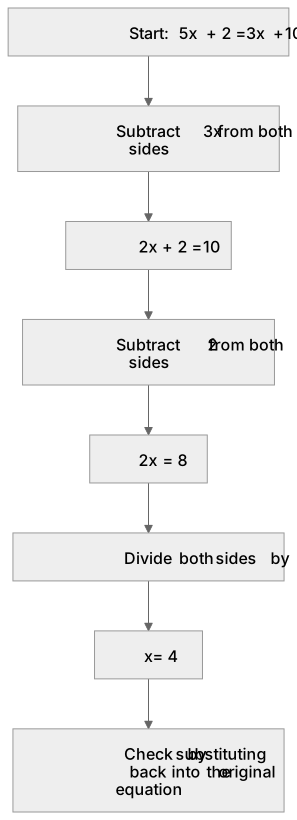
Put it in order
Put these steps in the order they happen.
- 1. Subtract 3x from both sides
- 2. 2x + 2 = 10
- 3. Subtract 2 from both sides
- 4. 2x = 8
- 5. Divide both sides by 2
- 6. x = 4
- 7. Check by substituting back into the original equation
- 8. Start: 5x + 2 = 3x + 10
Key words
Say what each word means before you turn the card.
Collecting like terms
Try answering aloud or in your head before turning the card.
Balancing equations
Try answering aloud or in your head before turning the card.
Graphical solutions
Try answering aloud or in your head before turning the card.
See every definition
- Collecting like terms
- Gathering the unknown terms on one side of the equation and the constant terms on the other.
- Balancing equations
- Applying the same balance principle so that whatever operation you perform on one side must be performed on the other.
- Graphical solutions
- Plotting each side as a straight line and reading the x-coordinate of their intersection.
Label the diagram
Some boxes have lost their names. Pick the right name for each number.
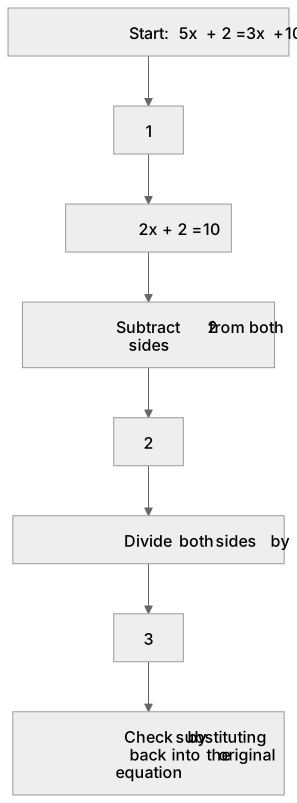
1Box 1
2Box 2
3Box 3
There is more to this lesson
The full lesson goes on to check your understanding and help you earn the marks. Create a free account to carry on, with your progress saved.
A week of Premium from your first lesson · Then the free plan continues · No card, no charge
Test your understanding of Solving equations and inequalities: including those with the unknown on both sides of the equation
Active recall beats re-reading. Take an instant quiz now to test what you’ve learned and lock it into long-term memory.
A week of Premium from your first lesson · Then the free plan continues · No card, no charge