AQA · GCSE · Mathematics
Course version: 8300 · Version from Sept 2015
Solving equations and inequalities: solve quadratic equations algebraically by factorising find approximate solutions using a graph
A quadratic equation has an x² term.
- 4 key terms
Study notes
From the checked teaching notes for this specification point.
The idea
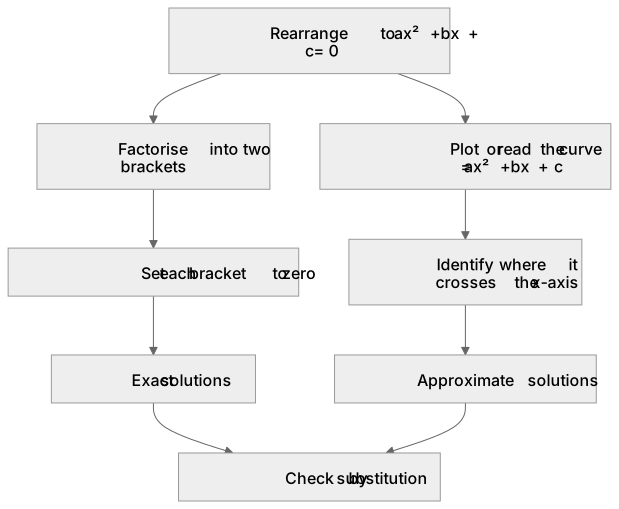
A quadratic equation has an x² term. To solve algebraically by factorising, rearrange to the form ax² + bx + c = 0, then factorise into two brackets. For x² + 5x + 6 = 0, find two numbers that multiply to 6 and add to 5: 2 and 3, so (x + 2)(x + 3) = 0. Setting each bracket to zero gives x = -2 or x = -3. If the coefficient of x² is not 1, factor out common factors or use appropriate factor pairs. To find approximate solutions using a graph, plot or read the curve y = ax² + bx + c and identify where it crosses the x-axis; those x-intercepts are the approximate roots. For example, from a graph the curve may cross near x = -2.1 and x = 0.6, so solutions are approximately -2.1 and 0.6. Always check by substitution.
What earns the marks
- Rearranges a quadratic equation into the standard form ax² + bx + c = 0 before factorising.
- Factorises a quadratic expression correctly, including cases where a common factor is taken out first.
- Uses the zero product property: if (x + p)(x + q) = 0 then x = -p or x = -q.
- Solves quadratic equations where the coefficient of x² is greater than 1 by factorising.
- Reads approximate solutions from the x-intercepts of the graph of y = ax² + bx + c.
- Checks algebraic solutions by substituting back into the original equation.
Common mistakes and how to put them right
Forgetting to rearrange to = 0 before factorising.
Put it right: First add 6 to both sides to get x² + 5x + 6 = 0, then factorise and set each bracket to 0.
Sign errors when finding the roots from brackets.
Put it right: Solve x + 2 = 0 to get x = -2 and x + 3 = 0 to get x = -3.
Reading the y-intercept instead of the x-intercepts from a graph.
Put it right: Approximate solutions are the x-values where the curve crosses the x-axis, not where it crosses the y-axis.
Exam tips
- Always rearrange the equation to the form ax² + bx + c = 0 before factorising, and show this step clearly.
- When using a graph, state that you are reading the x-axis intercepts and give your answers to a suitable degree of accuracy, such as one decimal place.
- Check each solution by substituting it back into the original equation; this catches sign errors quickly.
Try the lesson
The start of the Solving equations and inequalities: solve quadratic equations algebraically by factorising find approximate solutions using a graph lesson, made from checked teaching notes for this specification point.
Have a go first
Solve x² + 7x + 12 = 0 by factorising.
Listen
A quadratic equation has an x² term. To solve algebraically by factorising, rearrange to the form ax² + bx + c = 0, then factorise into two brackets. For x² + 5x + 6 = 0, find two numbers that multiply to 6 and add to 5: 2 and 3, so (x + 2)(x + 3) = 0. Setting each bracket to zero gives x = -2 or x = -3. If the coefficient of x² is not 1, factor out common factors or use appropriate factor pairs. To find approximate solutions using a graph, plot or read the curve y = ax² + bx + c and identify where it crosses the x-axis; those x-intercepts are the approximate roots. For example, from a graph the curve may cross near x = -2.1 and x = 0.6, so solutions are approximately -2.1 and 0.6. Always check by substitution. A strong answer earns marks for these points. Rearranges a quadratic equation into the standard form ax² + bx + c = 0 before factorising. Factorises a quadratic expression correctly, including cases where a common factor is taken out first. Uses the zero product property: if (x + p)(x + q) = 0 then x = -p or x = -q. Solves quadratic equations where the coefficient of x² is greater than 1 by factorising. A common slip: Forgetting to rearrange to = 0 before factorising; for example, solving x² + 5x = -6 by writing (x + 2)(x + 3) = -6 and then incorrectly setting each bracket to -6. Instead, first add 6 to both sides to get x² + 5x + 6 = 0, then factorise and set each bracket to 0. Exam tip: Always rearrange the equation to the form ax² + bx + c = 0 before factorising, and show this step clearly.
See it
Key words
Say what each word means before you turn the card.
Factorising quadratic expressions
Try answering aloud or in your head before turning the card.
Using graphs to find approximate roots
Try answering aloud or in your head before turning the card.
Checking solutions by substitution
Try answering aloud or in your head before turning the card.
Algebraic manipulation and rearrangement
Try answering aloud or in your head before turning the card.
See every definition
- Factorising quadratic expressions
- Rearranging a quadratic expression into two brackets, such as finding two numbers that multiply to the constant and add to the coefficient of x.
- Using graphs to find approximate roots
- Plotting or reading the curve y = ax² + bx + c and identifying where it crosses the x-axis, as those x-intercepts are the approximate roots.
- Checking solutions by substitution
- Substituting each solution back into the original equation to catch errors such as sign mistakes.
- Algebraic manipulation and rearrangement
- Rearranging a quadratic equation to the form ax² + bx + c = 0 before factorising.
Label the diagram
Some boxes have lost their names. Pick the right name for each number.
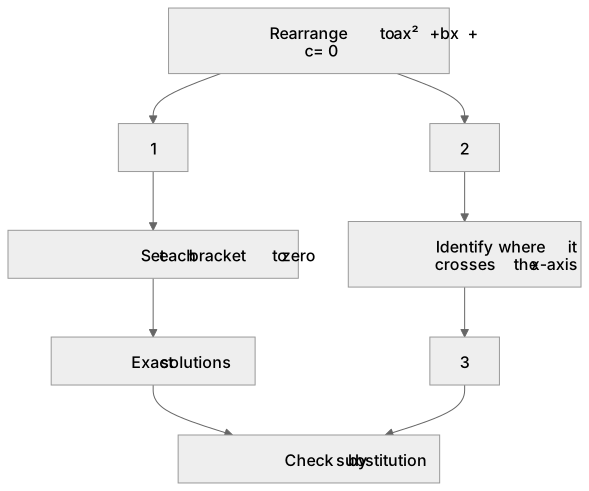
1Box 1
2Box 2
3Box 3
There is more to this lesson
The full lesson goes on to check your understanding and help you earn the marks. Create a free account to carry on, with your progress saved.
A week of Premium from your first lesson · Then the free plan continues · No card, no charge
Test your understanding of Solving equations and inequalities: solve quadratic equations algebraically by factorising find approximate solutions using a graph
Active recall beats re-reading. Take an instant quiz now to test what you’ve learned and lock it into long-term memory.
A week of Premium from your first lesson · Then the free plan continues · No card, no charge