AQA · GCSE · Mathematics
Course version: 8300 · Version from Sept 2015
Structure and calculation
From microscopic measurements to millions of people, standard form replaces strings of zeros with a coefficient and a power of ten. Master conversion, calculation and interpretation to secure marks on both AQA GCSE Mathematics tiers, including non-calculator questions. This guide focuses on N9 within section 3.1.1, not the whole Structure and calculation section.
- 11 min read
- 4 worked examples
- 8 practice questions
- 9 key terms
Try the lesson
The start of the Structure and calculation lesson, made from checked teaching notes for this specification point.
Have a go first
Write 4700 in standard form.
There is more to this lesson
The full lesson goes on to check your understanding and help you earn the marks. Create a free account to carry on, with your progress saved.
7 days Premium · Then the free plan continues · No card, no charge
Check what you remember
Read the wording for your board, then hide it and explain Standard form in your own words. Rough notes are fine. This is a self-check, with no mark or grade.
Reference: AQA
A positive number written as A × 10^n with 1 ≤ A < 10 and integer n.
Study Notes

Overview
Standard form makes enormous and tiny numbers easier to read, compare and calculate with. Instead of counting strings of zeros, candidates write a positive number as A × 10^n, where 1 ≤ A < 10 and n is an integer. The coefficient gives the significant digits; the power of ten gives the scale. For example, 45 000 becomes 4.5 × 10^4, while 0.00072 becomes 7.2 × 10^-4.
This guide covers AQA GCSE Mathematics 8300, 3.1.1 Structure and calculation, N9, not every objective in section 3.1.1. N9 is assessed on both Foundation and Higher tiers, with and without a calculator, including interpretation of calculator displays. No standard-form technique taught here is Higher-only; challenging questions combine shared skills rather than introducing a separate tier rule. 1
Typical questions ask candidates to convert numbers, work out calculations, order values, interpret measurements or solve a contextual problem. Links to integer indices, significant figures, ratio and unit conversion make the topic particularly useful. Marks depend on the particular question, not a fixed allocation for standard form. All newly written questions and marking breakdowns in this guide are original AQA-style practice, not official AQA questions or mark schemes.
Key Concepts
1. Coefficient, index and place value
In 3.2 × 10^5, 3.2 is the coefficient and 5 is the index, also called the exponent. Since 10^5 = 100 000, the number is 320 000. A coefficient of 1 is allowed; 10 is not. Consequently, 10 × 10^3 must become 1 × 10^4. Although 0.32 × 10^6 represents 320 000, it is not a valid final standard-form answer.
Powers of ten work because each multiplication by 10 changes a digit's place value by one position. Saying that the decimal point moves is a useful shortcut, but the underlying operation is multiplication or division. The decimal point itself is not a physical object being moved.
Cover and recall: Why does 10^0 equal 1 rather than 0? Dividing 10^1 by 10^1 gives 10^(1 - 1) = 10^0, and a non-zero number divided by itself is 1. A number such as 7.2 therefore becomes 7.2 × 10^0. Zero cannot satisfy the strict coefficient rule; write zero as 0. If a subtraction gives a negative answer, normalise its positive magnitude and keep the minus sign outside, for example -(3 × 10^4).
2. Converting ordinary numbers to standard form
For 45 000, choose the coefficient 4.5. The original is 10 000 times larger, so 45 000 = 4.5 × 10^4. The index is positive because the original positive number is at least 10. Check by multiplying back, not simply by trusting the number of zeros.
For 0.00072, choose 7.2. The original is 7.2 divided by 10 000, so 0.00072 = 7.2 × 10^-4. There are four place-value changes, not three. The initial zero before the decimal point does not count as a significant digit. A negative index means a reciprocal power of ten; it does not mean that the number is negative.
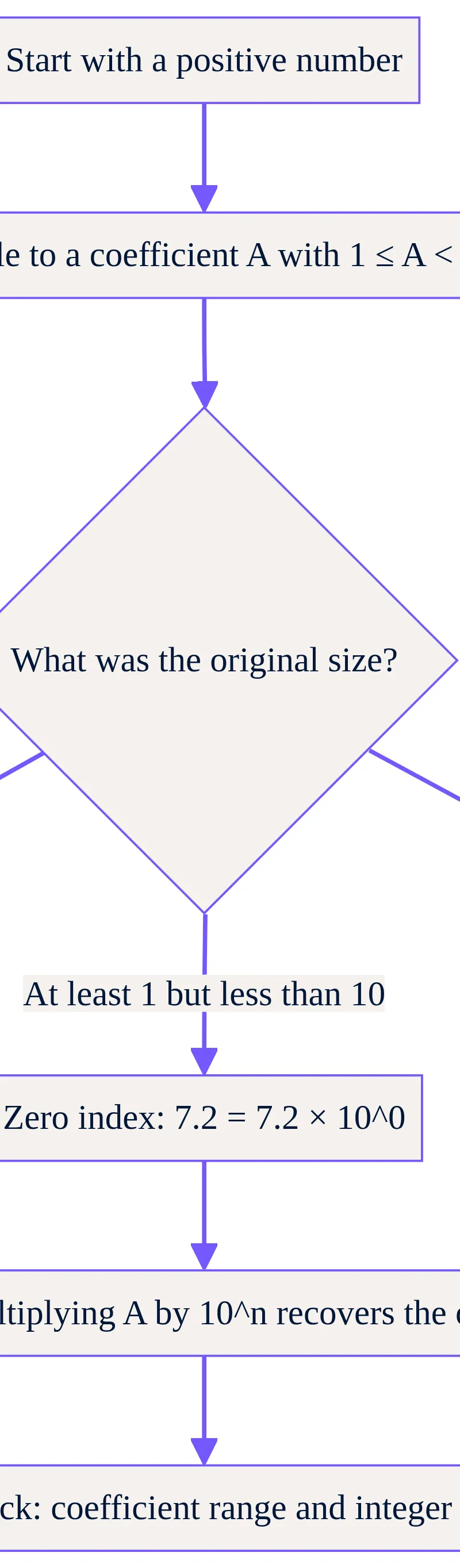
The useful memory hook is big number, positive scale; tiny positive number, negative scale. Use it for numbers at least 10 and numbers between 0 and 1. Values from 1 up to, but not including, 10 have index zero. Candidates should check all three cases rather than assuming every number needs a non-zero index.
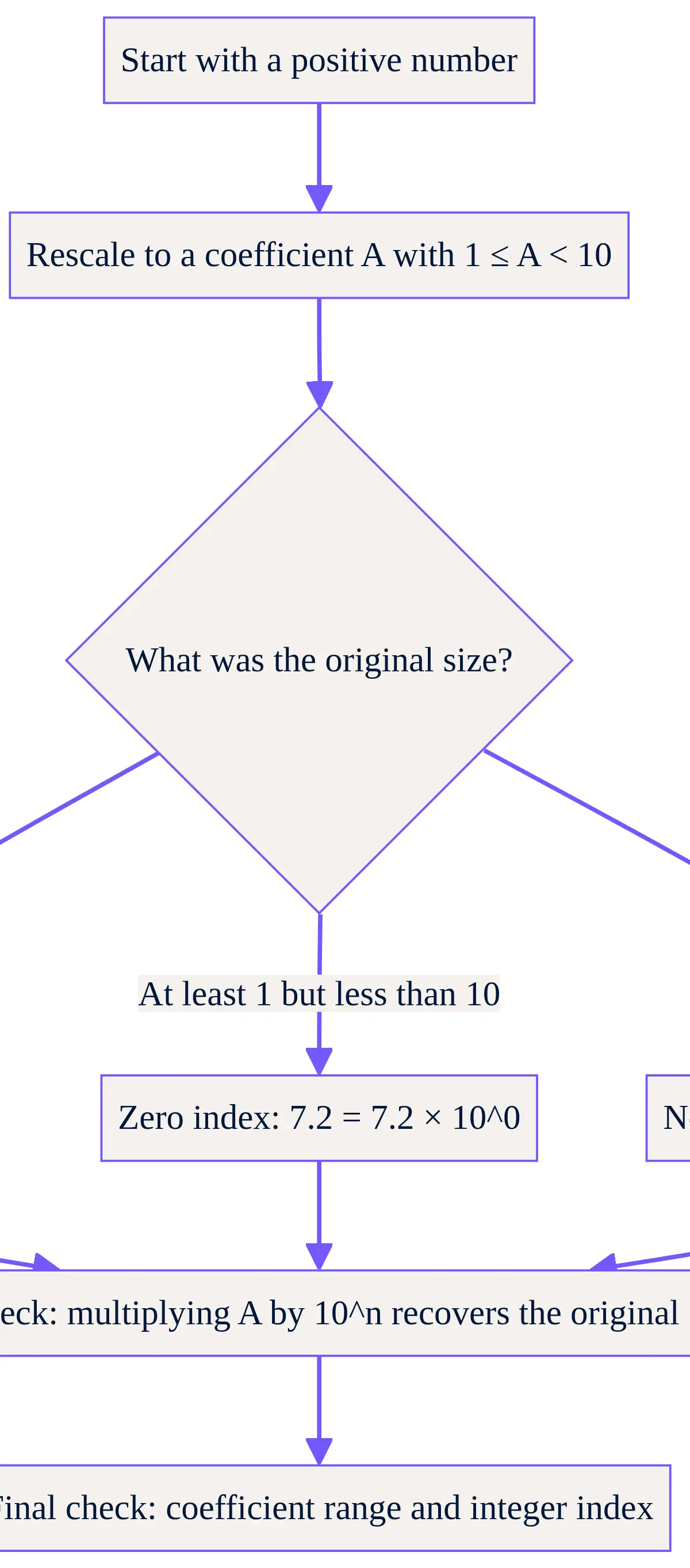
Why does this work? Replacing 45 000 with 4.5 makes the coefficient 10 000 times smaller. Multiplication by 10^4 compensates exactly. Standard form changes the notation, not the value.
3. Converting back and interpreting a calculator display
Evaluate the power first: 3.2 × 10^5 = 3.2 × 100 000 = 320 000. For a negative index, 6.4 × 10^-3 = 6.4 ÷ 1000 = 0.0064. Keep the digits in order, inserting zeros as place holders where needed. The quick size check is that the second answer is positive and smaller than 1.
A calculator display such as 3.2E5 means 3.2 × 10^5. A display 7.2E-4 means 7.2 × 10^-4. E is display notation, not a variable and not an instruction to multiply by the displayed index. Write conventional standard form on the answer line when requested.
The exponent-entry key may be labelled EXP, EE or ×10^x, depending on the calculator. Practise with your own model. For division, bracket the whole denominator, including its coefficient and power. Check the calculation against an estimate. Paper 1 is non-calculator; calculators are allowed on Papers 2 and 3. 2
4. Multiplication: two separate tracks
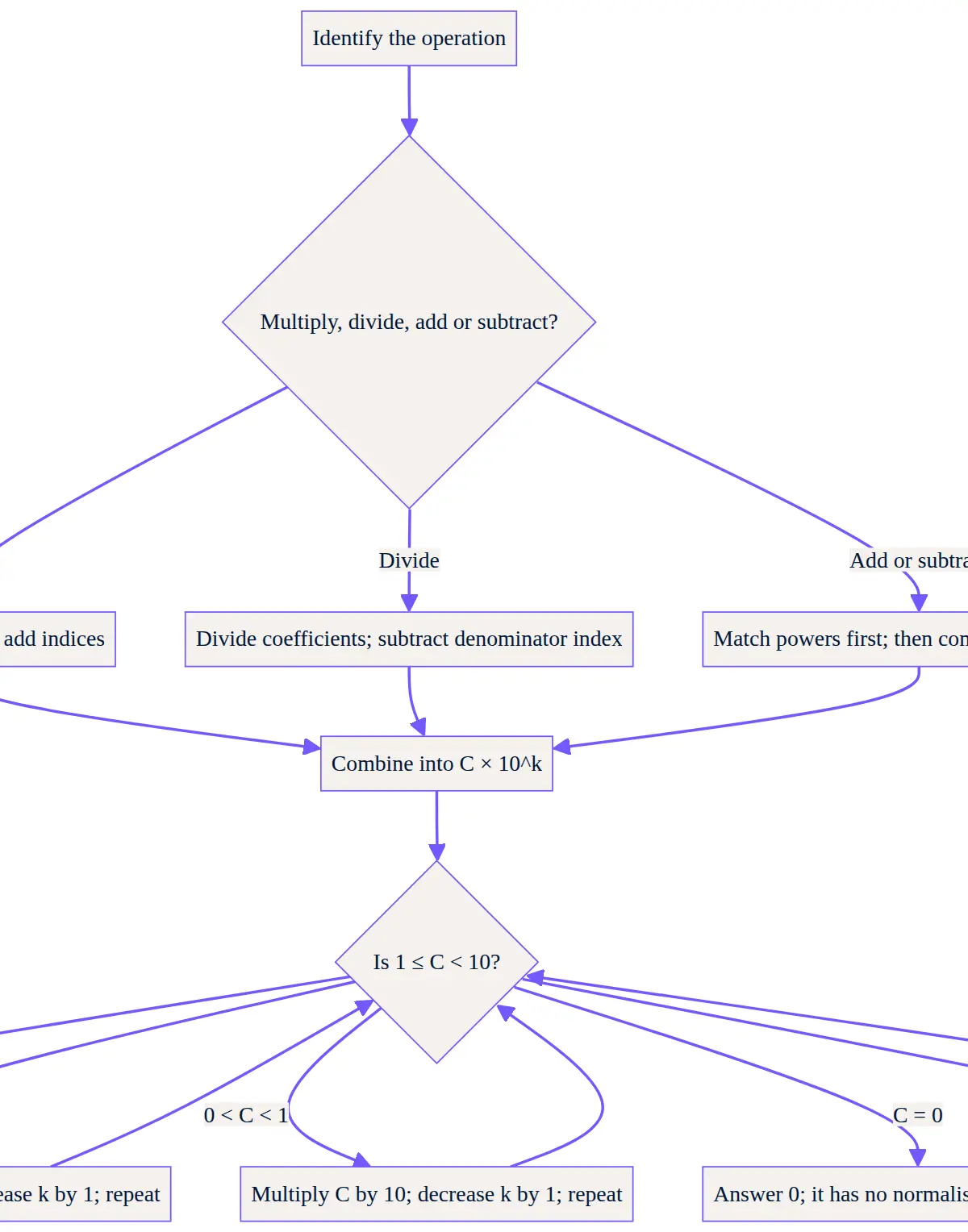
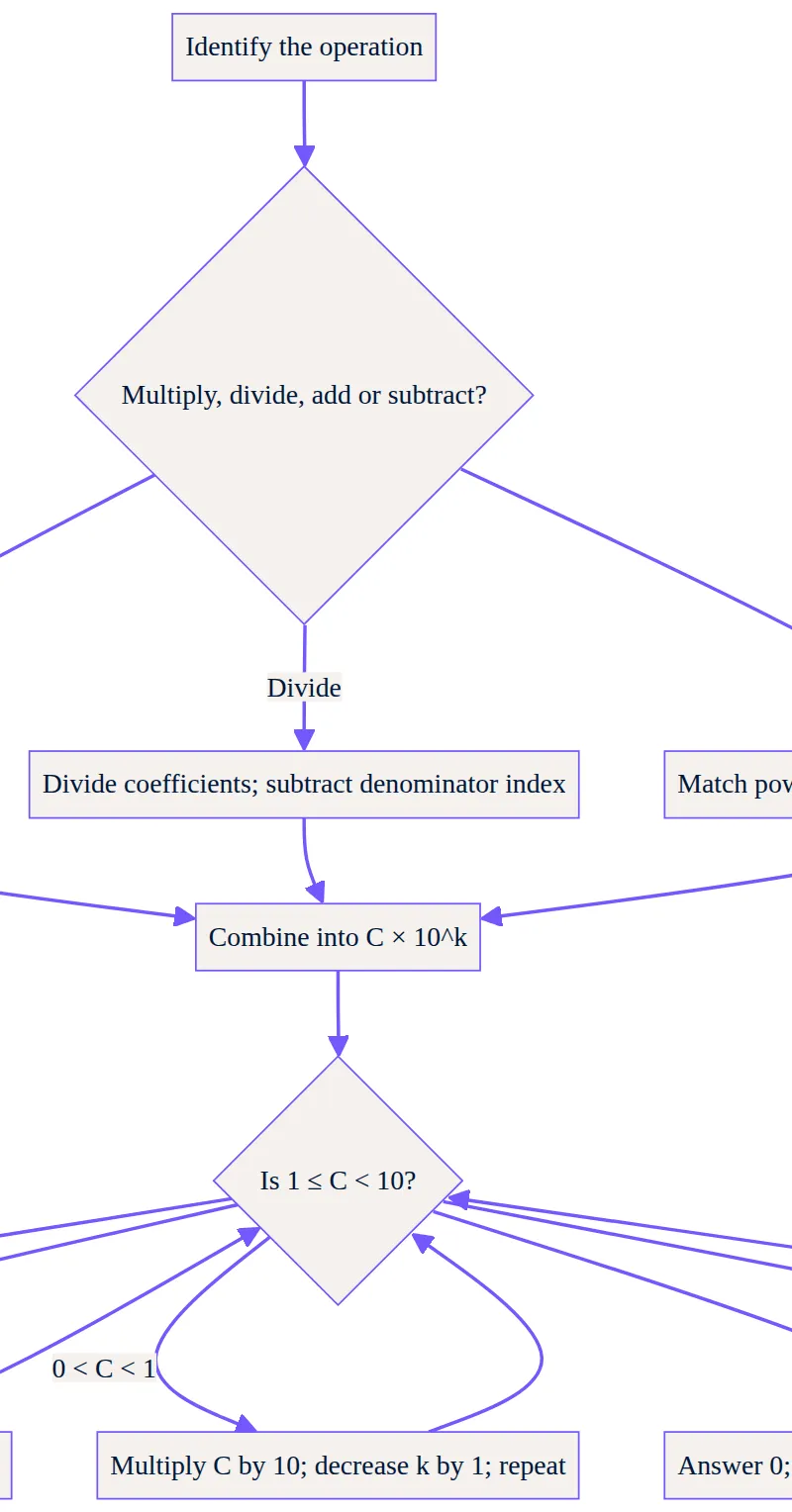
Use multiply coefficients, add indices. For (2 × 10^3)(4 × 10^5), calculate 2 × 4 = 8 and 3 + 5 = 8, giving 8 × 10^8. Adding the indices follows from multiplying powers with the same base. You are not adding the original numbers.
If the coefficient is too large, normalise it. For (3 × 10^4)(5 × 10^-2), the intermediate result is 15 × 10^2. Since 15 = 1.5 × 10, the final answer is 1.5 × 10^3. Divide the coefficient by 10 and increase the index by 1. Repeat if needed.
An equivalent ordinary number is useful for checking, but it may not meet an instruction to give the answer in standard form. Cover and recall: What final correction is needed for 24 × 10^-7? Answer: 2.4 × 10^-6. Increasing the index from -7 to -6 makes the scale larger, even though both indices remain negative.
5. Division: subtract the denominator index
Use divide coefficients, subtract indices. For (6 × 10^7) ÷ (2 × 10^2), 6 ÷ 2 = 3 and 7 - 2 = 5, so the answer is 3 × 10^5. Keep the numerator's index first.
A negative denominator index requires brackets: (6 × 10^7) ÷ (2 × 10^-2) = 3 × 10^(7 - (-2)) = 3 × 10^9. Dividing by a small positive number makes the result larger, so this index is sensible.
If the coefficient is below 1, normalise in the opposite direction. (2.4 × 10^3) ÷ (8 × 10^5) = 0.3 × 10^-2 = 3 × 10^-3. Multiply the coefficient by 10 and decrease the index by 1. Both changes preserve the value. The phrase coefficient down, index up; coefficient up, index down prevents an unbalanced correction.
6. Addition and subtraction: match the scale first
You cannot directly combine coefficients whose powers differ, because they describe different-sized units. For 3.2 × 10^4 + 4.5 × 10^3, rewrite the second term as 0.45 × 10^4. Then (3.2 + 0.45) × 10^4 = 3.65 × 10^4. A temporary coefficient below 1 is permitted in working; the final answer must be normalised.
Subtraction follows the same principle: 5 × 10^6 - 8 × 10^5 = (5 - 0.8) × 10^6 = 4.2 × 10^6. Do not subtract the indices. Alternatively, convert both terms to ordinary numbers, calculate, then convert back. Credit is given for valid alternative methods under AQA's marking principles. 4
What if the sum crosses ten? 8.7 × 10^4 + 2.5 × 10^4 = 11.2 × 10^4 = 1.12 × 10^5. Matching powers does not remove the need for a final coefficient check.
7. Comparing numbers and rounding
For positive, normalised numbers, compare indices first. A number with index -3 is larger than one with index -4, irrespective of their permitted coefficients. Thus 9 × 10^-4 < 1.2 × 10^-3. If the indices match, compare coefficients: 3.4 × 10^6 < 5.1 × 10^6. Normalise before applying this shortcut.
Round only when instructed or when the context demands an appropriate accuracy. To round 9.96 × 10^5 to two significant figures, 9.96 becomes 10, so the final answer is 1.0 × 10^6. The zero records two significant figures. Do not leave 10 × 10^5, and do not round intermediate calculations prematurely. AQA explicitly includes appropriate rounding and warns against rounding during intermediate steps. 1
Mathematical Relationships
Every relationship below is Must memorise. The 2027 AQA Foundation and Higher formula sheets do not supply standard-form rules or integer index laws. This does not mean no formula sheet is provided: a sheet is supplied, but it contains other formulae. 3 5 6
Definition, Must memorise: x = A × 10^n, with 1 ≤ A < 10 and integer n, for positive x. A is the coefficient and n the index.
Powers, Must memorise: 10^0 = 1; 10^-k = 1/10^k. For integer indices p and q, 10^p × 10^q = 10^(p + q), 10^p ÷ 10^q = 10^(p - q), and (10^p)^q = 10^(pq).
Multiplication and division, Must memorise: (a × 10^p)(b × 10^q) = ab × 10^(p + q); (a × 10^p)/(b × 10^q) = (a/b) × 10^(p - q), with b non-zero. Normalise afterwards.
Matching powers, Must memorise: b × 10^q = (b × 10^(q - p)) × 10^p. Therefore a × 10^p ± b × 10^q = (a ± b × 10^(q - p)) × 10^p.
Normalisation, Must memorise: C × 10^k = (C/10) × 10^(k + 1) = (10C) × 10^(k - 1). Choose the direction that brings the positive magnitude into range.
Context formulas, Must memorise: speed = distance/time; density = mass/volume; number of equal pieces = total length/length per piece. Use consistent units. For an integer r, (A × 10^n)^r = A^r × 10^(nr), followed by normalisation. Fractional indices are Higher-only N7 content and are outside this guide. 1
Practical Applications and Unit Conversions
Standard form appears in populations, scientific measurements, data storage and distances. 5 × 10^-3 m = 0.005 m = 5 mm. Converting metres to millimetres multiplies the numerical value by 1000 because millimetres are smaller units. Converting back divides by 1000.
Metric facts, Must memorise: 1 km = 10^3 m; 1 m = 10^2 cm = 10^3 mm; 1 kg = 10^3 g; 1 minute = 60 seconds. Do not treat every conversion as a power of ten. For area, 1 m² = 10^4 cm² = 10^6 mm². For volume, 1 m³ = 10^6 cm³ = 10^9 mm³. Length factors must be squared or cubed when the units are squared or cubed.
A wire of length 2.4 × 10^2 m cut into pieces of length 8 × 10^-3 m gives (2.4/8) × 10^(2 - (-3)) = 0.3 × 10^5 = 3 × 10^4 pieces, assuming no material is lost. State that assumption when interpreting the answer. There is no required practical for this Mathematics objective.
Graph and Data Skills
Read the scale label before a table or graph. If an axis is labelled population (×10^6), a reading of 3.5 represents 3.5 × 10^6 people. On an ordinary linear scale, equal numerical steps have equal spacing. If plotting 2 × 10^4 and 5 × 10^4, you can label the axis in units of 10^4 and plot 2 and 5, clearly stating the multiplier. Do not silently treat an ordinary axis as logarithmic. Match units and scales before comparing datasets.
Learn Actively and Listen
The ten-minute episode contains an introduction at 00:00, core concepts at 01:00, exam tips at 06:00, a recall quiz at 08:00 and a summary at 09:00. Listen with the written examples covered; predict each answer before hearing the explanation. Then solve one conversion, one multiplication and one addition without notes. Check errors immediately, try again tomorrow and revisit mixed questions later in the week. The purpose is accurate retrieval and method selection, not familiarity from rereading.
References
Worked Examples
4 worked examples — open one to explore the question and available guidance.
Practice Questions
Try the question, then reveal an answer plan or example response
Original practice: Write (a) 45 000 and (b) 0.00072 in standard form. [2 marks]
Hint: Choose a coefficient between 1 and 10, then check the original size.
Original practice: Write 3.2 × 10^5 as an ordinary number. A calculator shows 7.2E-4. Write that display as an ordinary decimal. [2 marks]
Hint: E-4 means multiply by 10^-4.
Original practice: Work out (2.5 × 10^4) × (6 × 10^-3). Give your answer in standard form and show working. [3 marks]
Hint: Calculate 2.5 × 6 and 4 + (-3), then check the coefficient.
Original practice: Work out (2.4 × 10^3) ÷ (8 × 10^5). Give your answer in standard form and show working. [3 marks]
Hint: The coefficient is initially less than 1.
Original practice: Work out 3.2 × 10^4 + 4.5 × 10^3. Give your answer in standard form and show working. [3 marks]
Hint: Rewrite 4.5 × 10^3 using 10^4, or use ordinary numbers.
Original practice: Put these numbers in ascending order: 9 × 10^-4, 1.2 × 10^-3, 7.5 × 10^-5. Explain which comparison you use first. [2 marks]
Hint: All three positive coefficients are normalised. Which index is smallest?
Original practice: A rectangular film measures 5 × 10^-3 m by 2 × 10^-3 m. Work out its area in m² in standard form, then convert that area to mm². Show working. [4 marks]
Hint: 1 m² = 10^6 mm² because 1 m = 10^3 mm.
Original practice: (a) Round 9.96 × 10^5 to two significant figures, giving the result in standard form. (b) Evaluate (3 × 10^-2)^2, giving the result in standard form. [3 marks]
Hint: Rounding can make a coefficient reach 10. Squaring applies to the whole bracket.
Exam technique
How to turn what you know into marks
How to approach the question
Read the command and required answer form. Identify the operation and any unit conversion. Estimate the size. Show coefficient and index work, normalise, then check coefficient range, index sign and units. In multi-step questions, keep unrounded values until the final answer.
How to structure your answer
For a 1-mark conversion, give the requested number accurately. For 2-3 marks, show a relevant method and the correctly formatted final answer. For 4-6 marks, write linked stages: conversion if needed, calculation, normalisation and contextual conclusion. Actual allocations vary. AQA's June 2024 8300/2H mark scheme Q6 awards B1 for 6.4 × 10^-14 and accepts equivalent standard form such as 6.40 × 10^-14. Published scheme: https://examsolutions.s3.eu-west-2.amazonaws.com/exam+papers/maths/2024/AQA-83002H-MS-JUN24.PDF . M means method, A accuracy and B independent of method. A correct answer can imply working where the question and scheme permit; explicit show-working instructions still matter. Follow-through is not automatic.
Timing
AQA papers are 90 minutes for 80 marks, an overall average of 1.125 minutes per mark. Aim initially for about 1 minute per mark, so 3-mark questions take around 3 minutes and 6-mark questions around 6 minutes, preserving time for checking. This is revision advice, not an AQA question-by-question time rule.
Common pitfalls
- Leaving A = 10 or A < 1: normalise the final positive magnitude so 1 ≤ A < 10.
- Counting zeros instead of place-value changes: reconstruct the original number to check the index.
- Thinking a negative index means a negative number: 10^-n is a positive reciprocal power of ten.
- Adding coefficients during multiplication: multiply coefficients and add only the indices.
- Adding or subtracting indices during addition: match powers before combining coefficients.
- Mishandling p - (-q): write brackets and turn subtraction of a negative into addition.
- Changing the coefficient without balancing the index: apply the opposite factor-of-ten change to the scale.
- Using a length conversion factor for an area or volume: square or cube the factor.
- Misreading E notation or leaving a denominator unbracketed: practise correct entry on your own calculator.
- Rounding during the calculation: retain exact or unrounded intermediate values and round only the final result when asked.
What the command words want
- Explain
- Give a mathematical reason linked to evidence, for example because 12 is not less than 10, or because 30 minutes is less than 32 minutes.
- Estimate
- Use sensible rounded inputs and calculate an approximation. State the rounding so the estimate can be checked.
- Evaluate
- In a numerical Mathematics question, find the value of the expression. Do not write a discussion of advantages and disadvantages.
- Show that
- Provide convincing steps leading to the stated result; merely copying the result is insufficient.
- Write/Give
- Supply the requested answer or representation, including units if relevant. In standard-form questions, notation matters; this is not necessarily a 1-2-word response.
- Compare/Order
- Use a common representation or compare normalised positive indices then coefficients. Give the requested order or quantified comparison.
- Work out/Calculate
- Find the numerical result, show a useful method and include appropriate units. Normalise when standard form is requested.
Watch or listen (optional)
Test your understanding of Structure and calculation
Active recall beats re-reading. Take an instant quiz now to test what you’ve learned and lock it into long-term memory.
7 days Premium · Then the free plan continues · No card, no charge