AQA · GCSE · Mathematics
Course version: 8300 · Version from Sept 2015
Structure and calculation
Turn awkward square roots into exact answers that earn marks. This Higher-tier guide explains how to simplify and calculate with surds, rationalise denominators and show clear working when algebra and geometry bring these skills together.
- 11 min read
- 4 worked examples
- 6 practice questions
- 10 key terms
Try the lesson
The start of the Structure and calculation lesson, made from checked teaching notes for this specification point.
Have a go first
Write √50 in the form k√2, where k is an integer.
There is more to this lesson
The full lesson goes on to check your understanding and help you earn the marks. Create a free account to carry on, with your progress saved.
7 days Premium · Then the free plan continues · No card, no charge
Check what you remember
Read the wording for your board, then hide it and explain Surd in your own words. Rough notes are fine. This is a self-check, with no mark or grade.
Reference: AQA
An irrational root expressed in exact root form; in this guide, typically the square root of a positive integer that is not a perfect square.
Study Notes

Overview
An exact answer keeps every part of a number's value. Surds let candidates express irrational lengths and solutions without replacing them with rounded decimals. This guide covers AQA GCSE Mathematics 8300, section 3.1.1, N8, specifically exact calculation with surds, simplifying square-root expressions and rationalising denominators. These are Higher-only requirements, not the whole of the broader Structure and calculation section. Ordinary square numbers, factors and fraction arithmetic are prerequisite skills shared with Foundation. 1
Expect questions asking candidates to simplify, multiply out, rationalise, or give an answer in a specified exact form. Surds can also appear inside Pythagoras problems, quadratic solutions and geometrical reasoning. A calculator may check a value on Papers 2 and 3, but a decimal approximation does not replace an exact answer. Each AQA paper lasts 90 minutes and carries 80 marks; Paper 1 does not allow a calculator. 2
Your target is a reliable sequence: identify the operation, choose the correct rule, show a valid method, and finish in the requested form. The worked and practice questions here are original AQA-style teaching questions. Their mark allocations are illustrative, not official AQA mark schemes.
Key Concepts
1. Exact values, irrational numbers and surds
A rational number can be written as p/q, where p and q are integers and q is not zero. An irrational number cannot. For this topic, a surd is an irrational root kept in exact root notation. Thus √2 and √3 are surds, but √9 = 3 is not. The decimal expansion of an irrational number neither terminates nor repeats.
The radical symbol √ means the non-negative square root. Therefore √25 = 5, not ±5. However, solving x² = 25 gives x = ±5 because either sign squares to 25. This distinction prevents errors when surds occur in equations.
Example: A square of area 12 cm² has side length √12 cm, exactly. The decimal 3.46 cm is only an approximation. Candidates asked for an exact length should give 2√3 cm after simplification. Units describe the quantity, not the surd operation.
Cover and recall: Why is √16 not a surd, while √15 is? Explain without calculating either decimal.
2. Simplifying by extracting square factors
A square factor is a factor such as 4, 9, 16, 25 or 36. To simplify √n, write n as a square factor multiplied by another positive integer. Then use √(ab) = √a × √b. The square root of the square factor becomes an ordinary coefficient outside the radical.
Example: √72 = √(36 × 2) = √36 × √2 = 6√2. The largest square factor makes the route shorter. Using 4 first also works: √72 = 2√18 = 2 × 3√2 = 6√2. Credit is not restricted to the shortest valid method.
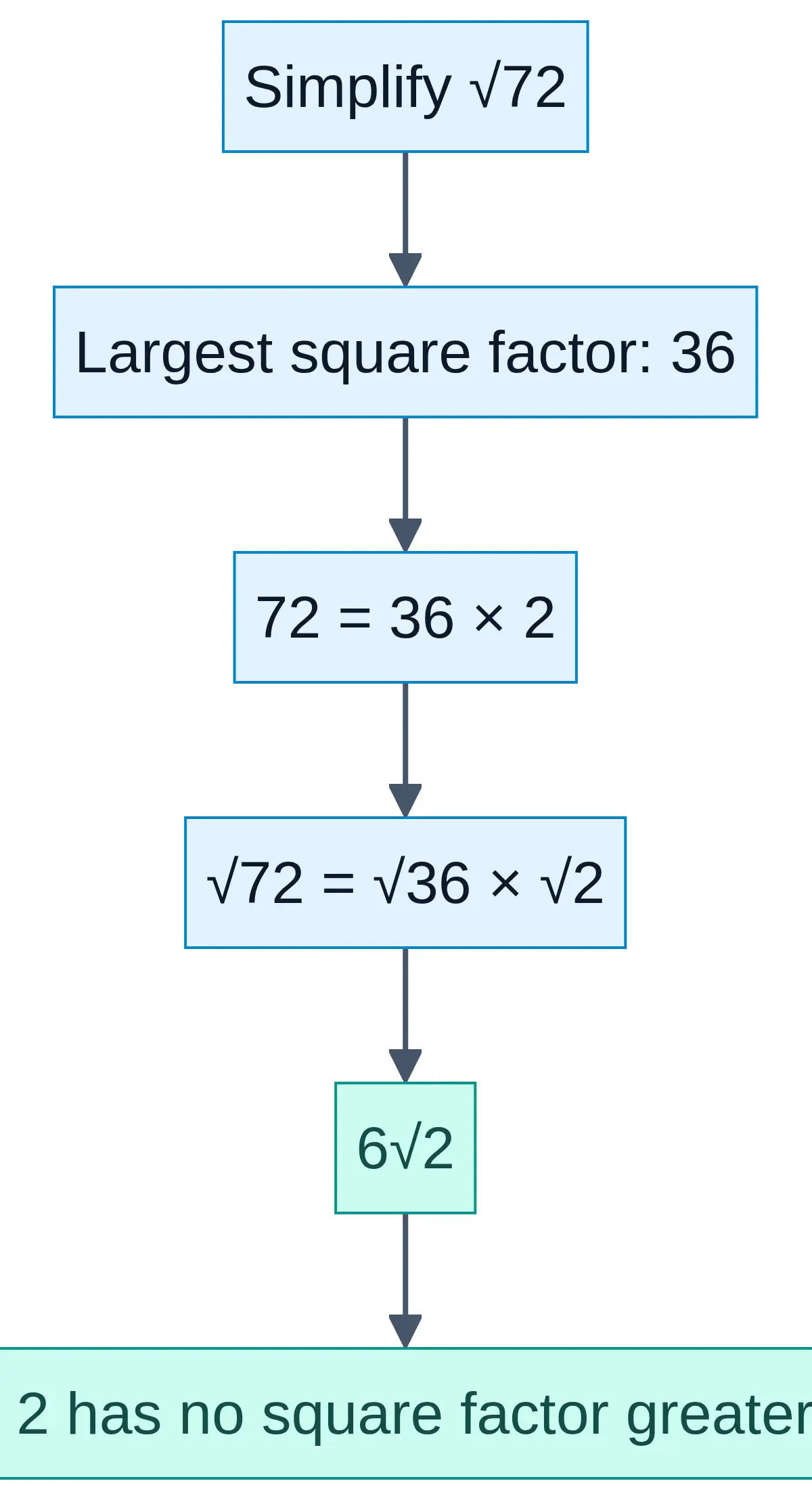
Why does this work? The square of 6√2 is 36 × 2 = 72, and 6√2 is non-negative. It must therefore be the non-negative square root of 72. A surd is fully simplified when the integer under its radical has no square factor greater than 1.
If square factors are difficult to spot, use prime factorisation. Since 180 = 2² × 3² × 5, the pairs of equal factors come outside: √180 = 2 × 3√5 = 6√5. Remember: pairs leave the root; unpaired factors stay. For an expression such as 3√20, simplify the surd and multiply the outside coefficients: 3 × 2√5 = 6√5.
3. Adding and subtracting like surds
Surds combine like algebraic terms. Just as 3x + 5x = 8x, we have 3√2 + 5√2 = 8√2. Here √2 is the common factor. Add or subtract the coefficients, but leave the shared radicand unchanged.
Example: √50 + √8 − √18 = 5√2 + 2√2 − 3√2 = 4√2. Simplifying first reveals that terms which initially look different are like terms.
In contrast, √2 + √3 has no common surd factor of this kind and cannot be combined into one simpler surd. It is not √5. A useful check is squaring: (√2 + √3)² = 5 + 2√6, whereas (√5)² = 5. These are different numbers.
Candidates should also reject √(a + b) = √a + √b as a general rule. For example, √(9 + 16) = 5, whereas √9 + √16 = 7. Split products, not sums. The product rule has specific conditions and does not distribute a square root over addition.
4. Multiplying, dividing and expanding
When multiplying surd terms, multiply the coefficients separately from the roots. Example: 2√3 × 4√5 = 8√15. If the new radicand has a square factor, simplify again: 3√6 × 2√10 = 6√60 = 12√15.
Division follows the quotient rule when the numerator radicand is non-negative and the denominator radicand is positive. For example, √18/√2 = √9 = 3. Keep any ordinary coefficients in the calculation too: (6√18)/(2√2) = 3√9 = 9.
Brackets use exactly the same distributive law as algebra. Example: (2 + √3)(4 − √3) = 8 − 2√3 + 4√3 − 3 = 5 + 2√3. Write all four products before collecting terms. The product √3 × √3 is 3, not 3√3.
Squaring a bracket means multiplying it by itself: (2 + √3)² = 4 + 4√3 + 3 = 7 + 4√3. The middle term is essential. Candidates who write 4 + 3 have incorrectly treated the square as if it distributed over addition.
5. Rationalising a single-term denominator
Rationalising means rewriting an equivalent fraction so its denominator is rational. A surd in the numerator is allowed. Multiplying top and bottom by the same non-zero quantity preserves the value because the multiplier is 1.
Example: 6/√3 = (6 × √3)/(√3 × √3) = 6√3/3 = 2√3. Write the multiplier explicitly when showing a method. AQA's updated specimen Paper 1 Higher mark scheme, question 26, specifically requires multiplying both numerator and denominator for its rationalising method mark. 4
For a denominator with an ordinary coefficient, keep that coefficient. Example: 5/(2√3) = 5√3/(2 × 3) = 5√3/6. The 2 is not also squared. Simplifying a denominator first can shorten the calculation: 4/√8 = 4/(2√2) = √2.
Why is multiplying only the numerator wrong? Replacing 6/√3 with 6√3/√3 changes the value to 6. The operation has multiplied the original value by √3 rather than by 1. Mathematical equivalence must be maintained at every line.
6. Rationalising a binomial denominator
A binomial has two terms. The conjugate of a + √b is a − √b, and vice versa. Multiplying conjugates cancels the two opposite surd terms, using the difference of two squares.
Example: 1/(3 + √2) = (3 − √2)/[(3 + √2)(3 − √2)] = (3 − √2)/(9 − 2) = (3 − √2)/7. The denominator is now rational and the value has not changed.
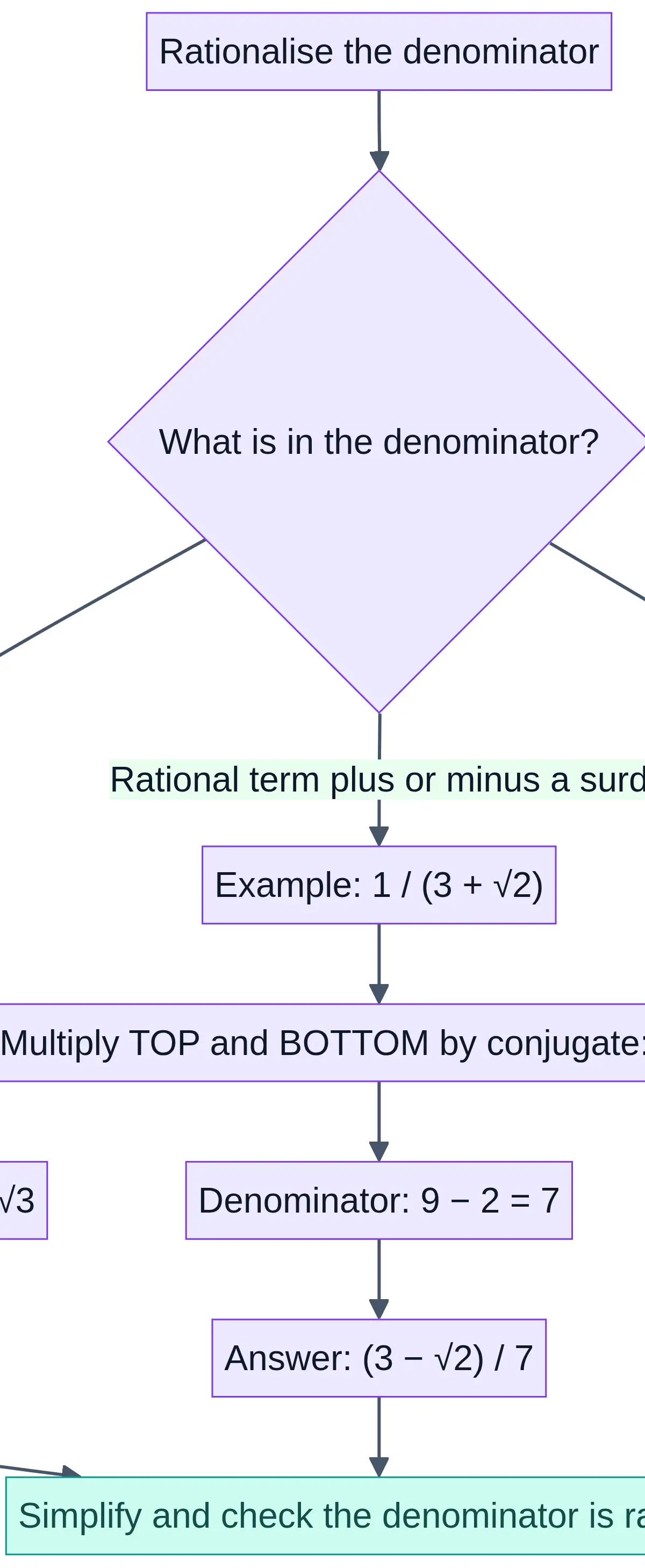
If the original denominator is 4 − √3, use 4 + √3. If it is 2 + 3√5, use 2 − 3√5. Square the entire surd term: (3√5)² = 9 × 5 = 45. Therefore (2 + 3√5)(2 − 3√5) = 4 − 45 = −41. A negative intermediate denominator is mathematically valid; reverse the numerator signs if moving that negative sign.
For √5 + √2, its conjugate √5 − √2 gives denominator 5 − 2 = 3. The same cancellation principle applies when both terms are surds. Never multiply by an expression equal to zero; any original fraction must also have a non-zero denominator.
7. Checking exact answers and comparison questions
First check the requested form, such as a√b with b having no square factor greater than 1, or (a + b√c)/d. Then check that any fraction is reduced and the denominator has no surd if rationalising was requested.
Approximation is useful as a check, not as a replacement answer. Since 64 < 72 < 81, we know 8 < √72 < 9. Thus 6√2, which is about 8.49, is plausible; 3√2 is not. On a non-calculator paper, bounding between square numbers gives a fast reasonableness check.
For positive numbers, comparison can use squares. To compare 3√2 and 4, calculate (3√2)² = 18 and 4² = 16, so 3√2 > 4. This inference works because both original values are positive. It cannot be applied blindly to negative numbers, whose ordering behaves differently when squared.
Mathematical Relationships
Must memorise below means that the relationship is not printed on the current 2027 Higher formula sheet. Understand it well enough to use or derive it fluently. The sheet is provided in 2027, but it is not a surds rulebook. 5 6
Must memorise: root rules. √(ab) = √a√b for a,b ≥ 0; √(a/b) = √a/√b for a ≥ 0,b > 0; (√a)² = a for a ≥ 0; √(k²a) = |k|√a for real k and a ≥ 0. In positive-integer simplification examples, |k| is simply k. Also √(x²) = |x|, not always x.
Must memorise: surd arithmetic. p√a ± q√a = (p ± q)√a; (p√a)(q√b) = pq√(ab), for non-negative a and b. Here p and q are real coefficients, while a and b are the radicands.
Must memorise: brackets and conjugates. (u + v)(u − v) = u² − v²; (u ± v)² = u² ± 2uv + v²; (a + b√c)(a − b√c) = a² − b²c, with c ≥ 0. The letters represent real numbers, subject to any denominator being non-zero.
Must memorise: rationalising templates. m/(k√n) = m√n/(kn), for n > 0,k ≠ 0; m/(a + b√c) = m(a − b√c)/(a² − b²c), for c ≥ 0 and a² − b²c ≠ 0. The matching minus-denominator version uses the plus conjugate. Learn the reasoning rather than treating these templates as unexplained tricks.
Given on formula sheet, 2027 Higher: a² + b² = c² for a right-angled triangle with hypotenuse c; x = (−b ± √(b² − 4ac))/(2a) for ax² + bx + c = 0,a ≠ 0. These linked formulae can generate surd answers. Must memorise: rectangle area A = lw and perimeter P = 2(l + w). 6
Practical Applications and Synoptic Skills
A square patio with area 18 m² has exact side length 3√2 m. A diagonal across a 2 m by 3 m rectangle is √13 m by Pythagoras. Exact values avoid introducing rounding before a later area, perimeter or comparison calculation. There is no required practical for this mathematics topic.
Quadratic equations can give irrational solutions. For instance, x² − 6 = 0 gives x = ±√6. Geometry then selects the positive solution if x represents a length. This is a genuine cross-topic application; merely naming another topic earns no automatic extra marks.
There is no dedicated graph-plotting requirement within N8. For a related quadratic graph, x² = 6 corresponds to intersections of y = x² and y = 6 at x = ±√6. A graph gives approximate readings; algebra gives exact surd coordinates.
Must memorise: unit conversions. 1 m = 100 cm, but 1 m² = 10,000 cm². Therefore 2√3 m = 200√3 cm, whereas 12 m² = 120,000 cm². Convert lengths using the linear factor and areas using its square. Pure surd expressions without a physical quantity need no units.
Listen, Retrieve and Apply
Listen once, then close the guide and reconstruct the six main rules from memory. Try one simplification, one mixed-surd sum and one rationalising question before checking solutions. Revisit missed skills tomorrow and again later in the week. This is retrieval practice, not another passive reading session.
Ask yourself why conjugates remove the surd and what changes if the denominator sign changes. When explaining an error, provide a numerical counterexample or an algebraic reason, not simply a claim that the rule is wrong. AQA requires evidence for instructions such as Show that and Give a reason. 3
References
Visual Resources
2 diagrams and illustrations
Interactive Diagrams
2 interactive diagrams to visualise key concepts
Conceptual Flow Outline
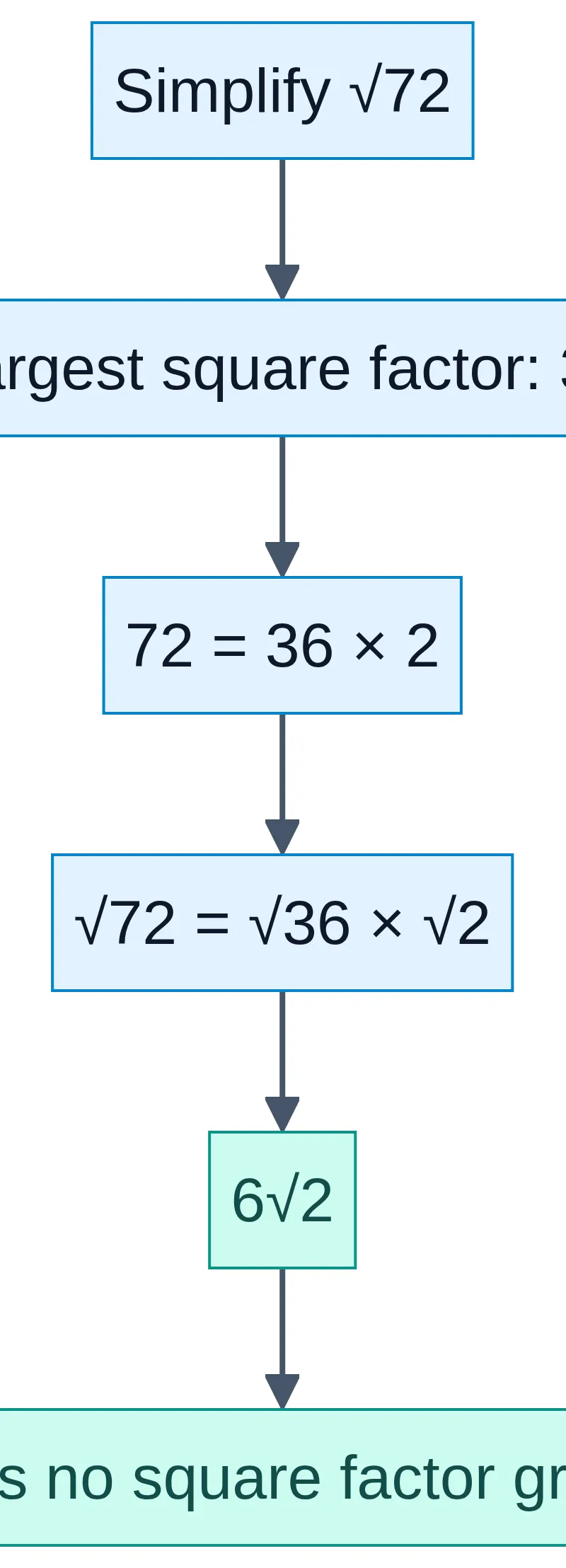
The square-factor simplification sequence for √72.
Conceptual Flow Outline
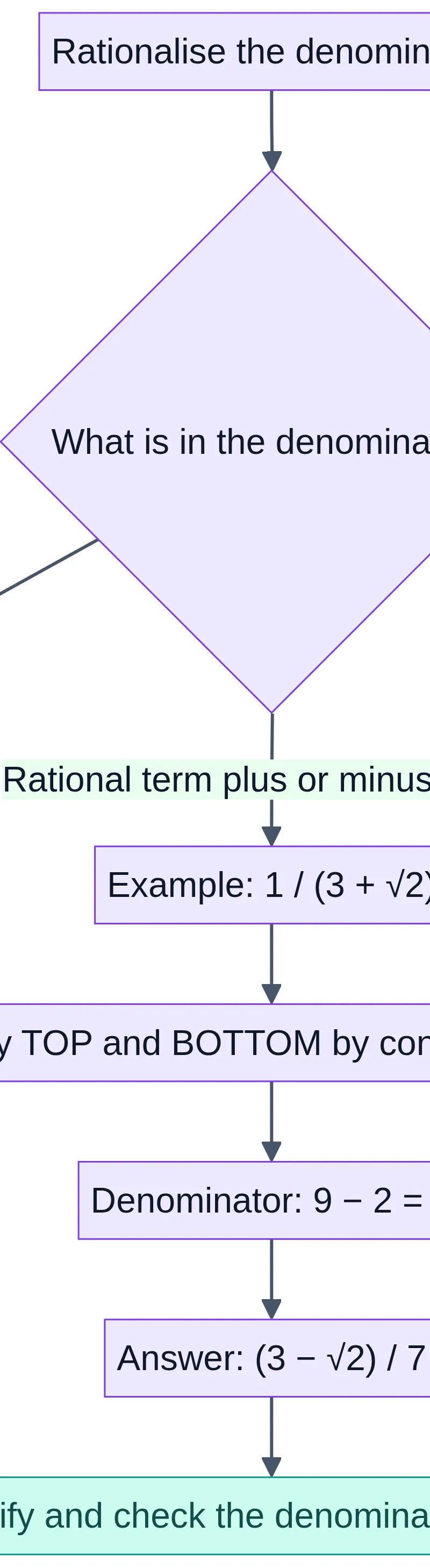
Choose between a surd multiplier, a conjugate, or no rationalising.
Worked Examples
4 worked examples — open one to explore the question and available guidance.
Practice Questions
Try the question, then reveal an answer plan or example response
Simplify fully √108. Show your working. [3 marks, original AQA-style teaching question]
Hint: Find a square number that divides 108. 'Foundation' here labels an accessible starting difficulty, not Foundation-tier assessment.
Simplify fully 2√12 + √27 − √3. [3 marks, original AQA-style teaching question]
Hint: Simplify √12 and √27 before collecting coefficients.
Multiply out and simplify (2 + √3)(4 − √3). Show your working. [4 marks, original AQA-style teaching question]
Hint: Write four products, then collect rational terms and like surds separately.
Rationalise the denominator of 8/√12. Give your answer in its simplest form. [3 marks, original AQA-style teaching question]
Hint: Either simplify √12 first or rationalise directly, then simplify fully.
Rationalise the denominator of 2/(√5 + √3). Give your answer in its simplest form and show your working. [4 marks, original AQA-style teaching question]
Hint: The conjugate is √5 − √3; the difference of the squares is rational.
A candidate writes (1 + √2)² = 3. Evaluate the candidate's method and give the correct exact answer. [3 marks, original AQA-style teaching question]
Hint: Expand (1 + √2)(1 + √2), including both cross-products.
Exam technique
How to turn what you know into marks
How to approach the question
Read the command word and required answer form before calculating. Identify whether the task is simplification, collecting terms, expansion, rationalising or a linked geometry problem. Simplify roots where helpful. Choose a valid method, preserve equivalence and inspect the final radicand, denominator, fraction and units. Foundation-labelled retrieval tasks here are accessible starting points for Higher content, not claims that surds are assessed on Foundation.
How to structure your answer
For a short simplification, show square-factor decompositions and the combined result. For 3–4 mark rationalising questions, show the multiplier on both numerator and denominator, evaluate the denominator, then simplify the full fraction. For multi-step geometry, define the unknown, write the relevant formula, substitute exact lengths, expand and give the final value with units. Marks are not automatically awarded one per line. M means method, A accuracy and B a mark independent of method; follow-through applies only when a particular scheme allows it. A correct answer can sometimes earn full marks without working, but not when the instruction or scheme explicitly requires working.
Timing
AQA gives 90 minutes for 80 marks: a paper-wide average of 1.125 minutes per mark, about 1 minute 8 seconds. Aim around 3.4 minutes for 3 marks, 4.5 minutes for 4 marks and 6.8 minutes for 6 marks, adjusting for difficulty and leaving checking time. This is planning guidance, not an AQA topic-specific rule.
Common pitfalls
- Writing √(a + b) = √a + √b. Test with a = 9,b = 16: the results are 5 and 7, so the rule is false.
- Combining unlike surds. Simplify each first; combine only terms with a matching radicand.
- Writing √12 = 6√2 or another unchecked form. Square your proposed answer to see whether it returns 12.
- Multiplying only the numerator while rationalising. Show the same multiplier above and below the fraction line.
- Using the same binomial instead of its conjugate. Reverse the sign between the two terms to cancel the middle products.
- Forgetting coefficients when squaring: (3√5)² = 45, not 15.
- Dropping the middle term: (2 + √3)² = 7 + 4√3, not 7.
- Cancelling across addition. Factor the entire numerator before cancelling a common factor with the denominator.
- Giving decimals for exact-answer questions or rounding during intermediate working. Keep roots until a rounding instruction explicitly requires a decimal.
- Writing √25 = ±5. The radical alone means 5; an equation such as x² = 25 has two solutions.
- Using a length conversion for area. Metres to centimetres uses 100; square metres to square centimetres uses 10,000.
What the command words want
- Compare
- Work out or identify the required values and say which is larger, smaller or equal. For positive surds, comparing squares can avoid decimals.
- Describe
- Use mathematical terminology to define the given information. This is uncommon as a standalone surd calculation instruction.
- Show that
- Give every step leading to the stated result. The printed target answer is not itself evidence.
- State/Give
- Write the required mathematical information or value. If the instruction adds 'Give a reason', include calculation and/or written evidence; this is not a one-word response.
- Simplify (fully)
- Collect like terms, extract square factors and cancel fractions completely. AQA expects full simplification even if 'fully' is absent.
- Explain/Give a reason
- Link your conclusion to mathematical evidence. For a false rule, provide a counterexample showing unequal results.
- Calculate/Work out/Find
- Carry out the required calculation. Show a valid method, respect exact-answer instructions and include units for quantities.
- Evaluate a method or claim
- Identify the incorrect step or explain why the method or assertion is correct. AQA mathematics does not expect a generic 'both sides' essay.
- You must show your working
- Give enough working to demonstrate the method. A correct unsupported final answer does not receive the required working marks.
- Rationalise the denominator
- Rewrite an equivalent fraction with a rational denominator. Multiply both numerator and denominator by the chosen surd or conjugate, then simplify.
- Give your answer in the form
- Finish in exactly the requested form, such as a√b or (a + b√c)/d, with any further conditions satisfied.
Watch or listen (optional)
Test your understanding of Structure and calculation
Active recall beats re-reading. Take an instant quiz now to test what you’ve learned and lock it into long-term memory.
7 days Premium · Then the free plan continues · No card, no charge