AQA · GCSE · Mathematics
Course version: 8300 · Version from Sept 2015
Structure and calculation: apply systematic listing strategies
Systematic listing means finding all possible outcomes of a situation by working in a fixed, repeatable order rather than writing items at random.
- 3 key terms
Study notes
From the checked teaching notes for this specification point.
The idea
Systematic listing means finding all possible outcomes of a situation by working in a fixed, repeatable order rather than writing items at random. A good method is to fix one choice and vary the others in turn: for two starters and three mains, list starter 1 with each main, then starter 2 with each main, giving 2 × 3 = 6 combinations. Tables, ordered lists and tree diagrams all support this. The skill is assessed by checking whether your list is complete and contains no repeats, so a clear system matters more than speed. At Foundation and Higher tier you may be asked for the number of outcomes or for the outcomes themselves, and marks reward evidence of an organised approach as well as the final answer.
What earns the marks
- Uses a fixed order, such as fixing one item and cycling through the others, so no outcome is missed or duplicated.
- Produces a complete list or count of outcomes for the given situation, for example 6 combinations from 2 starters and 3 mains.
- Recognises when a table, ordered list or tree diagram is an efficient systematic structure.
- Checks the list for repeats and omissions before stating the final answer.
Common mistakes and how to put them right
Listing outcomes at random and losing track.
Put it right: Fix one choice and vary the others in a set order.
Counting an outcome twice because order was not controlled.
Put it right: Keep one consistent order throughout the list.
Stopping as soon as a pattern appears.
Put it right: Continue the system until every branch is exhausted.
Exam tips
- Write the system down first, for example 'fix the first choice, then vary the second', so the method is visible.
- Use a table or tree diagram when there are two or more categories, as it makes omissions easier to spot.
- Finish by counting or checking the list against the structure to confirm completeness.
Try the lesson
The start of the Structure and calculation: apply systematic listing strategies lesson, made from checked teaching notes for this specification point.
Have a go first
A café offers a sandwich and a drink. The sandwich choices are cheese, tuna or egg. The drink choices are tea or juice. By listing all the possible combinations systematically, how many different sandwich-and-drink combinations are there?
Listen
Systematic listing means finding all possible outcomes of a situation by working in a fixed, repeatable order rather than writing items at random. A good method is to fix one choice and vary the others in turn: for two starters and three mains, list starter 1 with each main, then starter 2 with each main, giving 2 × 3 = 6 combinations. Tables, ordered lists and tree diagrams all support this. The skill is assessed by checking whether your list is complete and contains no repeats, so a clear system matters more than speed. At Foundation and Higher tier you may be asked for the number of outcomes or for the outcomes themselves, and marks reward evidence of an organised approach as well as the final answer. A strong answer earns marks for these points. Uses a fixed order, such as fixing one item and cycling through the others, so no outcome is missed or duplicated. Produces a complete list or count of outcomes for the given situation, for example 6 combinations from 2 starters and 3 mains. Recognises when a table, ordered list or tree diagram is an efficient systematic structure. Checks the list for repeats and omissions before stating the final answer. A common slip: Listing outcomes at random and losing track. Instead, fix one choice and vary the others in a set order. Exam tip: Write the system down first, for example 'fix the first choice, then vary the second', so the method is visible.
See it
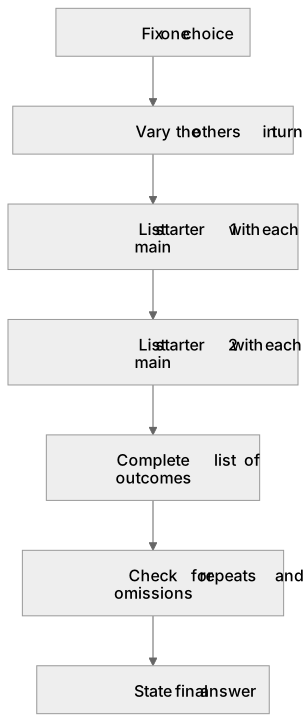
Put it in order
Put these steps in the order they happen.
- 1. Vary the others in turn
- 2. List starter 1 with each main
- 3. List starter 2 with each main
- 4. Complete list of outcomes
- 5. Check for repeats and omissions
- 6. State final answer
- 7. Fix one choice
Key words
Say what each word means before you turn the card.
Systematic listing
Try answering aloud or in your head before turning the card.
Tables and tree diagrams
Try answering aloud or in your head before turning the card.
Checking for repeats and omissions
Try answering aloud or in your head before turning the card.
See every definition
- Systematic listing
- Finding all possible outcomes of a situation by working in a fixed, repeatable order rather than writing items at random.
- Tables and tree diagrams
- Organisational tools that support systematic listing, with a table or tree diagram efficient when there are two or more categories.
- Checking for repeats and omissions
- Checking the list for repeats and omissions before stating the final answer, finishing by counting or checking the list against the structure.
Label the diagram
Some boxes have lost their names. Pick the right name for each number.
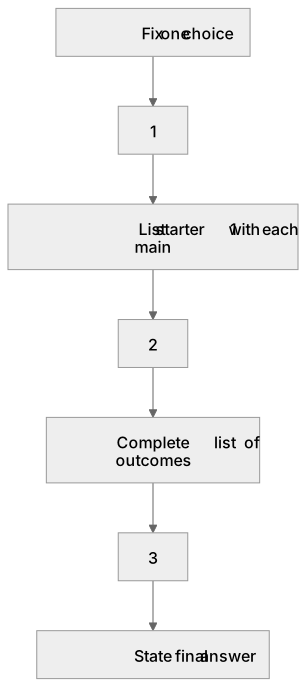
1Box 1
2Box 2
3Box 3
There is more to this lesson
The full lesson goes on to check your understanding and help you earn the marks. Create a free account to carry on, with your progress saved.
A week of Premium from your first lesson · Then the free plan continues · No card, no charge
Test your understanding of Structure and calculation: apply systematic listing strategies
Active recall beats re-reading. Take an instant quiz now to test what you’ve learned and lock it into long-term memory.
A week of Premium from your first lesson · Then the free plan continues · No card, no charge