AQA · GCSE · Mathematics
Course version: 8300 · Version from Sept 2015
Structure and calculation: apply the four operations, including formal written methods, to integers, decimals and simple fractions (proper and improper), and mixed numbers – all both positive and negative understand and use place value (eg when working with very large or very small numbers, and when calculating with decimals)
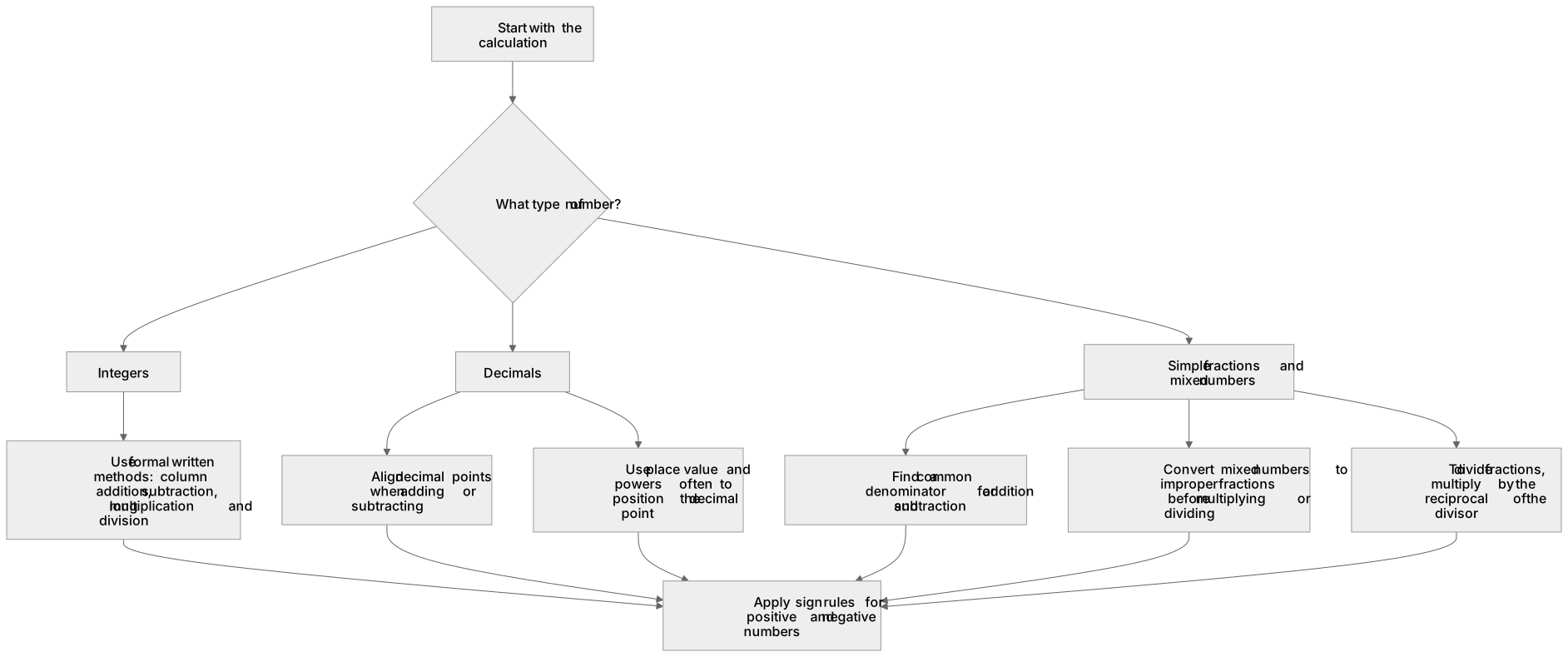
This topic covers applying the four operations to integers, decimals, simple fractions (proper and improper) and mixed numbers, including both positive and negative values.
- 4 key terms
Study notes
From the checked teaching notes for this specification point.
The idea
This topic covers applying the four operations to integers, decimals, simple fractions (proper and improper) and mixed numbers, including both positive and negative values. Formal written methods include column addition, subtraction, long multiplication and division. For decimals, align decimal points when adding or subtracting. For fractions, find a common denominator for addition and subtraction; for multiplication, multiply numerators and denominators. Convert mixed numbers to improper fractions before multiplying or dividing; to divide fractions, multiply by the reciprocal of the divisor. Understand and use place value: when working with very large or very small numbers, use powers of ten, e.g. 3.2 × 10⁴ = 32000, and apply place value when calculating with decimals.
What earns the marks
- Applies column addition and subtraction accurately to integers and decimals, aligning place value.
- Uses formal written methods like long multiplication and division correctly for integers and decimals.
- Adds and subtracts simple fractions (proper and improper) by finding a common denominator, including negative fractions.
- Multiplies and divides fractions, including improper fractions and mixed numbers converted to improper form.
- Applies sign rules for both positive and negative numbers across all four operations.
- Understands and uses place value when working with very large or very small numbers, and when calculating with decimals.
Common mistakes and how to put them right
Misaligning decimal points when adding, e.g. adding the 4 in 3.4 to the 1 in 2.15.
Put it right: Align the decimal points so the tenths are added together, writing 3.4 as 3.40.
Forgetting to convert mixed numbers to improper fractions before multiplying, e.g. 1½ × 2/3.
Put it right: Convert 1½ to 3/2 first.
Applying the wrong sign rule, e.g. (−5) × (−2) = −10.
Put it right: The product of two negatives is positive, so (−5) × (−2) = 10.
Misplacing the decimal point after multiplication, e.g. 0.3 × 0.4 = 1.2.
Put it right: 0.3 × 0.4 = 0.12.
Exam tips
- Estimate the answer first to check the position of the decimal point when calculating with decimals.
- For fractions, always simplify your final answer and convert improper fractions to mixed numbers if asked.
- When dividing decimals, multiply both numbers by a power of ten to make the divisor an integer.
Try the lesson
The start of the Structure and calculation: apply the four operations, including formal written methods, to integers, decimals and simple fractions (proper and improper), and mixed numbers – all both positive and negative understand and use place value (eg when working with very large or very small numbers, and when calculating with decimals) lesson, made from checked teaching notes for this specification point.
Have a go first
Work out 47.6 + 8.35. Select the correct answer.
Listen
This topic covers applying the four operations to integers, decimals, simple fractions (proper and improper) and mixed numbers, including both positive and negative values. Formal written methods include column addition, subtraction, long multiplication and division. For decimals, align decimal points when adding or subtracting. For fractions, find a common denominator for addition and subtraction; for multiplication, multiply numerators and denominators. Convert mixed numbers to improper fractions before multiplying or dividing; to divide fractions, multiply by the reciprocal of the divisor. Understand and use place value: when working with very large or very small numbers, use powers of ten, e.g. 3.2 × 10⁴ = 32000, and apply place value when calculating with decimals. A strong answer earns marks for these points. Applies column addition and subtraction accurately to integers and decimals, aligning place value. Uses formal written methods like long multiplication and division correctly for integers and decimals. Adds and subtracts simple fractions (proper and improper) by finding a common denominator, including negative fractions. Multiplies and divides fractions, including improper fractions and mixed numbers converted to improper form. A common slip: Misaligning decimal points when adding, e.g. adding the 4 in 3.4 to the 1 in 2.15. Instead, align the decimal points so the tenths are added together, writing 3.4 as 3.40. Exam tip: Estimate the answer first to check the position of the decimal point when calculating with decimals.
See it
Key words
Say what each word means before you turn the card.
Four operations with integers and decimals
Try answering aloud or in your head before turning the card.
Formal written methods
Try answering aloud or in your head before turning the card.
Fractions and mixed numbers
Try answering aloud or in your head before turning the card.
Place value with very large or small numbers
Try answering aloud or in your head before turning the card.
See every definition
- Four operations with integers and decimals
- Applying the four operations to integers and decimals, including both positive and negative values.
- Formal written methods
- Methods including column addition, subtraction, long multiplication and division.
- Fractions and mixed numbers
- Calculating with simple fractions (proper and improper) and mixed numbers, converting mixed numbers to improper fractions before multiplying or dividing.
- Place value with very large or small numbers
- Understanding and using place value when working with very large or very small numbers, using powers of ten, and when calculating with decimals.
Label the diagram
Some boxes have lost their names. Pick the right name for each number.
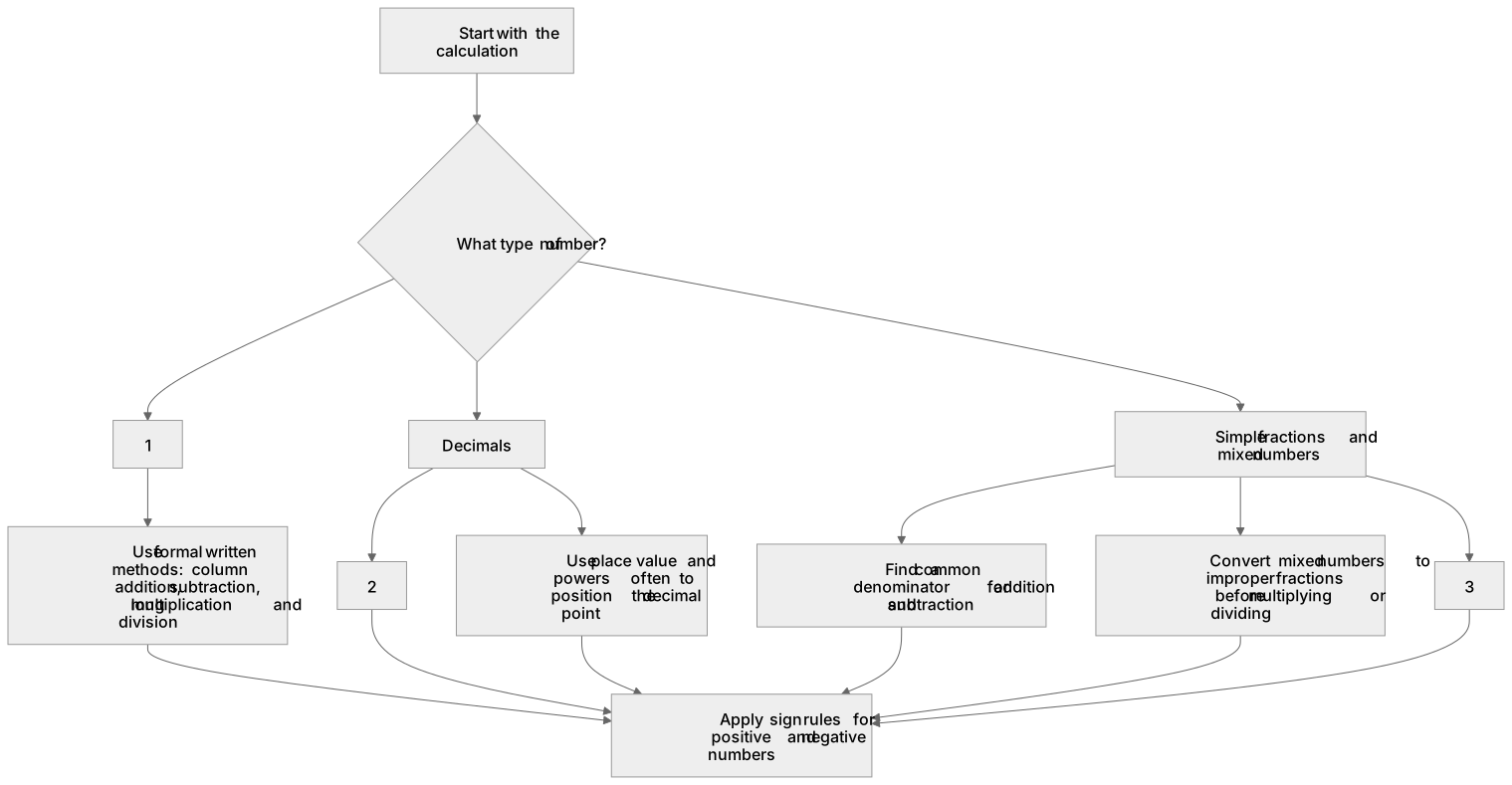
1Box 1
2Box 2
3Box 3
There is more to this lesson
The full lesson goes on to check your understanding and help you earn the marks. Create a free account to carry on, with your progress saved.
A week of Premium from your first lesson · Then the free plan continues · No card, no charge
Test your understanding of Structure and calculation: apply the four operations, including formal written methods, to integers, decimals and simple fractions (proper and improper), and mixed numbers – all both positive and negative understand and use place value (eg when working with very large or very small numbers, and when calculating with decimals)
Active recall beats re-reading. Take an instant quiz now to test what you’ve learned and lock it into long-term memory.
A week of Premium from your first lesson · Then the free plan continues · No card, no charge