AQA · GCSE · Mathematics
Course version: 8300 · Version from Sept 2015
Structure and calculation: calculate exactly with fractions
Fractions reward accurate, orderly thinking: make equal parts before adding or subtracting, cancel factors when multiplying, and use a reciprocal when dividing. This N8 skill is assessed across both GCSE tiers, and exact fractional work keeps multi-step answers reliable on every AQA paper.
- 12 min read
- 3 worked examples
- 7 practice questions
- 10 key terms
Try the lesson
The start of the Structure and calculation: calculate exactly with fractions lesson, made from checked teaching notes for this specification point.
Have a go first
Work out 3/4 + 1/8, giving your answer as a fraction in its simplest form.
There is more to this lesson
The full lesson goes on to check your understanding and help you earn the marks. Create a free account to carry on, with your progress saved.
7 days Premium · Then the free plan continues · No card, no charge
Check what you remember
Read the wording for your board, then hide it and explain fraction in your own words. Rough notes are fine. This is a self-check, with no mark or grade.
Reference: AQA
A number written as a numerator over a non-zero denominator, representing division or a number of equal parts.
Study Notes
Overview
Fractions are an exact way to represent a part of a whole, a ratio, or the result of a division. In AQA GCSE Mathematics 8300, N8, calculate exactly with fractions, is basic Foundation content and so can be assessed on both Foundation and Higher papers. The skill is not merely a set of rules: it lets candidates keep rational quantities accurate through several stages of a problem, for example a recipe, a probability calculation, algebraic substitution or a measure conversion. Typical questions ask you to work out, simplify, write down a value, or use fractions inside a context. You may add or subtract unlike denominators, multiply and divide proper or improper fractions, work with mixed numbers and negative values, and decide a sensible final form. The key exam habit is to identify the operation before calculating, use an equivalent fraction only when needed, and check that the final answer answers the precise question. Exact fractional work is especially useful on calculator papers too, because entering a decimal early can build rounding error into later steps. 1
Assessment status: All original worked examples, practice questions, model answers and mark allocations in this guide are illustrative only. They are not AQA questions or official AQA mark schemes. Challenging practice here is still accessible as Foundation-and-Higher fraction work, not a claim of Higher-only content.
Specification placement and scope
AQA places this objective in 3.1.1 Structure and calculation, N8. Supporting knowledge is N2, positive and negative proper and improper fractions and mixed numbers; N3, inverse operations, reciprocals and order of operations; and N4, HCF and LCM. 1 The N8 surd aspect and recurring-decimal conversion in N10 are Higher-only, but are outside this guide. A number line can help you interpret size or sign, but no compulsory graph drawing is involved. There is no required practical for this mathematical topic.
Exact values and sensible forms
An exact value has not been rounded. A fraction such as 7/12 is exact, and so is a terminating decimal such as 0.375: it equals 3/8 exactly. Therefore, never use the shortcut “a decimal is not exact”. A decimal that has been rounded, such as 0.33 for 1/3, is only an approximation. When a question requests a fraction, give a fraction. During multi-step work, fractions preserve rational accuracy and avoid turning a recurring value into a rounded decimal prematurely.
Simplify by dividing numerator and denominator by their HCF. However, do not invent a universal rule that an unsimplified answer always loses a mark. Follow the demanded form. A simplified improper fraction and a mixed number can both be correct if the question does not prescribe one. As an example of question-specific acceptance, the June 2024 8300/1H mark scheme accepted both 65/41 and 1;24/41 in Question 9; it also accepted both 10/7 and 1;3/7 in Question 19. The particular B mark for simplification in Question 9 is not a blanket rule for every answer. 5
Key Concepts
Add and subtract: make the bottoms match
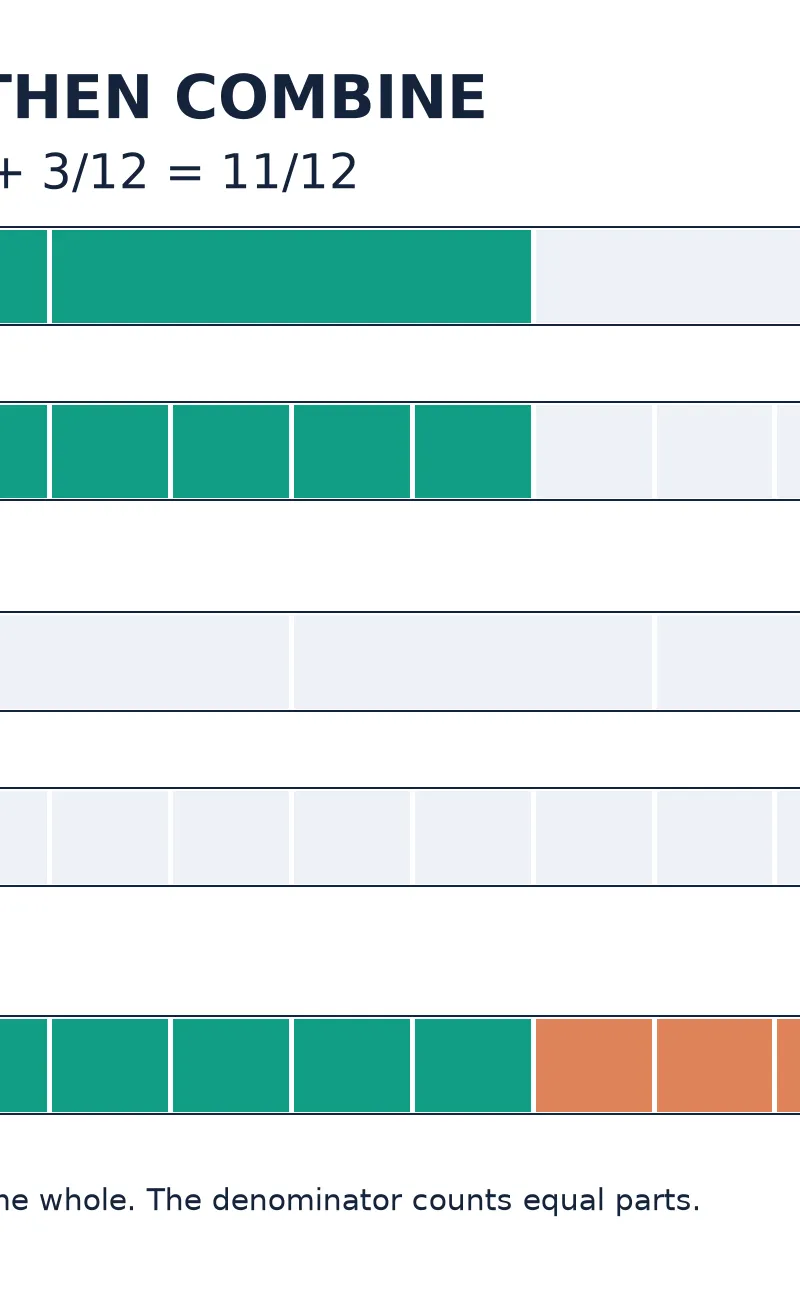
You can add or subtract only fractions expressed in equal-sized parts. Find a common denominator, preferably the LCM, then multiply the numerator and denominator of each fraction by the same factor. For 2/3 + 1/4, the LCM is 12, so 2/3=8/12 and 1/4=3/12; the sum is 11/12. In 5/6-1/4, use twelfths: 10/12-3/12=7/12. Never add denominators to make a new denominator.
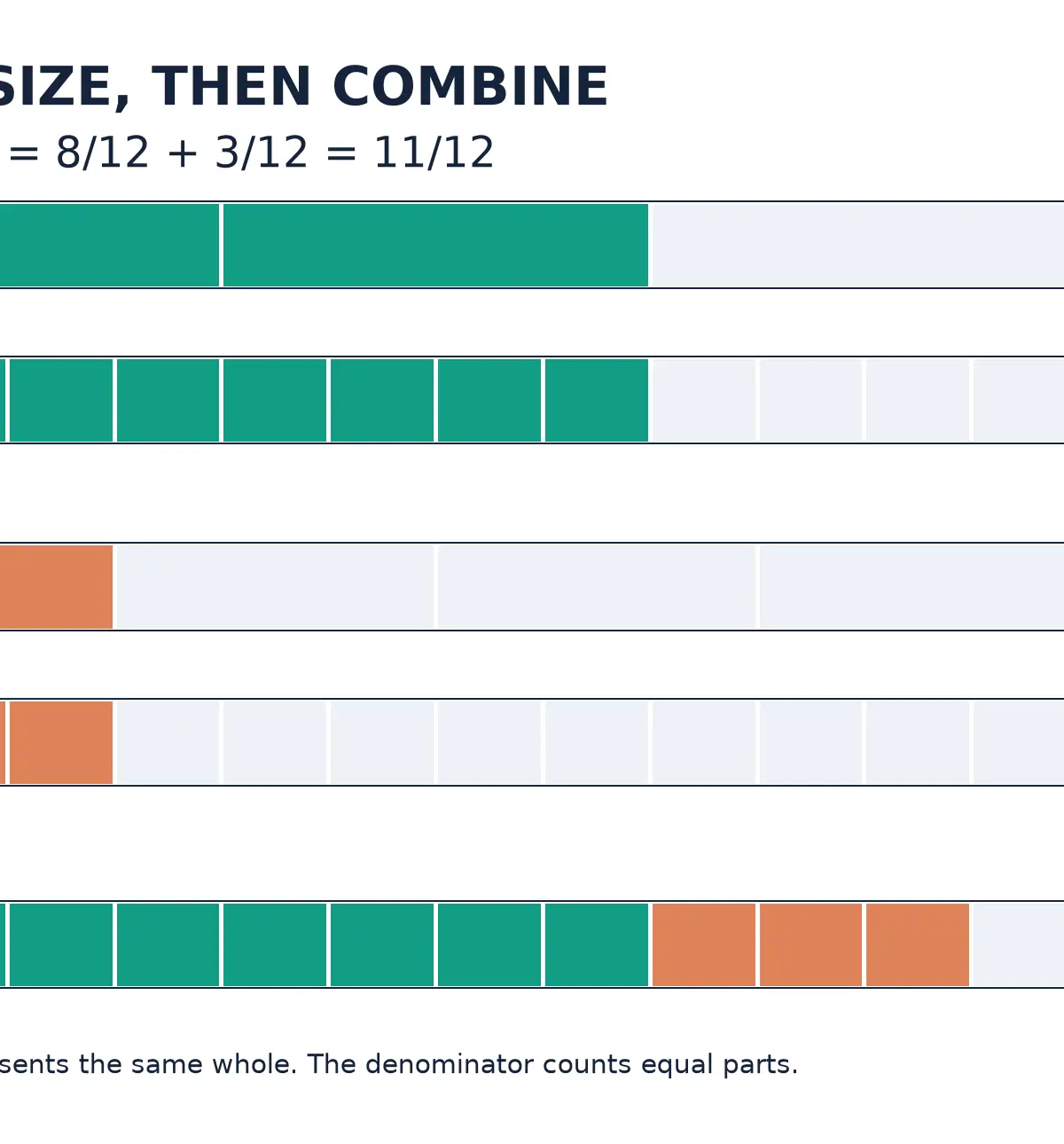
A useful check is size: 5/6-1/4 must be positive and less than 5/6. With negative fractions, use signed-number rules first. For example, 5/6-(-1/4)=5/6+1/4, so a subtraction of a negative becomes addition.
Multiply: cancel factors, then multiply
Multiplication asks for a fraction of a fraction. Multiply numerators together and denominators together. Before multiplying, cancel common factors across a numerator and a denominator. For 6/35 \times 14/9, cancel 6 with 9 to make 2 and 3, and 14 with 35 to make 2 and 5. The result is 4/15. Cancellation is division by the same non-zero factor in a numerator and a denominator, so it preserves value. Do not cancel across a plus or minus sign.
Think of 2/3\times3/4 as two thirds of three quarters of one rectangle. Divide the whole into 12 equal cells: the overlap covers 6, so the product is 6/12=1/2. This explains why multiplying denominators counts smaller equal pieces. Cover and recall: which parts of 6/35\times14/9 can be cancelled, and why?
Divide: multiply by the reciprocal
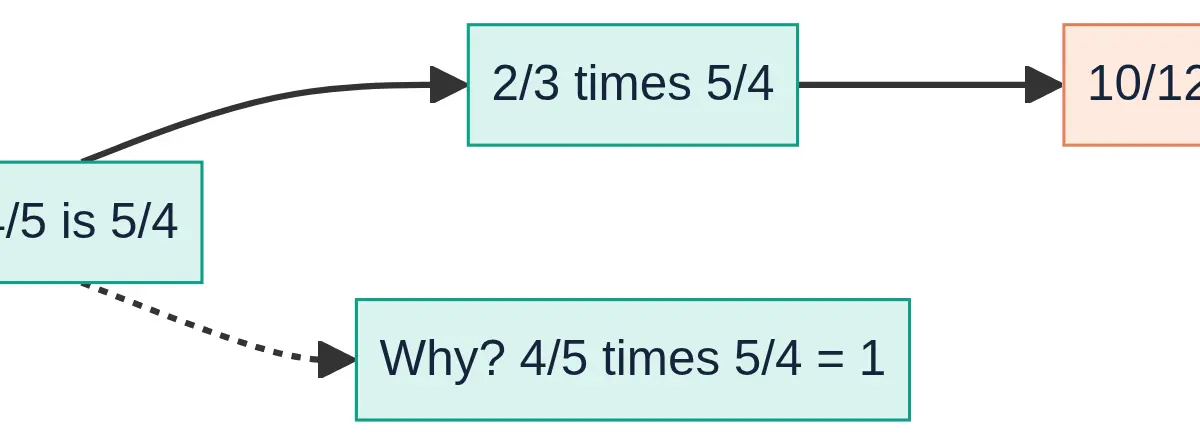
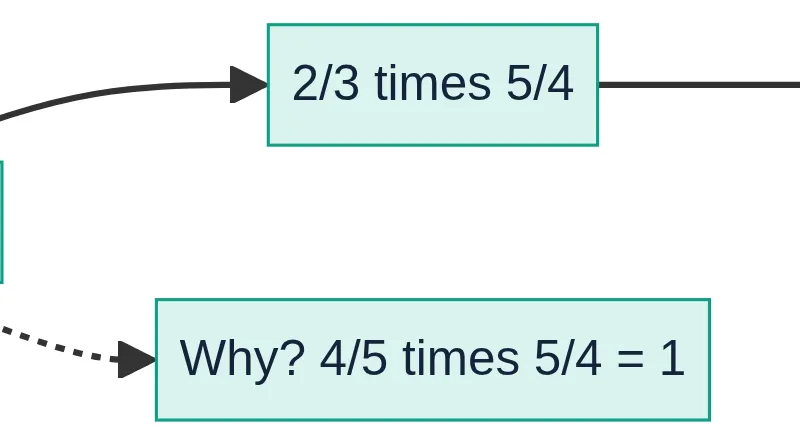
Division asks how many of the second fraction fit into the first. Keep the first fraction, change \div to \times, and invert only the divisor. Thus 2/3\div4/5=2/3\times5/4=10/12=5/6. If the divisor is a mixed number, convert it to an improper fraction before finding its reciprocal. Division by zero is undefined, so a zero fraction cannot be a divisor.
The reciprocal works because (4/5)\times(5/4)=1: multiplying by 5/4 undoes multiplication by 4/5. Check the result backwards: (5/6)\times(4/5)=2/3. For positive fractions, dividing by a value less than 1 increases the starting amount, so 5/6>2/3 is sensible. Cover and recall: work out 3/4\div1/4 and explain the answer as a number of equal groups.
Mixed numbers, negatives and order
Convert a mixed number before multiplication or division: 2;1/4=9/4. For addition or subtraction, you may convert first or carefully combine whole and fractional parts, but one consistent method is safer. A negative sign applies to the whole fraction: -3/5=(-3)/5=3/(-5). A product or quotient of two negative fractions is positive; one negative factor gives a negative result. In expressions with brackets, calculate the bracketed additions or subtractions before multiplying outside them, following the normal order of operations.
Mathematical Relationships: rules to memorise
In these rules, a and c are integer numerators; b and d are non-zero integer denominators, normally written positive. For the mixed-number rule, w is a non-negative whole number and 0\le a<b. The common factor k is a positive integer dividing both numerator and denominator. For a negative mixed number, convert the magnitude first, then apply the negative sign to the complete fraction.
None of the fraction-operation rules below is supplied on the AQA 2026 formula sheet. The 2026 sheet is the source for formula-sheet guidance, not a reason to predict future policy. 4
- Addition/subtraction rule: \frac{a}{b}\pm\frac{c}{d}=\frac{ad\pm bc}{bd}. Must memorise, not on the AQA 2026 formula sheet. In working, an LCM is often more efficient than multiplying denominators.
- Equivalent-fraction rule: \frac{a}{b}=\frac{ak}{bk} for a non-zero integer k. Must memorise, not on the AQA 2026 formula sheet. Multiply both numbers by the same factor when making a common denominator.
- Multiplication rule: \frac{a}{b}\times\frac{c}{d}=\frac{ac}{bd}. Must memorise, not on the AQA 2026 formula sheet. Cancel factors first where helpful.
- Division rule: \frac{a}{b}\div\frac{c}{d}=\frac{a}{b}\times\frac{d}{c}, where $c/d
e0$. Must memorise, not on the AQA 2026 formula sheet. Only the second fraction is inverted. - Reciprocal rule: the reciprocal of a/b is b/a, provided $a
e0andb
e0$. Must memorise, not on the AQA 2026 formula sheet. The product of a non-zero fraction and its reciprocal is 1. - Mixed-number conversion: w;a/b=(wb+a)/b. Must memorise, not on the AQA 2026 formula sheet. This prepares multiplication and division.
- Simplification rule: \frac{a}{b}=\frac{a\div k}{b\div k} for a non-zero common factor k. Must memorise, not on the AQA 2026 formula sheet. Choose the HCF for one efficient final simplification.
- Signed product/quotient rule: same signs give positive, different signs give negative. Must memorise, not on the AQA 2026 formula sheet. Apply the sign once, then calculate magnitudes.
- Useful square rule: \left(\frac{a}{b}\right)^2=\frac{a^2}{b^2}. Must memorise if a fraction is squared, not on the AQA 2026 formula sheet. Square both numerator and denominator, including the sign correctly.
Practical Applications: fractions in measures and contexts
To find a fraction of a quantity Q, calculate (a/b)\times Q. Must memorise, not on the AQA 2026 formula sheet. For example, 3/4 of 200 g is (3/4)\times200=150 g. A recipe scaled to 2/3 of its original size uses this same multiplication for each ingredient, not subtraction of 1/3 gram from each amount.
Keep units visible. The conversions most often useful with fractional contexts are 1 kg = 1000 g, 1 litre = 1000 ml and 1 hour = 60 minutes. Convert only when it makes the requested unit clear. For instance, 1/8 kg is 125 g, and 5/4 hours is 1 hour 15 minutes. The terminating decimal 0.375 is exactly 375/1000=3/8, which may make a fractional calculation easier. In a context, decide whether a fractional answer represents an allowed amount, a remainder, or only complete items. Do not round a count of complete items up without checking the question.
Exam method, command words and marking
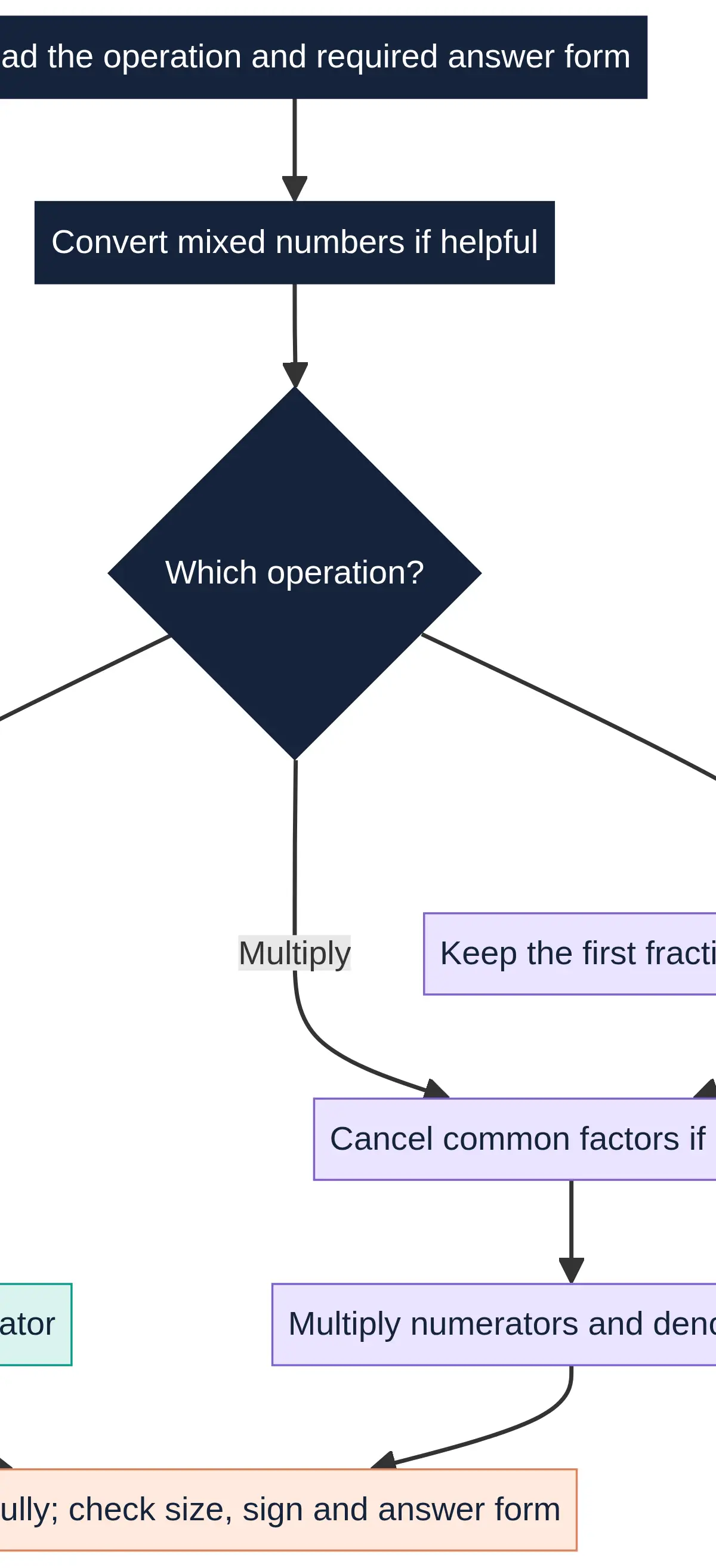
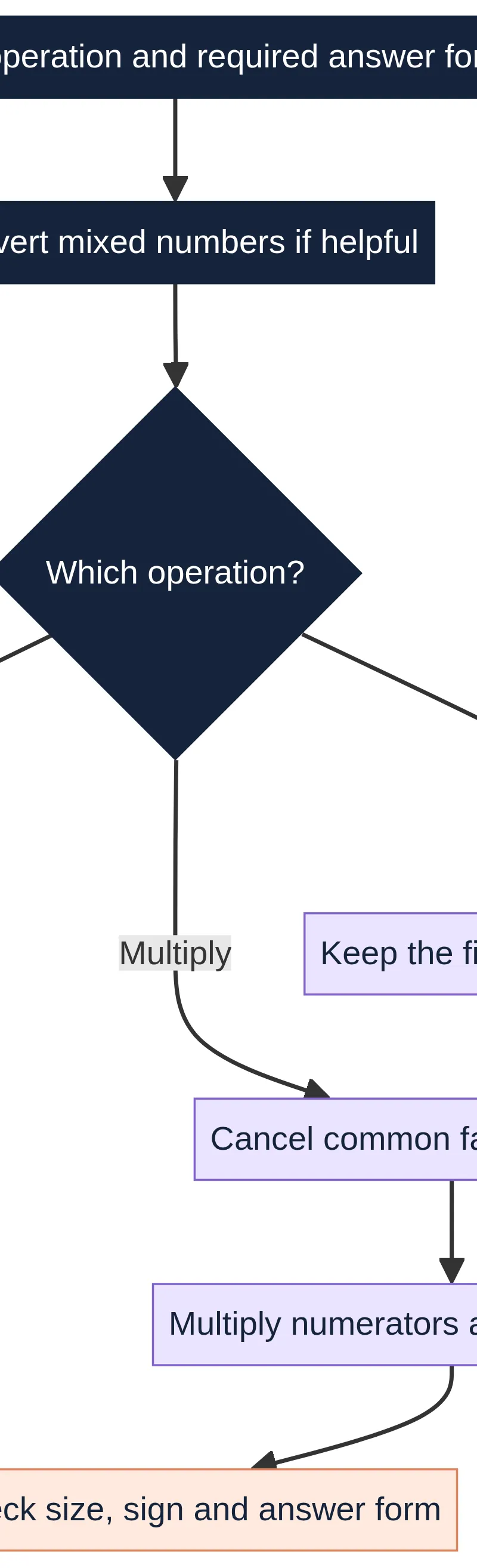
Read the last line first: it tells you the required quantity, unit and form. Then: (1) circle the operations and any brackets; (2) convert mixed numbers where necessary; (3) use a common denominator for + or -, or factors and a reciprocal for \times or \div; (4) simplify, state units and perform a size/sign check. Showing working is strongly advised because it communicates a valid method and protects against a small arithmetic slip. It is required when the instruction says to show it. If working is not expressly required, a correct answer can still receive full marks.
AQA’s glossary distinguishes M method marks, A accuracy marks that depend on a correct method and may have the method implied, and B independent marks. Follow-through is available only where a scheme specifies it, and valid methods can receive credit. 5 Do not reverse-engineer every live question from one past allocation.
Use command words precisely. Work out asks for a calculation, with clear steps prudent. Simplify asks for an equivalent expression or fraction in the requested simplest form, not a decimal substitute. Show that asks you to present enough valid steps to establish the stated result, normally without assuming it. Write down calls for a direct value or fact, so do not overwork it. Why needs a mathematical reason, such as “because both numerator and denominator were divided by 6”. On AQA’s command-word list, Evaluate a method or claim is Higher-tier wording and asks candidates to analyse the mathematical correctness of that method or claim; it is not a generic instruction to “weigh both sides”. Separately, to evaluate a numerical expression means calculate its value. 3
Each GCSE paper is 90 minutes for 80 marks, so the exact average is 90/80=1.125 minutes per mark, about 68 seconds. As revision targets, not AQA prescriptions, allow about 3.4 minutes for 3 marks, 4.5 minutes for 4 marks and 6.75 minutes for 6 marks. Paper 1 is non-calculator; Papers 2 and 3 are calculator papers. 2
Revision and listen
Use the retrieval prompts below after closing your notes. The ten-minute female-tutor podcast runs from introduction (00:00) to core concepts (01:00), exam tips (06:00), recall quiz (08:00), and summary (09:00). Say answers aloud during the recall pauses. Redo any question where you changed an operation, denominator or sign. The audio recap is available here:
Download the complete JSON guide
References
Visual Resources
3 diagrams and illustrations
Interactive Diagrams
2 interactive diagrams to visualise key concepts
Conceptual Flow Outline
Choose the correct fraction operation, apply a valid method and check the final answer.
Conceptual Flow Outline
Rewrite division as multiplication by the reciprocal, then check using the inverse operation.
Worked Examples
3 worked examples — open one to explore the question and available guidance.
Practice Questions
Try the question, then reveal an answer plan or example response
Illustrative original practice, not an AQA question. Work out 7/12+5/18. Give your answer in simplest form.
Hint: The LCM of 12 and 18 is 36.
Illustrative original practice, not an AQA question. Work out 5/6-(-1/4). Give your answer in simplest form.
Hint: Subtracting a negative is addition.
Illustrative original practice, not an AQA question. Work out 2;2/3\times(-9/16).
Hint: Convert the mixed number to thirds before multiplying.
Illustrative original practice, not an AQA question. Work out -7/10\div14/15.
Hint: Multiply by the reciprocal of $14/15$.
Illustrative original practice, not an AQA question. Work out (3/4-1/6)(2/5+1/3). Give your answer in simplest form.
Hint: Complete both brackets before multiplying.
Illustrative original practice, not an AQA question. A cyclist has 2;1/4 hours available. She takes a 1/6 hour break, then cycles for 3/5 of the time remaining. Work out the cycling time in hours and minutes.
Hint: Subtract the break before taking $3/5$ of the remaining time.
Illustrative original practice, not an AQA question. Work out 0.375+5/12 as an exact fraction in simplest form.
Hint: Write $0.375$ as $375/1000$, then simplify.
Exam technique
How to turn what you know into marks
How to approach the question
Read the requested final form and unit first. Identify each operation and bracket. Convert mixed numbers for multiplication or division; use a common denominator for addition or subtraction; invert only the divisor for division. Simplify, then check sign, size, units and whether the context requires whole items.
How to structure your answer
For 1-2 marks, use a compact calculation and exact answer. For 3-4 marks, show conversion, common-denominator or reciprocal steps on separate lines. In multi-step contexts, label intermediate quantities, retain units and interpret any non-integer count. Showing working is strongly advised and required when instructed; without an express requirement, a correct answer can earn full marks.
Timing
Each paper is 90 minutes for 80 marks: 90/80 = 1.125 minutes per mark, approximately 68 seconds. As revision targets rather than AQA prescriptions, 3 marks take about 3.4 minutes, 4 marks about 4.5 minutes and 6 marks about 6.75 minutes.
Common pitfalls
- Adding numerators and denominators directly, for example $1/3+1/4=2/7$. Rewrite both fractions in equal-sized parts first.
- Changing a denominator without changing its numerator by the same factor. Equivalent fractions require both numbers to change together.
- Flipping the first fraction or both fractions during division. Only the divisor becomes its reciprocal.
- Cancelling across addition or subtraction. Cancel common factors in products, not separate terms in sums.
- Treating a mixed number as multiplication. $2\;1/4$ means $2+1/4$, not $2\times1/4$.
- Treating every decimal as inexact. Terminating decimals can be exact, but rounded decimals are approximate.
- Assuming mixed numbers are forbidden or every unsimplified answer automatically loses a mark. Follow the required answer form and the particular marking points.
What the command words want
- Why
- Give a mathematical reason, such as multiplying numerator and denominator by the same non-zero number preserves value.
- Simplify
- Give an equivalent fraction or expression in simplest form. Cancel common factors rather than replacing the fraction with a rounded decimal.
- Work out
- Perform the required calculation. Clear working is prudent, especially when using common denominators, reciprocals or conversions.
- Show that
- Set out valid steps establishing the stated result. Writing the conclusion alone does not demonstrate it.
- Write down
- Give the direct requested value or fact, normally obtainable from the information given.
- Give your answer as
- Use precisely the requested form, such as an improper fraction, mixed number or specified unit.
- Evaluate a method or claim
- AQA lists this as Higher-tier wording for analysing mathematical correctness. Separately, evaluating a numerical expression means calculating its value, not weighing both sides of an argument.
Watch or listen (optional)
Test your understanding of Structure and calculation: calculate exactly with fractions
Active recall beats re-reading. Take an instant quiz now to test what you’ve learned and lock it into long-term memory.
7 days Premium · Then the free plan continues · No card, no charge